Twelve months, twelve birthstone colors, and most people can confidently name about three. That's not your fault. Birthstones are one of those things you pick up in fragments. Your own, your partner's, maybe your mum's, and the rest stays a blur. This guide fixes that. We'll walk through every month, name every color, and at the end I'll show you the easiest way to make it all stick.
Why Birthstone Colors Are Worth Knowing
Birthstones aren't just gift hints. They're a 3,000-year-old shorthand for personality, season, and meaning, and the colors are doing most of the work. A January garnet is the deep, blood-warm red of midwinter. A March aquamarine is the pale, watery blue of the first thaw. The colors carry the story.
Once you can match month to color on instinct, gift shopping gets dramatically easier, jewelry shopping gets smarter, and you stop nodding politely when someone says "her birthstone is teal-ish, I think?"
The Twelve Birthstone Colors at a Glance
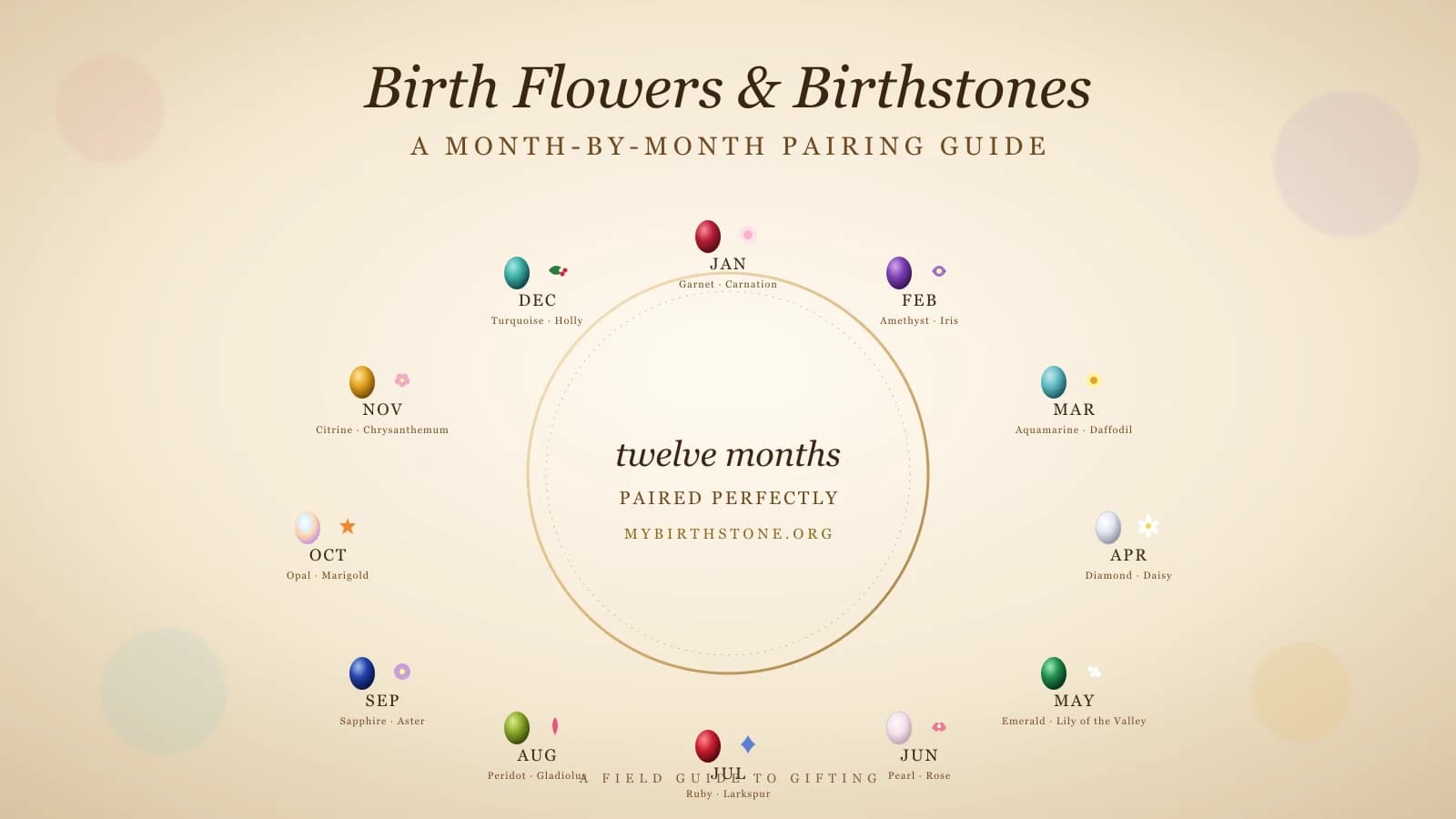
Here's the cheat sheet. We'll go deeper on each one below.
- January: Garnet, deep red
- February: Amethyst, purple
- March: Aquamarine, pale blue
- April: Diamond, clear or white
- May: Emerald, vivid green
- June: Pearl, Moonstone, Alexandrite (cream, white, color-shifting)
- July: Ruby, red
- August: Peridot, lime green
- September: Sapphire, royal blue
- October: Opal and Tourmaline (multicolor, pink-green)
- November: Topaz, Citrine (yellow, golden)
- December: Turquoise, Tanzanite, Zircon (blue to blue-violet)
Notice the pattern? The calendar walks you through warm reds in winter, cool blues in spring, lush greens in summer, then back into golds and deep blues by year-end. Birthstones are basically a color wheel pretending to be a calendar.
Month-by-Month: The Color and the Story
January: Garnet (Deep Red)
Garnet is the kind of red that doesn't apologize. Think pomegranate seeds, mulled wine, the inside of a heart. Most people picture it as a single color, but garnet actually shows up in greens, oranges, and even color-changing varieties. The dark crimson is just the headliner. Pair this with the January birthstone page if you want the full lore.
February: Amethyst (Purple)
If garnet is mulled wine, amethyst is the lavender field at dusk. It runs from pale lilac to a deep, bishop's-robe violet. Romans believed it prevented drunkenness. Modern people just believe it looks fantastic in a pendant. Both are valid takes on the February birthstone.
March: Aquamarine (Pale Blue)
Aquamarine is the color of pool water on a hot day. Soft, transparent, slightly green-tinged blue. Sailors used to carry it for safe passage, which makes sense once you've actually held one. It looks like the ocean decided to harden into a stone. Read more on the March birthstone page.
April: Diamond (Clear / White)
April gets the most famous color of all: none. Diamonds reflect every color the light brings them and pick none of their own. That's the whole point. The April birthstone is the gemstone equivalent of a white t-shirt. Effortless, takes nothing for granted.
May: Emerald (Vivid Green)
There's "green," and then there's emerald green. Cleopatra hoarded these. Mughal emperors carved scripture into them. The color is so distinctive that "emerald" became a color name in its own right, which is maybe the highest honor a gemstone can earn. Visit the May birthstone page for the rest of the story.
June: Pearl, Moonstone, Alexandrite (Cream, White, Color-Shifting)
June refuses to pick. Pearls bring soft cream and iridescence, moonstone offers blue-white shimmer, and alexandrite (the show-off) actually changes color from green in daylight to red under lamplight. If you want a single answer, default to "cream-white with a rainbow sheen." The June birthstone hub has all three.
July: Ruby (Red)
Ruby is to garnet what a sports car is to a sedan. Same family, more dramatic. Where garnet leans burgundy and shadowy, ruby is bright, almost neon, with a fluorescence that makes it glow under sunlight. The most prized rubies are called "pigeon's blood" red, which is a phrase you'll never unhear. More on the July birthstone.
August: Peridot (Lime Green)
Peridot is the only birthstone with a real claim to "extraterrestrial." Small amounts have actually been found in meteorites. Its color is a yellow-leaning, almost olive green that looks nothing like emerald. Think key lime pie, fresh basil, the first leaves of spring. The August birthstone page goes deeper.
September: Sapphire (Royal Blue)
Sapphire is the blue you draw when someone says "draw a blue gem." Deep, velvety, slightly purple. Royals wear it. Engagement rings wear it. The Princess Diana ring is the cultural reference point. (Quick note: sapphires also come in pink, yellow, green, and white, but blue is the headline.) See the September birthstone hub.
October: Opal and Tourmaline (Multicolor / Pink-Green)
October is where the color rules break. Opal flashes every color at once thanks to its play-of-color (we wrote a whole opal colors guide on this), while tourmaline shows up in pinks, greens, and even watermelon-striped versions. If you have to pick a "color" for October, the honest answer is "yes." October birthstone for context.
November: Topaz and Citrine (Yellow / Golden)
November glows. Citrine is the warmer, honey-colored option, while topaz ranges from pale champagne to imperial orange. Both feel like late autumn light caught in a crystal. The November birthstone page covers both.
December: Turquoise, Tanzanite, Zircon (Blue to Blue-Violet)
December went all-in on blue. Turquoise is matte and sky-toned, tanzanite is a deep blue-violet that looks lit from inside, and blue zircon has the brightness of antifreeze (in a good way). Three different shades, one consistent vibe. More at the December birthstone hub.
How to Actually Memorize All Twelve
Reading a list is not learning a list. Here's what actually works.
1. Anchor each month to a color story
The brain loves narratives. Don't memorize "May = green." Memorize "May is when leaves explode, and emerald is the loudest green there is." Stories stick. Lists slide off.
2. Group by season
Notice the rhythm. Winter leans red and purple, spring goes pale blue and clear, summer goes green and ruby-red, autumn swings into multicolor and gold, then it closes on blue. Four buckets is easier to hold in your head than twelve scattered facts.
3. Use color, not the gem name, as the hook
Most people forget "alexandrite" before they forget "color-shifting June stone." Train yourself on the colour first, and the gem name will follow.
4. Practice with a color memory game
This one is underrated. Birthstone recall is fundamentally a color-association task. Twelve colors, twelve labels. Drilling color recognition trains exactly the muscle you need. Spend a few minutes on a color memory game and you'll start clocking color sequences faster, which makes the month-to-color match feel almost automatic. The kind of practice that doesn't really feel like practice.
5. Test yourself with a chart, not a list
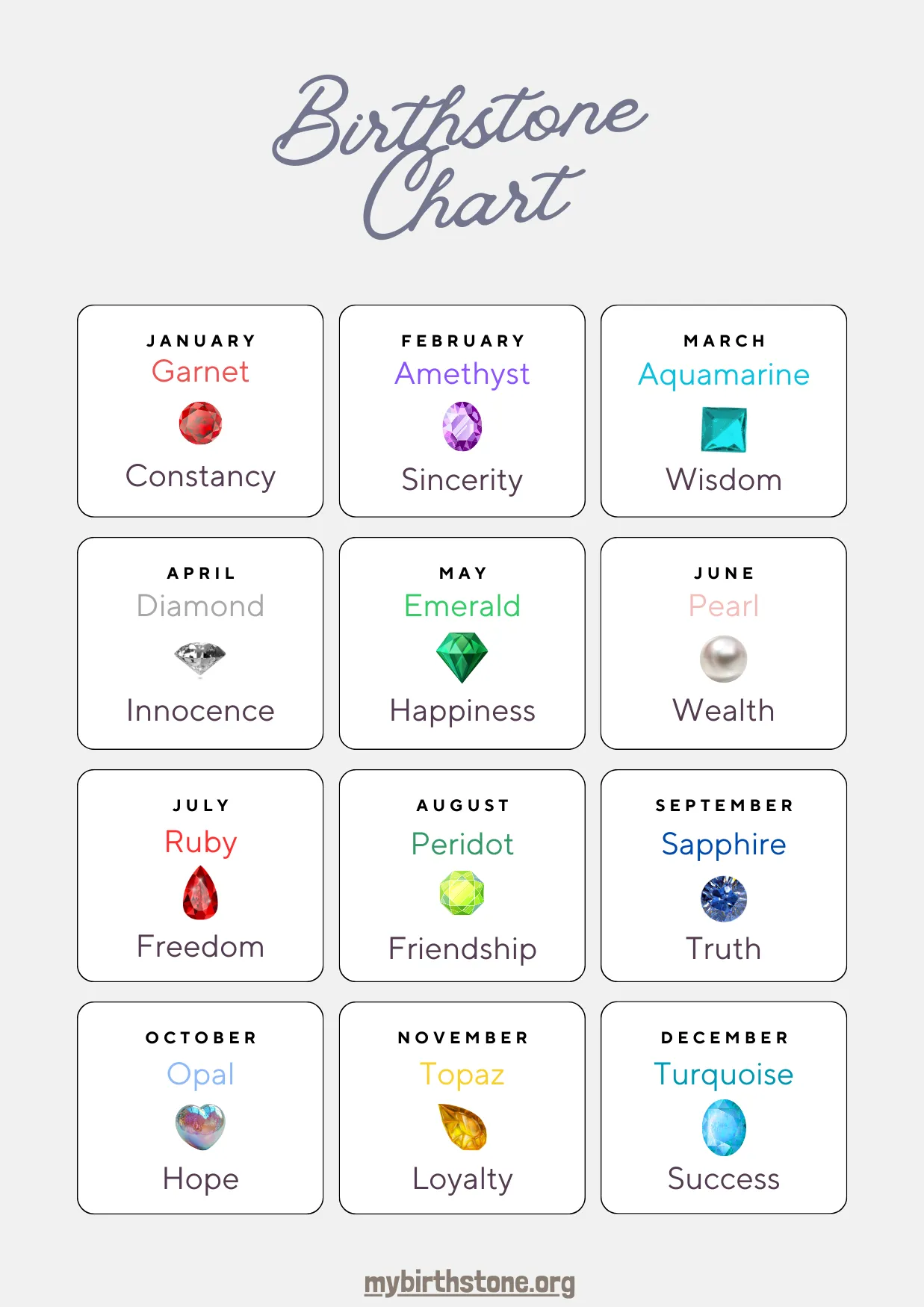
Lists train recognition. Charts train recall. Use the birthstone chart to quiz yourself. Cover the names, look only at the colors, and call out the months. Flip the exercise the next day. Two weeks of this and you'll have all twelve locked.
What to Do With This Knowledge
Once the colors are second nature, a few things change. Gift hunts get faster, because you can scan a jewelry case and immediately spot what works for whose birthday. Estate jewelry stops feeling like a foreign language. Even the meanings start to click into place, because color and meaning travel together. Red for passion, blue for trust, green for renewal. Birthstones didn't invent these associations, they just packaged them.
If you don't know yours yet, the find your birthstone tool is the fastest way to get the answer plus the color, the meaning, and the lore in one shot.
The Short Version
Twelve months, twelve colors, one color wheel hiding in plain sight. Learn the seasonal pattern, anchor each stone to a story, drill your color recall with a quick game, and the whole calendar locks in. After that, every birthday becomes a little easier, and every gemstone you see in the wild starts to mean something.