The History of Pearl & Alexandrite
Tracing June's two birthstones, from ancient pearl fisheries to a nineteenth-century discovery in the Ural Mountains
The Ancient Origins of Pearl
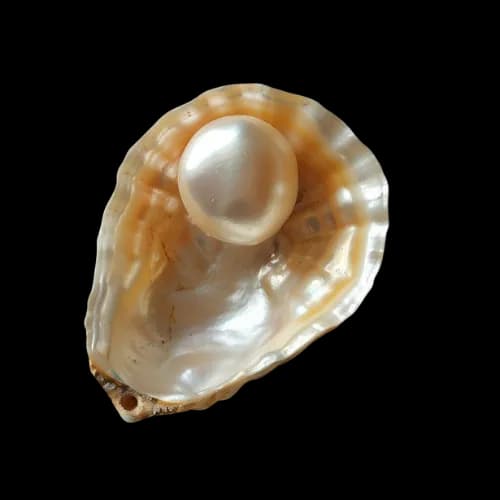
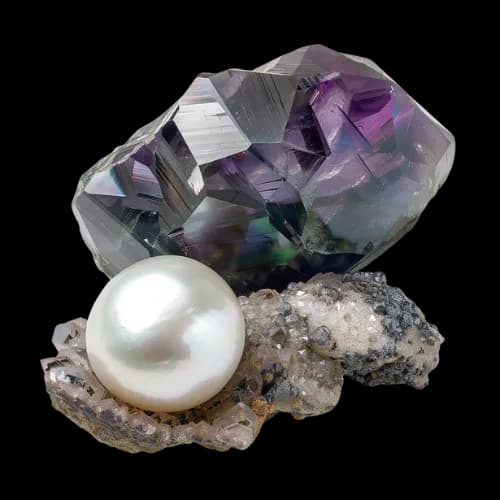
Pearl is the odd one out among gemstones. Every other stone on this list was pulled from rock. A pearl grows inside a living creature. When an irritant lodges inside a mollusk from the Pinctada family of oysters, the animal defends itself the only way it can: by coating the intruder in layer after layer of nacre, the same iridescent material that lines its shell. Years later, someone opens that shell and finds a gem. The word “pearl” likely comes from the Latin perna, meaning “leg,” a reference to the leg-shaped bivalve that produces it.
Pearl is also the oldest gemstone by use, if not by geological age. The earliest known written reference to a natural pearl appears in a Chinese historical record dated to 2206 BC. For thousands of years before Columbus ever reached the Americas, two regions supplied nearly the entire world's pearl trade: the Persian Gulf and the waters around Ceylon, now Sri Lanka, in the Gulf of Mannar. Divers worked these beds by hand, holding their breath and hauling up oysters one basket at a time, to feed demand that stretched from Rome to Persia to the Chinese imperial court.
Rome, in particular, could not get enough of them. Pearls became such a marker of status that Julius Caesar passed a law restricting their ownership to the ruling class, a rule that did little to dampen demand. Kunz records a stranger belief from further east: pearl fishers off Borneo saved every ninth pearl they found, sealed it in a bottle with two grains of rice per pearl, and stoppered the bottle with a dead man's finger, convinced the pearls inside would breed and multiply. It never worked, of course. But it says something about how much value people placed on a gem nobody could manufacture.
Alexandrite: A Nineteenth-Century Discovery
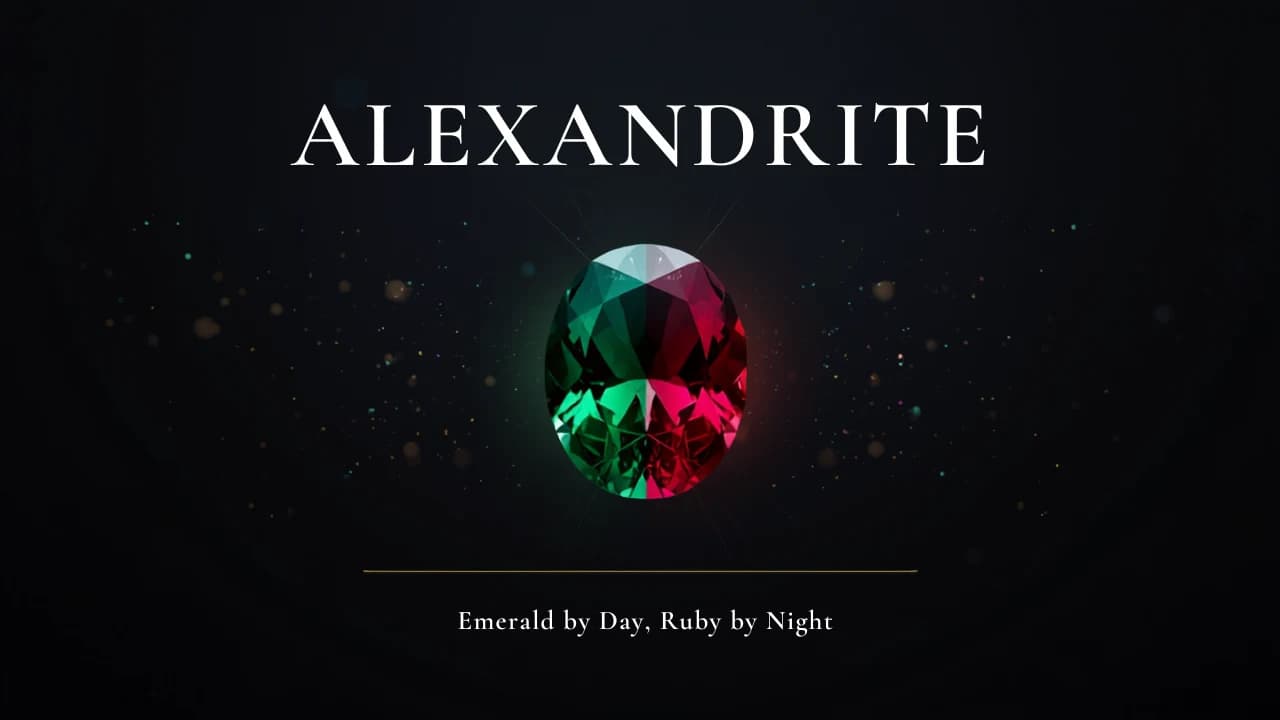
Alexandrite has none of pearl's ancient pedigree, and that's the point. It wasn't found until around 1830, in the emerald mines of Russia's Ural Mountains, where miners kept pulling out green crystals that behaved strangely under lamplight. By candle or oil flame, the green vanished and the stones glowed red. The mineralogist credited with identifying it, often given as Nils Gustaf Nordenskiöld, realized he wasn't looking at emerald at all but a new variety of chrysoberyl. He named it alexandrite, for the young Alexander II, heir to the Russian throne. Kunz, writing decades later, dated the discovery to 1831 and repeated the story that it surfaced on the very day Alexander came of age. That detail is a good story more than a verified fact, but the timing and the name stuck regardless.
The color change itself comes down to chromium, the same element responsible for the red in ruby and the green in emerald. Trace amounts absorb light unevenly, so the stone reads green under daylight's blue-heavy spectrum and red under the warmer, yellow-heavy glow of candlelight or incandescent bulbs. Gemologists still describe it with the same shorthand used a century ago: emerald by day, ruby by night. Because red and green happened to be Russia's national colors, the timing could not have been better. Kunz notes plainly that alexandrite became “a great favorite with the Russians,” prized as a stone of good omen, and that its fame quickly spread well beyond imperial circles.
Alexandrite didn't become an official birthstone until 1952, when the Jewelry Industry Council added it to the modern list as June's second stone, alongside pearl. By then the original Ural deposits were running out. Today the finest color-change material comes from Brazil, Sri Lanka, and East Africa, though gemologists still hold the nineteenth-century Russian stones as the benchmark. None of the newer sources quite match that saturation.
Pearl in the Middle Ages and Renaissance
Alexandrite wouldn't exist as a known gem for another five centuries, so this era belongs entirely to pearl. Medieval Europe treated pearl as a symbol of purity and rank, sewn into ecclesiastical vestments and royal regalia. Everything changed after 1492. Christopher Columbus's voyages, and later expeditions to the coasts of present-day Venezuela and Panama, opened up pearl beds Europe hadn't known existed. Demand exploded. What became known as Europe's pearl age filled royal courts on a scale the ancient world never saw, until overfishing collapsed most of those American beds within a century.
One pearl fished from those Panamanian waters in the 1570s became famous enough to earn its own name: La Peregrina, “the wanderer.” Its full story appears among the famous specimens below, but it's worth noting here that a pearl of that quality could change hands for sums that rivaled the great commissioned artworks of the age.
Renaissance writers also passed down a stranger belief: that gemstones, pearls included, were somehow alive. Kunz cites a period source claiming that stones could take offense at injury and “become rough and pale,” and notes that when a lady of the era said her pearls had “sickened,” it was often just a polite way of admitting they had never been very fine to begin with. It's folklore, not fact, but it captures how personally people related to a gem that quite literally comes from a living animal.
Pearl & Alexandrite Across Cultures
June's two birthstones traveled very different paths to reach the cultures that prized them:
China
China holds the oldest written record of pearls anywhere, a reference dating to 2206 BC. Beyond ornament, pearls carried a specific protective meaning: many Chinese traditions held that pearls guarded against fire, including the fire supposedly breathed by dragons. Divers worked China's rivers and coastal waters for millennia, long before Persian Gulf pearls ever reached Chinese markets.
India
Ancient Hindu treatises on gemstones describe the naoratna, a nine-gem talisman meant to channel the influence of the sun, moon, and five visible planets. Pearl was assigned to the moon and set in the ring's southeast position, one of five “great gems,” or maharatnani, alongside diamond, ruby, sapphire, and emerald.
Russia
Alexandrite found its most devoted audience at the doorstep of its own discovery. Because its green and red matched Imperial Russia's military colors exactly, the stone became an instant status symbol at court. Fabergé and other court jewelers set the finest Ural material into pieces meant for the Romanov family and the aristocracy around them.
Southeast Asia
Pearl-fishing communities across Southeast Asia developed their own body of belief around the gem. Off the coast of Borneo, fishers were said to set aside every ninth pearl they harvested, convinced those pearls could breed more of their kind. The custom persisted long after it had any practical explanation, a reminder of how magical pearls once seemed to the people who found them.
Famous Pearl & Alexandrite Specimens
La Peregrina Pearl
Found in the Gulf of Panama in the 1570s, this pear-shaped pearl made its way to Spain, where King Philip II purchased it in 1586 for 9,000 ducats, reportedly three times what Michelangelo was paid to paint the Sistine Chapel ceiling. It passed through generations of Spanish and European royalty for nearly four centuries. In 1969, Richard Burton bought it at auction for $37,000 as a gift for Elizabeth Taylor, who later had Cartier mount it into a necklace. After Taylor's death, La Peregrina sold at Christie's for $11.8 million.
The Hope Pearl
Once believed to be the largest natural saltwater pearl in the world, this baroque pearl weighs roughly 450 carats and stands about two inches tall. Banker Henry Philip Hope, better known for the Hope Diamond, acquired it in the early 1800s as part of a broader collection that included nearly 150 rare pearls. It was catalogued in 1839, the year Hope died, and remains privately owned today.
Mikimoto's First Cultured Pearls
On July 11, 1893, Kokichi Mikimoto pulled the first commercially viable cultured pearls from Akoya oysters on Ojima Island, working with guidance from marine biologist Kakichi Mitsukuri. Those early pearls were hemispherical, not fully round. Mikimoto patented the process in 1896 and didn't achieve a complete, spherical cultured pearl until 1905. Ojima Island was later renamed Mikimoto Pearl Island in his honor.
The Alexandrite Cat's-Eye
Among the rarest phenomena in gemology is a stone that combines two optical effects at once. Kunz describes an alexandrite cat's-eye exhibited by Tiffany & Co: a stone that shows the sharp chatoyant band of a cat's-eye while still shifting from green in daylight to a ruddy red under artificial light. The twinned crystal structure that produces the cat's-eye effect makes stones like this exceptionally difficult to find in gem quality.
Pearl & Alexandrite in Modern Times
Scientific Understanding
- Modern gemology explains alexandrite's color change through chromium's uneven light absorption, the same trace element behind ruby's red and emerald's green, working inside a different crystal structure (chrysoberyl instead of corundum or beryl).
- Cultured pearl technique, refined after Mikimoto's early experiments, involves inserting a small bead nucleus and a piece of donor mantle tissue into a host oyster, then waiting one to several years while the animal deposits layer after layer of nacre around it.
- Laboratories can now grow synthetic alexandrite with the same chemical composition and color-change behavior as the natural stone, sold at a fraction of the price. Reputable dealers always disclose the difference.
Mining and Production
- China now produces the overwhelming majority of the world's cultured freshwater pearls, while Japan, Australia, and Indonesia lead in saltwater varieties like Akoya and South Sea. French Polynesia remains the primary source of Tahitian black pearls.
- Natural alexandrite mining today centers on Brazil's Minas Gerais region, Sri Lanka, and parts of East Africa. Supply is tiny compared to demand, which keeps fine natural alexandrite among the most expensive gemstones by carat.
- The original Russian deposits that started it all are essentially exhausted, so most alexandrite sold today, natural or synthetic, comes from somewhere else entirely.
Cultural Significance Today
- Pearl has been June's primary birthstone since the modern list was standardized in 1912 by the American National Retail Jewelers Association, now known as Jewelers of America; alexandrite joined it in 1952. Many jewelers also list moonstone as a third June option.
- Pearl marks the 3rd and 30th wedding anniversaries; alexandrite is tied to the 55th, a fitting stone for a milestone that rare.
- Both gems remain popular in bridal jewelry today: pearl for its classic, understated elegance, and alexandrite for buyers who want something genuinely rare and conversation-worthy.
Sources & Further Reading
This history draws on gemological research from GIA and the American Gem Society, alongside George Frederick Kunz's 1913 study of gemstone folklore. For more detail on any of the facts above, these are good places to start: