A geode tells you nothing from the outside. It sits in the pile looking like the dullest rock on the table, and then someone cracks it open and the inside is a hollow chamber lined with crystals that took millions of years to grow. Gem-quality minerals turn up in these cavities, including February birthstone amethyst, and the volcanic rocks that host geodes belong to the same settings that yield August birthstone peridot.
The Birth of a Geode: Volcanic Origins
Geode formation begins with volcanic activity, usually millions of years ago. When lava flows cool rapidly, gas bubbles get trapped in the solidifying rock, leaving hollow spherical or oblong cavities called vesicles. Every crystal-lined geode started life as one of these empty pockets. Volcanic settings produce more gems than most people expect, January birthstone garnet among them.
Not every cavity becomes a geode. The surrounding rock has to be porous enough for mineral-rich groundwater to seep through, yet stable enough to hold the cavity's shape over geological time. That combination is rarer than it sounds, and it occurs most often in volcanic ash deposits, basalt flows, and sedimentary limestone formations.
Chemical Architects: How Minerals Build Crystal Walls
The step from empty cavity to crystal chamber is called precipitation. Groundwater carrying dissolved minerals works through the outer rock shell and into the hollow space. When that solution meets a change in temperature, pressure, or chemical composition, it starts dropping its mineral cargo onto the cavity walls, one thin layer at a time.
The most common geode minerals:
- Quartz varieties: clear quartz, amethyst, and citrine
- Chalcedony: the source of banded agate patterns
- Calcite: which grows in sharp crystal clusters
- Celestite: pale blue and prized by collectors
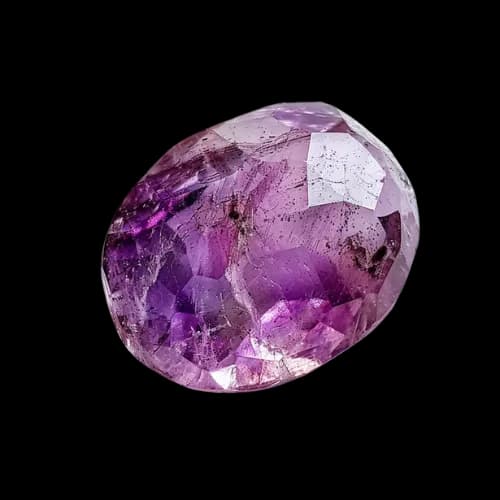
Which minerals grow depends entirely on the chemistry of the surrounding rock and groundwater. Iron in the solution produces the purple of February birthstone amethyst geodes, while copper deposits can produce green crystals related to the May birthstone emerald family.
The Million-Year Process: How Long Geodes Take to Form
The timescales are the part worth sitting with. Crystal nucleation alone, the stage where the first mineral particles attach to the cavity walls, can take thousands of years. After that, growth crawls forward in microscopic layers added over millennia.
Temperature runs the quality control. Slow, steady cooling gives crystals time to organize into large, well-formed shapes, the same unhurried conditions that produce high-quality April birthstone diamonds deep in the earth. Rapid temperature swings do the opposite, producing smaller, more crowded crystals or microcrystalline material like chalcedony.
Reading Geode Geology: Layers Tell Stories
Every geode keeps a diary. The outermost bands formed first, and each later layer grew inward toward the center, so a sliced geode reads as a timeline. Scientists read the bands the way they read tree rings, recovering ancient climate conditions, shifts in groundwater chemistry, and geological events that happened mid-formation.
Color changes between layers mark changes in the water. A geode might open with white quartz, switch to purple amethyst bands when iron entered the system, and finish with clear quartz once conditions stabilized. Those transitions create the zoned patterns that make a cut geode look deliberately designed. It was not, and that is the appeal.
Geographic Hotspots: Where the Best Geodes Come From
A handful of regions produce geodes far better than anywhere else, and in every case the local geology explains why. Brazil's Rio Grande do Sul state cuts enormous amethyst geodes out of basalt flows left by ancient volcanic activity, some literally large enough to walk inside. If you have stood next to a cathedral-sized February birthstone amethyst geode in a museum or rock shop, it almost certainly came from there.
Mexico's Chihuahua region yields agate geodes with intricate banding patterns, while Madagascar produces geodes carrying rarer minerals like celestite alongside its quartz varieties. In the United States, Iowa's Keokuk geodes are famous for their calcite and quartz combinations, and Oregon's Thunder Eggs are a category of their own, a geode-type formation in volcanic rhyolite.
Modern Detection: How Scientists Find Geodes
Finding geodes starts with reading the landscape. Experienced collectors target ground with ancient volcanic activity or limestone deposits, then watch the weathering: geode-bearing rock erodes differently from the surrounding matrix, and that difference is usually the first visible clue.
Technology now handles the part eyes cannot:
- Ground-penetrating radar: detects hollow spaces within rock formations
- Seismic surveys: identify subsurface cavity patterns
- Geochemical analysis: maps mineral distribution in potential geode fields
- Magnetic surveys: locate iron-rich formations that often accompany geode deposits
The Gemstone Connection: Birthstones Born in Geodes
Several birthstones entered human history through geode discoveries. February birthstone amethyst geodes have been prized since ancient times; the Greeks believed the stone prevented intoxication, which is why they drank from amethyst cups. November birthstone citrine often forms in geodes alongside amethyst, and sometimes it is former amethyst: heat transforms the purple quartz to golden yellow, occasionally within the same cavity.
The connection runs past quartz, too. September birthstone sapphire occasionally forms in geode-like cavities within metamorphic rocks, through different processes than typical sedimentary geodes. March birthstone aquamarine grows in pegmatite pockets that work on the same principle: a void in the rock, a mineral-rich fluid, and an enormous amount of time.
Preservation Challenges: Protecting Ancient Crystal Chambers
Geodes survive underground for millions of years and can be ruined at the surface within decades. Exposure breaks down the protective outer shell, letting moisture and temperature swings attack the crystals inside. Mining operations reach the best specimens, and the trade-off is real: extraction has to be balanced against preserving geological heritage.
Climate change reaches even here. Shifting groundwater patterns and temperature cycles alter the processes that build geodes, and some geode fields are still slowly forming today, which means environmental changes now could shape the geodes of the deep future. Conservation efforts work both ends of the problem: protecting existing geode sites and protecting the ongoing processes that create new ones.
Ruby, the July birthstone, forms in metamorphic environments. Tanzanite, the December birthstone, comes from a single unusual geological setting in Tanzania. Geodes grow in gas bubbles trapped in ancient lava. Different recipes, same lesson: the earth builds its best work slowly and hides it well. Crack a geode open and you are the first thing in millions of years to put light on those crystals. We think that earns them a little protection.