Opals are unlike any other gemstone on Earth. No two stones show the same play-of-color, which is exactly why there is no tidy grading chart for them. Diamonds get the 4Cs and a price table; the traditional October birthstone has to be judged stone by stone. So what makes an opal valuable?
Five things, mainly: the strength of the play-of-color, the body tone behind it, the clarity, the size, and where the stone was dug. Learn how those five interact and a confusing market starts to make sense. Here is each one in turn, with real prices attached.
The Rarity Factor: Why Opals Command High Prices
Precious opals are genuinely rare. Only about 5% of all opals mined display the play-of-color that makes them valuable. The rest is mostly potch, common opal with no fire in it, the material cutters set aside or use as backing.
Supply is concentrated as well as scarce. Around 95% of the world's precious opals come from Australia, most of it from a handful of outback fields, and one country controlling supply keeps prices firm. Lightning Ridge, the home of black opal, produces stones that can exceed $15,000 per carat for exceptional specimens. Ethiopian opals, a far more recent discovery, sell for much less and are the sensible entry point if Australian material is out of budget.
Understanding Play-of-Color: The Heart of Opal Value
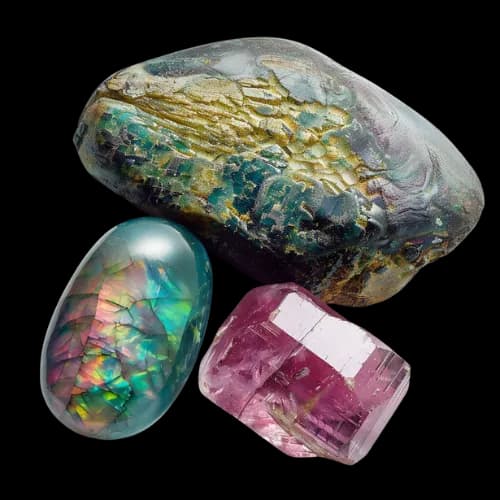
The primary value driver for any opal is its play-of-color, the rainbow flashes that move across the stone's surface as it turns. The effect comes from light diffracting through microscopic silica spheres inside the opal's structure. The size and arrangement of those spheres determine which colors appear and how vivid they look.
Red is the most valuable color in opal play-of-color patterns. Why? Red requires the largest silica spheres to produce, making it the rarest.
A stone flashing brilliant reds, oranges, and greens commands significantly higher prices than one showing only blues and greens. The pattern matters too. Broad flashes and rolling sheets of color are worth more than small, scattered pinfire, and top-quality opals hold their color from multiple angles instead of going flat the moment the stone tilts.
Body Tone: The Canvas for Color
An opal's body tone is the backdrop its play-of-color performs against. Think of it as a canvas: the darker the canvas, the harder the colors pop. This is why black opals from Lightning Ridge are the most valuable opal variety, often selling for 50-100 times more than white opals of similar quality.
The body tone scale runs from N1 (black) to N9 (white). Here's how value typically breaks down.
Black opals (N1-N4) command premium prices, especially those with bright play-of-color. Dark opals (N5-N6) are the value pick of the scale, showing vivid color against a background still dark enough to do the job. Light opals (N7-N9) are more plentiful and their color reads softer, so they generally sell for less.
Clarity and Transparency: Hidden Value Factors
Clarity is the factor most buyers skip when evaluating opals, and it significantly affects the price.
Crystal opals, transparent to semi-transparent stones with play-of-color, can be extremely valuable when the color is bright, because transparency gives the play a three-dimensional depth that opaque stones cannot match. Mexican fire opals, with their orange to red body color and transparency, are another valuable category, especially the rarer pieces that also show play-of-color.
The inclusions that drag value down are potch lines, sand spots, and webbing. There is one happy exception: dendritic inclusions can raise the price when they form attractive, picture-like scenes inside the stone.
Size Matters: The Exponential Price Curve
Opal prices don't rise in a straight line with size. They rise exponentially.
A 2-carat opal isn't simply worth twice as much as a 1-carat stone of equal quality; it might be worth three or four times more. The reason is in the ground. Most rough opal is riddled with cracks, inclusions, and thin color bars that limit the size of finished stones, so big flawless gems almost never come out whole.
Origin: The Geographic Premium
Where an opal comes from moves the price. Australian opals, particularly from Lightning Ridge, Coober Pedy, and Mintabie, command the highest prices, and the reputation is earned: these stones rarely crack or lose their color, which is exactly what you want in a gem you plan to hold for decades.
Ethiopian opals entered the market in 2008 and caught on quickly. They are often lovely and usually cheaper, but many are hydrophane, meaning they absorb water, and that affects both stability and value. Brazilian opals are the third option, known for bright play-of-color against lighter body tones.
Current Market Prices: What to Expect
Here is roughly where prices sit, category by category.
Commercial-grade white opals typically range from $10 to $100 per carat. Good-quality white opals with bright play-of-color fetch $100 to $500 per carat. Fine crystal opals command $500 to $2,000 per carat. Black opals start around $1,000 per carat for decent specimens, with top-quality stones exceeding $15,000 per carat.
Boulder opals, unique to Queensland, are the quiet bargain of the list. Their ironstone backing provides durability and often a dramatic dark contrast behind the color. Prices range from $50 to $1,000 per carat depending on the brightness and pattern of the color play.
Investment Potential: Opals as Alternative Assets
High-quality opals have appreciated steadily over the past few decades. Black opals in particular have outperformed many traditional investments.
If you are buying with one eye on value, our advice is simple: buy the best single stone you can afford. One exceptional opal will appreciate more than a drawer full of mediocre ones. Look for brilliant play-of-color, a good dark body tone, and a clean face, and get certification from a reputable laboratory, which adds both value and liquidity when it's time to sell.
Unlike the traditional birthstones with their established grading systems, opals take real expertise to evaluate. Build relationships with reputable dealers and get more than one opinion before spending serious money.
Caring for Your Investment
Opal value retention depends heavily on proper care. At 5.5-6.5 on the Mohs scale, opals need gentler handling than harder gems like diamonds or sapphires.
Store opals away from heat and direct sunlight. Skip ultrasonic cleaners and harsh chemicals entirely. Some opals benefit from occasional water exposure to prevent cracking, while others (particularly Ethiopian hydrophane opals) should avoid water contact altogether. Know which type you own, because the care rules run in opposite directions.
The Future of Opal Values
Several concrete pressures point to opal values continuing to rise.
Australian opal fields are becoming depleted, and new discoveries are increasingly rare. Mining costs keep climbing, which pushes prices upward. Demand from Asian markets, particularly China and Japan, keeps growing against that limited supply. And younger buyers increasingly want a unique, individual gem rather than a standardized diamond, which favors opal more than almost any other stone.
As more people find opals beyond their role as October's birthstone, demand for quality specimens will likely outpace supply. Our honest take: buy an opal because you love the individual stone, buy the best one you can afford, and treat the appreciation as a bonus rather than the plan.
Wondering how it stacks up against every other gem? Compare values in our gemstone price guide and toughness on the sortable Mohs hardness table.