May BirthstoneEmerald
By Emily RichardsonUpdated September 2026
The birthstone of rebirth, love, and wisdom, used in jewelry for over 4,000 years
Quick answer
The birthstone for May is Emerald.
Emerald is both the modern and traditional birthstone for May, known for its vivid green color and long history as a symbol of love and renewal.
- Birthstone
- Emerald
- Color
- Vivid Green (bluish-green to yellowish-green)
- Hardness
- 7.5–8 Mohs
- Meaning
- Rebirth, Love, Wisdom
- Zodiac
- Taurus & Gemini
- Birth Flower
- Lily of the Valley & Hawthorn
- Anniversary
- 20th & 35th Wedding Anniversary
What Is the Birthstone for May?
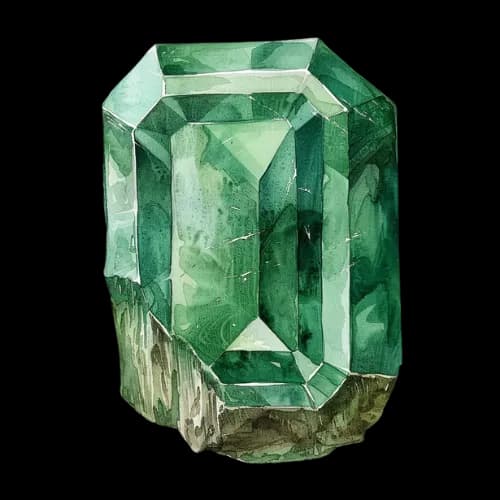
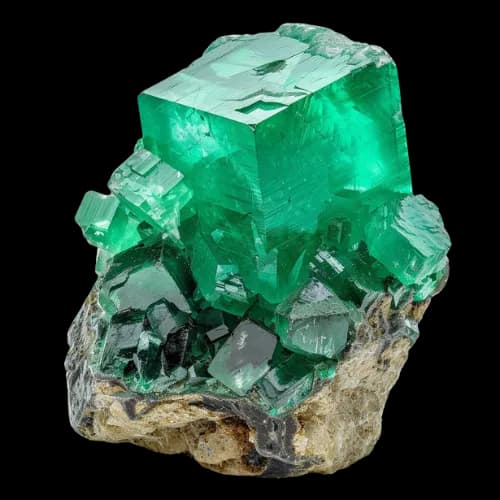
The May birthstone is emerald. One of the four precious gemstones alongside diamond, ruby, and sapphire, emerald has been used in jewelry for over 4,000 years for its green color. It is a variety of the mineral beryl, colored by trace amounts of chromium and sometimes vanadium.
The name "emerald" traces back through Old French and Latin to the Greek smaragdos, simply meaning "green gem." Legend holds that Cleopatra claimed Egypt's emerald mines for herself, and the ancient workings near the Red Sea are still called "Cleopatra's Mines," though the story rests on tradition rather than surviving records. The Roman author Pliny the Elder declared that nothing was greener than an emerald.
Today emerald is a fixture of fine jewelry collections and a popular choice for May birthday gifts.
Emerald Meaning & Symbolism
Emerald has carried a number of meanings across cultures and centuries, many of them tied to May themes.
Rebirth & Renewal
Emerald has long been linked to spring, new beginnings, and growth.
Love & Devotion
Sacred to Venus, emerald has been the stone of faithful love for centuries.
Wisdom & Insight
Known as "the stone of successful love and wisdom," emerald is believed to sharpen the intellect and enhance memory.
Prosperity & Abundance
Emerald has long been associated with wealth, worn by merchants and rulers to attract success.
Truth & Foresight
Ancient cultures believed emerald could reveal truth and predict the future.
Healing & Balance
Emerald is said to soothe the eyes, calm the spirit, and restore emotional balance.
Emerald Colors & Varieties
While emeralds are defined by their green color, origin and formation create distinctive varieties:
Pure Vivid Green
Colombian
The benchmark variety. Warm, saturated green with a subtle bluish tint from the Muzo, Chivor, and Coscuez mines.
Deep Bluish-Green
Zambian
Cooler-toned gems with good clarity, increasingly popular for their deep color.
Yellowish-Green
Brazilian
Lighter, warmer tones with good clarity. Often more affordable.
Star-Pattern Green
Trapiche
Rare emeralds displaying a six-rayed spoke pattern of dark carbon inclusions.
Chatoyant Green
Cat's Eye
Rare emeralds that display a moving band of light. Always cut as cabochons.
Bright Vivid Green
Ethiopian
A newer market discovery with good clarity and vivid color comparable to Colombian stones.
Why Is Emerald the May Birthstone?
Emerald's association with May comes from its long connection to spring and renewal. The Northern Hemisphere turns green in May, and emerald's color matches that shift. Ancient cultures linked the gem to fertility goddesses and the cycle of rebirth.
The modern birthstone list was standardized in 1912 by the American National Retail Jewelers Association (now Jewelers of America). They formalized emerald as the May birthstone. Emerald had already appeared on birthstone lists tracing back to the biblical Breastplate of Aaron and to early Hindu and Arabic gemological traditions.
Emerald connects to both May zodiac signs: Taurus values its grounding qualities and earthly beauty, while Gemini connects to its themes of communication, mental clarity, and adaptability.
The History of Emerald
Emerald mining dates back to at least 1500 BCE in Egypt, where Cleopatra's well-known passion for the green gem made it a symbol of royal power. Egyptian emerald mines near the Red Sea, later called "Cleopatra's Mines," operated for centuries, supplying the ancient Mediterranean world.
The Incas and Aztecs of South America valued emerald long before the arrival of Europeans. When the Spanish conquistadors reached the New World in the 16th century, they found Colombian emerald deposits of exceptional quality. The mines at Muzo, Chivor, and Coscuez went on to supply the world's finest emeralds for centuries.
The Mughal emperors of India, including Shah Jahan (builder of the Taj Mahal), were avid collectors of emeralds. They inscribed sacred texts onto large emerald tablets and set the stones into elaborate jewelry and ceremonial objects. The "Mogul Emerald," a 217.80-carat tablet inscribed with prayers, dates to 1695.
In medieval and Renaissance Europe, emeralds were believed to cure diseases, reveal truth, and protect against evil. They were a favorite of the clergy, who wore them as symbols of faith and moral purity. Today emerald remains one of the four precious gemstones and is mined primarily in Colombia, Zambia, Brazil, and Ethiopia.
Emerald Properties
⚗️Physical Properties
- Mineral
- Beryl
- Hardness
- 7.5-8 on Mohs scale
- Crystal System
- Hexagonal
- Refractive Index
- 1.57-1.58
- Chemistry
- Be₃Al₂Si₆O₁₈
- Color Range
- Green (ranging from light to deep green)
🌍Where Emerald Is Found
Emerald is sourced from deposits around the world, each producing stones with distinct character:
How to Care for Emerald Jewelry
Emerald needs gentler care than harder gemstones due to its natural inclusions. Follow these guidelines to keep your emerald looking its best:
Clean emerald jewelry gently with mild soap and warm water using a soft brush.
Avoid ultrasonic cleaners and steam cleaning, which can damage emeralds due to their potential inclusions and fractures.
Avoid exposure to harsh chemicals and solvents.
Avoid sudden temperature changes.
Store separately to prevent scratching other gemstones.
Remove emerald jewelry before engaging in sports, household chores, or any activity that might subject the stone to impact.
How Much Does Emerald Cost?
Emerald prices depend heavily on color saturation and clarity rather than carat weight alone. Included, commercial-grade stones are affordable, while fine Colombian emeralds with vivid color can rival or exceed top diamonds per carat.
| Quality tier | Typical price | What you get |
|---|---|---|
| Commercial grade | $50 – $500 per carat | Visibly included stones with the classic "jardin," suited to everyday jewelry |
| Fine Colombian | $5,000 – $50,000+ per carat | Vivid, evenly saturated green with good clarity, on par with or above top diamonds per carat |
Indicative 2026 retail prices for loose stones; settings and brand add to the total.
How to Choose Emerald Jewelry
When shopping for emerald jewelry, color is the most important factor. Look for stones with a vivid, saturated green. The richer the hue, the more valuable the gem. A slight bluish-green tint (typical of fine Colombian emeralds) is highly prized.
- 1. Color first: A vivid, evenly saturated green with a medium-to-dark tone is most desirable. Avoid stones that look too light or too yellow.
- 2. Clarity: Some inclusions are expected. Aim for stones where the "jardin" does not seriously affect transparency or structural integrity.
- 3. Cut: The emerald cut (a rectangular step cut) was invented for this stone. Oval, round, and pear shapes are also popular.
- 4. Setting: Bezel or halo settings give the best protection for emerald in rings worn regularly.
Facts About Emerald
Almost all emeralds have inclusions visible to the naked eye. These inclusions are poetically called "jardin" (garden in French) because they resemble moss or foliage. These "gardens" are considered part of the character of emeralds.
The rectangular step-cut with truncated corners known as the "emerald cut" was developed specifically for emeralds to protect them from pressure and impact during cutting, due to their relatively fragile nature.
Cleopatra was so passionate about emeralds that she claimed ownership of all emerald mines in Egypt during her reign. She often wore emeralds as part of her royal adornment and gave them as gifts to important dignitaries.
One of the most famous emeralds in the world, the Chalk Emerald, weighs 37.8 carats and is renowned for its exceptional clarity and color. It's now housed at the Smithsonian National Museum of Natural History.
May Birthstone by Date
No matter which day in May you were born, emerald is your birthstone. Here's how each part of the month connects to emerald:
May 1–10
Taurus
Early May births connect to emerald's themes of grounding, abundance, and the blossoming earth.
May 11–20
Taurus
Mid-May ties to emerald's themes of loyalty, patience, and steady growth.
May 21–31
Gemini
Late May connects to emerald's themes of mental clarity, communication, and adaptability.
May birthstone for every date
| Date | Zodiac Sign | Birthstone |
|---|---|---|
| May 1st | Taurus | Emerald |
| May 2nd | Taurus | Emerald |
| May 3rd | Taurus | Emerald |
| May 4th | Taurus | Emerald |
| May 5th | Taurus | Emerald |
| May 6th | Taurus | Emerald |
| May 7th | Taurus | Emerald |
| May 8th | Taurus | Emerald |
| May 9th | Taurus | Emerald |
| May 10th | Taurus | Emerald |
| May 11th | Taurus | Emerald |
| May 12th | Taurus | Emerald |
| May 13th | Taurus | Emerald |
| May 14th | Taurus | Emerald |
| May 15th | Taurus | Emerald |
| May 16th | Taurus | Emerald |
| May 17th | Taurus | Emerald |
| May 18th | Taurus | Emerald |
| May 19th | Taurus | Emerald |
| May 20th | Taurus | Emerald |
| May 21st | Gemini | Emerald |
| May 22nd | Gemini | Emerald |
| May 23rd | Gemini | Emerald |
| May 24th | Gemini | Emerald |
| May 25th | Gemini | Emerald |
| May 26th | Gemini | Emerald |
| May 27th | Gemini | Emerald |
| May 28th | Gemini | Emerald |
| May 29th | Gemini | Emerald |
| May 30th | Gemini | Emerald |
| May 31st | Gemini | Emerald |
May Birth Flower: Lily of the Valley & Hawthorn
May's birth flowers, the lily of the valley and hawthorn, share emerald's themes of renewal and hope. Both the white blossoms and the green emerald reflect the spring season.
Explore May's Birth Flowers