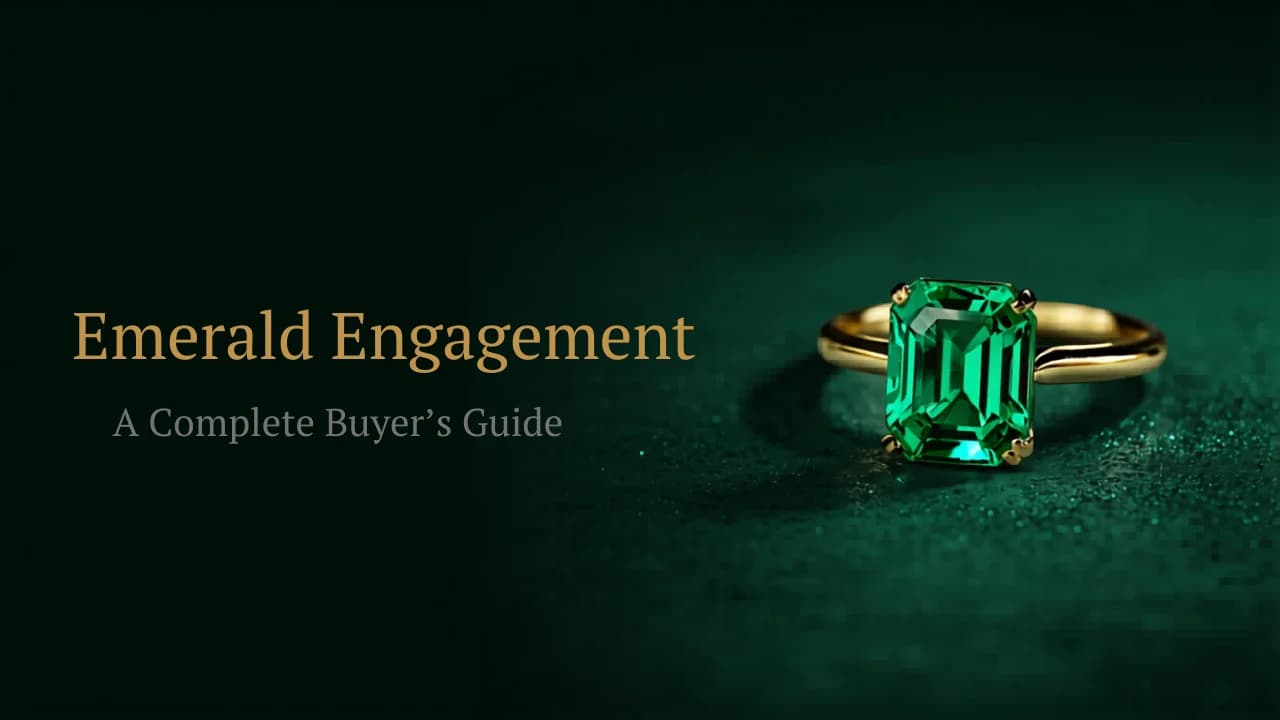
There is no green like emerald green. Sapphire and ruby are gorgeous, but they have rivals in their own colour lanes. Emerald does not. When someone wants a green engagement ring, they want that specific velvety, slightly blue-leaning green that has meant spring, renewal and new love since the days of Cleopatra. Nothing else gets close, and that is exactly why people fall for it.
We will be honest with you from the first paragraph, because it shapes everything that follows. An emerald is the most beautiful coloured stone you can put on an engagement ring, and it is also the most demanding. It is not a stone you buy and forget about like a sapphire. It rewards a buyer who understands what they are getting, and it quietly punishes one who does not. This guide is about being the first kind of buyer.
If you want the full backstory of the stone itself, the Cleopatra mines, the truth-telling lore and the symbolism, our emerald history and lore guide is the companion piece. Here we are focused entirely on the ring, the buying decisions and the trade-offs nobody at the jewellery counter wants to slow down and explain.
First, the Honest Part: Emerald Is a High-Maintenance Stone
Most engagement ring guides skip this, and we think that is doing buyers a disservice. So here it is up front.
Emerald is a variety of the mineral beryl, coloured green by traces of chromium and vanadium. On the Mohs hardness scale it sits at 7.5 to 8, which sounds perfectly respectable, and on scratch resistance it is. The problem is not hardness. It is toughness, which is a different property entirely. Toughness is resistance to chipping and cracking, and emerald is genuinely poor at it. Almost every natural emerald is riddled with internal fractures and inclusions, and those flaws are weak points where a sharp knock can start a crack or pop a chip.
Compare that with the sapphire engagement ring, which sits at hardness 9 and is famously tough enough to shrug off decades of daily wear. Emerald is not in that category and never will be. This does not mean you should not buy one. It means you have to buy and set and care for it with its nature in mind, and if you do, it will be fine. We have seen plenty of hundred-year-old emerald rings still looking glorious. They survived because their owners treated them with a little respect, not because emerald is secretly indestructible.
Our blunt opinion: if the person wearing the ring is hard on their hands, never takes jewellery off, and wants something they will genuinely never think about, steer them to sapphire. If they love that green enough to give it a little care, read on, because the payoff is the most romantic stone in the case.
Those Inclusions Are Not Flaws, They Are the Jardin
Here is the single biggest mindset shift for an emerald buyer, and it saves you both money and disappointment.
In a diamond, you chase clarity. You want it as clean and flawless as the budget allows. In an emerald, you do not, because a flawless natural emerald is so rare it is essentially a museum object and priced like one. Instead, the trade has a lovely word for the inclusions inside an emerald. They are called the jardin, French for garden, because under magnification the wisps and crystals look like foliage. A jardin is normal. It is expected. It is, in a real sense, the fingerprint that proves your stone grew in the earth rather than in a factory.
So the goal is not a clean emerald. The goal is an emerald whose inclusions do not ruin its beauty or its strength. You want them not too obvious to the naked eye from a normal viewing distance, and crucially not running to the surface in a way that threatens the stone. A pile of tiny internal wisps is fine and frankly gives the stone character. A big fracture breaking the surface near a corner is a structural worry. Learn to tell those two apart and you are most of the way to buying well.
Almost Every Emerald Is Oiled, and That Is Normal
This one surprises people, so we always say it plainly. Roughly ninety-five percent or more of the emeralds on the market have been treated with oil or resin, and that has been standard practice for centuries.
Because emeralds are full of surface-reaching fractures, those gaps get filled with a clear substance, traditionally cedarwood oil, sometimes a modern polymer resin, that has a similar light-bending quality to the stone. Filling the fractures makes them far less visible and improves the apparent clarity. This is accepted in the trade and is not fraud, as long as it is disclosed. What matters is the degree, and reports grade it as none, minor, moderate or significant. The less treatment a stone needs to look good, the better the underlying material and the higher the price.
Two practical consequences flow from this. First, insist on knowing the treatment level in writing, because "minor" and "significant" are very different stones at very different fair prices. Second, oiling is not always permanent. Over many years, with heat or harsh cleaning, oil can dry out or escape, and the previously hidden fractures reappear as whitish lines. The fix is simple and routine: a jeweller can re-oil the stone. Nobody tells first-time buyers this, and then they panic a decade later thinking the ring is ruined. It is not. It just needs a service, the same way a car does.
Colour Is King: How to Judge an Emerald
With diamonds people obsess over the four Cs equally. With emerald, colour towers over everything else. A smaller, more included stone in a superb colour will always beat a bigger, cleaner stone in a weak colour, both in beauty and in value. Get the colour right and you have got the stone right.
Three things make up colour, and it helps to judge them separately.
- Hue. The finest emeralds are a pure green to very slightly bluish green. A stone that drifts too far toward yellow-green reads as cheaper and less "emerald." A whisper of blue is desirable and is the signature of the best Colombian material.
- Tone. This is how light or dark the stone is. You want medium to medium-dark. Too light and, strictly speaking, the trade may call it green beryl rather than emerald, and it will not have that rich presence. Too dark and it goes sleepy and lifeless in anything but bright light.
- Saturation. This is the intensity of the colour, and it is where the magic is. The most prized emeralds have vivid, strongly saturated green that almost seems to glow from inside. Saturation is the quality you are really paying for.
Our advice, and the same logic we give for every coloured stone: view the emerald in normal daylight or daylight-balanced light, never only under the warm yellow spotlights at a counter, which flatter everything and hide a weak green. If a seller will not let you take the stone to a window, that tells you something.
Where It Came From: Origins Worth Knowing
Origin genuinely affects both look and price with emerald, more than with most gems, so it is worth a quick tour.
- Colombia. The historic benchmark and still the name that commands the highest prices. Colombian emeralds, especially from the Muzo and Chivor mines, tend toward that pure, slightly bluish, warm green that the whole world judges every other emerald against. They can be heavily included, and you pay for the colour.
- Zambia. The modern value champion in our view. Zambian emeralds run a touch bluer and sometimes slightly darker, and they are often cleaner and more durable than Colombian stones of the same colour grade, for noticeably less money. If you want fine colour and a tougher stone for a daily ring, this is where we would look first.
- Brazil. A broad range of qualities, often a slightly lighter or more yellowish green, and a good hunting ground for value at the commercial end.
- Afghanistan (Panjshir). Smaller production, but capable of exceptional Colombian-style colour. More of a connoisseur's pick.
Here is the buying lesson hiding in that list. Colombia is the famous name, but a top Zambian emerald in a beautiful green is a smarter buy for an engagement ring than a heavily fractured Colombian one bought just for the postcode. Pay for what is in front of your eyes, not for the label.
The Emerald Cut Exists Because of This Stone
Most people do not realise that the rectangular step cut everyone now calls the "emerald cut" was literally invented to cut emeralds. It is a brilliant piece of problem solving, and understanding why tells you a lot about choosing a shape.
Because emerald is brittle and prone to chipping, cutters needed a shape that reduced the pressure on the stone during cutting and protected its vulnerable corners afterwards. The answer was a rectangular outline with the corners cropped off at angles, and long straight facets running like steps down the sides. Those cropped corners are not just a style choice. They remove the most chip-prone points of the stone, which is exactly what a fragile gem needs. The step facets also show off colour beautifully, like looking down into deep clear water, which is what you want when colour is the whole point.
So the emerald cut is the natural and most popular choice for an emerald engagement ring, and it is the one we lean toward recommending, both for its looks and for the genuine protection it offers. That said, you will also see ovals, cushions, rounds and pears. They are all fine, but pay extra attention to protecting any sharp points or corners in the setting, which brings us neatly to the most important decision of all.
The Setting Matters More for Emerald Than Any Other Stone
For a sapphire, the setting is mostly about looks. For an emerald, the setting is also doing a protective job, and getting it right is the difference between a ring that lasts and one that chips. This is where we would spend real attention.
- Bezel. A rim of metal that wraps fully around the stone and protects its entire edge. For a stone as chip-prone as emerald, a bezel is the single best protective setting, and it gives a clean, modern, very secure look. This is our top recommendation for anyone who wants to actually wear the ring hard.
- Halo. A ring of small diamonds around the centre emerald. It does three things at once: it makes the green pop against the white sparkle, it makes the centre look larger, and the surrounding stones act as a little buffer zone around the vulnerable emerald. A genuinely smart choice for this gem.
- Protected prongs and V-tips. If you do go with prongs, insist that the corners of an emerald cut are covered by V-shaped prongs that cup and shield each corner. Exposed, unprotected corners on a brittle stone are asking for trouble.
- Three-stone. A centre emerald flanked by two diamonds, the classic past-present-future look, and a gorgeous one with emerald's green against white. Lovely, just make sure the centre is well protected.
Our honest take: for an emerald, we would pick a bezel or a halo nearly every time over a high, exposed solitaire. The exposed solitaire that looks so elegant on a sapphire is the riskiest possible home for an emerald, and we would gently talk a friend out of it unless the stone is exceptionally clean.
Which Metal Suits an Emerald?
Metal changes the whole mood of the ring and interacts with that green.
- Yellow gold. Our favourite pairing, and the most traditional. Warm yellow gold against rich green is a timeless, almost regal combination that feels antique in the best way. It is the look we picture when we picture an emerald ring.
- White gold and platinum. Cool white metal makes the green look crisp and modern and lets the colour read as deep and saturated. Platinum is the most durable choice and naturally white forever, while white gold needs its rhodium plating refreshed occasionally.
- Rose gold. A softer, more romantic and contemporary look. The warm pink against green is unexpected and lovely, and it has become popular for a reason.
There is no wrong answer here, only a look. If you want classic and warm, go yellow. If you want the green to look as vivid and modern as possible, go white.
Natural or Lab-Grown? For Emerald, This Is a Strong Question
Searches for lab-grown emerald are climbing fast, up around a quarter year on year, and for this particular stone the lab-grown option is more interesting than for most. So it deserves a proper answer.
Lab-grown emerald is real emerald. It is the same mineral, beryl, with the same chemistry, colour and hardness, grown in a lab by either a flux or a hydrothermal process over weeks or months rather than in the earth over millions of years. Here is the part that makes it genuinely compelling for emerald specifically: because it is grown in controlled conditions, a lab emerald typically has far fewer fractures and inclusions than a natural one. That means it is often both cleaner to look at and a touch tougher and more reliable on a finger, at a fraction of the price.
The trade-off is the romance and the resale. A natural emerald carries the story of being pulled from a Colombian or Zambian mine and holds its value over time. A lab-grown emerald has almost no resale value but gives you a cleaner, more saturated stone for far less money, with a clean sourcing conscience. Neither is better in the abstract. We dig into this across every gem in our lab-grown versus natural birthstones guide, and for emerald in particular the durability angle tips the value case further toward lab-grown than it does for most stones. If your priority is a flawless green at the best price and you do not care about resale, lab-grown emerald is a seriously smart buy.
Either way, get it in writing. A reputable seller will state plainly whether a stone is natural or lab-grown and what treatment it has had. Vagueness is your cue to walk away.
What You Will Actually Pay
Emerald pricing has an enormous range, so here is a realistic frame rather than a single misleading number.
A pretty, well-oiled commercial emerald in a decent green runs from a few hundred to a couple of thousand dollars per carat. A fine, vividly saturated natural stone with only minor treatment, especially a certified Colombian, runs into many thousands per carat and the very best into the tens of thousands. Lab-grown sits at the bottom of the range and gives you the most clean, saturated colour for the least money. Zambian stones tend to offer the best ratio of fine colour to fair price in the natural category, which is exactly why we point value-minded buyers there.
A money-saving note on size. Emerald is slightly less dense than diamond, so a one-carat emerald is actually a little larger across the top than a one-carat diamond. That works in your favour. As always, shop by how the stone looks face up and by millimetre size, not purely by carat weight.
The Four Questions That Save You Money on an Emerald
Before you pay real money for the centre stone, ask these four. They are the emerald-specific version of the checklist we use for any serious coloured gem.
- What is the colour, judged in daylight? Hue, tone and saturation drive value far more than size or clarity. Insist on seeing the stone away from warm counter spotlights, in normal daylight, where a weak green has nowhere to hide.
- What is the treatment level, in writing? Every emerald is assumed oiled, so the real question is how much. Insist the report or receipt states none, minor, moderate or significant. A "minor" stone is worth a real premium over a "significant" one and you deserve to know which you are buying.
- Where do the inclusions sit? Internal wisps are fine and expected. Fractures that reach the surface, especially near corners, are a durability risk. Ask, and ideally look through a loupe yourself.
- Is there an independent lab report? For any natural emerald of real value, you want a report from GIA or a comparable lab confirming it is natural emerald and stating the treatment. For a lab-grown stone, you want it documented as lab-grown. No report on a four-figure stone is a hard no for us.
Caring for an Emerald Ring: The Rules That Keep It Alive
This is the part to actually take to heart, because emerald care is genuinely different from other gems and a single mistake can be expensive.
The golden rule: never put an emerald in an ultrasonic or steam cleaner. The vibration and heat can drive out the oil that fills its fractures, making hidden flaws suddenly visible, and worse, the thermal shock can crack the stone outright. This is the most common way people accidentally damage an emerald, and plenty of jewellers have done it to customers' stones by not paying attention. If you take the ring in for cleaning, say "it is an emerald, hand clean only" every single time.
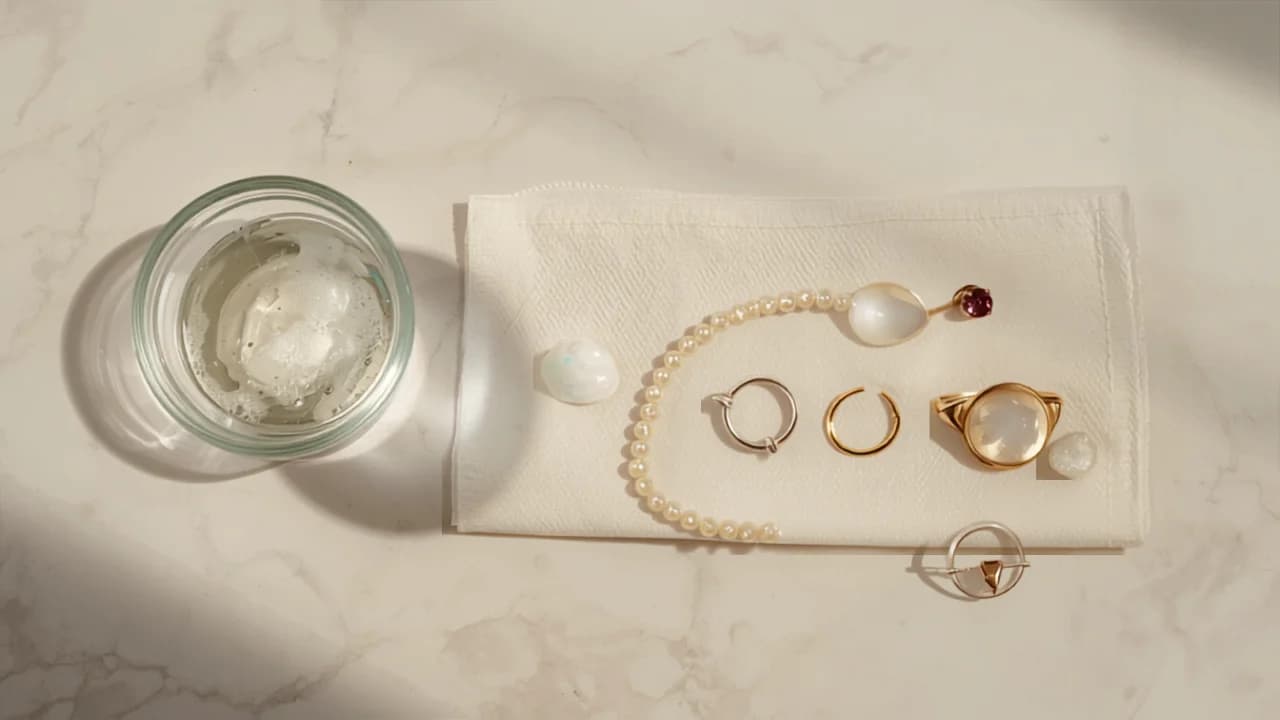
The right way to clean it is gentle and boring: lukewarm water, a drop of mild dish soap, a soft brush, then pat dry. That is the whole routine. Take the ring off before the gym, gardening, cleaning with chemicals, or anything that risks a sharp knock to the hand, because it is a blow to a corner, not everyday wear, that chips an emerald. Store it on its own so harder stones do not scratch it. And once every several years, if the stone starts to look a little dry or veiled, have a jeweller re-oil it. That is normal maintenance, not a repair, and it will bring the colour right back.
The Bottom Line: Our Honest Advice for Buyers
A few closing opinions, the kind we would give a friend who just decided to propose with an emerald:
- Buy the green, not the clarity. Colour is everything in an emerald. A vivid, slightly bluish, medium-to-medium-dark green beats a bigger, cleaner, weaker stone every time, and the inclusions are the jardin, not a defect.
- Set it to survive. Choose a bezel or a halo over an exposed solitaire, and demand V-prongs on the corners of any emerald cut. The setting is doing protective work, so do not skimp on it.
- Treat oiling as normal, but get the level in writing. Every emerald is oiled. Knowing whether yours is minor or significant is the difference between a fair price and an overpaid one.
- Look hard at Zambian and at lab-grown. Zambian stones give you fine colour with better toughness and price, and lab-grown emerald gives you a cleaner, stronger, cheaper green if resale does not matter to you. Both are smarter buys than chasing a fractured stone for its origin label.
- Respect the care rules. Never ultrasonic, never steam, hand clean only, and re-oil every few years. Follow those and your emerald will outlive you. Ignore them and it might not see the decade.
For more on styles across every birth month, our month-by-month birthstone engagement ring guide is the next read, and its closest sibling is our sapphire engagement rings buyer's guide if you are weighing the two great coloured-stone choices. When you are ready to browse pieces, the birthstone jewellery collection is the place to start, and for the full story of the stone itself, head back to our emerald history and lore guide or the May birthstone hub.
Sources and Further Reading
- George Frederick Kunz, The Curious Lore of Precious Stones, 1913. Kunz records emerald's ancient reputation as a stone of truth, of healing for the eyes, and of love that supposedly fractured if a lover proved false, the lore behind its long use in betrothal jewellery. We also wrote a plain-English summary of the whole book.
- For the full story of the stone, see our emerald history and lore guide.
- For the natural versus lab-grown question across all gems, see lab-grown versus natural birthstones.
- For the other great coloured-stone ring, see our sapphire engagement rings buyer's guide, and for styles by month, the birthstone engagement rings guide.
Working out a budget? Our engagement ring budget calculator turns a monthly figure into a realistic ring spend, and the ring size calculator gets the fit right before you order.