Moonstone vs Opal: How to Tell Two Ghostly Gems Apart in Seconds
Some gems get confused because they share a colour. Moonstone and opal get confused because they share a mood. Both of them do that soft, dreamy, slightly ghostly thing where the stone seems to hold light inside it and let it drift around as you move. Neither one is a flat, single colour like a ruby or an emerald. They shimmer, they float, they change with the angle. People see two milky, glowing, ethereal stones and reasonably ask whether they are the same thing, or which one they are actually looking at.
They are not the same thing, and once you understand why they glow, you will never mix them up again. The glow is the whole story here, and moonstone and opal produce it in two completely different ways. This is one of our favourite gem comparisons on the site precisely because the answer is not "look at the colour." It is "look at how the light behaves," and the difference is dramatic once you know what you are watching for.
So let us do it properly. We will explain what moonstone and opal each actually are, why each one glows the way it does, the single test that tells them apart in seconds, the two big things that muddy the water (rainbow moonstone and a glass fake called opalite), and then the practical stuff: which is more expensive, which is tougher, what each one means, and which you should buy. No mysticism dressed up as fact, just the physics and the honest market.
The One-Sentence Difference
Here is the whole comparison compressed into a single line, and it is worth reading twice.
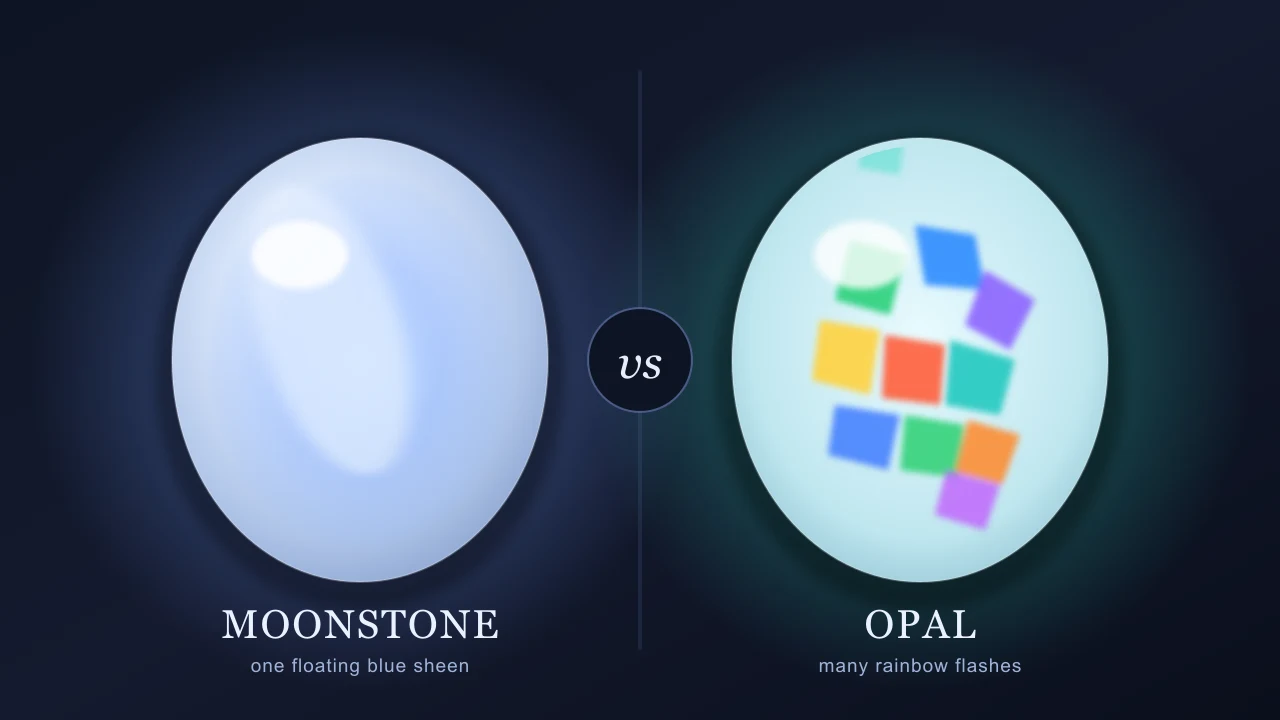
Moonstone glows with one soft, floating sheen of blue or white light. Opal flashes with many separate spots of pure rainbow colour.
That is it. That is the tell that works in a shop, in a photo, across a table. Moonstone gives you a single billowy glow, usually silvery-blue, that rolls across the surface like moonlight on water. Opal gives you distinct flecks and patches of red, green, blue and orange that flash on and off as the stone tilts. One is a unified drifting shine. The other is a scatter of coloured sparks. Everything else in this article is really just an explanation of why that difference exists and the handful of cases that make it trickier than it sounds.
What Moonstone Actually Is
Moonstone is a variety of feldspar, one of the most common mineral families on Earth. Specifically, gem moonstone is usually an intergrowth of two feldspars, orthoclase and albite, that formed in extremely thin alternating layers as the mineral cooled. Those layers are the secret to the whole thing.
When light enters the stone and hits those microscopically thin, stacked layers, it scatters. Because the layers are close to the wavelength of visible light and scatter the shorter blue wavelengths most strongly, the light that bounces back to your eye is that characteristic soft blue-to-white glow. Gemologists call this effect adularescence, after Mount Adular in Switzerland, an old source of fine material. The important part for telling moonstone from opal is what the glow does: it appears to sit just below the surface, and it moves. Tilt the stone and the billow of light rolls across it, like a spotlight sweeping under frosted glass. It is one glow, in one colour range (silver, white, and that prized cool blue), and it drifts.
Moonstone is the softest sort of glow in gemology, and it has been loved for exactly that reason for thousands of years. It sits at around 6 to 6.5 on the Mohs hardness scale, which matters for durability and which we will come back to. We wrote a full breakdown of the stone, its colours, and its lore in our moonstone meaning and colours guide, and it is worth a read if moonstone is the one you are drawn to, because there is more variety in it than most people expect.
What Opal Actually Is
Opal could hardly be more different in its construction, even though the result looks related at a glance. Opal is not a crystal at all. It is hydrated silica, essentially microscopic spheres of silicon dioxide with water trapped between them, and it is amorphous, meaning it has no orderly crystal structure the way quartz or feldspar do. A typical opal is somewhere between 3 and 20 percent water by weight. That is a genuinely strange thing for a gemstone to be, and it drives both opal's beauty and its fragility.
The famous rainbow effect, properly called play-of-colour, comes from those tiny silica spheres being stacked in a regular three-dimensional grid. When the spheres are uniform in size and neatly arranged, they act like a natural diffraction grating: light bends around them and splits into its spectral colours, exactly the way a soap film or a CD surface throws rainbows. The size of the spheres determines which colours you see, which is why some opals flash mostly blue and green (small spheres) and the rarest flash red and orange (larger spheres). These are pure spectral colours in distinct patches, and they wink on and off as the angle changes, because each patch of spheres is oriented slightly differently.
Not all opal does this, by the way. "Common opal" or "potch" has the silica spheres arranged too randomly to diffract light, so it is just a milky or coloured stone with no fireworks. The opal people prize, and the opal that gets confused with moonstone, is precious opal, the kind with play-of-colour. We went deep on how much the good stuff is actually worth in our guide to how valuable an opal is, and on the full colour range in our piece on opal colours.
So the structural summary: moonstone is a layered crystal that scatters one soft blue sheen, opal is a watery ball-bearing grid that diffracts many rainbow sparks. Same first impression, opposite machinery.
The Optical Tell: One Sheen vs Many Sparks
This is the section to remember, because it is the part you can actually use. Put a moonstone and a precious opal side by side, or just examine one stone carefully, and watch the light rather than the colour.
Moonstone shows adularescence: a single, soft, billowing glow that floats over the stone in one broad sweep. It is almost always blue or white or silver. It does not break into separate coloured spots. It behaves like a cloud of light passing under the surface, and it is directional, so it swells and fades as one unit when you tilt the stone. Think moonlight, mist, the sheen on the inside of a shell.
Opal shows play-of-colour: multiple, distinct flashes of saturated spectral colour, red, orange, green, blue, sometimes all at once, arranged in flecks, patches, pinfires, or broad flashes across the stone. Each patch flares and dies independently as the angle shifts. Think confetti, stained glass, a scatter of tiny coloured flames.
If you see one drifting blue-white glow, it is moonstone. If you see many separate rainbow flashes, it is opal. We genuinely cannot overstate how reliable this is for the classic examples of each stone. The confusion almost always comes from the two edge cases we are about to cover, not from a proper white moonstone sitting next to a proper precious opal, which look nothing alike to a trained eye.
The 30-Second Home Test
If you have a stone in hand and want to settle it quickly, here is the practical routine we would run, in order.
First, tilt it slowly under a single light source and count the colours. One floating sheen means moonstone. Many separate coloured flashes mean opal. This alone settles most cases.
Second, look at the direction of the effect. Moonstone's glow moves as a single sweep and often has a visible "line" where it is brightest, like the sheen tracking across a cat's eye. Opal's colours pop in fixed patches tied to the stone's internal structure, so different regions light up rather than one wave sweeping across.
Third, check the body. Moonstone tends to be fairly clear or milky-translucent with the glow living inside a colourless-to-white body. Opal often has a more obviously milky, jelly-like, or watery body (white opal, crystal opal) or a dark one (black opal), with the colours playing against it.
Fourth, if you can do it safely, note the weight and warmth. Opal is quite light for its size because of its water and silica content, and it can feel slightly warmer and less glassy than a crystalline stone. This is a supporting clue, not a decider, so do not lean on it alone.
You will notice we are not suggesting any test that risks the stone. Both of these gems are soft and, in opal's case, genuinely fragile, so no scratching, no heat, no chemicals. The eye test is more than enough.
The Rainbow Moonstone Trap
Here is where a lot of the genuine confusion actually comes from, and most articles skate right over it. Not all "moonstone" glows blue-white in a single sheen. The variety sold as rainbow moonstone throws off flashes of blue, and sometimes green, gold, and violet, in a way that can genuinely start to resemble opal's play-of-colour to an untrained eye. If someone has only ever seen rainbow moonstone, and then sees an opal, the leap to "these are the same" is understandable.
The honest twist is that most "rainbow moonstone" is not really moonstone at all. It is labradorite, a different feldspar, whose flashy effect is called labradorescence. Labradorescence is directional and metallic, it switches on and off at specific angles, and it comes in bold blues, greens, golds, and peacock tones. It is closer to opal in drama than classic moonstone is, which is exactly why it fuels the mix-up. We pulled that whole tangle apart in our labradorite meaning and flash guide, because "rainbow moonstone," true moonstone, and opal form a three-way confusion that trips up beginners constantly.
The distinction that still holds: labradorite's flash is a metallic sheet of colour that appears and vanishes as one broad flash at a certain tilt, whereas opal's play-of-colour is a scatter of small pure-spectral patches that each behave independently. Labradorite flashes like a beetle's wing or an oil slick catching the light. Opal sparkles like a handful of coloured embers. If you learn those two textures, plus classic moonstone's single soft sheen, you can sort all three by eye. It takes a little practice, but it sticks once it clicks.
The Opalite Trap: The Fake Sold as Both
There is one more thing muddying the water, and it is deliberate. Opalite is not opal and it is not moonstone. It is man-made glass (sometimes resin), engineered to have a milky body with a soft bluish glow and a warm orange cast when you hold it up to the light. It is cheap, it is mass-produced, and unscrupulous or careless sellers market it as both "opal" and "moonstone," which is a big reason those two names get tangled together in the first place.
Opalite is easy to catch once you know the tell. Its glow is flat, even, and static. It does not have moonstone's floating directional sheen, and it certainly does not have opal's scatter of distinct spectral flashes. Instead it shows one uniform milky-blue haze that looks the same from every angle, and held against a light it goes a characteristic pale orange. It often looks a bit too perfect, too clean, too evenly glowy, because it was poured, not grown. Any "moonstone" or "opal" that is suspiciously cheap, perfectly uniform, and glows the same no matter how you turn it is almost certainly opalite glass.
We are not snobs about opalite as a material, incidentally. As an honestly-sold glass bead for a few pounds, it is a pretty thing and there is nothing wrong with wearing it. The only problem is when it is passed off as, or priced like, real moonstone or opal. As with every gem on this site, the sin is the misrepresentation, not the material.
Hardness, Durability, and Care
Both moonstone and opal are soft, delicate stones that need looking after, but they are fragile for different reasons, and the practical care overlaps heavily. If you want the full ranking of every birthstone by toughness, our gemstone hardness reference lays it out, but here is how these two compare directly.
Moonstone sits at Mohs 6 to 6.5 and, more importantly, has perfect cleavage, meaning it can split cleanly along an internal plane if it takes a sharp knock in the wrong direction. It scratches relatively easily and can chip. It is not a stone for a ring you wear while gardening or doing the dishes.
Opal is even softer, around Mohs 5.5 to 6.5, and its real vulnerability is that water content. Opal can craze, developing a network of fine internal cracks, if it dries out too fast or is exposed to heat, sudden temperature changes, or very dry air over time. It is also sensitive to knocks and chemicals. Solid natural opal is more stable than people fear, but it is still one of the more demanding gems to own.
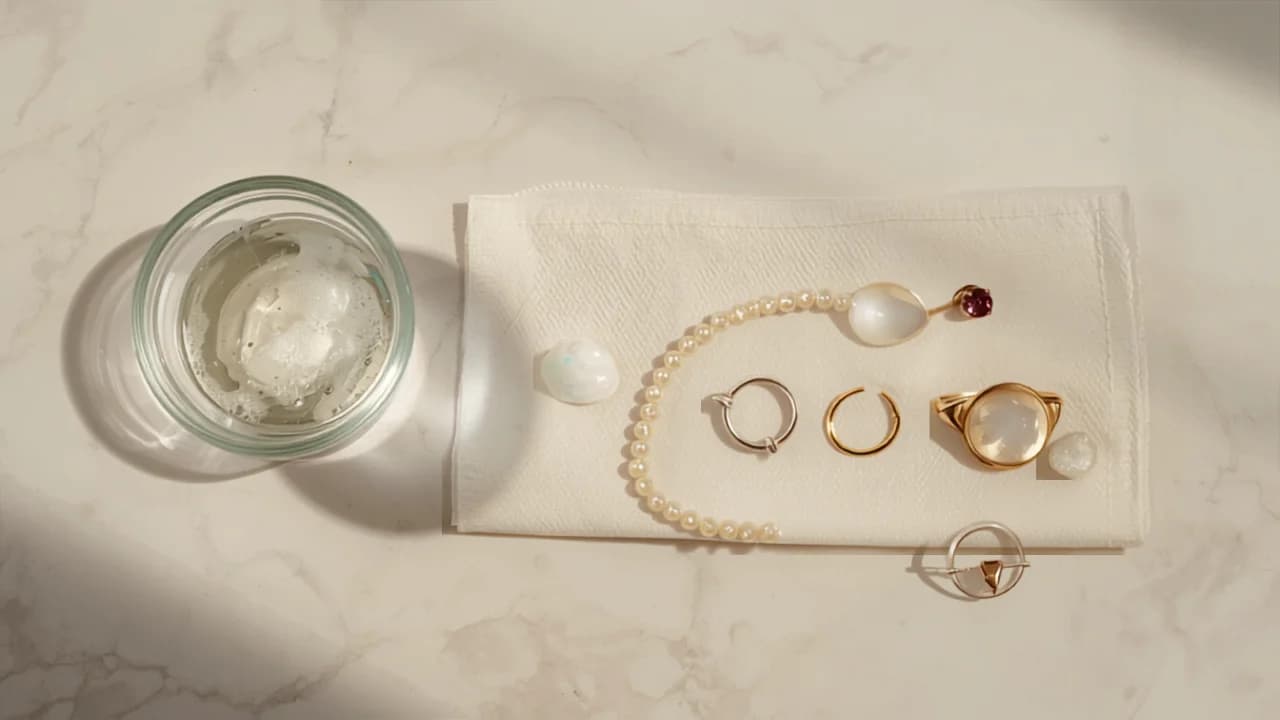
For both stones the care rules are almost identical, and they are strict. No ultrasonic cleaners, no steam, no harsh chemicals, no sudden temperature swings. Clean with a soft damp cloth and mild soap, nothing more. Take rings off for anything physical. Store them away from harder gems that could scratch them. And favour settings that protect the stone: earrings, pendants, and brooches subject a soft gem to far less abuse than a ring does, so if you love either of these as a daily-wear ring, go in with your eyes open and consider a protective bezel setting. On pure durability, neither of these is a "wear it and forget it" gem the way a sapphire is. They are beautiful, and they ask for care in return.
One honest edge: if durability is your deciding factor and you are torn between the two, moonstone is marginally the more robust for everyday wear, mostly because opal's water content adds a failure mode (crazing) that moonstone does not have. But it is a close call, and both belong in the "handle with care" camp.
Which Is More Expensive?
This is one of the most-searched questions in the whole comparison, and the honest answer is "it depends entirely on the quality, but opal has the far higher ceiling."
At the everyday end, both stones are affordable, and plain white moonstone and common milky opal are genuinely cheap gems, the kind you can buy by the strand. But the two stones scale very differently as quality rises.
Moonstone's value climbs with the quality of its glow. Fine material with a strong, clean, electric-blue adularescence over a colourless, transparent body, the classic Sri Lankan "blue sheen" moonstone, can command real money and is increasingly scarce. But even top moonstone rarely reaches the dizzy heights of top opal.
Opal's ceiling is much higher, because fine black opal, the kind with vivid red-and-green play-of-colour against a dark body, is one of the genuinely valuable gemstones on Earth and can sell for thousands of pounds per carat. Australian black opal from Lightning Ridge sits among the most prized coloured stones going. So while a random opal and a random moonstone might cost about the same, the best opal is worth vastly more than the best moonstone. We put opal in context against every other birthstone in our most expensive birthstones ranked piece, and it climbs surprisingly high.
Our practical read: for casual, affordable jewellery, they are in the same bracket, with moonstone often the slightly cheaper of the two. For fine, investment-grade stones, opal wins the price race by a wide margin thanks to black opal. If someone is trying to sell you a "rare, valuable moonstone" at black-opal money, be sceptical, and if a "cheap opal" flashes a full spectrum of red, ask hard questions, because it may well be a doublet, a triplet, or synthetic.
The Meaning and Spiritual Side
People often reach for these two stones for their symbolism as much as their looks, and the meanings are as different as the physics, so it is worth a straight comparison. We will keep our usual honest footing here: these are cultural and historical associations, lovely to know and to wear for, not medical or magical facts.
Moonstone is, unsurprisingly, tied to the moon: intuition, femininity, cycles, new beginnings, and calm. Across many cultures it has been a traveller's stone and a stone of inner reflection, and its very name and glow make the lunar connection feel earned. It reads as gentle, receptive, and quietly emotional. It is a classic gift for new starts, and its June birthstone status ties it neatly to that season of change.
Opal carries a more complicated reputation, and part of that is a genuine historical slander. Opal was associated with hope, creativity, and imagination for most of history, and was considered lucky and even magical (its shifting colours were thought to hold the virtues of every gem at once). Then a single popular novel in the 19th century, Sir Walter Scott's Anne of Geierstein, tangled an opal up with a doomed character, and a superstition that opals are "unlucky" spread from there. It is worth saying plainly: that superstition has no basis and is a literary accident, not folklore of any depth. Opal's older and truer symbolism is creativity, emotional expression, and imagination. If anyone tells you opals are bad luck, they are quoting a Victorian novel, not any real tradition.
For the deeper history of how gems like these were worn as protective and meaningful objects across the centuries, our talismans and amulets guide covers the ground fully. The short version for these two: moonstone is the calm, lunar, intuitive one, and opal is the creative, expressive, unfairly-maligned one.
Which Birthstone Is Which?
If you are buying either of these as a birthday gift, the month matters, and here the two stones split cleanly.
Opal is the birthstone for October. It is October's traditional and most iconic stone, sitting alongside the more modern addition of tourmaline. If you are shopping for an October birthday, opal is very much the headline choice, and we covered the pairing in our October birthstone guide and the fuller opal and tourmaline breakdown.
Moonstone is associated with June. June is unusual in having several birthstones (pearl and alexandrite are the modern headliners), and moonstone is a long-standing traditional June stone that many people prefer to all of them. If you are buying for a June birthday and want something with more presence than a pearl and a far gentler price than alexandrite, moonstone is a lovely, underrated pick. Our June birthstone pillar lays out all the June options, and our pearl vs alexandrite guide covers the other two if you are weighing the whole month.
So as birthstones they do not actually compete: opal is October's, moonstone is one of June's. If the gift is birthday-driven, the recipient's month makes the choice for you.
Can You Wear Them Together?
A surprising number of people ask whether opal and moonstone can be worn or set together, and the answer is a happy yes. They are aesthetic cousins even though they are geological strangers. Both have that soft, luminous, ethereal quality, both come in cool white-and-blue palettes, and both read as gentle and dreamy rather than bold and saturated. A piece that combines a moonstone's floating sheen with an opal's coloured flashes can be genuinely beautiful, and the two do not clash the way, say, a moonstone and a fire-engine ruby might.
The only real consideration is practical, not stylistic: because both stones are soft and fragile, a combined piece is best worn as earrings, a pendant, or a brooch rather than a knockabout ring, and it needs the same gentle care either stone would need alone. Symbolically, pairing the lunar calm of moonstone with the creative spark of opal is a rather nice combination too, if that side of things matters to you.
Which Should You Actually Buy?
After all that, the decision comes down to a few clean questions.
Buy moonstone if you love that single, soft, floating blue-white glow, you want something calm and lunar and understated, you are shopping for a June birthday, or you simply prefer one quiet sheen to a scatter of colour. Look for a strong, clean blue adularescence over a transparent body if budget allows, and read our moonstone guide before you spend so you know what separates ordinary white moonstone from the good blue-sheen material.
Buy opal if you want the rainbow, the drama of separate spectral flashes, a stone with genuinely high-quality upside, or an October birthstone. Decide early whether you want affordable white or crystal opal or you are reaching for fine black opal, because the price gap is enormous, and check our how valuable is an opal guide so you can spot a doublet or triplet before you overpay for what looks like solid stone.
Either way, accept that you are buying a soft, delicate gem that wants gentle handling and protective settings. That is the shared cost of both stones' beauty. Neither is a durable everyday-ring gem in the way corundum or a diamond is, so wear them with a little love and they will reward you for a lifetime.
And if you turn out to want the glow without the fragility, that is worth knowing too: no other common gem quite replicates moonstone's adularescence or opal's play-of-colour, which is part of why both are so treasured. If it is specifically that ethereal shift of light you are after, these two really are the stones for it, one in a single blue sweep, the other in a spray of rainbow. You just have to decide which kind of magic you want.
Quick Answers
Are moonstone and opal the same stone? No. Moonstone is a feldspar that shows one soft blue-white glow (adularescence). Opal is hydrated silica that shows many separate rainbow flashes (play-of-colour). Different minerals, different effects, different birth months.
How can I tell moonstone from opal at a glance? Count the colours in the glow. One floating blue-white sheen means moonstone. Multiple separate patches of pure spectral colour means opal.
Is opal or moonstone more expensive? At the affordable end they are similar, with moonstone often slightly cheaper. But opal has a far higher ceiling, because fine black opal is one of the most valuable coloured gems in the world, well beyond even top moonstone.
Which is more durable, moonstone or opal? Both are soft and need care, but moonstone is marginally tougher for daily wear. Opal is a touch softer and can craze (crack) if it dries out or is exposed to heat, a failure mode moonstone does not have. Neither should ever see an ultrasonic cleaner.
Why does rainbow moonstone look like opal? Because most "rainbow moonstone" is actually labradorite, a related feldspar whose flashy labradorescence resembles opal's colour more than classic moonstone's single sheen does. The tell: labradorite flashes as one broad metallic sheet at certain angles, opal sparkles in many small independent patches.
Is opalite real moonstone or opal? Neither. Opalite is man-made glass with a flat, even, static glow that turns orange against a light. It is sold as both, which fuels the confusion. Real moonstone's sheen floats and moves, real opal's colours flash in distinct patches, opalite's haze looks the same from every angle.
What months are moonstone and opal birthstones for? Opal is the birthstone for October. Moonstone is a traditional birthstone for June, alongside pearl and alexandrite.
If disambiguating lookalike gems is your thing, we do a lot of it: our labradorite guide untangles the third stone in this exact confusion, and our lab-grown vs natural birthstones guide covers how synthetics and imitations fit into the picture for soft gems like these. Whichever of these two you fall for, you are choosing one of the few gems that trades hard colour for something rarer: light that moves.