The Most Expensive Birthstones, Ranked From Priciest to Cheapest
Ask a room full of people which birthstone costs the most and almost everyone says diamond. It is the obvious guess, because diamond has spent a century being sold as the most precious thing you can put on a finger. The obvious guess is also wrong.
The most expensive birthstone, carat for carat, belongs to June. Not the pearl that most June babies think they are stuck with, but alexandrite, a colour-changing stone so scarce that fine examples regularly outprice diamond, ruby and everything else in the calendar. That single fact tells you why this question is more interesting than it looks. The birthstone calendar hides a price spread of roughly a thousand to one, and the labels people attach to each month ("precious," "semi-precious," "just a birthstone") barely track the real numbers.
So we are going to rank all twelve months honestly, by what a genuinely fine, one-carat stone actually costs per carat. We will tell you the cheapest birthstones too, because some of them are the best value in all of jewellery. And we will flag the part most articles miss: almost every "cheap" month has a rare, expensive version hiding inside it. No marketing, no mysticism, just the numbers and our honest read on them.
The Short Answer
If you only want the headline, here it is.
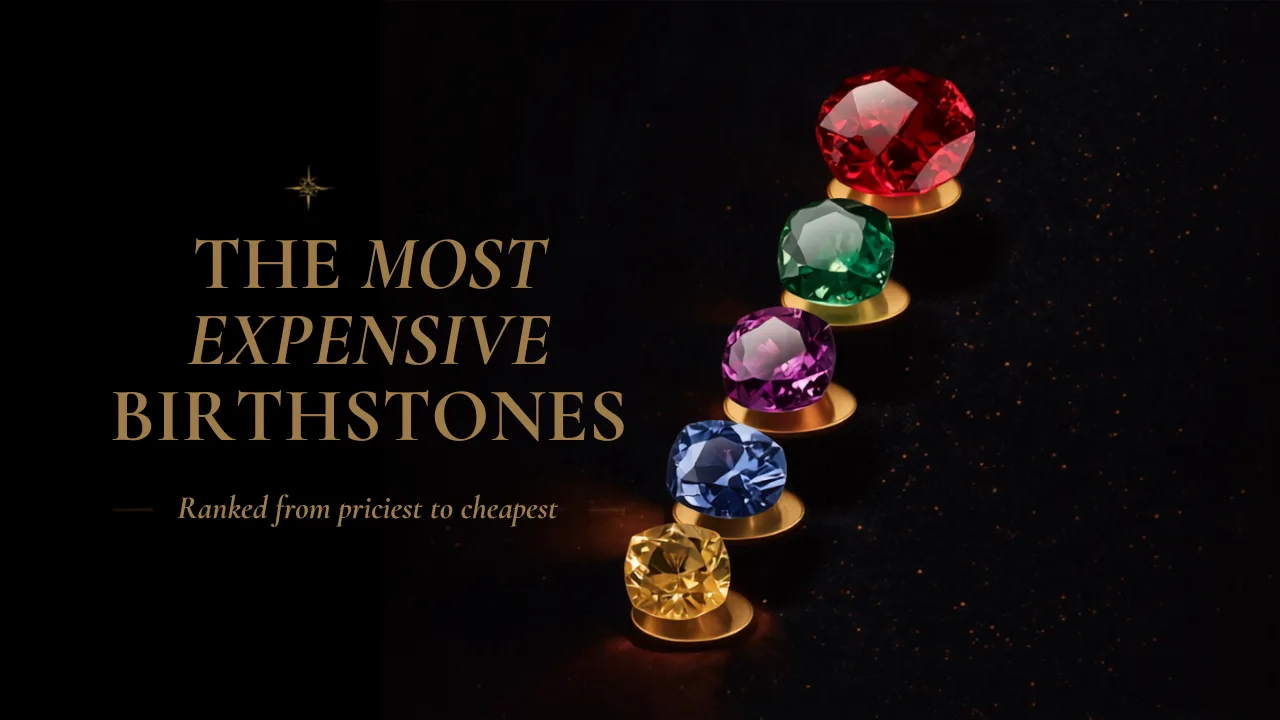
The single most expensive birthstone is alexandrite (June), followed by ruby (July) and then the rest of the so-called big four, emerald (May), diamond (April) and sapphire (September). The cheapest mainstream birthstone is amethyst (February), with citrine and blue topaz (November) right beside it.
The trick is that "month" and "stone" are not the same question. June, August, October, November and December each carry more than one birthstone, and the gap between them can be enormous. June runs from a cheap moonstone to a five-figure alexandrite. So the most expensive birthstone month is June, the most expensive single birthstone is alexandrite, and if you only mean the classic precious four, the order is ruby, emerald, diamond, sapphire at the top end. Everything below is the long version.
How We Ranked These
A quick word on method, because it changes the whole list.
We ranked by the price per carat of a fine, one-carat example, not by the cheapest chip you can find online and not by the record-breaking auction lots either. That matters because every gem species spans a huge quality range. A pale, included, poorly cut sapphire can cost less than a good citrine, while a fine Kashmir sapphire of the same weight can cost more than a car. Ranking by the fine grade is the fairest way to answer "which birthstone is most expensive," because it compares like with like.
Two honest caveats. First, price per carat climbs steeply with size, so a fine three-carat stone costs far more per carat than a fine one-carat stone of the same type. We held size constant at one carat to keep the comparison clean. Second, where a month has several birthstones, we ranked it by its most valuable mainstream stone and called out the spread in the entry. Pearl is the one oddball, because pearls are sold per piece and by type rather than per carat, so we handle it separately rather than forcing it into a per-carat line.
With that settled, here is the ranking.
The Ranking, Most Expensive to Cheapest
1. June, Alexandrite, roughly $15,000 to $70,000 per carat
Alexandrite is the quiet giant of the birthstone calendar. It is a colour-change variety of chrysoberyl that looks green or teal in daylight and red or purple under warm indoor light, and good colour change in a clean stone is breathtakingly rare. Fine material runs from around $15,000 a carat well into the tens of thousands, and exceptional Russian or Brazilian stones with a crisp, complete colour flip can go higher still. Even commercial alexandrite is not cheap.
Here is the part that always surprises people: most June babies have no idea they hold the most expensive birthstone in the calendar, because they were handed a pearl as kids and told that was their stone. In our view alexandrite is the most underappreciated birthstone going, precisely because its own month does not advertise it. If you want the full picture of June's three stones and why alexandrite outclasses the others on price, our June birthstone guide and our pearl vs alexandrite comparison lay it out. The catch, of course, is that very few buyers ever afford a real one.
2. July, Ruby, roughly $3,000 to $15,000 per carat, and far higher at the top
Ruby is the stone that diamond marketing made everyone forget. Fine ruby is one of the most expensive gem materials on earth by weight, and untreated Burmese "pigeon blood" rubies have sold for more per carat than comparable diamonds, with record stones reaching into the hundreds of thousands of dollars per carat at auction. A fine one-carat ruby in a normal retail setting sits in the low thousands to low tens of thousands, depending on origin, treatment and colour.
Our honest take is that ruby, not diamond, deserves the "most precious" crown in the public imagination, and the only reason it does not have it is advertising budgets. The big caveat is treatment: the overwhelming majority of rubies are heat-treated, which is normal and accepted, while glass-filled "composite ruby" is a cheap imitation dressed up as the real thing. We cover the whole story in ruby, the king of gems and map the colour grades in our ruby colour chart. It is the July birthstone, and it earns the number-two spot easily.
3. May, Emerald, roughly $2,000 to $10,000 per carat
Emerald is the green heavyweight, and a fine Colombian emerald with a deep, even, slightly bluish green can run from a few thousand to well over ten thousand dollars a carat. What you are paying for is colour first and clarity second, which is unusual, because emerald is the one major gem where inclusions are expected and forgiven. The internal "jardin," French for garden, is part of the stone's character rather than a flaw to be eliminated.
The thing to understand about emerald value is treatment again: almost all emeralds are oil-treated to improve clarity, so the rare untreated stones with naturally good clarity command big premiums. Emerald is also brittle, which is a durability point rather than a price point, but it does affect how you should set and wear it. It is the May birthstone, and it sits comfortably in the top tier.
4. April, Diamond, roughly $4,000 to $8,000 per carat for fine colourless, much more at the very top
Here is the great reveal of this whole article. Diamond, the birthstone everyone assumes is the most expensive, lands fourth. A fine one-carat colourless diamond (think G colour, VS clarity, excellent cut) sits in the mid four figures, and only the rarest D-flawless stones push into the $15,000-plus-per-carat range. Fancy coloured diamonds can cost a fortune, but those are not what people mean by "the April birthstone."
Why does diamond rank below alexandrite, ruby and emerald? Because diamond, for all its hardness and sparkle, is simply not as rare as the gems above it. It is mined in enormous quantities, and the price you pay reflects an extraordinarily well-managed supply chain as much as scarcity. We are not knocking diamond, it is a superb, hard, brilliant stone and the April birthstone for good reason. We are just pointing out that "expensive birthstone" and "diamond" are not the same thing, no matter what the adverts taught you. The lab-grown revolution has made this even clearer, and we dug into it in lab-grown vs natural diamond.
5. September, Sapphire, roughly $1,000 to $5,000 per carat, and far higher for top origins
Sapphire rounds out the classic big four. A fine blue sapphire sits in the low thousands per carat, but this is the stone with the widest top-end blow-out on the list. Unheated Kashmir and fine Burmese sapphires with a velvety cornflower blue can reach $10,000 to $50,000 a carat and beyond, because the best origins are effectively mined out. So sapphire is "mid-pack" only if you average it. At the top it competes with anything.
Sapphire is also the most practical of the expensive stones, at 9 on the Mohs hardness scale it is second only to diamond and moissanite, which makes it the sensible choice for an engagement ring you actually wear every day. It is the September birthstone, and if you want the buyer's-eye view we wrote a full sapphire engagement ring guide. For the clear-stone version of the value question, white sapphire vs diamond is the honest comparison.
6. August, Spinel, roughly $1,000 to $5,000 per carat for fine red and cobalt blue
Spinel is the connoisseur's secret and the fastest riser on this list. For centuries the world's most famous "rubies," including stones in the British Crown Jewels, were actually spinel, because nobody could tell them apart. Now that gemmology can, fine red and hot-pink spinel, and especially the rare cobalt-blue material, have climbed into the thousands per carat as collectors catch on. It is almost never treated, which is a genuine selling point in a world of heated rubies and oiled emeralds.
We think spinel is the smartest "expensive" buy in the calendar, because you get rarity and untreated natural colour without the ruby price tag, at least for now. It is one of August's three birthstones, and it single-handedly drags August up the ranking. The August birthstone guide covers it alongside peridot and sardonyx, and we explain how to choose between all three in our August three-stone guide.
7. December, Tanzanite, roughly $500 to $1,200 per carat for fine vivid blue-violet
Tanzanite is the rarity story of the modern era. It comes from a single small area near Mount Kilimanjaro in Tanzania, and that is the only commercial source on the planet, which makes it geologically far rarer than diamond. Fine vivid blue-violet stones sit in the high hundreds to low thousands per carat. The reason it is not higher on this list is that supply, while finite, has been steady enough to keep prices moderate, and almost all tanzanite is heat-treated to bring out the blue.
Our honest view is that tanzanite is wildly underpriced relative to its true scarcity, and when that single mine runs dry, as it eventually must, today's prices will look like a bargain. It is one of December's three birthstones, and the most valuable of them by a wide margin. See the December birthstone guide and our December three-stone comparison for turquoise and zircon, which sit far lower.
8. October, Opal, anywhere from $10 to $10,000 per carat depending on type
Opal is the hardest stone to rank because it spans almost the entire price range by itself. Common white opal with weak play-of-colour can cost a few dollars a carat, while fine black opal from Lightning Ridge in Australia, with vivid flashes of red and green against a dark body, reaches thousands per carat and occasionally five figures. We placed October here based on the fine black material, but a buyer should know the floor is genuinely cheap.
This enormous spread is exactly why opal rewards a careful eye more than almost any other stone. Body tone and the brightness and pattern of the colour play matter far more than carat weight. We wrote a whole piece on how valuable an opal is because the range is so wide it confuses everyone. It is one of two October birthstones alongside tourmaline, which we compare in the October two-stone guide.
9. March, Aquamarine, roughly $200 to $1,000 per carat for fine deep blue
Aquamarine is where the calendar tips from "expensive" to "affordable luxury." Fine stones with a deep, saturated, slightly greenish-blue ("Santa Maria" colour) reach several hundred to around a thousand dollars a carat, but the pale, watery stones that fill most jewellery cases cost a fraction of that. Because aquamarine grows in large, clean crystals, big eye-clean stones are far more attainable than they would be in ruby or emerald.
Our take: aquamarine is one of the best ways to own a large, clean, genuinely lovely gem without spending serious money, as long as you chase colour and do not overpay for size alone. It is the March birthstone, paired with bloodstone, and the March two-stone guide covers both.
10. January, Garnet, roughly $30 to $150 per carat for common types, far more for rare green garnets
Garnet is the great value stone of the calendar, and also a trap for anyone who thinks "garnet" means one thing. Common red garnets (almandine and pyrope) are genuinely cheap, often under a hundred dollars a carat even in fine quality, which makes them one of the best-value coloured stones you can buy. But garnet is a whole family, and the green members, tsavorite and demantoid, are rarer than fine ruby and priced accordingly, into the thousands per carat.
So garnet sits low on this list only if you mean the common red version. We love it precisely because it gives you a deep, glowing, almost-never-treated red for budget money, which is a rare combination. It is the January birthstone, and because it shares a colour with the far pricier ruby, we wrote garnet vs ruby to help you tell them apart and avoid overpaying.
11. November, Topaz and Citrine, roughly $10 to $50 per carat, with imperial topaz the exception
November gets two cheerful, warm, inexpensive stones. Blue topaz and citrine both sit at the bottom of the price range, often well under fifty dollars a carat even in large, clean, beautifully cut stones, because both are abundant and most are treated (citrine is usually heated amethyst, and most blue topaz is irradiated). For pure colour-per-dollar, November is hard to beat.
The exception worth knowing is imperial topaz, the pink-to-peachy-orange natural topaz that is genuinely scarce and can reach a thousand or more per carat. Outside of that, November is the budget month, and we think that is a feature, not a flaw. You can buy a big, joyful cocktail-ring stone for pocket money. The November birthstone guide and our topaz vs citrine comparison explain why these two get confused and how to buy each one right.
12. February, Amethyst, roughly $20 to $60 per carat for fine deep purple
Amethyst is the cheapest mainstream birthstone, and that is a relatively recent fall from grace. For most of history amethyst was a cardinal gem, ranked alongside ruby, emerald and sapphire, until huge deposits were found in Brazil and Uruguay in the nineteenth century and the price collapsed. Today even a richly saturated, eye-clean, well-cut amethyst costs a few dollars to a few tens of dollars per carat.
We do not see this as bad news at all. Amethyst is hard enough for daily wear, available in big clean stones, and one of the most beautiful purples in nature, all for the price of a nice dinner. It is the best value in the entire calendar, full stop. It is the February birthstone, and we made the full case in our February amethyst guide.
The Cheapest Birthstones, and Why That Is Good News
If your birth month landed near the bottom of that list, do not feel short-changed. The cheapest birthstones are, in our honest opinion, some of the smartest jewellery buys going.
The four budget champions are amethyst (February), citrine and blue topaz (November), common garnet (January) and peridot (August). All of them can be had in large, clean, vividly coloured, well-cut examples for the price of a meal out, and all of them are durable enough for normal wear. Turquoise and zircon round out the affordable group in December, and moonstone gives June a budget option to sit beside its five-figure alexandrite.
Here is the logic that took us years to appreciate: with a cheap stone, the gem is the least expensive part of the piece, so your money goes into the setting and the metal, which is where everyday durability and how a ring actually wears really come from. With an expensive stone, you are paying mostly for the gem and tend to skimp on everything around it. For a piece you will wear daily, a beautiful affordable stone in a well-made setting often outperforms a tiny precious stone in a thin one. We make this same argument in our amethyst ring guide, and we stand by it.
The Plot Twist: Almost Every Month Has an Expensive Escape Hatch
This is the part most "most expensive birthstone" articles miss, and it is the most useful thing in this whole piece.
Almost every "cheap" month hides a rare, expensive version of its stone. January looks budget until you meet tsavorite and demantoid garnet, which outprice many rubies. August looks affordable until you reach fine spinel. November is pocket-money territory until you find imperial topaz. October swings from a few dollars to five figures depending on whether you are holding common opal or fine black opal. Even September, already expensive, has an upper floor (unheated Kashmir sapphire) that leaves the rest of the list far behind.
So the real answer to "is my birthstone expensive" is almost always "it depends which version you buy." The month sets the floor. The specific stone, its origin, and whether it is treated set the ceiling, and the ceiling can be a hundred times the floor. If you want a genuinely impressive gem from a "cheap" month, the escape hatch is there, you just have to ask for it by name.
Is the Most Expensive Birthstone Actually Worth It?
Our honest opinion, after all of this, is that the price ranking is a terrible way to choose a stone and a great way to understand the market.
A fine alexandrite or an untreated Burmese ruby is a genuine treasure and, frankly, an investment-grade object that holds value the way most jewellery does not. If you have the budget and you love the stone, the top of this list is real and the rarity is real. But for the vast majority of buyers, chasing the "most expensive birthstone" means buying a tiny, compromised version of a precious stone instead of a large, gorgeous version of an affordable one. We would rather wear a big, glowing, well-set amethyst or aquamarine than a melee-sized ruby you need a loupe to admire.
The one place price should genuinely guide you is resale and heirloom intent. If you want a stone that may hold or grow its value, the rare end of this list (alexandrite, fine ruby, top sapphire, fine spinel) is where it happens, while the affordable stones are for joy, not investment. Know which you are buying for, and the whole question gets simpler.
So What Is the Rarest Birthstone?
Rarity and price usually travel together, and the rarest mainstream birthstone is the same as the most expensive: alexandrite. Genuine, untreated, strong colour-change alexandrite is so scarce that most jewellers go years without handling a fine one, which is exactly why it tops the price list.
Just behind it sit fine spinel, demantoid garnet and Paraiba tourmaline (a neon blue-green October stone that, in its rarest form, can outprice almost everything here). It is worth noting that the world's genuinely rarest gemstones, things like painite, grandidierite and red beryl, are not birthstones at all, they are collector curiosities you will never see in a shop. Among stones you can actually buy and wear as a birthstone, alexandrite is the rarity king, with tanzanite close behind on geological scarcity even if its price has not caught up yet.
Quick Answers
What is the most expensive birthstone? Alexandrite, the June birthstone, at roughly $15,000 to $70,000 per carat for fine colour-change material, more for exceptional stones. It outprices diamond, ruby, emerald and sapphire carat for carat.
What is the most expensive birthstone month? June, because of alexandrite. June also carries pearl and moonstone, but its alexandrite makes it the priciest month overall.
Is diamond the most expensive birthstone? No. Fine diamond ranks around fourth among birthstones, behind alexandrite, ruby and emerald. A fine one-carat colourless diamond costs less per carat than a fine ruby or alexandrite of the same size.
What are the three most expensive birthstones? Alexandrite (June), ruby (July) and emerald (May), with diamond (April) and sapphire (September) close behind to round out the top five.
What is the cheapest birthstone? Amethyst (February), closely followed by citrine and blue topaz (November), then common garnet (January) and peridot (August). All can be bought in fine quality for the price of a nice meal.
What is the rarest birthstone? Alexandrite again, with fine spinel, demantoid garnet and Paraiba tourmaline behind it. Tanzanite is geologically rarer than most of these but stays cheaper because of how it is mined.
Why is diamond so famous if it is not the most expensive? Marketing and supply control, mostly. Diamond is hard, brilliant and beautifully promoted, but it is mined in far larger quantities than the rarer coloured stones, so it is not as scarce as its reputation suggests.
Keep Reading
If this changed how you think about your own birthstone, these go deeper on the same no-nonsense approach. Start with our birthstone colours by month for the full visual calendar, then read lab-grown vs natural birthstones for how synthetics are reshaping prices across the board. For the precious end, ruby, the king of gems and garnet vs ruby explain why two red stones can sit a hundredfold apart. For the value end, our February amethyst guide and topaz vs citrine make the case for the affordable stones we genuinely love. Whatever your month, the smartest buy is the one that fits your eye and your budget, not the one that tops a price list.
Wondering how it stacks up against every other gem? Compare values in our gemstone price guide and toughness on the sortable Mohs hardness table.