If you ask five jewellers what it costs to resize a ring, you can easily get $35, $60, $140, $220, and "we would have to see it first." All five can be honest quotes for the same job on paper. That spread is the reason this question keeps getting asked, and it is the reason most of the price guides you will find are not much help, because they answer it with a table of metals and stop there.
Metal matters, but it is not the main thing you are paying for. I want to give you the numbers first, then explain what actually moves them, because once you understand that, you can tell a fair quote from a lazy one in about thirty seconds at the counter.
One thing worth saying up front. If you are here because a birthstone ring does not fit, check your size properly before you spend anything, since a surprising number of rings that feel wrong are being measured against the wrong finger, at the wrong time of day, in the wrong weather. Our ring size calculator will get you a real number from a piece of string and a ruler, and knowing whether you need half a size or two sizes changes which of the fixes below makes sense.
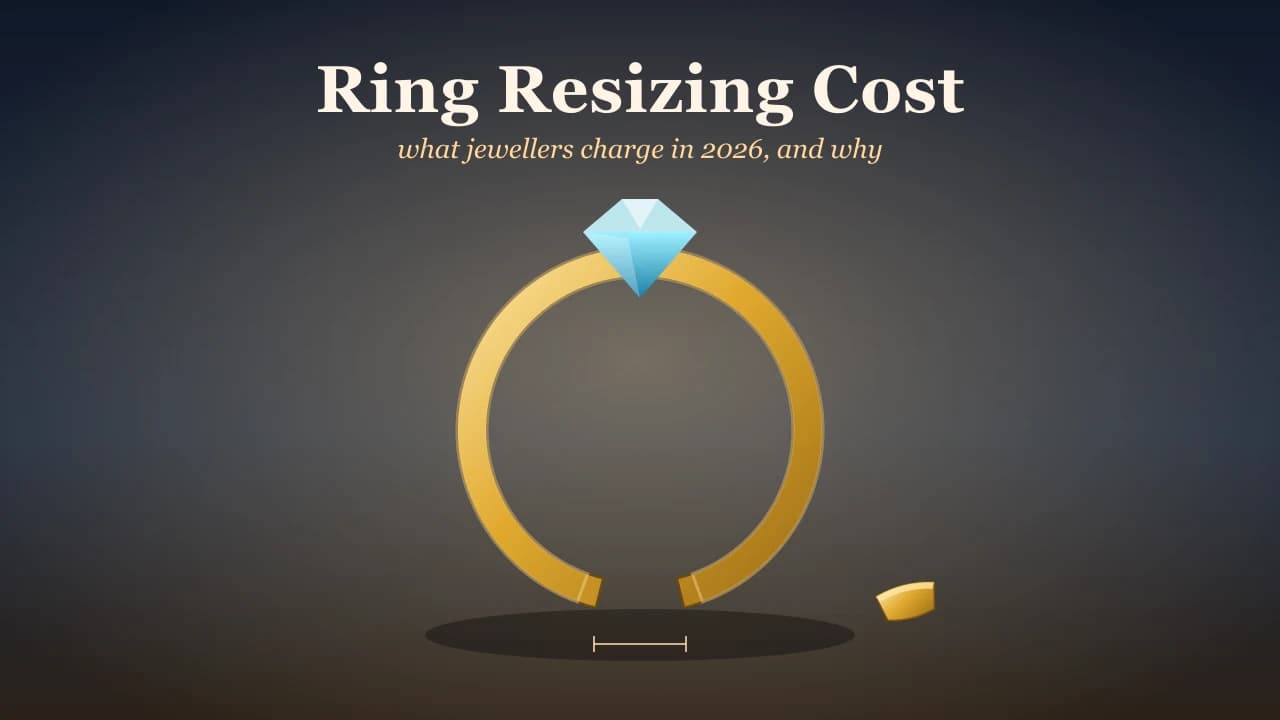
What ring resizing costs in 2026
These are the ranges I would expect from an independent jeweller with a bench on the premises, in the United States, for one size of movement. Chain stores tend to sit at the top of each range or above it, because most of them send the work out.
Sterling silver band, plain: $25 to $60. Silver is soft, cheap, and quick, and some shops will not touch it at all because there is no money in it.
10k or 14k gold band, plain: $40 to $90. This is the single most common resizing job in the country and the number most people should expect.
18k gold band, plain: $60 to $120. Higher gold content, higher metal cost when sizing up, and a slightly fussier solder.
White gold, any karat: add $30 to $80 to the above for rhodium replating. White gold is yellow gold wearing a thin rhodium coat, and heating and polishing the shank strips that coat off the area you worked on. If a quote for a white gold ring does not mention replating, ask, because the alternative is a ring with a two-tone patch you will notice for the rest of its life.
Platinum band, plain: $90 to $250. Platinum needs much higher temperatures, dedicated tooling, and a jeweller who works in it regularly. Fewer benches do, so you pay for scarcity as much as for difficulty.
Any ring with stones set into the band: $120 to $350. Pavé, channel set, or a row of small diamonds down the shoulders turns a ten minute solder into an hour of careful work with stones coming out and going back in.
Complex engagement rings, halos, vintage pieces, filigree: $150 to $400, sometimes more. At this level you are buying a jeweller's judgement, not their torch.
Removing and resetting a heat-sensitive centre stone: add $40 to $120 on top of whatever the metal work costs. More on which stones need this below, because this is where a birthstone ring is different from a diamond ring.
New shank, meaning the bottom half of the band is replaced: $150 to $500. This is the answer for big size changes and for bands that have worn thin, and it is often better value than it sounds.
Sizing beads: $20 to $60. Two small balls of metal soldered inside the bottom of the shank, which take a ring down by roughly a half size and stop it spinning. The cheapest real fix there is.
Mail-in resizing services: $50 to $150 flat, shipping included, usually with insurance. Convenient, competent, and completely blind to your particular ring, which is exactly the trade you are making.
So the honest headline answer is $40 to $150 for most rings people actually own, with plain silver below that and stone-set or platinum work above it.
The thing most price guides miss: you are paying for risk
Here is the mental model I wish someone had given me earlier. When a jeweller looks at your ring and names a price, they are not costing out solder and gold. They are pricing the chance that something goes wrong and they have to make it right at their own expense.
A plain gold band carries almost no risk. Worst case is a visible joint, which a competent bench will not produce. A halo engagement ring with thirty two pavé diamonds carries a lot of risk, because heat travels, tiny stones sit in tiny beads of metal, and if two of them loosen next month you are coming back annoyed and they are fixing it for free.
That is why the same physical operation, cut the shank and rejoin it, ranges from $40 to $400. It also explains the quotes that feel insulting. A shop that says $240 for a ring another shop quoted at $90 is usually not gouging. They are either seeing a problem the other shop ignored, or they are including work the other shop was planning to skip, like tightening the stones afterwards and replating the white gold.
The corollary is useful. Cheap quotes are not always bargains and expensive quotes are not always rip-offs. What you want is an itemised quote, so you can see whether the difference is greed or diligence.
Sizing up versus sizing down
Sizing down is usually the cheaper of the two. The jeweller cuts the shank, removes a measured piece, and closes the gap. No new metal to buy, so you are paying labour only.
Sizing up costs more because metal has to be added. On a heavy 14k band that might be a meaningful amount of gold, and on platinum it adds up quickly. Expect sizing up to run maybe 20 to 50 percent more than sizing the same ring down.
Two things about this that most guides never mention.
First, sizing down produces an offcut, and if your ring is solid gold or platinum, that offcut is worth money. It is usually not a fortune, often somewhere between the price of a coffee and the price of a nice dinner depending on karat and how heavy the band is. But it is your metal, and the default at most shops is that they keep it as scrap. I think it is entirely reasonable to ask them to weigh it and credit it against your bill, and the reaction you get to that question tells you a lot about the shop.
Second, there is a limit. Roughly two sizes in either direction is the safe range. Push further down and the band goes out of round and the setting starts sitting off centre on your finger. Push further up and you are stretching metal that was never meant to be stretched, ending up with a thin spot at the bottom that will crack in a few years. If you need three or more sizes, do not let anyone stretch it. Ask about a new shank instead. It costs more today and it saves the ring.
Where the price really jumps: stones on the shank
The single biggest cost driver is not the metal and not the direction. It is whether there are stones in the part of the ring being cut.
A solitaire with a clean, plain band is cheap to size. The same stone in a pavé setting where small diamonds run halfway down each shoulder can triple the bill, because the jeweller has to work out how much of that stone line has to come out, protect what stays, resize, then rebuild the line so the spacing still looks even. Channel set stones are worse, because the channel walls distort when the shank is compressed and the stones start rattling.
Then there are the rings where the answer is no. A full eternity band, with stones the whole way around, has no plain metal to cut. Making one bigger means either adding stones and metal, which means matching the originals and effectively remaking a section, or accepting that it cannot be done. Most shops will tell you to sell it and buy the right size, and most of the time they are right.
The birthstone problem: which stones survive the torch
This is the part that jewellery retailers rarely spell out, and it matters more on a birthstone ring than on a diamond one, because a lot of the twelve months are represented by stones that genuinely hate heat.
Resizing involves a flame at somewhere around 700 to 900 degrees Celsius, a few millimetres from your stone, followed by a dip in warm acid to clean the join. Some gems shrug at that. Others crack, cloud, fade, or dissolve their glue and fall out. If you know which camp your birthstone is in, you know whether the quote you are being given is realistic.
Generally fine in the setting, with care: diamond, ruby, sapphire, spinel, and most garnets. These are hard, thermally tough, and rarely treated in ways heat will undo. A good bench still shields them with heat paste and keeps the flame moving. Two caveats worth knowing. A fracture-filled or clarity-enhanced diamond must never be torched, because the filler is glass and it will cloud or leak. And a heavily included stone of any kind can fracture along an existing inclusion when it expands, which is nobody's fault and still your loss.
Must come out of the setting, or the job needs a laser: opal, pearl, emerald, tanzanite, moonstone, turquoise, peridot, and treated blue zircon. Opal holds water in its structure and crazes into a web of fine cracks when it dries out too fast. Pearl is a layered organic material sitting in a cup of glue, and heat destroys both. Emerald is normally oiled to soften the look of its internal fractures, and heat drives that oil out and can widen the fractures underneath. Tanzanite is thermally sensitive and cleaves. Moonstone has perfect cleavage and cracks on thermal shock. Turquoise is porous, so heat and pickle both discolour it, and if it has been stabilised with resin, that resin will not survive. Peridot fractures on rapid temperature change. Treated blue zircon can lose the colour that heat gave it in the first place.
Borderline, ask specifically: amethyst, citrine, and topaz. Amethyst and citrine are both quartz, and quartz loses colour at temperatures a torch reaches easily, so an amethyst can come back paler than it went in. Topaz has perfect basal cleavage and irradiated blue topaz can shift colour with heat. None of these are catastrophic risks if the stone comes out first, and all of them are real risks if it does not.
Two practical consequences of all this.
If your ring has a stone from the second list, expect the quote to include $40 to $120 for unsetting and resetting it, and be suspicious if it does not. And if a jeweller says they will "just be careful" with an opal in place, that is your cue to leave. I have never regretted paying to take a stone out. Plenty of people regret not doing it.
The other option is a laser welder, which puts a very small, very local weld into the metal with almost no heat spread. A shop with a laser can often size a ring with a delicate stone still in place, safely, and it is one of the best reasons to seek out a bench that has invested in one. If you have a fragile stone, ask "do you have a laser" as your first question rather than your last. If you want to see where your own stone sits on the toughness scale, our gemstone hardness chart covers hardness, cleavage, and the care notes that come with each.
Rings that cannot be resized at all
No jeweller can size these, and any who says otherwise is either about to ruin it or about to sell you a replacement band.
Titanium, tungsten carbide, ceramic, cobalt, and stainless steel. Tungsten and ceramic are hard and brittle and will crack rather than move. Titanium can technically be machined slightly smaller by a specialist, but almost nobody offers it and it cannot be sized up. These metals are cheap for a reason, and the reason is that they are consumables. If the size is wrong, replace the ring.
Full eternity bands. Covered above. No plain metal, nothing to cut.
Tension settings. The stone is held by the spring pressure of the metal itself. Change the geometry and you change the grip, which is the whole safety mechanism.
Hollow or tube bands. There is no solid metal to work with, and cutting into one usually collapses it.
Rings with a pattern, engraving, or milgrain running the full circumference. You can physically size them. You cannot make the pattern meet again, and the mismatch is exactly where everyone will look.
How long it takes
A plain band at a shop with its own bench is often same day to three days. Add stones and you are typically at one to two weeks. Send it out to a third party workshop, which is standard practice at most mall chains, and one to three weeks is normal.
Then there is the season, which nobody warns you about. Bench jewellers are buried from early November until Christmas, because that is when every engagement ring in the country needs sizing and every heirloom needs cleaning. The same job that takes four days in March takes three to six weeks in December. If your ring has any sentimental weight and you want it on your hand for the holidays, get it in before Halloween or wait until January. I would apply the same logic to the run up to Valentine's Day and to May, when birthstone jewellery gifting picks up for Mother's Day.
When resizing is free
Ask before you pay. It is free more often than people expect.
Most jewellers include one free resize within 30 to 90 days of the original purchase, which exists precisely because rings are so often bought as surprises. Many engagement ring specialists include free sizing for life in a care plan, sometimes conditional on you bringing the ring in for a periodic inspection, which is a fair trade and also good for the ring. And a lot of independent shops will quietly do a simple sizing at no charge for someone who bought a significant piece from them, even years later, because keeping you as a customer is worth more than $60.
What is essentially never free is a shop sizing a ring they did not sell. That is normal. They are taking on liability for someone else's workmanship.
When resizing is the wrong answer
Sometimes the cheapest good decision is not to resize at all.
Sizing beads, two small metal balls soldered inside the bottom of the shank, take a ring down by about half a size, stop it spinning, and cost $20 to $60. For anyone whose fingers swell in heat or whose knuckle is larger than the base of the finger, this is often a better fix than a true resize, because the ring still slides over the knuckle and then stops.
A ring guard or spring insert does something similar without any permanent change, for a few dollars. It looks like what it is, and for a ring you wear occasionally, who cares.
A hinged or arthritic shank opens on a tiny hinge so the ring can pass a swollen or fused knuckle and then close snugly. It costs a few hundred dollars and it is genuinely life changing for people who had given up on wearing their rings. Very few articles mention it and I think it deserves to be better known.
A new shank rather than a stretch, for big size changes or a band worn thin over decades. You are replacing metal that was going to fail anyway.
Doing nothing, for cheap rings. This is the one I would push hardest. If you have a fashion or costume birthstone ring that cost $60, a $90 resize makes no sense, and a plated ring will come out of the process looking worse than it went in because the plating will not survive the polishing. Buy the right size instead. The same logic applies to any ring where the resize costs more than about a third of what the ring is worth, unless the sentiment outweighs the arithmetic, which it sometimes does and that is a fine reason.
Seven questions that get you a fair price
I would ask all of these, in this order, before handing anything over.
- Do you do the work here, or does it get sent out? In house means faster, cheaper, and one person accountable. Sent out is fine, but you should know, and you should know who is insuring it in transit.
- Do you have a laser welder? Decisive if your stone is on the fragile list.
- Does the stone need to come out, and is that in the price? Get the answer for your specific stone, not for stones in general.
- Does this include rhodium replating? White gold only, and easy to leave off a quote.
- Will you tighten and check all the stones afterwards? It should be included. If it is not, that is where the surprise second bill comes from.
- If you are sizing down, will you credit me the metal you remove? Small money, revealing question.
- What is written on the receipt? You want the ring described, the stones counted, the agreed price, and the return date in writing. Any decent shop does this without being asked, and the ones that resist are telling you something.
Photograph the ring from several angles on your own phone before you leave it. This takes twenty seconds and it is the only evidence you will have if something looks different when you collect it.
What I would actually do, by situation
A plain gold or silver band that is one size out. Get it sized, locally, in house. It is $40 to $90 and it will be perfect.
An engagement ring with pavé or a halo. Go to the original seller first because it may be free, and if it is not, go to the best independent bench in your area rather than the cheapest. This is the ring you will wear every day for decades. A $200 job done properly beats a $90 job done fast.
A birthstone ring with opal, pearl, emerald, moonstone, turquoise, or tanzanite in it. Find a shop with a laser welder, or insist the stone comes out first. Budget $120 to $250 all in and consider it insurance. Our month by month guide to birthstone engagement rings has more on which of these stones cope with daily wear in the first place, which is the question to settle before you spend money making one fit.
Anything titanium, tungsten, or ceramic. Replace it. It costs less than the resize you cannot have.
A cheap fashion ring. Sizing beads, a ring guard, or a new ring. Do not put $90 of labour into $50 of jewellery.
A ring three or more sizes out. New shank, or sell and rebuy. Do not let anyone stretch it that far.
The general principle I keep coming back to is that resizing is cheap when it is only metalwork and expensive the moment stones are involved, and that the expensive version is usually still worth paying for. The rings people end up regretting are almost never the ones they spent an extra hundred dollars on. They are the ones where somebody put a torch near an opal to save forty.