Opal Rings: A Buyer's Guide to Types, Settings, Engagement Rings and Price
Every October, searches for opal rings almost double. Last year they jumped from around 33,000 a month to more than 60,000, which makes October the busiest month of the year for this gem by a long way. Some of that is October birthdays. Some of it is people who have fallen for an opal engagement ring on Pinterest and now want to know whether it is a terrible idea.
Here is our answer up front, so you do not have to read the whole guide to get it. An opal ring is not a terrible idea. It is a ring that asks for three good decisions: the right type of opal, the right setting, and a wearer who will take it off now and then. Get those right and an opal ring is a joy. Get them wrong and you will be the person posting a photo of a chipped stone eighteen months after the proposal.
Most of the pages ranking for "opal ring" sell opal rings, so none of them have much reason to tell you which ones to avoid. That is what this guide is for. If you want the stone's background first, our opal meaning and colours guide covers the history and the bad-luck myth, and the October birthstone page explains why the month has two stones.
The Honest Durability Picture
Let's start with the part retailers tend to skip.
Opal sits at 5.5 to 6.5 on the Mohs hardness scale, and its toughness is rated poor. Those are two separate problems. Hardness is about scratching. Toughness is about chipping and cracking when the stone is hit.
The scratching problem comes from an unglamorous source: dust. Household dust contains tiny grains of quartz, which sits at 7 on the Mohs scale. Anything softer than 7 gets slowly sanded by everyday life, and opal is softer than 7. That is why a daily-wear opal ring loses its crisp polish over a few years while an amethyst or a sapphire ring does not. You can see where every birthstone lands on our gemstone hardness chart.
The chipping problem is the more serious one. Opal is a hardened gel of silica and water with no crystal structure to hold it together, so a sharp knock against a door frame or a granite worktop can chip the edge of a cabochon. This is the one that actually ends opal rings.
We want to be fair here, because the internet tends to overstate it. Opal is not fragile like a soap bubble. People wore opal rings through the whole of the Victorian era, when Queen Victoria made the stone fashionable, and plenty of those rings survive. The trick is that opal rewards a little care in a way that diamond does not need. If you are someone who forgets you are wearing a ring at all, that matters. If you notice your rings, it barely does.
In our mother's ring buyer's guide we sorted all twelve months by how well their stones cope with a ring, and October's opal was one of six birthstones we flagged as a real problem in a daily ring. That still stands. Opal is very wearable, but not in a carefree way.
Which Type of Opal Belongs in a Ring
This is the decision that matters most, and the one most buyers never realise they are making. "Opal" covers stones that behave very differently on a hand.
| Opal type | What it is | Water | Ring verdict |
|---|---|---|---|
| Solid Australian white or crystal opal | One piece of natural opal, light or transparent body | Fine | Good choice for a careful daily ring or an engagement ring |
| Solid black opal | Natural opal with a dark body, mostly from Lightning Ridge | Fine | Superb but costly, so insure it and set it in a bezel |
| Boulder opal | Thin opal veins left on ironstone host rock | Fine | One of the toughest opal options, because the ironstone backing supports the opal |
| Ethiopian (Welo) opal | Natural opal, usually porous hydrophane | Absorbs water, can go clear for days | Lovely for an occasional ring, risky for an engagement ring |
| Mexican fire opal | Orange to red body, often faceted | Fine | Pretty, but facet edges chip, so use a bezel or halo |
| Doublet | Thin slice of opal glued to a dark backing | Keep dry | Fine for a fashion ring, not for anything meant to last |
| Triplet | Doublet with a clear quartz or glass dome on top | Keep dry | The most scratch-resistant top surface, still not an heirloom |
| Lab-created opal | Made in a lab, Gilson-type and others | Varies by maker | Fine for a budget ring if sold honestly as lab-created |
A few things in that table deserve more than a cell.
Solid opal is what you want for anything sentimental
A solid opal is one piece of natural stone all the way through. It can be re-polished when it gets scuffed, it is fine in water, and it will still be a solid opal in fifty years. If the ring marks an engagement, an anniversary or a birth, we think solid is the only sensible choice, even if it means a smaller stone. A small solid opal with bright colour beats a large doublet every time.
Boulder opal is the underrated ring stone
Boulder opal from Queensland is cut with its ironstone backing left on. That dark backing makes the colour flash like black opal, and it also supports the thin opal layer like a bed of rock. Each stone has a natural freeform shape, which some people love and others find hard to set. Our opinion: for someone who wants the drama of black opal on a real-world budget, and plans to wear the ring often, boulder opal is the best-kept secret in the opal world.
Ethiopian opal is beautiful and thirsty
Most Ethiopian opal is hydrophane, which means it is porous and soaks up water. Wash your hands with it on and the stone can turn glassy and lose its play-of-colour until it dries out, which can take days. It usually comes back, but soap, lotion and oils can also get drawn into the stone and dull it over time. Some Ethiopian material is more stable than others, and good dealers test their rough before cutting it.
We like Ethiopian opal a great deal. It has some of the brightest colour on the market at a fraction of Australian prices. We just would not put it in a ring that gets worn while washing up ten times a day. For a right-hand cocktail ring, a pair of earrings or a pendant, it is a gorgeous choice.
Doublets and triplets are honest if they are sold honestly
A doublet is a thin slice of real opal glued to a dark backing. A triplet adds a clear dome on top, usually quartz or glass. There is nothing wrong with either at doublet prices, and the quartz cap on a triplet actually makes its top surface harder than solid opal.
The trouble is the glue. Repeated soaking can let water creep into the join, and the stone turns cloudy or grey. That is why doublets and triplets should never go in the shower or the washing-up bowl. It is also why we would not choose one for an engagement ring. You want a ring you never have to think twice about putting near a tap, and a doublet is always a little bit of a worry.
To check, look at the stone from the side. A straight, neat line between the opal and a black base is a doublet. If the setting has a closed back that hides the side, ask the seller directly and get the answer on the receipt.
Lab-created opal is fine, at lab prices
Lab-created opal has been around since Pierre Gilson brought it to market in the 1970s, and the good stuff is attractive. You can usually spot it by colour patches that look too regular, sometimes in a pattern like lizard skin when seen from the side. Some lab opal on the cheaper end of the market is stabilised with resin, which makes it softer still, so ask what you are buying.
Our general rule from the lab-grown versus natural birthstones guide applies: the material is fine, paying natural prices for it is not. A lab opal ring in sterling silver for $150 is an honest piece of fun. The same stone described vaguely as "opal" at $600 is not.
Settings: The Decision That Saves the Stone
If the type of opal decides how the ring ages, the setting decides whether it survives a bad day. We would rank the options like this.
| Setting | Protection | Our take |
|---|---|---|
| Full bezel | Excellent | Metal rim wraps the whole edge. Our first choice for any opal ring worn often |
| Half bezel | Very good | Protects the two most exposed sides while showing more of the stone |
| Halo | Good | The surrounding stones take knocks before the opal does, as long as the halo sits slightly higher |
| Six prongs | Fair | Better than four, but the edge between prongs is still exposed |
| Four prongs | Poor | Leaves most of the girdle open to knocks. Fine for a pendant, not ideal on a finger |
| Tall cathedral or high solitaire | Poor | Lifts the stone into the path of every door frame |
Height matters as much as style. A low-profile ring keeps the opal close to the finger, where it is protected by the fingers either side. A tall setting looks dramatic in photos and catches on everything in real life.
The shape of the stone matters too. Opal is normally cut as a cabochon, a smooth dome. A medium dome is the safest shape. A very high dome looks lovely but takes the first hit, and a very flat stone can be thin enough to crack under pressure. Oval and round cabochons are easiest to protect. Pointed shapes such as marquise, pear and kite have tips that chip, so if you love them, make sure the points are covered by a V-prong or a bezel.
A practical note on resizing: opal does not like the heat of a jeweller's torch, so a stone often has to come out of the ring before it is sized. That adds cost and a little risk. Use our ring size calculator to get the size right first time, and read our guide to ring resizing cost before you commit to a ring that is a size out.
Choosing the Metal
Opal looks different depending on what it sits in, and this is where personal taste comes in.
White and crystal opals look warmer and more alive in yellow or rose gold, which picks up the orange and red flashes in the stone. Black and boulder opals tend to look best in white gold or platinum, which keeps the focus on the blue and green fire against the dark body. We know plenty of people who disagree, and it is your hand, but if you are unsure, hold the stone against both before you decide.
For a ring meant to last, choose solid gold, platinum or good sterling silver. We would avoid gold-plated and vermeil bands for a forever ring. The plating wears through on the underside of a band within a few years, and replating means more heat near a heat-sensitive stone. Our gold plated vs gold filled vs vermeil guide explains why those terms matter so much on a ring.
Opal Engagement Rings: Our Honest Verdict
Searches for "opal engagement ring" sit around 10,000 to 15,000 a month in the US, and the top results are almost all shops selling them. In the middle of those shop pages there is usually a Reddit thread full of people who love their opal engagement rings, and the occasional jeweller's blog warning that opal is not the best choice.
Both are right, and that is the point. Opal is not the best engagement stone on durability. That title belongs to diamond, sapphire and ruby, which we compare in our birthstone engagement rings by month guide. But "not the best" is very different from "unsuitable". Plenty of people wear opal engagement rings happily for decades.
We would say yes to an opal engagement ring if all of these are true:
- The stone is solid natural opal, not a doublet or triplet. Australian or boulder opal is the safest bet.
- The setting is a bezel, a half bezel or a protective halo, kept fairly low.
- The wearer does not work with their hands, or is genuinely happy to take the ring off at the gym, in the garden, and at the sink.
- You accept maintenance. Plan on a professional re-polish every few years, which a good opal cutter can usually do for a modest fee.
If any of those is a no, we would steer you to a different centre stone and keep the opal close. Two ideas we like:
- An opal as the side stones. Small opal accents either side of a sapphire or diamond keep the colour in the ring while the hard centre stone takes the wear.
- An opal right-hand ring alongside a tougher engagement ring. It costs more, but you get to wear the opal when you want it and leave it safely at home when you do not.
And if the person you are buying for loves the look of opal but has an October birthday, it is worth knowing that tourmaline is also an official October birthstone. A pink or green tourmaline is 7 to 7.5 on the Mohs scale, wears far better in a daily ring, and our tourmaline guide shows just how many colours it comes in. A two-stone ring with an opal and a tourmaline is a lovely way to use both of October's stones.
What Opal Rings Actually Cost Right Now
Opal ring prices vary more than almost any other gem ring, because the material ranges from mass-produced lab stones to some of the most valuable gems on earth. We pulled current prices from the shopping and organic results for opal ring searches on 1 October 2026. These are listed prices, not appraisals, and they will move, but they give you an honest picture of the market.
| Where we found it | What it was | Listed price |
|---|---|---|
| Independent seller | Round opal solitaire with pavé halo, metal not stated | $90 (sale) |
| Aquamarise | Australian opal ring in 14k gold vermeil | $150 |
| Jared | Lab-created opal with lab-created sapphire halo, sterling silver | $200 |
| MollyJewelryUS | Natural and lab opal engagement rings | $239 to $558 |
| Zales | Pear-shaped opal with lab-grown diamond accents, 10k gold | $499 |
| Black Star Opal | Australian opal engagement rings in gold | $523 to $7,022 |
| Eternate | Opal engagement rings with moissanite or diamond | $873 to $3,349 |
| Michellia Fine Jewelry | Designer opal rings | $995 to $2,180 |
| Diamondere | Natural opal rings | $1,044 to $3,460 |
| Staghead Designs | Australian opal engagement rings | $1,610 to $3,390 |
Reading across that table, the market splits into three rough tiers:
- Under $250: almost always lab-created opal, a doublet or triplet, or plated metal. Fine for a fashion ring or a teenager's birthstone gift. Not what we would choose for an engagement ring.
- $250 to $1,000: small natural opals in solid gold, often Ethiopian or Australian white opal. This is the sweet spot for an everyday birthstone ring if you check what type of opal you are getting.
- $1,000 and up: engagement-quality rings with chosen Australian stones, and eventually black opal, where the stone itself becomes most of the cost.
One retailer in the results suggested opal engagement rings typically cost $1,200 to $4,000, which matches what we see from the specialists. Our opinion is that you can get a very good opal engagement ring for less than that if you put the money into the opal's colour and a solid gold bezel rather than a big halo of diamonds. Our engagement ring budget calculator can help you work out what you are comfortable spending.
For more on what pushes an individual stone's value up, read how valuable is an opal. The short version is that play-of-colour comes first, body tone second, and size a distant third. A stone that shows red among its colours is the rarer one, and black opal from Lightning Ridge sits at the very top. It is one of the few birthstones that can beat diamond per carat, which is why it made our list of the most expensive birthstones.
How to Look at an Opal Ring Before You Buy
When you have a ring in front of you, or a good video of it, do these five things.
- Look at it in different light. Opal performs brilliantly under a jeweller's spotlight. Look at it by a window on a grey day too. A good opal still shows colour in ordinary daylight.
- Tilt it slowly. The colour should move across the stone as you turn it. Patches that only flash at one exact angle mean less fire than the photos suggest.
- Check the side. If you can see the side of the stone, look for a straight dark line that would mean a doublet or triplet.
- Look for cracks. Under a loupe, check for fine lines that do not move with the colour. Some opals craze, developing small internal cracks as they dry out, sometimes years after cutting. A crazed opal is a stone to walk away from.
- Get it in writing. Ask the seller to write "solid natural opal", the origin, and "untreated" on the receipt if those things are true. A trustworthy seller will do it without fuss. If they hesitate, you have your answer.
If the ring is a significant purchase, a jewellery appraisal costs far less than finding out later that a "black opal" is a doublet, and it gives you the paperwork you need for jewellery insurance.
Living With an Opal Ring
None of this needs to be a chore. These are the habits that keep an opal ring looking good for decades.
Take it off for rough or wet jobs. Gym, gardening, moving furniture, cleaning, washing up and swimming. Put it back on afterwards. That one habit prevents most opal damage.
Put it on last. Hairspray, perfume, sun cream and hand lotion all leave a film on the stone, and porous Ethiopian opal can absorb them. Let them dry first.
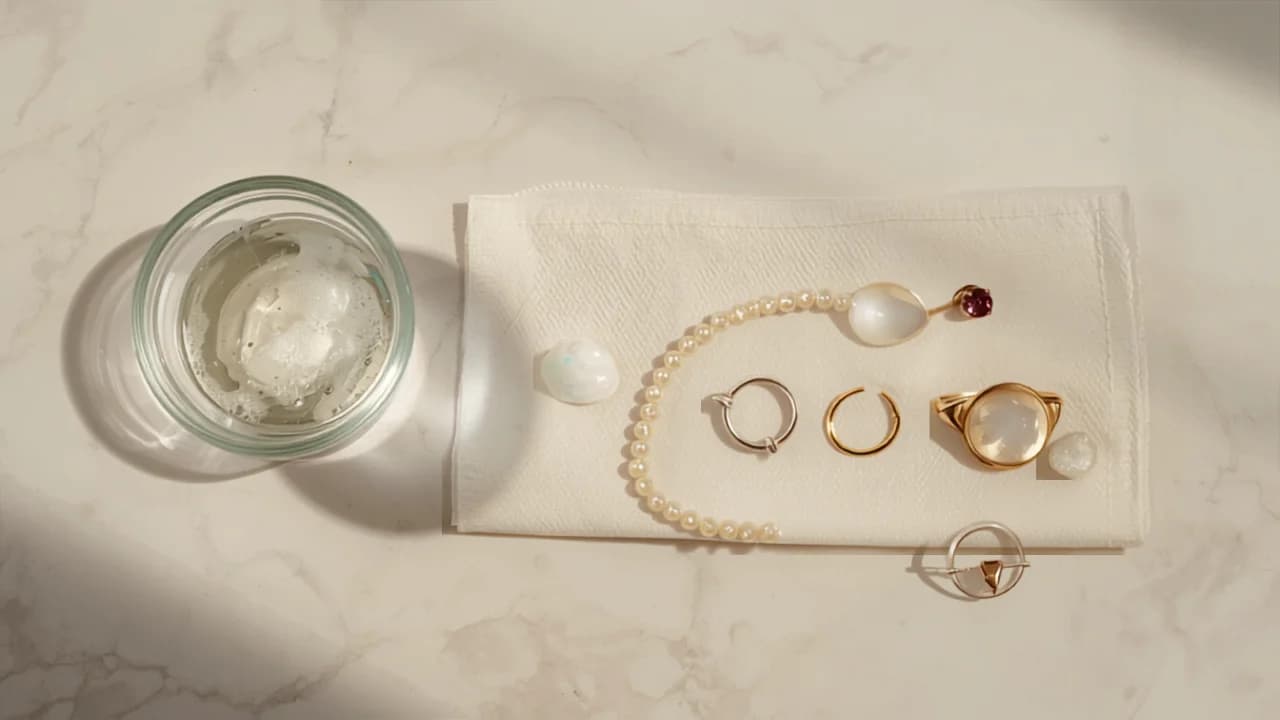
Clean it gently. Warm water, a drop of mild washing-up liquid and a soft brush is all a solid opal needs. Dry it straight away. Never use an ultrasonic cleaner or a steamer on any opal, and keep doublets and triplets out of water altogether, just a damp cloth. Our birthstone jewellery cleaning guide lists the safe method for every stone if your ring mixes opal with others.
Store it on its own. Keep it in a soft pouch or its own compartment, away from diamonds and sapphires, which will scratch it. Do not leave it in a hot car or on a sunny windowsill, and do not lock it away somewhere bone dry for years. Opal prefers normal room conditions.
Have the prongs or bezel checked once a year. Any jeweller can do it in a few minutes, and a loose setting is how stones get lost.
Re-polish when it looks tired. Unlike many stones, a solid opal can be re-polished to look almost new. When the surface starts to look misty, take it to an opal specialist rather than a general repair counter.
What We Would Actually Buy
If you are shopping for an opal ring this October, here is our honest advice.
- For an engagement ring: a solid Australian white, crystal or boulder opal in a solid gold bezel, kept low. Spend on the colour of the stone, not on carat weight or a big halo.
- For an October birthday gift: a small natural opal in solid gold, worn on the right hand. If it is for a teenager or someone hard on jewellery, a lab-created opal in sterling silver is a perfectly good choice at a fraction of the cost.
- For a statement cocktail ring: an Ethiopian opal with strong colour, worn for evenings and taken off before the washing up.
- For a mother's or family ring: be careful putting opal in a ring with several harder stones, because the opal will be the first to show wear. Our mother's ring guide suggests tourmaline as October's swap for exactly this reason.
What we would skip: any doublet or triplet sold without saying so, "black opal" at a bargain price, opal in plated metal meant to last a lifetime, and tall four-prong settings that leave the stone hanging out in the open.
The Bottom Line
An opal ring is not the low-maintenance choice, and nobody honest will tell you it is. It is the choice for someone who wants a stone that changes every time they move their hand, and who is willing to look after it in return. Solid opal, a protective setting and a few sensible habits are all it takes.
We think that trade is worth it. No other birthstone does what opal does, and October babies got the most alive-looking stone in the whole calendar. Just buy it with your eyes open.
To keep going, compare opal's colours and patterns in our opal colours guide, learn to tell it from its look-alike in moonstone vs opal, or see every month's stones at a glance in the birthstone chart.