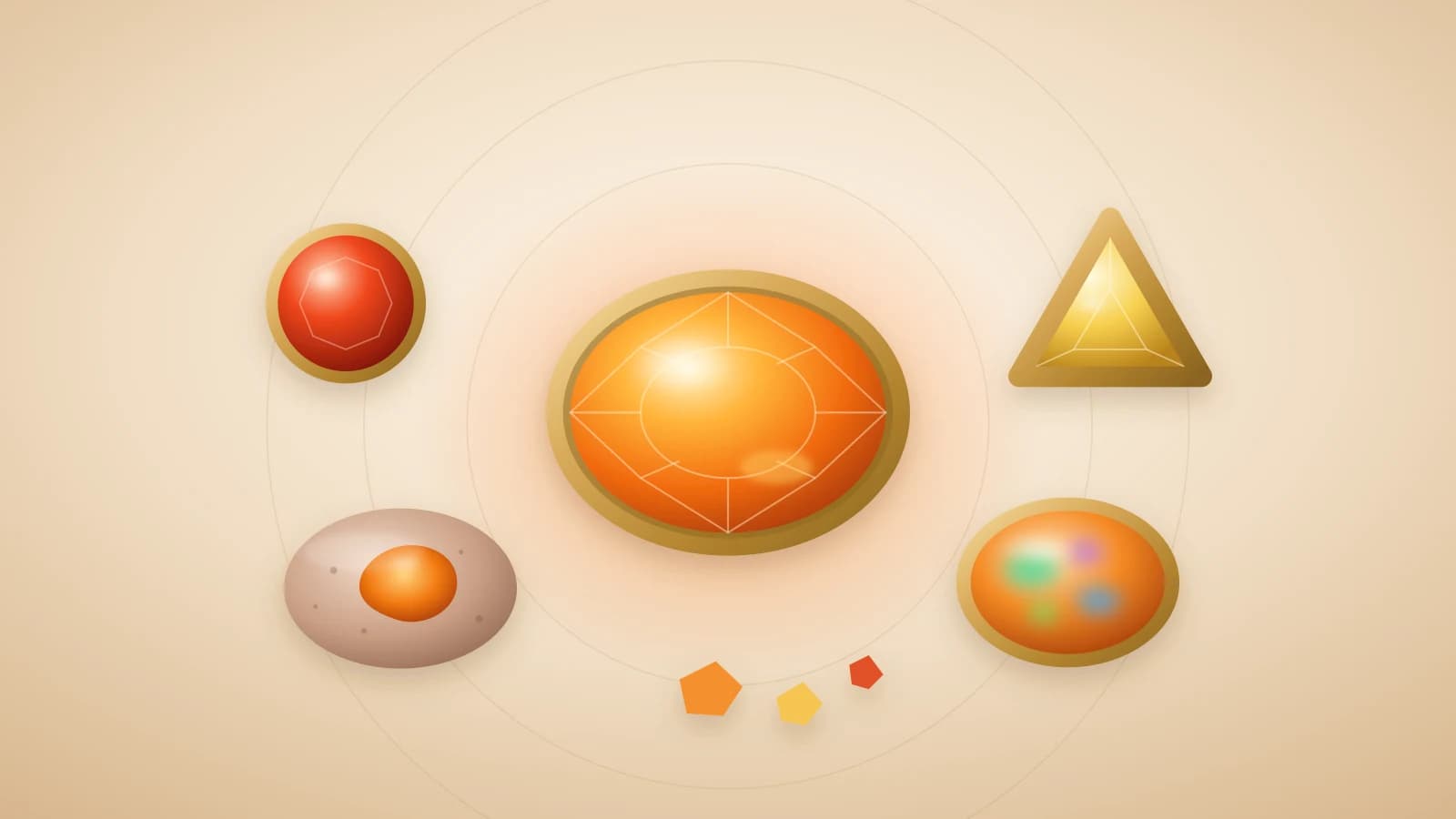
Most opal sells on one thing: the rainbow. You tilt the stone, colours roll across it, and that flash is what you pay for. Fire opal breaks that rule. A good one may show no rainbow at all. What it has instead is colour in the body of the stone, a clear glowing orange that looks like the inside of a tangerine held up to the sun.
It is also one of the most confusing stones to shop for. The name gets used for Mexican opal, for orange Ethiopian opal, for dyed material, for glass, and sometimes for ordinary white opal with a bit of red flash. Prices run from a few dollars to a few thousand for stones that look similar in a phone photo.
We do not sell fire opal, so we have no stock to clear. This guide covers what fire opal actually is, why Mexico owns it, what it costs right now, the crazing problem most product pages leave out, the fakes, and where we think it belongs in your jewellery box.
If you want the bigger picture on opal first, our opal meaning and colours guide covers every type, and the October birthstone page explains why the month shares opal with tourmaline.
What Fire Opal Actually Is
All opal is the same basic stuff: silica with water trapped inside it, usually somewhere between 3 and 10 percent by weight. It does not form crystals the way sapphire or topaz does. It forms from silica-rich water seeping into cracks and cavities, then slowly hardening into a solid gel.
Fire opal is opal with a warm body colour. That is the colour of the stone itself, with any flashes ignored. The colour comes from tiny amounts of iron oxide, the same family of compounds that makes rust orange. A little iron gives you yellow. More gives you orange. The richest stones lean toward red.
There are two kinds of fire opal, and the difference matters a lot to price:
- Fire opal without play-of-colour. This is most of what you will see. The stone is transparent or translucent, glows orange or red, and has no rainbow flashes. It is usually faceted like any other coloured gem.
- Precious fire opal. These stones have the orange body colour and play-of-colour on top, flashes of green, blue or violet floating inside the orange. They are usually cut as cabochons to show the flash. They are much rarer and much more expensive.
The quickest way to think about it: in a black opal, you pay for the rainbow and the dark background is the stage. In fire opal, the background is the show.
The numbers
| Property | Fire opal |
|---|---|
| Chemistry | Hydrated silica (SiO2 · nH2O) |
| Hardness | About 5.5 to 6.5 on the Mohs scale |
| Density | About 2.0 (light for its size) |
| Colour cause | Traces of iron oxide |
| Transparency | Transparent to translucent |
| Usual cut | Faceted, or cabochon for play-of-colour stones |
| Main sources | Mexico, then Ethiopia, Brazil, Oregon and others |
The hardness figure is the one to remember. Fire opal is softer than quartz, and quartz is in ordinary household dust. Our gemstone hardness chart puts that in context against the other birthstones.
Why Mexico Owns Fire Opal
Ask a dealer where fire opal comes from and the answer is Mexico, nearly every time. The country's volcanic highlands are full of rhyolite, a pale volcanic rock, and the gas pockets in that rock are where fire opal forms.
The most famous mining area is the state of Querétaro, north of Mexico City, where opal has been dug commercially since the nineteenth century. The towns around Tequisquiapan and Colón still trade in it, and you can buy rough from small family mines there. The state of Jalisco, around Magdalena, is the other big name, along with smaller workings in Nayarit, Guerrero and Hidalgo.
Trade histories say fire opal was known in Mexico long before the Spanish arrived, and that the Aztecs used it in mosaics and ritual objects under a name usually translated as "hummingbird stone". We would treat the details with some caution, since a lot of gem history gets repeated from one dealer site to the next without a source, but the link between Mexico and fire opal is old and real.
Cantera: fire opal left in the rock
One Mexican speciality is worth knowing about. Cantera opal is fire opal cut while it is still sitting in its host rhyolite. The finished piece is a cabochon of pinkish or tan rock with a pool or vein of orange opal inside it. It is cheap, it is tough compared with loose fire opal, and every piece is different.
We like cantera a lot. It shows you where the stone came from, and the rock gives the opal some protection in a ring. If you want fire opal on a budget and do not need a perfect faceted gem, start here.
Other sources
- Ethiopia. Ethiopia produces some orange and red opal. Some of it is natural colour, and some is white Welo opal that has been dyed. Ethiopian opal is also often hydrophane, meaning it soaks up water and can change colour when wet. More on that below.
- Brazil. Brazil has produced fire opal in small quantities, mostly yellow to orange.
- Oregon and Nevada. Opal Butte in Oregon produces some fire opal, often with very clean, glassy material. Nevada is better known for its black opal, but fire-coloured stones turn up too.
Our view: for a faceted stone, Mexican fire opal is the default and the one with the most reliable supply. We would only pay a premium for another origin if the stone itself is better, not for the name.
The Colour Ladder and Why It Sets the Price
Fire opal pricing is mostly about colour, then clarity, then cutting. Size matters less than you would expect, because large clean stones are not as hard to find as large clean rubies or emeralds.
Here is roughly how the colour ladder runs:
- Pale yellow and honey. The cheapest fire opal. Pleasant but quiet.
- Yellow-orange. Brighter and more lively. Very common in commercial jewellery.
- Bright orange. The classic look, the colour most people picture.
- Orange-red. Where prices start to climb steeply.
- Cherry red. The top of the ladder. Rare in clean, transparent material.
Brown is the colour you want to avoid. A brownish tint flattens the glow and pulls the price down sharply, and it is easy to miss under warm shop lighting. Look at any stone you are considering under daylight or a neutral white light before you pay.
Clarity matters more in fire opal than in most opal, because so much of it is faceted and transparent. A cloudy or milky stone loses the glow that makes fire opal worth buying. Some faint haze is normal. Strong cloudiness should come with a big discount.
What fire opal costs by grade
These bands come from dealer price lists and live listings we checked on 29 October 2026. Treat them as a guide to the market, not as a valuation of any single stone.
| Grade | What it looks like | Typical price per carat |
|---|---|---|
| Commercial yellow | Pale yellow to honey, some haze | $10 to $30 |
| Good orange | Bright orange, mostly clean, decent cut | $30 to $150 |
| Fine orange-red | Saturated orange-red, clean, well faceted | $150 to $600 |
| Precious red with play-of-colour | Red-orange body plus clear rainbow flash | $500 to $2,000+ |
| Cantera (in matrix) | Opal pool or vein inside rhyolite | Priced per piece, often $20 to $200 |
What the market is asking this week
We looked at what sellers ranking on Google for "mexican fire opal price per carat" were asking on 29 October 2026. These are asking prices, not sale prices, and they move.
| Listing | Weight | Asking price | Rough price per carat |
|---|---|---|---|
| Mexican fire opal cabochon (eBay) | 3.6 ct | $60 | About $17 |
| GemSelect fire opal range | Various | $14 to $374 per stone | Mostly under $100 |
| Faceted oval Mexican fire opal (Fire & Brilliance) | Various | $345 to $1,115 | Varies by size |
| Natural Mexican fire opal (JupiterGem) | 1.81 ct | $1,090 | About $600 |
| Natural Mexican fire opal (JupiterGem) | 4.82 ct | $2,670 | About $550 |
| Natural Mexican fire opal (Opal Auctions) | 12 ct | $12,999 | About $1,080 |
The spread tells you most of what you need to know. A $60 cabochon and a $1,090 faceted stone are both honestly described as natural Mexican fire opal. The difference is colour, clarity and cutting, and you can see most of it with your own eyes if the photos are good and the seller shows the stone in daylight.
Our take on value: the sweet spot is a clean, bright orange stone in the $40 to $150 per carat range. It gives you nearly all the beauty of a top stone at a fraction of the price. The jump from fine orange to cherry red costs a lot more than it looks in jewellery, especially in a small stone seen from across a room.
If you want to compare fire opal against other birthstones on cost, our gemstone price guide and the most expensive birthstones ranked list are good next stops. For how fire opal fits into the broader opal market, see how valuable is an opal.
Crazing: The Problem Product Pages Skip
Here is the thing we wish more sellers said up front. Some opal, including some fire opal, can craze. Crazing is a network of fine cracks that appears as the stone slowly loses some of its water. It cannot be polished out and it ruins the stone.
Crazing usually shows up within the first months after the opal is mined and cut, if it is going to happen at all. Good dealers deal with this by holding rough and cut stones for a while before selling them, sometimes many months, so the unstable ones reveal themselves before they reach a customer. Material from some deposits is known to be more prone to it than others.
What this means for you:
- Buy from sellers who have held their stock. It is fair to ask a dealer how long a stone has been cut. A seller who knows opal will not be offended.
- Be careful with very fresh, very cheap rough. Bargain lots straight from the mine are where crazing risk is highest.
- Ask about returns. A decent opal seller will take back a stone that crazes soon after purchase.
Once a fire opal has been stable for a year or so, it is very unlikely to start crazing out of nowhere. The bigger risk after that is sudden heat or temperature shock, which we cover in the care section.
Hydrophane opal and the "it changed colour" surprise
Some opal, especially from Ethiopia, is hydrophane. It soaks up water like a sponge. When wet it can turn clear, and then turn cloudy or change colour as it dries out over hours or days. Hydrophane opal also soaks up oils, lotion and dye, which is how a lot of cheap orange "fire opal" is made from white stock.
If an Ethiopian stone is sold as fire opal, ask whether the colour is natural. If the seller does not know, assume it is not.
Fakes and Lookalikes
Fire opal is not as heavily faked as black opal, but the cheap end of the market has plenty of traps.
| What you might be sold | What it really is | How to tell |
|---|---|---|
| "Fire opal" at a few dollars a stone | Orange glass | Round gas bubbles and swirl lines under a loupe, heavier in the hand |
| Lab-created fire opal | Synthetic opal, sometimes with resin | Too-perfect colour, sometimes a regular "lizard skin" pattern in flash stones |
| Orange Ethiopian "fire opal" | Dyed white hydrophane opal | Colour sits in cracks or patches, can bleed with acetone, too cheap for its colour |
| "Opalite" | Man-made glass with a milky glow | Bluish-white glow, no orange body, very cheap |
| Fire opal doublet | Thin opal slice glued to a backing | Straight glue line visible from the side |
| Citrine, carnelian or spessartine | A different gem altogether | Heavier, different refraction; an honest dealer will say what it is |
Two quick checks catch most problems. First, weight. Opal is light, around 2.0 in density, so a real fire opal feels light for its size compared with glass or citrine. Second, a 10x loupe. Glass shows round bubbles and flow lines. Natural fire opal shows small fluid inclusions, faint colour zoning or soft haze.
If a stone costs more than a few hundred dollars, ask for a written description that says natural, untreated fire opal, and get an independent lab report for anything in four figures. Our gemstone identification tool can help you narrow down what an orange stone is likely to be, and our lab-grown vs natural birthstones guide covers how synthetic gems are disclosed.
We do not think lab-created fire opal is a bad thing to own. It just should not cost natural prices, and it should be labelled.
Fire Opal in Jewellery: Where It Works
This is where we get opinionated.
Earrings: our first choice
Earrings are where fire opal is happiest. They take almost no knocks, they catch light from every angle, and the warm colour flatters most skin tones. A pair of small faceted fire opals in yellow gold is one of the best-value pieces of coloured-gem jewellery you can buy. If you are buying fire opal for the first time, buy earrings.
Pendants and necklaces: also great
A pendant is the next safest home, and the best way to show off a larger stone or a precious fire opal with play-of-colour. A bezel or a simple four-claw setting is fine here because the stone is rarely hit.
Rings: possible, with conditions
Fire opal rings are popular and they can last, but we would set one up carefully:
- Use a bezel or a halo. Faceted fire opal has sharp edges that chip. A metal rim or a ring of small diamonds or white sapphires takes the knocks first.
- Keep the stone low. A tall setting looks dramatic and gets caught on everything.
- Choose a ring for evenings and weekends. It is not a stone for gardening, gym sessions or washing up.
- Consider cantera. A cantera cabochon in a ring is far tougher than a faceted loose stone, because the rock protects the opal.
Would we use fire opal for an engagement ring? Only for someone who already knows they are careful with jewellery and loves the colour enough to accept the upkeep. For an everyday ring that will be worn for decades, we would steer most people toward something harder. Our opal ring buyer's guide goes into setting choices in more detail, and the same advice applies to fire opal.
Metal colour
Yellow and rose gold bring out the warmth in fire opal. White metals can look sharp with a cherry red stone but tend to make yellow and honey stones look washed out. If the stone leans yellow, put it in yellow gold.
How to Care for Fire Opal
Fire opal is not delicate in the way some people think, but it has a few clear rules.
- Clean it with warm water, a drop of mild soap and a soft brush. Rinse and dry it with a soft cloth.
- Never use an ultrasonic or steam cleaner. The vibration and heat can crack it.
- Avoid sudden temperature changes. Do not go straight from a hot car into an icy pool with a fire opal ring on, and keep it away from hairdryers and hot work.
- Keep it away from chemicals. Perfume, hairspray, bleach and household cleaners can dull the surface over time.
- Store it on its own. Harder gems and even dust can scratch it. A soft pouch or a separate compartment is enough.
- Do not oil or soak it. Some guides suggest storing opal in water or oil. Solid, stable fire opal does not need it, and hydrophane opal can be damaged by it.
Our birthstone jewellery cleaning guide has the full routine for opal next to every other birthstone.
Fire Opal Meaning and Birthstone Status
Fire opal counts as opal, so it is a perfectly good choice for an October birthday. If someone born in October wants something warmer and more wearable-looking than white opal, fire opal is a lovely alternative, and it sits well next to pink tourmaline, October's other birthstone, if you are designing a piece with both.
In crystal shops, fire opal is sold as a stone of energy, passion and creativity. Those meanings are modern, and there is no evidence a stone can change your mood or luck. We think it is fine to enjoy the symbolism, as long as nobody is charging you extra for it. The colour does the talking anyway.
The old superstition that opal is unlucky unless it is your birthstone comes from a novel published in 1829 and has no real history behind it. You can wear fire opal whatever month you were born in. Our opal meaning guide tells the full story of how that rumour started.
Fire Opal vs Other Orange Stones
If you love orange, fire opal is not your only option. Here is how we would choose:
- Fire opal gives you the softest, most glowing orange, with a slightly jelly-like look. Softest of the group.
- Citrine is harder, cheaper and more durable, though its orange is usually more yellow-brown. See our topaz vs citrine comparison.
- Imperial topaz gives a richer orange-pink and is much harder, at a much higher price.
- Spessartine garnet is a vivid, hard-wearing orange with more sparkle and less glow.
For earrings and pendants, fire opal is our pick for pure colour. For a ring you will wear every day, citrine or spessartine garnet will cope with real life much better.
The Short Version
- Fire opal is regular opal with a warm orange to red body colour from iron oxide. Most has no play-of-colour, and the ones that do cost much more.
- Mexico, especially Querétaro and Jalisco, is the classic source. Cantera, fire opal left in its rock, is a great budget buy.
- Colour sets the price. Pale yellow costs $10 to $30 a carat. Fine orange-red can pass $600. Precious red stones with play-of-colour go higher still.
- The best value is clean, bright orange in the $40 to $150 per carat range.
- Ask how long a stone has been cut to avoid crazing, and be wary of cheap orange Ethiopian opal, which is often dyed.
- Fire opal shines in earrings and pendants. In a ring, use a bezel or halo and treat it as a careful-wear piece.
If you have a fire opal already and want to know what it is worth, our jewellery appraisal cost guide explains what an appraisal involves and what it should cost. And if you are building an opal collection, our guide to black opal covers the opposite end of the opal world.