Most jewelry cleaning advice online is written by people who sell jewelry, not by people who have watched a stone come apart in a machine. That is why almost every guide gives you the same warm soapy water paragraph, adds one throwaway line about pearls being delicate, and stops.
It is not wrong. It is just not enough for birthstone jewelry, because birthstone jewelry is the one category where the stone in the setting is chosen by birth date rather than by durability. Nobody buying a family necklace checks whether October's opal can survive the same cleaning as July's ruby. It cannot, and the gap between them is enormous.
So here is the guide we wanted to read. Every birthstone, what each cleaning method actually does to it, and the specific reason behind each answer.
The one method that is safe for every birthstone
Start here, because ninety percent of the time this is all you need.
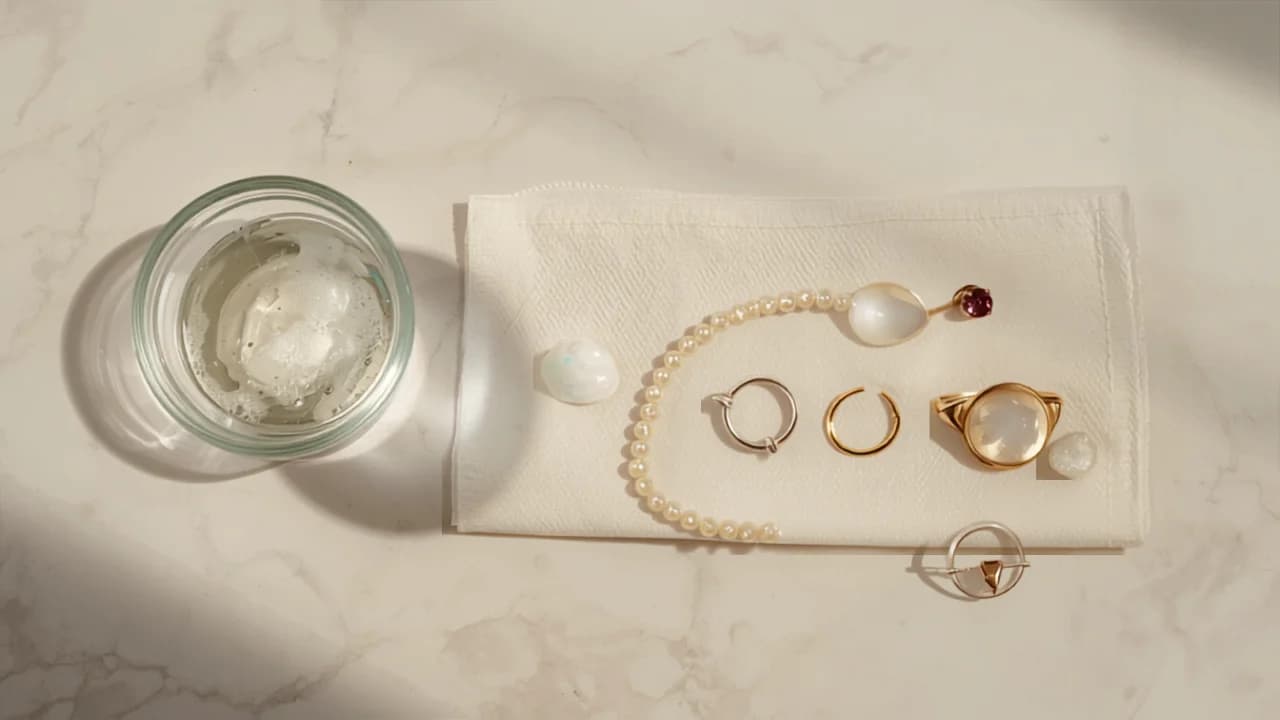
- Half fill a bowl with warm water. Warm means comfortable on the inside of your wrist, not hot from the tap.
- Add two drops of plain dish soap. Fragrance free, no added moisturiser, no bleach.
- Soak the piece for ten to fifteen minutes. Pearls are the exception, and we will come to them.
- Brush gently with a soft baby toothbrush, paying most attention to the underside of the stone where the setting traps a film you cannot see from above.
- Rinse in lukewarm water with the drain closed or a strainer in the sink.
- Dry with a lint free cloth and leave it out on the cloth for an hour before putting it away.
Step five is not fussiness. Every jeweler has a story about a customer's ring going down a plughole during a rinse, and there is no version of that story with a happy ending.
Step four is where the actual cleaning happens. What makes a stone look dull is almost never the stone. It is a microscopic film of hand cream, sunscreen, soap residue and skin oil sitting on the pavilion, the underside facets, blocking the light that would otherwise bounce back out at you. Clean that surface and a tired looking gem comes back to life in a way that looks like magic and is really just optics.
Our honest opinion: the reason this method is universal is the reason people distrust it. It sounds too mild to work. It works because dirt on jewelry is oily rather than bonded, and oil comes off with surfactant. If your stone still looks dead after a proper soak and brush, the problem is not dirt. It is a scratched or worn facet surface, an abraded girdle, or a stone that needs repolishing at a bench, and no home method fixes any of those.
The three machines, and what they actually do
Everything that goes wrong with jewelry cleaning goes wrong at a machine. Here is what each one is really doing, because the mechanism explains every rule that follows.
Ultrasonic cleaners do not vibrate dirt loose in the way people imagine. A transducer sends high frequency sound waves through the liquid, and those waves create and collapse millions of microscopic vacuum bubbles against every surface of the piece. That is called cavitation, and each collapsing bubble is a tiny hammer blow. It is brilliant at clearing packed grime out from underneath a setting. It is also, in the most literal sense, hitting your gemstone several thousand times a second. A stone with a fracture inside it, or a filled fracture, or cleavage planes, or a structure that holds water, is being worked on along its weakest line. So is a loose prong.
Steam cleaners blast hot pressurised steam at the piece. There is no vibration, so a fractured stone is not being levered apart, but there is heat and there is a sharp temperature change. That is thermal shock, and it is what actually breaks stones. Steam is also brutal on anything oiled, waxed or resin filled, because heat makes filler sweat out of the fractures it was hiding.
The foil and baking soda trick is neither of those. It is a small electrochemical cell. Aluminum foil, hot water and baking soda pull the sulfur off tarnished silver and hand it to the aluminum, so black tarnish vanishes in about forty seconds. It genuinely works on plain silver. It also uses near boiling water and strips deliberate oxidation out of antiqued designs, which makes it the wrong tool for almost any piece with a stone in it.
Every birthstone, every method
This is the table nobody publishes, and it is the reason this article exists. Ratings follow GIA's published care guidance for each gem species.
| Birthstone | Mohs | Warm soapy water | Ultrasonic | Steam | The real risk |
|---|---|---|---|---|---|
| Diamond | 10 | Safe | Usually safe | Usually safe | The setting, not the stone |
| Ruby | 9 | Safe | Usually safe | Usually safe | Fracture filled and dyed stones |
| Sapphire | 9 | Safe | Usually safe | Usually safe | Fracture filled and dyed stones |
| Alexandrite | 8.5 | Safe | Usually safe | Usually safe | Fracture filled stones only |
| Spinel | 8 | Safe | Usually safe | Usually safe | Internal fractures |
| Topaz | 8 | Safe | Never | Never | Basal cleavage, thermal shock, coatings |
| Emerald | 7.5 to 8 | Safe | Never | Never | Oil and resin sweating out of fractures |
| Aquamarine | 7.5 to 8 | Safe | Usually safe | Usually safe | Liquid inclusions and fractures |
| Tourmaline | 7 to 7.5 | Safe | Never | Never | Thermal shock and colour change |
| Garnet | 6.5 to 7.5 | Safe | Usually safe | Not recommended | Fractures, softer demantoid |
| Zircon | 6.5 to 7.5 | Safe | Never | Never | Brittle, heat alters colour |
| Amethyst | 7 | Safe | Usually safe | Never | Heat, and fading in strong light |
| Citrine | 7 | Safe | Usually safe | Never | Heat, and fading in strong light |
| Bloodstone and sardonyx | 6.5 to 7 | Safe | Caution | Not recommended | Dye in treated material |
| Onyx | 6.5 to 7 | Safe | Caution | Not recommended | Almost all black onyx is dyed |
| Peridot | 6.5 to 7 | Safe | Never | Never | Acids and uneven heat |
| Tanzanite | 6.5 | Safe | Never | Never | Cleavage and temperature change |
| Moonstone | 6 to 6.5 | Safe | Never | Never | Cleavage in two directions |
| Opal | 5.5 to 6.5 | Safe | Never | Never | Water content, crazing, heat |
| Lapis lazuli | 5 to 6 | Safe, test first | Never | Never | Dye and wax sealers |
| Turquoise | 5 to 6 | Safe | Never | Never | Porous, and surface treatments |
| Pearl | 2.5 to 4.5 | Wipe, brief wash | Never | Never | Every acid, and the silk thread |
Print that, screenshot it, do whatever you like with it. The short version: five birthstones tolerate a machine, and everything else in the calendar does not.
The rule that matters most for birthstone jewelry
Here is the thing the big brand guides never say, because they are writing about single stone jewelry and birthstone jewelry usually is not.
A multi stone piece is cleaned to the rules of its most fragile stone.
A mother's ring with a January garnet, a June pearl and an October opal is not a garnet ring. It is an opal and pearl ring that happens to contain a garnet. Every method choice you make has to satisfy the pearl. A three stone birthstone necklace with April, July and December is a diamond and ruby piece until the December stone turns out to be turquoise, at which point it is a turquoise piece and the machine is off the table.
This is not a small edge case. Family pieces, custom birthstone necklaces for mom and birthstone bracelets are the most common form birthstone jewelry takes, and the odds of a five stone family piece containing at least one of the eleven never stones are high. Check the whole piece before you choose a method, not the stone you happen to be thinking about.
The same logic applies at a jeweler's counter. If you hand over a mixed piece and say "give it a clean", it may go into the shop ultrasonic by default, because that is what happens to nine pieces out of ten. Say what is in it. A good bench will thank you.
Month by month, and why
January, garnet
Garnet is more forgiving than its 6.5 to 7.5 hardness suggests, and GIA rates ultrasonic cleaning as usually safe unless the stone has fractures. Steam is not recommended. Garnet is a family rather than a single mineral, so a demantoid garnet is a little softer than an almandine or a tsavorite and deserves more care. Warm soapy water covers everything with no thought required. See our garnet ring buyer's guide for the varieties.
February, amethyst
Ultrasonic is usually fine for untreated amethyst. Steam is not, because amethyst should not be heated. There is a second, slower problem that has nothing to do with cleaning: some amethyst fades with prolonged exposure to intense light. If you leave a purple ring on a sunny windowsill to dry, you are running a small bleaching experiment. Dry it on a cloth in a drawer instead, and read our amethyst ring buyer's guide if yours is a daily piece.
March, aquamarine and bloodstone
Aquamarine handles ultrasonic and steam well unless it holds liquid inclusions or fractures, and plenty of aquamarine does hold exactly those. Since you often cannot see them without magnification, we would leave the machine alone. Heat is not recommended either way. Bloodstone is chalcedony, which means it is a compact microcrystalline quartz that is tougher than its hardness suggests but frequently dyed or treated, and dye is what limits you. Soap and water for both. There is more on both stones in our March birthstone guide.
April, diamond
Diamond is the hardest natural material on earth and nothing in a cleaning bath touches it. The risk is entirely the setting. GIA's own consumer guidance advises against home ultrasonic and steam cleaners for diamond jewelry, and the reason is worth quoting plainly: they can loosen gemstones in their settings. A tired prong that would have survived another year of wear can give up in a cavitation bath. That is a real risk, and it is the risk with every stone in the usually safe column too.
Our honest opinion: a home ultrasonic on a diamond ring is a fine tool in the hands of someone who checks their prongs with a loupe and a pick. For everyone else it is a machine that eventually converts a small maintenance problem into a lost stone. Soap, brush, and an annual prong check at a bench is the better system. Our lab grown versus natural diamond guide covers the stone itself, and cleaning is identical for both.
May, emerald
Emerald is the most misunderstood stone in the calendar. It is a beryl at 7.5 to 8 on the Mohs scale, which sounds robust, and it is famously fragile anyway. The reason is that emerald almost always contains a network of surface reaching fractures, and roughly ninety percent of emeralds on the market are fracture filled with oil or resin to make those fractures less visible.
That filler is the thing you are protecting. GIA is direct about it: ultrasonic vibrations can weaken an already fractured stone, and hot steam can make the oil or unhardened resin sweat out of the fractures. Once the filler leaves, every fracture reappears at once and the stone visibly changes in front of you. It can be refilled at a bench, but the filler is not a permanent part of the gem and never was.
Soap, warm water, gentle brush. Nothing else, ever. Our emerald meaning and colour guide has more on why emerald is built this way.
June, pearl, moonstone and alexandrite
June is a month with three stones that could not be more different in the sink.
Pearl is organic, it sits between 2.5 and 4.5 on the Mohs scale, and GIA states that it can be damaged by many chemicals and all acids, listing hairspray, perfume, cosmetics and even perspiration. Never ultrasonic, never steam. Wipe with a soft cloth after every wear and give it an occasional careful wash in warm soapy water. If the pearls are strung, the silk thread is a second problem: soaked silk stretches, dries slowly, and holds the dirt you were trying to remove. Wipe rather than soak a strand, and if the knots between pearls look grey or the strand hangs longer than it used to, it needs restringing rather than cleaning.
Moonstone is a feldspar with cleavage in two directions and GIA is unusually blunt about it: ultrasonic and steam cleaners are never recommended. High heat or a sudden temperature change can break it. Labradorite behaves the same way for the same reason.
Alexandrite is the outlier. At 8.5 with excellent toughness and no cleavage, it takes ultrasonic and steam without complaint unless it has been fracture filled. It is the only June birthstone you could put in a machine, and it is also the one you can least afford to replace, which is a good argument for not bothering. Our pearl versus alexandrite guide covers the choice between them.
July, ruby
Ruby is corundum at 9, and GIA rates ultrasonic and steam as usually safe for untreated, heat treated and lattice diffusion treated stones. The exception is significant: fracture filled, cavity filled or dyed material should only be cleaned with a damp cloth.
Lead glass filled ruby is very common at the lower end of the market, and it is exactly the material most likely to end up in an inexpensive birthstone piece. The glass is attacked by mild acids, including lemon juice, so it will not survive a machine or a household cleaner. If your July stone came from an unlabelled setting and the price was gentle, assume it is filled. Our ruby colour chart will help you place what you actually own.
August, peridot, sardonyx and spinel
Peridot is a trap, because 6.5 to 7 sounds like it belongs in the durable group. GIA recommends warm soapy water and specifically not ultrasonic or steam. Peridot is attacked by sulfuric acid and, over a long period, by acid perspiration, and rapid or uneven heat can fracture it. That last part rules out steam completely. Our peridot guide has more.
Sardonyx is banded chalcedony, so the dye question applies as it does to all treated chalcedony. Spinel is the durable one at 8, usually safe in both machines except where fractures are present. If you own spinel you own the toughest August option by a distance.
September, sapphire
Same mineral as ruby, same rules. Untreated, heat treated and lattice diffusion treated sapphire handles ultrasonic and steam. Fracture filled, cavity filled or dyed sapphire gets a damp cloth and nothing else. Sapphire is one of very few birthstones we are comfortable calling machine safe, which combined with a 9 hardness is a large part of why it makes such a good everyday engagement ring.
October, opal and tourmaline
Opal is the most cleaning sensitive stone in the entire calendar, and it earns that title honestly. It holds water inside its structure, it sits at 5.5 to 6.5 with poor to fair toughness, and GIA's position is that the only safe way to clean opal is with warm soapy water. Heat and sudden temperature change can fracture it. There is also crazing, the fine network of surface cracks that can develop in opal when it dries out or is shocked, and crazing is permanent. No ultrasonic, no steam, no hot water, no leaving it in a hot car. Doublets and triplets add a further problem, because they are assembled with adhesive and soaking dissolves the bond. Our guide on how valuable an opal is explains why crazing wipes out value.
Tourmaline sits at 7 to 7.5 and looks safe on paper. It is not. GIA does not recommend ultrasonic or steam, because high heat alters the colour and thermal shock causes fracturing. Pink tourmaline in a birthstone piece deserves the same handling as the softer stones.
November, topaz and citrine
Topaz is the best illustration in this whole article of why hardness is not durability. It is an 8, harder than emerald, harder than quartz, harder than almost everything you will scratch it against. It also has perfect basal cleavage, a plane along which the crystal will split cleanly if you hit it right, and GIA rates its toughness as poor. High heat or a sudden temperature change can cause breaks. So topaz gets warm soapy water and neither machine.
There is a second issue with coated topaz. The rainbow surfaced material sold as mystic topaz carries a thin metallic oxide coating, and abrasive cleaners or a buffing wheel will take it straight off. Mild soap only. Our topaz guide goes deeper on the varieties.
Citrine is quartz and behaves like its sibling amethyst. Ultrasonic is usually fine, steam is not because citrine should not be heated, and prolonged intense light can fade the colour. Nearly all commercial citrine is heat treated amethyst, which is worth knowing when you read the difference between topaz and citrine.
December, turquoise, tanzanite, zircon and blue topaz
December has more birthstones than any other month and almost all of them are fragile.
Turquoise is porous at 5 to 6, and GIA says it is safe in warm soapy water but should never be cleaned with steam or an ultrasonic. Most turquoise on the market is stabilised, waxed or dyed, and heat or solvents damage those treated surfaces. It can also be discoloured by cosmetics, skin oils and perspiration alone, so the most useful care for turquoise is putting it on last and taking it off first. Our turquoise guide covers the treatments in detail.
Tanzanite is 6.5 with fair to poor toughness and true cleavage. GIA's wording is that warm soapy water is always safe and ultrasonic and steam cleaners are never recommended, with a further warning against very high temperatures or sudden temperature changes. It is a beautiful stone with the durability of a pendant rather than a ring, and cleaning is the moment most owners find that out. See our tanzanite guide.
Zircon is brittle despite a respectable 6.5 to 7.5 hardness, and its facet edges abrade against other jewelry over time. Ultrasonic and steam are both out, and heat can alter the colour. Blue topaz follows the topaz rules above. Lapis, December's older traditional stone, is porous, frequently dyed and often sealed with wax or plastic, and GIA suggests testing a hidden area before cleaning because some dyes are unstable. Acetone and denatured alcohol strip lapis dye outright.
The metal matters too
Everything above is about the stone. The setting has its own rules, and one of them is genuinely dangerous.
Chlorine and karat gold do not mix. Karat gold is an alloy, and the copper and nickel mixed in with the gold are what chlorine attacks. Pool water, hot tubs and bleach cause a slow corrosion inside the alloy that concentrates in the thinnest, most stressed parts of a piece, which is to say the prongs. The failure does not happen while you are swimming. It happens weeks later when a prong that looked fine snaps. Take rings off before a pool, and never let bleach anywhere near jewelry.
Sterling silver tarnishes and that is not dirt. Silver reacts with sulfur compounds in air, wool, rubber and perspiration to form a dark silver sulfide film. A silver polishing cloth removes it in seconds and is the correct tool. Storage in a closed bag with an anti tarnish strip prevents it. Damp bathrooms accelerate it dramatically.
Plated and vermeil pieces have a wear budget. Every clean removes a little of a finish that is measured in microns to begin with. No ultrasonic, no polishing cloth, no abrasive anything. A soft dry wipe after wear, and a very brief soapy rinse only when you must. Our guide to gold plated versus gold filled versus vermeil explains exactly how thin those layers are and why a plated piece cannot be brought back once it wears through.
White gold is rhodium plated. That bright white surface is a plating over a yellowish alloy, it wears off at the points of contact, and no amount of cleaning restores it. Replating is a bench job that costs a fraction of what people expect, and it is the single most transformative thing you can do to a tired white gold ring.
Things people put on jewelry that they should not
- Toothpaste. It is an abrasive, deliberately. It hazes gold, dulls polished facets and scratches anything under about 7 on the Mohs scale. The shine people report is a very fine matte finish, which is the opposite of what you wanted.
- Bleach. See above. The worst single thing for karat gold.
- Boiling water. Thermal shock for opal, tanzanite, peridot, topaz, moonstone and tourmaline.
- Vinegar. An acid. Fine on nothing you own, disastrous on pearl and treated stones.
- Denture tablets. Effervescent, alkaline, and completely unnecessary. Same result as soap, more risk.
- Rubbing alcohol and acetone. Degrease well, and strip dye out of treated lapis and turquoise, dissolve adhesive in opal doublets, and dry out organic materials.
- Baking soda paste. Mildly abrasive. The foil method is a different chemistry and a different question.
- Ammonia based commercial cleaners. Genuinely effective on diamond and gold. Not for pearl, opal, turquoise, emerald, lapis or any plated finish, which is most of what a birthstone collection contains.
What we actually do, and what we hand over
Our honest opinion, in full. A home ultrasonic cleaner is a fifty dollar machine that does a job soap does almost as well, on the five birthstones that tolerate it, while presenting a real risk to the eleven that do not and to every prong in your collection. We do not own one and do not recommend one for the average collection.
What a jeweler's ultrasonic is genuinely good for is a piece that has been worn continuously for years, where compacted grime sits underneath the setting in a place a toothbrush cannot reach. That is a once every couple of years job, done by someone who checks the setting first and steam finishes afterwards. It is not weekly maintenance and it was never designed to be.
Hand a piece to a professional when there is a chip in a stone, a prong that catches on fabric, a stone you can rock with a fingernail, a strand of pearls with grey knots, or a white gold ring that has gone dull yellow. Any of those, cleaning is not your problem. Our jewelry appraisal cost guide and the ring resizing cost guide will tell you what bench work should cost before you walk in.
Store it so it needs cleaning less
The best cleaning strategy is doing less of it.
Put jewelry on last, after hand cream, perfume, hairspray and sunscreen. Take it off first, before washing up, showering, swimming, gardening or the gym. Those two habits alone cut how often anything needs a bath by more than half.
Store pieces separately rather than in one dish. Diamond scratches everything. Quartz at 7, which includes the dust in ordinary air, scratches everything below it, which is why opal, turquoise, pearl, lapis and moonstone should never be tumbled together in a drawer. A soft pouch each is enough.
Keep pearls out of an airtight box. Nacre wants some humidity and dries out in a sealed environment, which is one of the few cases where less air is worse.
Keep silver in something sealed with an anti tarnish strip, which is the exact opposite advice, for the exact opposite reason.
The one page version
If you take nothing else from this, take these five lines.
- Warm water, two drops of dish soap, soft brush, closed drain. Safe for all twelve months.
- Only diamond, ruby, sapphire, spinel and alexandrite tolerate a machine, and only when untreated or heat treated.
- Treatment beats mineral. A fracture filled ruby is fragile even though ruby is not.
- A multi stone piece follows the rules of its weakest stone, which for most birthstone jewelry means no machine at all.
- The annual prong check protects you far more than any cleaning ever will.
Not sure what is actually in your setting? Our gemstone identification tool will narrow it down from colour, hardness and lustre, our gemstone hardness chart has the durability figures for thirty plus gems, and the birthstone chart will tell you which stones belong to each month in the first place.