Spinel: Meaning, Colours, and the Gem That Fooled Kings for Centuries
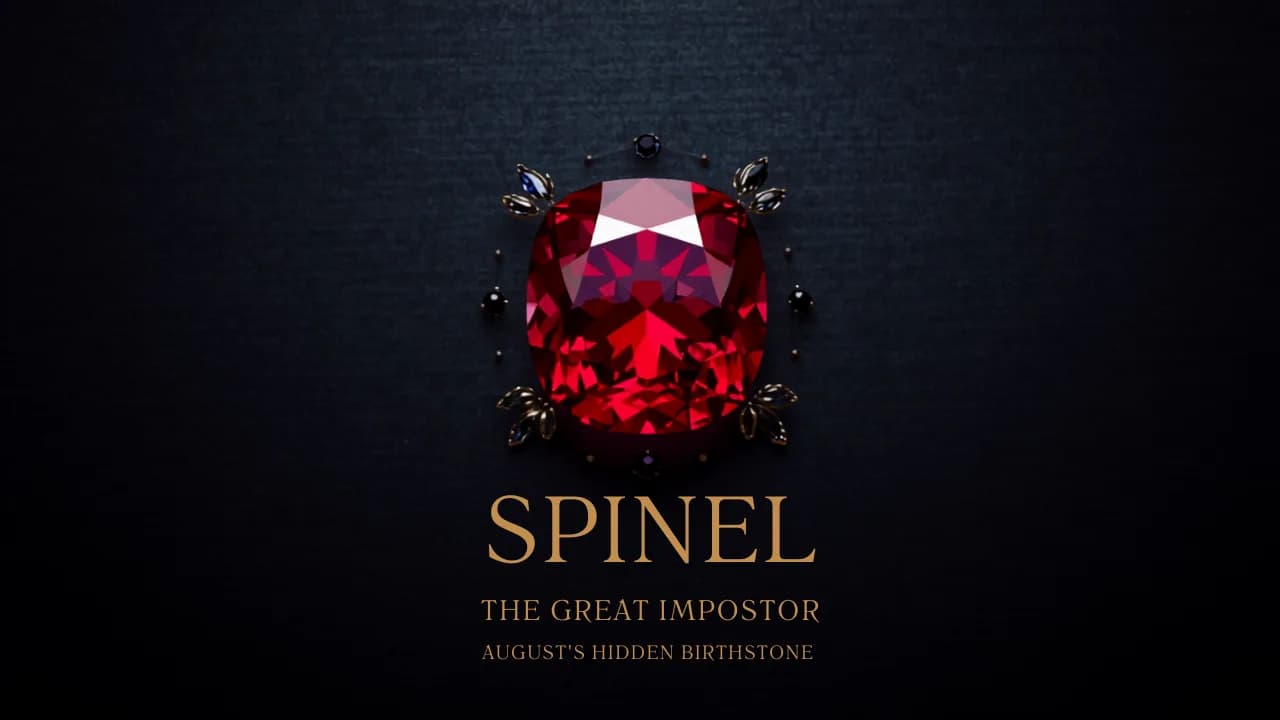
There is a 170-carat red stone sitting at the front of the British Imperial State Crown. For roughly six hundred years it was called the Black Prince's Ruby, it was treated as one of the most precious objects in England, and it has been worn by kings into battle and queens into coronations. There is just one problem. It is not a ruby. It never was. It is a spinel.
That single fact tells you almost everything you need to know about spinel, the most quietly remarkable gem on the birthstone calendar. For most of recorded history nobody could tell fine red spinel and fine ruby apart, so the world's great "rubies," the crown jewels of empires, were very often spinel wearing a borrowed name. Only when gemmology grew up in the nineteenth century did people realise that some of the most famous rubies on earth were a completely different mineral. By then spinel had spent centuries as the great impostor of the gem world, and the reputation stuck. It is still the gem that experts quietly buy for themselves while everyone else chases ruby.
This is the honest, complete version. What spinel actually is, why it fooled everyone for so long, what it has meant to people, the colours that matter and what they cost, why it joined the birthstone list only in 2016, how it really compares to ruby, and how to make sure the stone you buy is the genuine untreated article. We think spinel is the smartest gem most people have never heard of, so we will also tell you exactly where its weak spots are.
Spinel Meaning in One Sentence
If you only want the quick answer: spinel is treated as a stone of revitalisation, energy, and renewal, the gem of starting fresh and shaking off exhaustion, with each colour carrying its own slant on that theme. Because it spent so long mistaken for ruby, much of its symbolism was borrowed wholesale from ruby's, passion and vitality and protection, and only in the last few decades has spinel been given a character of its own in crystal and gem lore.
That is the meaning in a line. But spinel's real story is not in the crystal books, it is in the history, because no other gem has a backstory quite this good. To understand why, it helps to know what the stone physically is.
What Is Spinel?
Spinel is a magnesium aluminium oxide, and that chemistry is the first clue to why it kept getting confused with ruby. Ruby is aluminium oxide too, just with a different structure, and both get their red from traces of chromium. So a fine red spinel and a fine red ruby are coloured by the same element, glow with a similar fire, and form in the same kinds of rock, often side by side in the same marble deposits in places like Myanmar, Tajikistan, and Sri Lanka. Miners pulling red crystals out of the same gravel had no way to know they were finding two different gems.
Spinel sits at 8 on the Mohs hardness scale, which is genuinely excellent for jewellery. That puts it above every quartz, above topaz on toughness in practice, and only just below ruby and sapphire at 9. It has no cleavage, meaning no built-in planes of weakness that can split, so it resists chipping well. In plain terms, spinel is one of the most wearable coloured gems there is. You can put it in a ring and live your life without babying it, which is more than you can say for emerald, opal, moonstone, or even tanzanite.
One more physical detail that matters later: spinel is singly refractive, like garnet and diamond, while ruby is doubly refractive. That sounds like trivia, but it is one of the cleanest ways a gemmologist tells them apart, and it is part of why the confusion lasted only until people had the right tools.
The Great Impostor: Spinel's History
This is the best part, and it is all true. For most of history, "ruby" simply meant a red gemstone. The word described a colour and a value, not a mineral, because the science to separate them did not exist. So the largest and most famous red stones on earth, the ones that ended up in royal treasuries, were judged by eye, and the eye cannot reliably tell fine spinel from ruby.
The result is that some of the most legendary "rubies" in the world are spinels. The Black Prince's Ruby in the British Imperial State Crown, that 170-carat red stone above the Cullinan II diamond, is spinel. The Timur Ruby, a 361-carat stone in the British royal collection inscribed with the names of the Mughal emperors who owned it, is spinel. Several of the great "rubies" in the Iranian crown jewels and other royal hoards turned out, under modern testing, to be spinel as well. Kings carried these stones into war as talismans, paid fortunes for them, and passed them down as the crown's greatest treasures, never knowing they were a gem the trade now sells for a fraction of ruby's price.
We find this genuinely delightful, and it is worth sitting with the irony. Spinel did not fool anyone by being a cheap fake. It fooled everyone by being beautiful enough, and rare enough, and red enough, that for six centuries it earned ruby's status on pure merit. The only thing it lacked was the right name. When gemmology finally separated the two minerals in the 1800s, spinel did not suddenly become less beautiful. It just lost the marketing.
That history is also why spinel's value is, in our opinion, the most quietly mispriced on the whole calendar. You are buying the exact stone that was good enough to crown kings, at a price set by the fact that most people have still never heard of it.
Spinel Meaning and Symbolism
Because spinel rode under ruby's name for so long, it inherited a lot of ruby's symbolism: vitality, passion, courage, and protection in battle, fitting for a stone soldiers literally wore into war. Those older associations are really ruby's lore that spinel absorbed by accident.
In the last few decades, as spinel earned its own identity, modern crystal culture gave it a distinct theme: renewal, energy, and recovery from burnout. It is often described as the stone for people who are exhausted, depleted, or recovering, a gem of fresh starts and renewed enthusiasm. The different colours then carry their own slants, and this is where it gets fun:
- Red spinel keeps the ruby-adjacent meaning of passion, vitality, and physical energy.
- Pink spinel is tied to love, gentleness, and emotional healing.
- Blue spinel is associated with calm, communication, and clear thinking.
- Black spinel is treated as a grounding, protective stone, the spinel equivalent of black tourmaline or onyx.
- Violet and purple spinel lean toward intuition and spiritual work.
Here is our honest position, the same one we hold for every gem. These are cultural and symbolic meanings, not physical effects. Spinel will not literally restore your energy or heal your heart. What a stone like this genuinely offers is symbolism you can carry, a small daily reminder of an intention you have set, and that is a real and ancient reason people wear gems. Enjoy the meaning for what it is. If you want the deeper story of how stones picked up these protective and healing roles in the first place, our piece on talismans and amulets in gemstone lore traces where it all began.
Spinel Colours: The Full Range
This is where spinel quietly out-performs almost everything, because it comes in nearly every colour and the best examples rival far pricier gems. Here is what actually matters.
Red spinel is the classic, the colour that fooled the kings. The finest is a pure, vivid red that looks like a slightly softer, warmer ruby, and top stones genuinely rival fine ruby to the eye. This is the most historically important and one of the most valuable spinel colours.
Hot pink and "hot" red-pink spinel is, in our view, the colour spinel does better than almost any other gem. There is a vivid, slightly electric pink-red, often associated with material from Myanmar (Burma) and Tanzania, that has a glow to it few stones can match. If you want maximum impact for your money in spinel, this is where we would look first.
Cobalt blue spinel is the rare prize. A true, vivid, almost electric blue spinel, coloured by cobalt, is one of the rarest and most expensive things in the spinel world, and fine examples climb into the thousands per carat. Most "blue spinel" is a softer greyish or inky blue, pretty and affordable, but the rare cobalt material is a different league entirely.
Black spinel is the surprise volume seller. It is fully opaque, jet black, takes a bright polish, and has become hugely popular as an affordable, durable alternative to black diamond and onyx in modern jewellery, especially beaded bracelets and minimalist designs. At 8 on the Mohs scale it wears far better than onyx. If you searched your way here from "black spinel," this is the everyday, accessible face of the gem.
Lavender, violet, and purple spinel are soft, romantic, and underrated, often very affordable for the beauty you get. Grey and "steel" spinel has a quiet, modern appeal. There is even orange and "flame" spinel for collectors.
The takeaway: spinel is a whole rainbow, and in most colours you are paying a fraction of what the lookalike gem (ruby, sapphire, black diamond) would cost. For where these colours sit on the wider price ladder, our most expensive birthstones ranked puts fine spinel in its proper place among the genuinely costly gems.
Is Spinel a Birthstone?
Yes, and this is recent enough that a lot of older charts have not caught up. Spinel was added as an official birthstone for August in 2016, by the American Gem Trade Association and Jewelers of America, joining peridot as a modern August stone. It was the first change to the birthstone list in a long while, and it was a deserved one, because August had been a slightly thin month gem-wise and spinel gave it a genuine heavyweight.
So August now has, in effect, three stones to choose from: peridot (the long-standing modern birthstone, lime green), sardonyx (the ancient traditional stone, banded red-brown), and spinel (the 2016 addition, available in nearly every colour). If you were born in August and never warmed to peridot's yellow-green, spinel is a spectacular alternative, and it lets you pick almost any colour you like while staying true to your birth month. Our full August birthstone guide covers all three, and if you are torn between them, our August three-stone guide walks through exactly how to choose.
It is worth noting that spinel does not appear on most zodiac or "mystical" birthstone charts, because those were largely fixed before 2016. So spinel is that rare thing: a gem with a real, official, modern birthstone credential that many people still do not know about. We think that obscurity is part of its charm.
Spinel vs Ruby: The Honest Comparison
Since spinel spent centuries impersonating ruby, this is the comparison everyone wants, and the honest answer is more interesting than "ruby is better."
They are different minerals. Ruby is corundum (aluminium oxide), spinel is magnesium aluminium oxide. They just happen to share a colouring agent (chromium) and a habit of forming in the same rocks, which is why they were confused for so long.
Ruby is harder, but only just. Ruby sits at 9 on the Mohs scale, spinel at 8. Both are excellent for daily wear. For practical purposes, you are not going to wear out either one.
Spinel is almost never treated. Ruby almost always is. This is the single most important point, and most people get it backwards. The vast majority of rubies on the market are heat-treated, and a large share are glass-filled or otherwise enhanced to improve a poor stone. Spinel, by contrast, is typically completely untreated, which means the colour you see is the colour the earth made. For a lot of buyers, including us, that natural, honest quality is a real selling point, and it is one of the strongest arguments for spinel over a treated ruby of similar appearance.
Spinel often has a cleaner glow. Because fine spinel is singly refractive and frequently very clean, the best stones have a soft, even, almost glowing brilliance. Ruby can be more intense and "hot," especially the famous pigeon's blood colour, but spinel's light is beautiful in its own right and many people prefer it.
Spinel costs far less. A fine red spinel typically costs a fraction of a comparable fine ruby. You are buying the same stone that fooled the crowns of Europe, at a price set by the fact that ruby got the famous name and spinel did not.
Our take: if you want the single most prestigious red gem and money is no object, ruby is the icon, and we love it for that, which is why we wrote a whole piece on ruby, the king of gems. But if you want a beautiful, durable, almost-always-natural red stone at a sane price, fine spinel is the connoisseur's pick, and you will be in extremely good historical company. For how to tell red gems apart in general, including the garnet that also gets mistaken for ruby, our garnet vs ruby guide covers the wider red-stone family.
What Is Spinel Worth?
Spinel pricing splits hard by colour and quality, more than almost any other gem, so knowing where your stone sits saves you from both overpaying and disappointment.
At the affordable end, black spinel, greyish blue spinel, lavender spinel, and smaller pale stones are genuinely inexpensive, often from a few dollars to a few tens of dollars per carat. Black spinel beads in particular are budget-friendly and a brilliant durable alternative to onyx. This is spinel as an everyday gem, and it is excellent value.
In the middle, good red, pink, and violet spinel in commercial qualities runs from roughly the low hundreds per carat, climbing with size and colour saturation. This is the sweet spot for most buyers wanting a real, beautiful coloured-stone ring without ruby money.
At the top, fine red and vivid hot-pink spinel from classic sources, and especially the rare cobalt-blue material, run from many hundreds into the low thousands per carat, and prices have been rising steadily as collectors and the trade catch on. Fine spinel is one of the genuine "smart money" gems right now, climbing precisely because it was undervalued for so long.
Our buying rule for spinel is simple: colour is everything, then clarity, then size. A small stone with a vivid, glowing, well-saturated colour beats a big stone with a washed-out or overly dark one. Because spinel is usually untreated and clean, you can and should hold out for a stone with bright, lively colour and good transparency. And insist on natural: which brings us to the one real trap.
How to Make Sure Your Spinel Is Real and Natural
Spinel has an unusual situation. The stone itself is rarely "faked" with glass in the cheap-bead sense, but it has two genuine pitfalls you need to know about.
The big one: synthetic (lab-grown) spinel is everywhere, and it is over a century old. Spinel was one of the very first gems to be mass-produced synthetically, way back in the early 1900s, and flame-fusion synthetic spinel has been used for decades as a cheap simulant for all sorts of other gems, birthstones included. That pale blue "aquamarine" or "blue zircon" in a vintage class ring, that bright stone in cheap costume jewellery, is very often synthetic spinel. Synthetic spinel is real spinel chemically, but it is lab-made, mass-produced, and worth very little. So when you buy natural spinel, get "natural spinel" stated in writing, and for any significant stone, ask for or budget for a report from a recognised gem lab. A good lab separates natural from synthetic easily.
The second: spinel sold under another gem's name. Historically the confusion ran the other way, with spinel sold as ruby. Today you will occasionally see synthetic spinel sold as something more expensive. The defence is the same: buy from sellers who name the stone precisely and will put "natural spinel" on the receipt.
A few quick natural-vs-synthetic tells, though none replace a lab for a valuable stone. Natural spinel usually has tiny natural inclusions, sometimes little octahedral crystals, while synthetic spinel is often suspiciously clean and flawless, sometimes with curved striae or gas bubbles visible under magnification. Vivid, perfectly clean, very cheap "spinel" in an unusual bright colour should make you ask questions. And as always, an unbelievable price is the loudest warning of all.
The good news is that real natural spinel, even fine material, is still affordable enough relative to ruby that there is little incentive for elaborate fakery of the gemstone itself. The honesty problem is almost entirely "natural or synthetic," so make that the question you settle before you pay. If the natural-versus-lab question interests you more broadly, we cover it across all the birthstones in lab-grown vs natural stones.
How to Wear and Care for Spinel
This is the easy part, because spinel is one of the most low-maintenance coloured gems you can own.
At 8 on the Mohs scale with no cleavage, spinel is tough enough for daily wear in any piece of jewellery, including rings, which is where softer gems struggle. It resists scratching and chipping far better than quartz, opal, moonstone, emerald, or tanzanite. You can wear a spinel ring every day without the constant worry those other stones demand. This durability, combined with its usually untreated nature, is a big part of why we rate it so highly as a practical gem and not just a pretty one.
For cleaning, warm water, mild soap, and a soft brush are all you need. Because natural spinel is untreated, it is generally safe in an ultrasonic cleaner, unlike treated rubies, oiled emeralds, or fragile opals, though if a stone has visible inclusions or you are unsure, the warm-soapy-water method is always the safe default. Store it apart from diamonds and sapphires, which can scratch it, and it will look brilliant for generations.
In short, spinel asks almost nothing of you and gives back a hard, brilliant, naturally coloured gem. For an engagement ring or an everyday piece, that combination of toughness and honesty is hard to beat.
The Bottom Line
Spinel is the gem that earned a king's crown without anyone knowing its real name. For six hundred years it was beautiful enough, rare enough, and red enough to pass for ruby in the greatest treasuries on earth, and the only thing it ever lacked was the marketing. That history is not a gimmick, it is the honest reason spinel today is, in our opinion, the most underpriced gem on the calendar.
Our summary: buy spinel for vivid, glowing colour over size, lean into the colours it does best (vivid red, hot pink, and the rare cobalt blue), and enjoy that it is almost always natural and untreated, which is a rare and genuine luxury in a market full of heated and filled stones. Make "natural spinel, in writing" your one non-negotiable to sidestep the century-old synthetic-spinel trap, get a lab report for anything valuable, and then wear it without fear, because at 8 on the Mohs scale with no cleavage it can take daily life better than most gems twice its price. It became August's official birthstone in 2016, and we think anyone born that month, or anyone who simply loves a great red or pink gem, should know its name.
If spinel's story pulled you in, the natural next stop is the gem it impersonated for so long, in our piece on ruby, the king of gems, or the other red stone that gets mistaken for ruby in our garnet vs ruby guide. And to see exactly where spinel sits among the genuinely expensive gems, our most expensive birthstones ranked lays out the whole price ladder.
Wondering how it stacks up against every other gem? Compare values in our gemstone price guide and toughness on the sortable Mohs hardness table.