Bloodstone: Meaning, Colours, and the Stone the Ancients Swore Made You Invisible
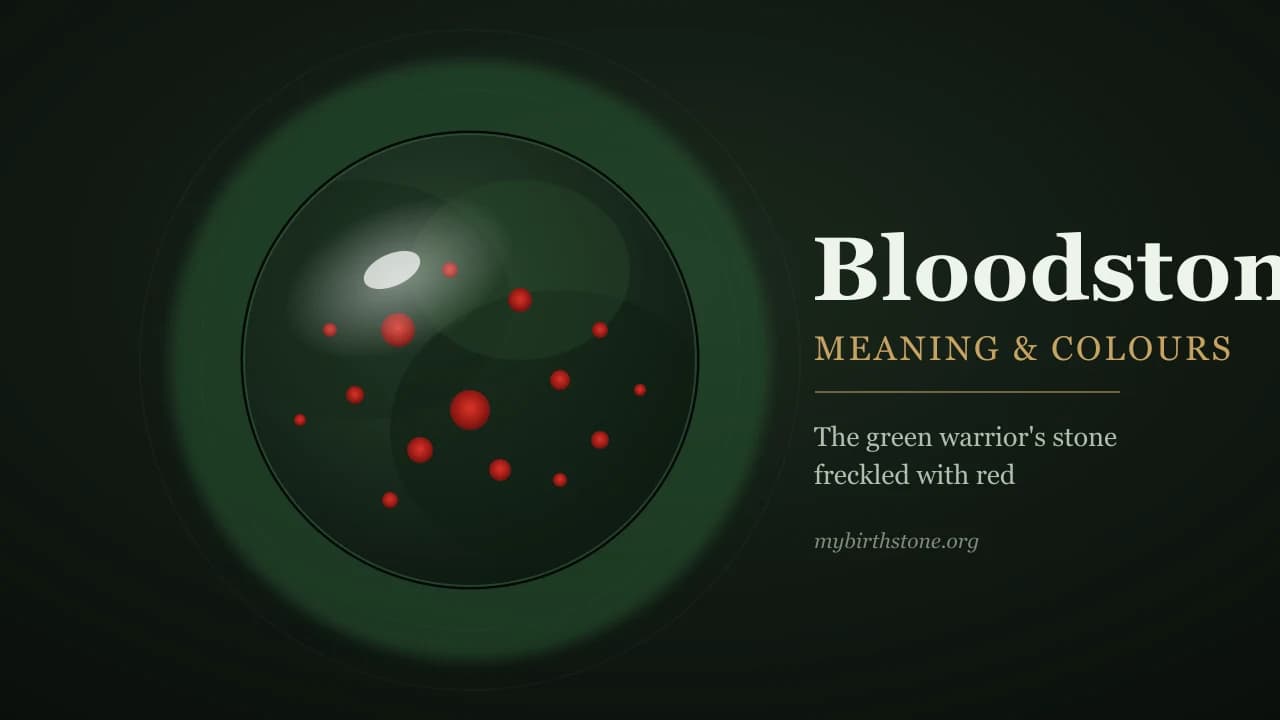
Most people, if they have heard of bloodstone at all, know it as the odd second half of March. Aquamarine gets the adverts and the engagement rings; bloodstone gets a raised eyebrow and a "the what stone?" That is a shame, because bloodstone carries some of the best history on the entire birthstone calendar, and it looks like nothing else. Picture a slab of deep, almost forest-green stone, opaque and solid, scattered with small drops of vivid red. The imagery is unmistakable, and the blunt name follows directly from it. This is a gem that reads like a battlefield in miniature.
We will give you our honest opinion up front, because it shapes everything below: bloodstone is one of the most underrated stones we write about, and its unpopularity has almost nothing to do with the stone itself. It is tough, it is characterful, it is astonishingly cheap, and it carries a thousand years of the strangest lore attached to any gem. It fell out of fashion simply because tastes drifted toward transparent, sparkling stones, and an opaque green-and-red talisman stopped fitting the mood. We think it deserves a second look.
This guide is the complete, honest take on bloodstone. What it actually is and why it is green and red, what it means and where that meaning comes from, the genuinely bizarre invisibility legend that the ancient and medieval world took seriously, the two different stones the modern trade sells under the single name "bloodstone," the full colour range, and how to buy and care for it without overpaying, which is easy, because almost nobody overpays for bloodstone. Let us get into it.
Bloodstone Meaning in One Sentence
If you only want the quick answer: bloodstone is the stone of courage, vitality, and protection, an ancient warrior's talisman long believed to strengthen the blood, steady the nerves, and shield its wearer from harm. Nearly all of that meaning flows straight from the look of the stone. A deep green field spotted with blood-red was always going to become the gem of blood, life, and battle, and for most of recorded history that is exactly what it was.
That reading has held remarkably steady across thousands of years, which is unusual. Where a stone like tanzanite has lore invented in the last sixty years, bloodstone's symbolism is genuinely ancient and consistent: blood, courage, endurance, protection, and life force. It is one of the few gems whose meaning you could probably guess correctly just by looking at it, and being right.
What Is Bloodstone?
Bloodstone is a variety of chalcedony, which is quartz built from crystals far too small to see, packed into a solid, opaque mass. That makes it a close cousin of onyx, agate, carnelian, and jasper, all of them the same microcrystalline quartz wearing different colours and patterns. Its older, grander name is heliotrope, and you will still see fine material sold under that word.
The deep green body colour comes from densely packed inclusions of green minerals, chiefly chlorite and amphibole, threaded through the quartz. The famous red spots are iron oxide, mostly hematite, sitting in the green like droplets. That is the whole recipe: green silicate ground, red iron freckles, all locked into tough chalcedony. There is a purely green version with no red spots at all, called plasma, which is essentially bloodstone that never got its blood. When the red is present, you have heliotrope, or bloodstone, and the red is the entire point.
There is a small, honest classification wrinkle worth knowing. Some bloodstone is translucent enough at the edges to be called chalcedony proper, while a lot of commercial material is fully opaque and grainy, which pushes it toward being called jasper. You will see it described both ways, sometimes as "chalcedony" and sometimes as "jasper," and both are defensible depending on the exact piece. It does not change how you wear it or what it costs. We mention it only so that when one seller calls it chalcedony and another calls it jasper, you know neither is lying to you.
On the Mohs hardness scale, bloodstone sits at about 6.5 to 7, the same broad range as most quartz, and crucially it has no cleavage, no built-in planes where it wants to split. Combined with its opacity, that makes it a genuinely practical stone. It is not cut to sparkle. It is cut and polished into smooth cabochons, flat plaques, beads, and carved seals, prized for its colour, its pattern, and the way it takes a fine engraving. This is a working stone, a talisman and a signet, not a chandelier gem, and that is exactly its charm.
The Strangest Legend in the Gem World: The Stone of Invisibility
Here is the piece of bloodstone lore that we think is the single most interesting thing about it, and that almost every modern write-up skips entirely. For well over a thousand years, serious people believed that bloodstone could make its wearer invisible.
The name heliotrope comes from Greek words meaning "sun turning," and the ancient explanation was that if you dropped the stone into a basin of water and angled it into direct sunlight, it turned the reflection of the sun blood red, as if the sun itself were bleeding. That optical party trick is where the magic started. Pliny the Elder, writing in the first century, recorded that the magi, the professional magicians of the ancient world, claimed that when heliotrope was combined with a particular herb of the same name and the right incantation, it would render the bearer invisible. Pliny, to his credit, reported this with clear scepticism, filing it under the tall tales of the magicians. But the idea stuck, and it stuck hard.
Medieval lapidary writers repeated the invisibility claim for centuries as though it were established fact, and it worked its way so deep into popular culture that in the fourteenth century Boccaccio built an entire comic story around it. In the Decameron, a gullible painter named Calandrino is convinced by two friends that a magical black-and-red stone called the heliotropia can be found in the local riverbed and will make whoever carries it invisible. He spends a ridiculous afternoon staggering home loaded with ordinary pebbles, convinced no one can see him, while his friends pretend they genuinely cannot find him and pelt him with stones. It is one of the funniest tales in the book, and it only lands because Boccaccio's readers already knew the bloodstone-invisibility legend by heart.
We love this, because it tells you how completely bloodstone's meaning was bound up with power and protection in the old imagination. This was not a pretty stone people admired. It was a stone people believed did things: turned the sun to blood, hid you from your enemies, staunched wounds, and gave you courage. Almost no gem on the calendar has a stranger or better-documented magical reputation, and it is a genuine pity that its modern identity has shrunk down to "the other March stone."
The Rest of the Lore: Warrior, Healer, and Martyr
The invisibility legend is the wildest thread, but bloodstone's symbolism runs through several others, and they all reinforce the same themes of blood, courage, and protection.
The warrior's and healer's stone. Roman soldiers, and later medieval fighters, carried bloodstone into battle. Partly it was for courage and strength, but there was a very literal belief underneath it: that the stone could stop bleeding. A green stone spotted with red was thought to have power over blood itself, so a soldier who pressed it to a wound expected it to help staunch the flow. We are firmly in folklore here, and we would gently point out that a lump of quartz does not clot blood. But you can see the logic, and it gave bloodstone a reputation as the athlete's and soldier's stone that has quietly survived to today.
The martyr's stone. The most famous single legend is Christian. Medieval tradition held that bloodstone was created at the Crucifixion, when drops of Christ's blood fell from the cross onto the green jasper at its foot and stained it forever. That is why it was sometimes called the "martyr's stone" and carved into religious scenes and devotional objects throughout the Middle Ages. We cover this and the rest of March's split personality in our full March birthstone guide, if you want the aquamarine side of the story too.
Seals and signets. Because bloodstone is tough, opaque, and takes a crisp carving, it was a favourite material for engraved seals, signet rings, and intaglios across the ancient and medieval world. This was one of the great working gemstones of history, the stone kings pressed into hot wax to close a letter, long before it became a curiosity.
Modern crystal lore. Today bloodstone turns up in the crystal-healing world as a stone of the root chakra, associated with circulation, detoxification, physical vitality, courage, and grounding. As with every gem, we are gentle sceptics on the medical claims: no stone cleans your blood or cures anything, and you should never treat a crystal as a substitute for actual care. What we will happily grant is that bloodstone is a genuinely meaningful symbol. Its whole history is about resilience, endurance, and life force, which makes it a quietly thoughtful gift for someone who has shown grit, faced something hard, or simply values substance over sparkle. If you are curious about how these talismanic traditions developed across all the birthstones, our talismans and amulets guide traces the whole story.
The Open Secret: Two Different Stones Called Bloodstone
Now the part that will actually save you from a small disappointment, and that fits a pattern we see again and again in the gem trade. Just as almost all black onyx is really dyed grey agate and most crystal-shop citrine is really heated amethyst, "bloodstone" is quietly used for more than one material.
The classic, traditional bloodstone, the heliotrope of all that ancient lore, is a dark green chalcedony or jasper with red iron-oxide spots, and the finest historic material has always come from India, out of the volcanic Deccan Traps. That is the real thing: deep green ground, distinct red flecks, the look that earned the name.
Over the last couple of decades, though, a second stone has flooded the market under the label "African bloodstone," sometimes sold as seftonite. This is a green jasper, usually from Africa, that carries red spots but also frequently cream, tan, or yellowish patches, giving it a more mottled, camouflage-like look than classic heliotrope. It is a real and perfectly nice stone, tough and cheap and often very attractive, but it is a different rock from traditional Indian bloodstone, and purists do not consider it true heliotrope at all. Neither is a scam, but if you have a specific look in mind, know which one you are buying. If you want the pure, dark green-with-red classic, ask specifically for Indian bloodstone or heliotrope, and be a little wary of anything described only as "African bloodstone."
There are two smaller name-traps worth flagging as well. The first is plain green jasper with barely any red, sold optimistically as bloodstone at the low end. If a piece is almost entirely dark green with only a faint smudge or two, it is really just green jasper wearing a better name. The second is "dragon bloodstone" or "dragon stone," a green-and-red rock made of epidote and piemontite that is not chalcedony at all and has nothing to do with real bloodstone beyond sharing two colours. It is the same kind of name-borrowing muddle we untangle for spinel and ruby, where one honest name has quietly been stretched over something else. None of these are dangerous mistakes. They just mean you should buy the stone in front of your eyes, not the word on the label.
Bloodstone Colours
Once you know the recipe, the colour range makes sense. Bloodstone is really a small family of looks built from the same two ingredients, green ground and red spots, in different proportions.
- Classic dark green with red spots is the archetype and the one to want. A deep, forest-to-blackish green body scattered with clearly separated, vivid red flecks. This is heliotrope at its best, and the tighter and brighter the red contrast, the finer the stone.
- Green with brownish spots is the more common, lower grade. Here the "blood" has oxidised toward a dull brown or rust rather than a bright red. It is perfectly wearable but reads as muddier and should cost less. Bright red beats brown-red every time.
- African bloodstone (seftonite), as covered above, brings cream, tan, or yellow into the mix alongside the red, for a more mottled, multi-tone look. Different character, not the classic, and priced accordingly.
- Plasma is the green-only version, a solid deep-green chalcedony with no red spots at all. Handsome in its own right, but strictly speaking it is bloodstone without the blood, and it was historically valued as its own material.
- Sea-green and lighter greens turn up occasionally, sometimes with the red more evenly distributed as a wash rather than distinct spots. These are the exception, not the rule.
Our buying opinion on colour is simple: contrast is everything. The whole appeal of bloodstone is the drama of red against green, so look for a deep, even green field and red spots that are genuinely red, well distributed, and cleanly separated rather than muddy or clumped into one patch. Because the stone is so cheap, you can afford to be fussy and simply hold out for a pattern you actually love.
How Durable Is Bloodstone? Care and Everyday Wear
Here is one of bloodstone's quiet advantages, and a place where it beats several far more expensive gems. Because it is a quartz at heart, hardness 6.5 to 7, with no cleavage and a tough, opaque body, bloodstone is genuinely fine for everyday wear. It is not in the fragile camp with opal, moonstone, or emerald, stones that need careful handling. A bloodstone ring or signet will take normal daily life without much drama, which is exactly why the ancient world used it for seals that got pressed into wax thousands of times.
That said, it is a touch softer than the very hardest gems, and like all chalcedony it can carry tiny internal fractures you cannot see, so treat it with reasonable respect:
- Clean it with warm soapy water and a soft cloth. That is genuinely all it needs.
- Skip the ultrasonic and steam cleaners. The vibration or heat can find a hidden fracture and turn it into a visible one. This is the single most important rule.
- Avoid harsh chemicals and prolonged, intense sunlight, which over a very long time can dull the colour of some material.
- Take it off for heavy work. A hard, direct knock is really the only thing likely to chip a cabochon, so pull a bloodstone ring off before rough manual jobs and it will stay handsome for decades.
Compared with the maintenance-heavy gems on the calendar, bloodstone is refreshingly low-drama. You can check where it sits against every other birthstone on our gemstone hardness chart, which ranks them all for daily wearability.
Is Bloodstone Valuable? What to Pay and Where It Comes From
Let us be honest, because it is good news: bloodstone is one of the most affordable gems there is. It is not rare, it forms in large masses, and there has never been much of a luxury market to inflate the price. Even a good-sized, well-patterned cabochon typically costs very little, and a bracelet or a run of beads is genuinely pocket-money jewellery. This is a stone where you buy for the pattern and the meaning, not as any kind of investment.
Because it is so cheap, the market around it is refreshingly honest. There is little incentive to fake or heavily treat something this inexpensive, so most of what you meet is exactly what it claims to be, allowing for the "African bloodstone" naming question above. The main sources are India (the classic Deccan Traps material and the historic gold standard), along with Brazil, Australia, Germany, and the United States. Indian material is the one to seek if you want the traditional dark-green-with-bright-red look.
When you are buying, the checklist is short:
- Is the green deep and even, and is the red genuinely red? Bright, well-scattered red spots on a rich green ground are the entire quality game.
- Is it classic heliotrope or "African bloodstone"? Both are fine, but they look different, so know which you are getting.
- Is it real chalcedony or thin green jasper wearing the name? If there is almost no red, it is really just green jasper.
That is it. There is no clarity grading to fret over, no treatment premium to argue about, and no report to commission. For serious money you would want a lab document on an aquamarine or a diamond, but bloodstone is the opposite kind of purchase: cheap, honest, and chosen entirely by eye. If you enjoy weighing natural stones against synthetic ones across the calendar, our lab-grown versus natural birthstones guide covers the trade-offs, and you can see where bloodstone sits on the price spectrum in our most expensive birthstones ranked, where it lands firmly at the friendly end.
Bloodstone vs Aquamarine: The Two Faces of March
If you were born in March, you get to choose, and it is a real choice because the two March stones could hardly be more different. Aquamarine is the modern birthstone almost everyone reaches for: a transparent, pale-blue beryl, faceted to sparkle, hard, elegant, and endlessly wearable. Bloodstone is the traditional one: opaque, dark, storied, cut as a smooth cabochon or a carving, and worn for its character rather than its shine.
Our flat recommendation, the same one we give in the full March guide: for a light, sparkling, universally loved everyday gem, aquamarine is very hard to beat, and you can read our dedicated aquamarine meaning and colours guide for the full picture. But if you are shopping for someone who prefers the unusual, the antique, or the meaningful over the merely pretty, especially for a man's signet, cufflinks, or a chunky cabochon ring, bloodstone is one of the most overlooked gifts on the whole calendar. You will be giving something with a thousand years of legend attached that almost nobody else thinks to give.
Quick Answers
Is bloodstone a birthstone? Yes. Bloodstone is the traditional birthstone for March, alongside the modern March stone, aquamarine. It is the older of the two and was March's stone for centuries before the modern list was standardised.
What does bloodstone mean? Bloodstone symbolises courage, vitality, strength, and protection. Its meaning comes directly from its look, a green stone spotted with blood red, and it was historically the stone of soldiers, healers, and endurance.
Why is it called bloodstone? For the obvious reason: the vivid red spots of iron oxide scattered across the deep green body look like drops of blood. Its older name, heliotrope, comes from a legend that the stone turned the sun's reflection blood red in water.
Did people really think bloodstone made you invisible? Yes, remarkably. From Pliny the Elder onward, magicians and lapidary writers claimed heliotrope, combined with the right herb and words, granted invisibility. The belief was so widespread that Boccaccio wrote a famous comic tale about it in the Decameron. It is folklore, but genuinely ancient and well-documented folklore.
Is bloodstone rare or valuable? No, and that is part of its charm. Bloodstone is common and one of the most affordable gemstones on the birthstone calendar. You buy it for its pattern and meaning, not as an investment.
Can you wear bloodstone every day? Yes. At hardness 6.5 to 7 with no cleavage, it is one of the tougher, more practical birthstones and stands up well to daily wear. Just clean it gently with soapy water and keep it away from ultrasonic cleaners.
What is the difference between bloodstone and jasper? Bloodstone is essentially a specific green-and-red variety of chalcedony that is often opaque enough to be called jasper. So bloodstone is a kind of jasper or chalcedony, but plain green jasper with little or no red is not true bloodstone.
The Bottom Line
Bloodstone is the birthstone that history remembers and fashion forgot. It has been a soldier's talisman, a healer's charm, a king's seal, a martyr's relic, and, for over a thousand years, a magician's key to invisibility. It is tough enough to wear every day, cheap enough to buy on a whim, and carries more genuine legend per gram than almost anything else on the calendar. Our advice is simple: look for a deep green stone with bright, well-scattered red, ask whether it is classic heliotrope or "African bloodstone," pay the small amount it should cost, and enjoy owning one of the most quietly interesting gems there is. March babies who default to aquamarine are missing a trick.