Onyx: Meaning, Colours, and the Black Stone That's Almost Always Dyed
Onyx is one of those stones almost everyone can picture instantly. Deep, even, glassy black, the colour of a starless night, set in silver on a signet ring or strung as a rope of dark beads. It reads as serious, grounded, a little gothic. It is the stone people reach for when they want protection, focus, or the feeling of being anchored. And it hides a secret that the trade has quietly kept for centuries.
Here it is, plainly, because we would rather you heard it from us than felt cheated later: almost all of the solid black onyx you have ever seen has been dyed. In its natural state, onyx is rarely a clean, uniform black. It usually turns up as ordinary grey and white banded agate, the sort of thing you would walk past in a rock shop. To get that flawless inky black, it is soaked in a sugar solution and then treated with acid, a recipe so old the Romans were using it two thousand years ago. The colour is permanent and stable, the stone underneath is completely real, and there is nothing dishonest about the practice itself. What bothers us is how rarely anyone actually says so.
This guide is the honest, complete take on onyx. What it means and where that meaning comes from, what onyx actually is, why black onyx is nearly always treated and why that is fine, the other "onyx" that shares the name but is a totally different and much softer stone you should not confuse it with, the real range of colours, why sardonyx is August's traditional birthstone and the stone the ancient world carved its cameos from, and how to buy and care for a gem that, for once, is genuinely tough enough for daily wear. Onyx is more interesting than its plain black reputation suggests. Let us get into it.
Onyx Meaning in One Sentence
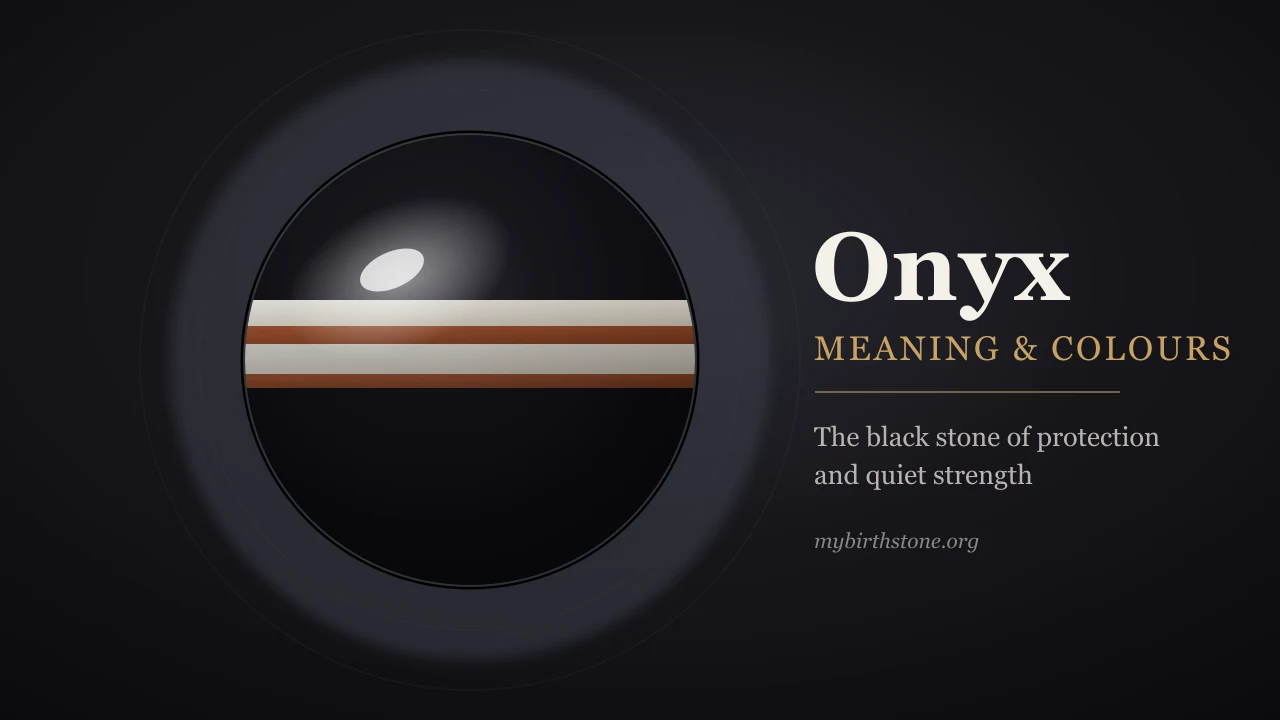
If you only want the quick answer: onyx is the stone of protection, grounding, and self-control, a deep black gem long believed to absorb negativity, steady the emotions, and give the wearer the willpower and focus to hold firm under pressure. Almost all of that meaning flows from the one obvious thing about the stone, its dense, absorbing blackness, which people across cultures read as a shield, a boundary, and a source of steady, unshowy strength.
That reading fits onyx unusually well. A stone this dark and this solid looks like it could soak up whatever you throw at it, so it became the natural symbol for defence, discipline, and keeping your feet on the ground. We will come back to the full symbolism further down, including a rather good ancient myth about where the name came from, but first the part that explains everything practical about the stone.
What Is Onyx?
Onyx is a variety of chalcedony, which is quartz made of crystals far too small to see, packed tightly into a solid mass. That makes it a close cousin of agate, carnelian, jasper, and bloodstone, all of them the same microcrystalline quartz wearing different colours and patterns. On the Mohs hardness scale onyx sits at about 7, the same as any other quartz, and crucially it has no cleavage, no built-in planes where it wants to split. We will make a fuss about this later, because it is the best practical thing about the stone.
Strictly speaking, in mineral terms "onyx" means chalcedony with straight, parallel bands of colour, the flat layers being what distinguishes it from agate, whose bands curve and swirl. That is the textbook definition. In the real world of jewellery, though, the word "onyx" has come to mean one thing above all others: solid black. When a jeweller says onyx, they almost always mean the plain black stone, and the banded and coloured versions get named separately. This gap between the strict definition and the everyday one is worth holding onto, because it explains a couple of the confusions coming up.
Onyx is opaque, which sets it apart from most of the gems we write about. It is not cut to sparkle or throw fire. It is cut and polished into smooth cabochons, beads, flat inlays, and signet faces, and prized for its rich, even colour and its deep glassy polish rather than for any play of light. It is a stone of surface and colour, not of internal fireworks, and that is exactly why it works so well as a bold, graphic, modern material.
The Open Secret: Why Black Onyx Is Almost Always Dyed
Now the part we opened with, in full, because it is the single most useful thing to understand about buying onyx. Natural, solid, gem-quality black onyx does exist, but it is genuinely uncommon. Most chalcedony that comes out of the ground in the right grey-and-white banded form is dull and unremarkable. So for a very long time, the trade has taken that ordinary grey agate and dyed it black.
The classic method is old and slightly wonderful: the stone is soaked in a sugar solution so the porous chalcedony draws it in, then treated with sulphuric acid, which chars the absorbed sugar into carbon black inside the pores. The colour ends up locked into the structure of the stone rather than painted on the surface, which is why it is so permanent and why dyed black onyx does not fade or rub off the way cheaper surface dyes do. Pliny the Elder described versions of this technique in the first century, so you are looking at one of the oldest gem treatments still in everyday use.
Our honest position on this is the same one we take with heated citrine and stabilised turquoise: a stable, permanent, disclosed treatment is not a fake, and dyed black onyx is real onyx. The chalcedony is genuine quartz, the black is permanent, and the stone will serve you well. The only thing we object to is the silence. Because almost nobody discloses it, buyers assume they are getting a rare natural black stone at a rare natural price, when in fact solid black onyx is one of the more affordable gems precisely because dyeing plain agate is cheap and easy. So the rule is simple: do not pay a premium for "natural" black onyx unless there is a lab report to back it up. Assume any solid, flawless, evenly black onyx has been dyed, price it as the affordable stone it is, and enjoy it for what it genuinely is, which is a handsome and durable black gem.
There is one small practical consequence. Because the black comes from carbon driven into the pores, very harsh chemicals, prolonged heat, or aggressive cleaning can, over a long time, affect dyed stones more than they would a natural one. It is not fragile, but it is another reason to clean it gently, which we cover at the end.
The Other Onyx: A Warning About the Name
Here is a trap that catches people out constantly, and it is worth a whole section because the two stones could hardly be more different. The word "onyx" gets used for two completely unrelated materials.
The first is the one we have been describing: true onyx, a chalcedony, a quartz, hardness 7, tough and durable, the black gemstone in your ring.
The second is what the stone trade calls "onyx marble" or "Mexican onyx" or "onyx" for short, the translucent, honey-coloured, green, or amber banded stone you see carved into lamps, chess sets, bookends, ashtrays, and countertops. That material is not quartz at all. It is a form of calcite, a completely different mineral, and it sits at only about 3 on the Mohs scale. That is soft enough to scratch with a coin or even a fingernail's edge on the softest examples, and it dissolves in acid, including the mild acids in fruit juice and household cleaners.
We cannot stress this enough, because it is the origin of a lot of disappointed buyers. If someone sells you a beautiful translucent green or golden banded "onyx" bowl or bangle, that is almost certainly the soft calcite kind, and it will scratch, etch, and wear far faster than you expect from something called onyx. It is lovely as a decorative or occasional-wear piece, but it is not the tough quartz gemstone, and it should never cost gemstone money. When you see the word onyx, your first question should be: is this the quartz or the calcite? For a ring or bracelet you want worn daily, you want the quartz. This is the same kind of name-borrowing muddle we untangle for spinel and ruby, where one name has quietly stood in for something else for centuries.
Onyx Colours
Once you know that black is usually dyed and that "onyx" can mean two minerals, the colour range makes much more sense. Here is the honest breakdown:
- Black onyx is the classic, the one everyone pictures, and, as covered above, nearly always dyed grey agate. Deep, even, glassy black. This is what "onyx" means to most people and most jewellers, and it is genuinely handsome. Just price it as the affordable, treated stone it almost always is.
- Sardonyx is the natural aristocrat of the family and the reason onyx matters to the birthstone calendar. It is onyx banded with sard, a reddish-brown to orange chalcedony, giving alternating layers of dark and warm brown-red. Those flat, contrasting bands are what made it the great carving stone of the ancient world, which we come to next.
- White onyx is a pale, milky-to-chalk-white chalcedony, sometimes banded, used for inlay and beads and as a calm counterpoint to the black.
- Banded onyx shows the strict, textbook onyx look: straight parallel layers of black and white, or grey and white, often cut so the bands run across a cabochon in clean stripes. Cameos and intaglios exploit exactly this layering.
- Green onyx, blue onyx, red onyx, and other bright colours are where you need your wits about you. Chalcedony takes dye readily, so most vividly coloured "onyx" is dyed the same way the black is, and some of the translucent green material sold as onyx is actually the soft calcite type in disguise. None of this is necessarily bad, but a bright, cheap, perfectly even colour is a dye job, not a natural rarity, and should be priced accordingly.
The through-line, which is the same lesson every honest gem guide keeps arriving at, is that a single word is hiding an enormous range, from a genuinely rare natural sardonyx to a bag of dyed agate beads. Knowing which is which is what lets you spend sensibly.
Sardonyx, Cameos, and the August Connection
Sardonyx deserves its own moment, because it is both the most historically important onyx and the one with a real place on the birthstone list. Sardonyx is August's traditional birthstone, the older stone for the month, sitting alongside modern peridot and, since 2016, spinel. If you want the full picture of the month, we lay out all three in our August birthstone guide, and the August pillar page ties the month together.
What makes sardonyx special is not sparkle, it is structure. Because it grows in flat, parallel layers of contrasting colour, a skilled carver can cut down through a pale layer to reveal a dark one beneath, leaving a raised light figure standing out against a dark background. That is a cameo, and sardonyx was the supreme cameo material of Greece and Rome. The layered stone let carvers create portraits and scenes with a depth and contrast no single-colour gem could match, and Roman senators wore sardonyx seal rings to stamp wax, trusting that the hard quartz would not stick to the seal. For a stone people now think of as plain, that is a genuinely grand history, and it is why sardonyx, not plain black onyx, is the one the traditional birthstone lists actually name.
Onyx Meaning and Symbolism
Onyx has a dense, consistent body of symbolism, and nearly all of it grows from that absorbing blackness. The main threads:
- Protection and defence. This is onyx's oldest and strongest meaning. Its darkness was read as a shield that absorbs and deflects negative energy, ill will, and psychic attack, which is why it turns up again and again as a guardian or grounding stone. If you want the real history of why any stone came to be worn as a protective charm, we dig into it in our talismans and amulets guide.
- Grounding and stability. A stone this heavy, dark, and solid became the natural symbol of being anchored, centred, and steady. Onyx is the stone people reach for when life feels chaotic and they want to feel their feet on the floor again.
- Self-control and willpower. Onyx has long been linked to discipline, focus, and mastering your own impulses, the strength to hold a line and not be swept away by emotion. It is a stone of quiet, contained power rather than showy energy.
- Mourning and remembrance. In the Victorian era, black onyx became the great stone of mourning jewellery. After a bereavement, people wore dark, sombre pieces, and onyx, being deep black yet still elegant, was perfect for it. That association with grief, memory, and honouring the dead still clings to the stone today and gives it some of its serious, solemn character.
And then there is the name, which comes with one of the better gem myths. "Onyx" comes from the Greek word for fingernail or claw. The story goes that Cupid, playing, trimmed the fingernails of the sleeping goddess Venus with an arrowhead and scattered the clippings on the ground, where the Fates, unwilling to let any part of a goddess perish, turned them to stone. That stone was onyx. The pale, banded, slightly translucent look of natural onyx really does resemble a fingernail, which is presumably where the name honestly comes from, but we prefer the version with Cupid.
Here is our standard and sincere position, the one we hold for every gem. These are cultural and symbolic meanings, not physical powers. Onyx will not literally absorb negativity, shield you from harm, or grant you willpower. What it genuinely offers is one of the most concentrated symbols of protection and grounding in the whole gem world, thousands of years of lore, and a deep, serious, handsome black stone that looks the part completely. You can enjoy every bit of that while understanding that the stone is doing nothing but being beautifully, densely dark.
Is Onyx a Birthstone?
This needs a careful, honest answer, because it is a common question and the truth is a little tangled. Plain black onyx is not one of the main modern birthstones for any month. What is on the traditional list is its banded cousin, sardonyx, the traditional birthstone for August, which we covered above. So if you were born in August, onyx has a real and ancient claim on you through sardonyx, and you can happily treat black or banded onyx as a stone of your month.
Beyond August, onyx also turns up in the older mystical and zodiac systems. It is frequently linked to the sign of Leo, whose bold, willful, protective character the grounding black stone is felt to suit, and you can see how the site handles sign stones on our Leo birthstone page. Some talismanic lists attach onyx to other months and signs too, because these older systems never fully agreed with one another. Our honest summary: onyx's firm, official birthstone claim runs through sardonyx and August, and everything beyond that is the looser, mystical tradition, which is fun and meaningful but not the same as the modern birthstone list.
What Onyx Is Worth
Onyx is, by gemstone standards, an affordable and accessible stone, and understanding why keeps you from overpaying. Solid black onyx is common and, as we have said, usually dyed from cheap grey agate, so it is one of the least expensive gem materials you can buy. That is genuinely good news: it means you can own a large, flawless, richly black stone for very little, and there is no shame in that at all. Onyx sits at the sensible, wearable end of the market, nowhere near the most expensive birthstones, and that is part of its appeal.
Where a little value does hide is in the natural and the finely carved. Genuinely natural, untreated black onyx is scarcer than the dyed kind and can carry a modest premium, but only if it is certified, so do not pay for "natural" on a seller's word alone. Fine sardonyx with strong, clean, well-contrasted banding, especially antique carved cameos and intaglios, is where onyx becomes genuinely collectible, because the artistry and the natural layering cannot be faked cheaply. And as always, once you cross into anything sold as translucent green or golden "onyx," check whether you are being quietly handed the soft calcite type, which should cost a fraction of the quartz.
Our buying opinion in one line: treat black onyx as the affordable, treated, durable stone it is, spend your money on the setting and the craftsmanship rather than the stone, and reserve any real budget for fine natural sardonyx if the layered look and the history appeal to you.
How to Buy and Care for Onyx
When buying onyx:
- Assume black onyx is dyed, and price it accordingly. This is not a reason to avoid it, it is a reason not to overpay. Only pay a natural premium against a proper lab report.
- Confirm it is quartz, not calcite. For anything you will wear regularly, especially rings and bracelets, make sure you are getting true chalcedony onyx (hardness 7), not the soft "onyx marble" calcite (hardness 3). If a translucent green or honey stone is suspiciously cheap and easily scratched, it is the calcite.
- Look at the polish and the evenness. Good onyx has a deep, glassy, mirror-like polish and an even colour with no dull patches or surface scratches. Because it is opaque, surface quality is everything.
- For sardonyx, judge the banding. Strong, clean contrast between the sard and the white, and a well-placed band on a cabochon or cameo, is what separates a fine piece from an ordinary one.
- Watch for imitations. Black glass and black plastic are sometimes passed off as onyx. Real onyx feels cool and heavier than plastic, and, being a natural stone, is harder to scratch than glass. When in doubt, a jeweller can confirm it in seconds.
Caring for onyx, which is refreshingly easy:
- Here is onyx's quiet superpower: it is genuinely durable. At hardness 7 with no cleavage, it is far tougher for daily wear than fragile stones like opal, moonstone, or tanzanite. It will not chip or split from an ordinary knock the way a cleaved stone can, which makes it one of the more practical gems for rings and bracelets that live a real life.
- Clean it gently despite that toughness, because most black onyx is dyed. Warm water, mild soap, and a soft cloth are all it needs. Avoid ultrasonic and steam cleaners, harsh chemicals, and prolonged heat or strong sunlight, all of which can, over time, affect the dye or the polish. You want the durability of the quartz without stressing the treatment.
- Store it sensibly. Onyx can scratch softer stones, and harder stones like sapphire, diamond, and topaz can scratch it, so keep it apart in your jewellery box. Its opaque, high-polish surface shows scuffs clearly, so a little separation keeps it looking sharp.
- If it is the calcite kind, treat it as delicate. Keep it away from acids, cleaners, perfume, and rough handling, and save it for occasional wear or display.
Handled with a bit of sense, onyx will stay deep, glossy, and handsome for a lifetime, which is a lot of stone for very little money. You can check exactly where it sits against every other gem on our gemstone hardness chart.
Quick Answers
What does onyx symbolise? Protection, grounding, self-control, and quiet strength. Its dense black colour made it the classic stone for absorbing negativity, steadying the emotions, and holding firm under pressure, and in the Victorian era it was the great stone of mourning jewellery.
Is black onyx dyed? Almost always, yes. Most solid black onyx starts as grey banded agate and is dyed black with an old sugar-and-acid method. This is stable, permanent, and legitimate, and the stone is real onyx, but it means black onyx should be priced as an affordable, treated gem rather than a rare natural one.
Is onyx a birthstone? Its banded cousin sardonyx is the traditional birthstone for August. Plain black onyx is not a main modern birthstone, but it is linked to August through sardonyx and to the sign Leo in the older mystical traditions.
What is the difference between onyx and "onyx marble"? They are two unrelated stones sharing a name. True onyx is a quartz (chalcedony), hardness 7, tough and durable. "Onyx marble," the translucent green or golden banded stone used for carvings and countertops, is calcite, hardness about 3, soft and easily scratched or etched. For jewellery you want the quartz.
Is onyx good for everyday wear? Yes. At hardness 7 with no cleavage, onyx is one of the more durable gemstones and stands up to daily wear far better than fragile stones like opal or moonstone. Just clean it gently, because the black is usually dyed.
What colour is onyx? Classic onyx is solid black, though most of that is dyed. Naturally it also occurs as sardonyx (reddish-brown and white bands), white, and grey-and-white banded forms. Bright greens, blues, and reds sold as onyx are usually dyed chalcedony or the soft calcite type.
The Bottom Line
Onyx is the deep black stone of protection and grounding, a quartz (chalcedony) that is genuinely tough enough for daily wear and, for once among gemstones, genuinely affordable. Its meaning, defence, stability, self-control, and remembrance, flows straight from its dense, absorbing darkness, and its finest natural form, banded sardonyx, is August's traditional birthstone and the stone the ancient world carved its cameos from.
But the idea to carry away is the open secret. Almost all black onyx is dyed grey agate, treated by a method two thousand years old, and while that is completely legitimate, it means you should never pay a rare-natural price for a common treated stone. Confirm you are buying the tough quartz and not the soft calcite that shares its name, spend your money on the setting and the craftsmanship rather than the stone itself, and save any real budget for fine natural sardonyx if its layered look and grand history appeal to you. Do that, and you will understand onyx better than most people who have worn it for years, and you will get a great deal of serious, handsome, durable black stone for very little.
If onyx drew you in, the natural next stops are its role in the month it belongs to in our August birthstone guide, the same open-secret story of treatment in our citrine meaning guide and turquoise meaning guide, the deeper roots of why gems were ever worn as protection in our talismans and amulets guide, the honest question of grown and treated stones in our lab-grown versus natural birthstones guide, and the full value map in our most expensive birthstones ranked, where onyx sits comfortably, and sensibly, near the affordable end.