Diamond: Meaning, Colours, and the Two Scales That Run in Opposite Directions
Everyone thinks they understand diamond. It is the birthstone of April, the stone on the engagement ring, the hardest natural material on the planet, the gem that means forever. All of that is true. But there is one thing about diamond that even people who own several have never quite grasped, and it is the most interesting thing about the stone: colour works in two completely opposite directions at once.
Here is what we mean. For an ordinary white diamond, the kind on almost every ring, colour is a defect. The less colour it has, the rarer, better, and more expensive it is, and the dream is a stone so utterly colourless it looks like a drop of pure light. You pay a premium to get rid of colour. But keep pushing past the bottom of that scale, past faint yellow into a real, saturated, unmistakable colour, and something remarkable happens. The rules invert entirely. Now the colour is not a flaw at all, it is the whole point, and a vivid pink, blue, or red diamond can be worth many times more than a flawless colourless one of the same size.
So diamond is really two gems wearing one name, judged on two scales that run in opposite directions. This guide is the honest, complete take on both. What diamond means and where its symbolism comes from, what a diamond actually is, the D-to-Z grade that governs white diamonds and why colourless wins, the astonishing world of fancy colour diamonds and why they break every rule, what physically causes each colour, how to tell a natural fancy from a treated or lab-coloured one, what drives the price, and how to care for a stone that is the hardest thing you own and yet can still chip. Diamond is April's birthstone and the most familiar gem on Earth. It also happens to be the most misunderstood. Let us fix that.
Diamond Meaning in One Sentence
If you only want the quick answer: diamond is the stone of enduring love, strength, and purity, a gem whose ancient name means "unconquerable" and whose flawless clarity and unmatched hardness made it, across cultures, the symbol of a bond and a character that nothing can break. Almost all of its meaning flows from two obvious physical facts, that it is the hardest substance known and that at its best it is perfectly clear, so people have always read it as invincibility made solid and truth made visible.
That meaning fits the stone unusually well, because nothing else in the natural world is quite this durable or, when fine, quite this clear. It is very easy to see why a culture that found the one material that could scratch everything and be scratched by nothing decided it must stand for permanence, and why the one gem that looked like frozen light came to mean purity. We will come back to the full symbolism below, but first the part that explains everything practical about diamond, what it is and why it does what it does.
What Is a Diamond?
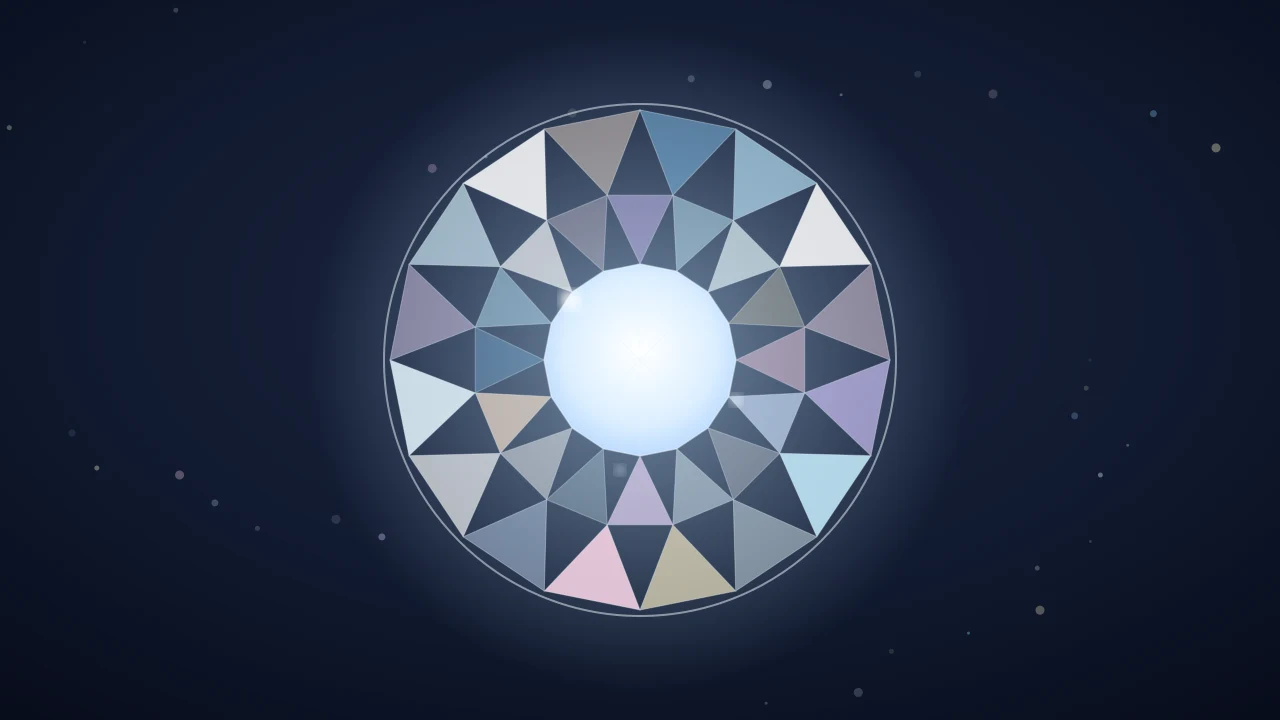
A diamond is pure carbon, the same element as the graphite in a pencil, arranged into a crystal so tightly and symmetrically that it becomes the hardest natural material on Earth. That is worth pausing on, because it is the whole story of the stone. The exact same atoms that make soft, grey, slippery pencil lead, put under enormous pressure and heat deep in the Earth's mantle and locked into a rigid three-dimensional lattice, become the most durable and one of the most brilliant gems there is. Carbon is the trick, and geometry is the magic.
On the Mohs hardness scale diamond sits at 10, the very top, and it is not a close race. Diamond is far harder than anything below it, which is why it resists scratches so completely and holds a razor-sharp polish that keeps its sparkle for generations. This is genuinely diamond's great practical virtue as a daily-wear stone, and it is a real one. A diamond ring worn every day for fifty years will still look sharp, where a softer stone would have gone dull at the facet edges.
But here is the honest caveat almost no marketing mentions, and it is the same lesson emerald teaches from the other direction: hardness and toughness are not the same thing. Hardness is resistance to scratching, and diamond wins that outright. Toughness is resistance to chipping and breaking, and diamond is only good, not perfect, because it has directions of cleavage, planes along which the crystal can split. A sharp, unlucky knock on the right spot and even a diamond can chip. This is rare, and diamond is still one of the toughest gems you can wear, but "unbreakable" is a myth, and it is exactly the myth we untangle in our April diamond myths guide, where the ancient belief that a real diamond could survive a hammer blow got a lot of good stones smashed.
What makes diamond sparkle is a second piece of physics: it bends and slows light dramatically (a high refractive index) and splits white light into its spectrum (dispersion, the "fire"). A well-cut diamond traps light, bounces it around inside, and throws it back at your eye as brilliance and flashes of colour. Cut, not colour or clarity, is what makes a diamond come alive, which is why we always tell people it is the one of the four Cs worth spending on.
The Two Colour Scales, and Why They Run Backwards
This is the section that sets diamond apart from every other gem, and once it clicks, the entire pricing of the stone suddenly makes sense. Think of diamond colour as a single long line. At one end, pure colourless. Move along it and you pick up a faint tint, usually yellow or brown, getting stronger. Keep going and the tint deepens into an obvious pale yellow. And then, if the colour keeps intensifying past a certain point, you cross a threshold into a rich, saturated, deliberate colour.
The strange part is that value is high at both ends of that line and lowest in the middle. A perfectly colourless diamond is rare and prized. A faintly tinted one, stuck in the middle of the scale, is the cheapest. And a diamond saturated enough to be a true fancy colour is rare and prized all over again, often far more than the colourless one. It is a U-shaped value curve, and almost nobody explains it, which is why so many people are baffled that a yellowish diamond is cheap but a yellow diamond is expensive. The answer is saturation. A little colour is a flaw. A lot of colour, past the threshold, is a feature. Let us take the two halves in turn.
Scale One: The D-to-Z Grade for White Diamonds
For the ordinary white diamonds that make up the vast majority of what is sold, colour is graded on a letter scale that runs from D to Z, and this is one of the small oddities of the gem world worth knowing. It starts at D, not A, because when the modern system was created the trade wanted a clean break from older, looser grading terms, so it began at a letter no one had used.
The scale runs from colourless to faintly tinted, and less colour is always better. Here is the shape of it:
- D, E, F are colourless, the top of the scale, genuinely rare and the most expensive. D is as close to no colour as a diamond gets. To the naked eye, D, E, and F look essentially identical, which matters for buying.
- G, H, I, J are near-colourless, where most fine jewellery actually lives. These look white face-up, especially once set, and represent the sweet spot of value for most buyers. A well-cut G or H diamond looks colourless to almost everyone and costs meaningfully less than a D.
- K through Z show an increasingly visible warm tint, usually yellow or brown, getting stronger as you go down. These are progressively cheaper, and by the bottom of the scale the tint is obvious.
Our honest opinion, and it saves people real money: do not chase D. Unless you are a collector who wants the certificate to say colourless, you are paying a steep premium for a difference you cannot see once the stone is on a hand. A G or H diamond in a well-chosen setting looks every bit as white to the human eye, and the money saved is far better spent on cut, which is what actually makes a diamond sparkle. This is the same logic we apply to clarity, and you can see the full grading picture in our diamond clarity chart, which walks through how the four Cs interact.
One practical note on setting: metal colour interacts with diamond colour. A very white D to F stone shows best in white metals like platinum or white gold, where nothing warms it up. A slightly tinted J or K stone can actually look whiter and lovelier set in yellow gold, because the warm metal cancels the warm tint. There is no waste in a warmer stone if you set it cleverly, which is another reason not to overpay at the colourless end.
Scale Two: Fancy Colour Diamonds, Where Every Rule Flips
Now for the half that most people have never really looked at, and the half we find genuinely thrilling. Once a diamond's colour is saturated enough to sit clearly outside the D-to-Z range, past faint tint and into a real, definite colour, it stops being a white diamond entirely and becomes a fancy colour diamond. And here every rule you just learned turns upside down.
For fancies, colour is no longer the flaw, it is the entire prize. They are graded not on how little colour they have but on how much, running from Faint up through Fancy Light, Fancy, Fancy Intense, Fancy Vivid, and Fancy Deep. The more intense and pure the colour, the rarer and more valuable the stone, which is the exact opposite of the white scale. A Fancy Vivid diamond is the aristocrat of its colour. These are the stones behind the record-breaking auction headlines, and they come in almost every colour imaginable:
- Yellow diamonds, often called canary at their finest, are the most available and affordable of the fancies, which makes a strong-colour fancy diamond genuinely attainable for the first time. A vivid yellow diamond is pure sunshine and, relative to pink or blue, a comparative bargain.
- Pink diamonds are among the most coveted and expensive gems on Earth, made famous by Australia's now-closed Argyle mine, which produced most of the world's fine pinks and shut in 2020, tightening supply and pushing prices even higher.
- Blue diamonds are extraordinarily rare and command staggering prices. The most famous gem in the world, the Hope Diamond, is a deep grey-blue, and its colour comes from a trace element we will meet in a moment.
- Green diamonds are rarer still and notoriously tricky, because their colour comes from natural radiation over geological time and can be skin-deep, which makes cutting them a nervous business and grading their natural origin a specialist's job.
- Red diamonds are the rarest of all. There are only a tiny handful of true fancy red diamonds known to exist in the entire world, and they are effectively priceless. When people ask what the rarest gem on Earth is, the honest answer is often a red diamond, and you will find it near the very top of our most expensive birthstones ranked guide.
So the same word, "colour," means a discount on one scale and a fortune on the other. That is the paradox at the heart of the stone, and it is why we think diamond is far stranger and more interesting than its familiar reputation suggests.
What Actually Causes Diamond's Colours
The colours are not dye or coating in a natural stone, they are physics, and each one has a specific cause worth knowing because it also explains the rarity:
- Yellow and brown come from nitrogen atoms scattered through the carbon lattice. Nitrogen is the most common impurity in diamond, which is exactly why faint yellow is the ordinary "off-colour" tint on the white scale and why yellow is the most available fancy. Common cause, common colour.
- Blue comes from boron. Boron is rare in the deep Earth where diamonds form, so natural blue diamonds are correspondingly rare. As a bonus of physics, boron makes the diamond faintly electrically conductive, which is one way labs can distinguish a natural blue from some imitations.
- Pink and red come not from an impurity at all but from distortion of the crystal lattice itself, caused by intense pressure and shearing deep underground, which changes how the structure absorbs light. Because it is a structural quirk rather than a chemical one, it is unpredictable and scarce, which is a big part of why pink and red sit at the top of the market.
- Green usually comes from natural radiation, where the stone sat near radioactive minerals in the ground for millions of years and its surface absorbed just enough to shift the colour. This is why green is often shallow and why proving a green is naturally coloured rather than lab-irradiated is one of the hardest calls in gemmology.
- Black diamonds get their colour from a dense scattering of dark inclusions, graphite and other minerals, throughout the stone, which is why they are opaque rather than sparkling.
Knowing the cause is genuinely useful when you buy, because it tells you which colours are naturally common and cheap (yellow) and which are naturally scarce and dear (blue, pink, red), and it sets up the one real trap in the fancy world, which is treatment.
Black, Champagne, and the Affordable End of Colour
Not every coloured diamond costs a fortune, and this is worth saying plainly because the auction headlines give a lopsided impression. Two fancies are genuinely accessible and have their own honest appeal.
Champagne and cognac diamonds are simply brown diamonds given a nicer name, ranging from light champagne to deep cognac. Brown was long treated as the least desirable diamond colour, dug up in quantity and largely used for industry, so these are among the most affordable diamonds with real colour, and a warm champagne stone can be genuinely beautiful in the right setting. Searches for "champagne diamond" have climbed sharply, and we think that is fashion catching up to good value.
Black diamonds are dramatic, modern, and relatively inexpensive for their size, because their colour comes from abundant inclusions rather than rarity. A black diamond carries its own symbolism too, often read as strength, power, and protection, which is why it has become popular for bold statement rings. Just know what you are buying: a black diamond is prized for looks and drama, not for the rarity that drives a blue or a pink.
The lesson across both scales is the same one we come back to for every gem. There is an enormous price range hiding under a single word, and understanding which colours are common and which are scarce is what lets you spend well instead of simply spending a lot.
The Trap: Natural Colour, Treated Colour, and Lab-Grown
Here is the one part of the fancy world that can genuinely catch you out, and it is the direct parallel to oiling in emerald or heat in sapphire. Because vivid natural colour is so rare and valuable, the trade has become very good at creating colour artificially, and there is nothing wrong with that as long as it is disclosed and priced accordingly. The problem is only ever an artificially coloured stone sold as a natural one.
There are three distinct things sitting under the words "colour diamond," and telling them apart is everything:
- Natural fancy colour is a mined diamond that got its colour from nature, nitrogen, boron, radiation, or lattice distortion, over millions of years. This is the rare, expensive, headline kind.
- Treated colour is a real diamond, often a cheap, faintly tinted or off-colour white one, whose colour has been transformed in a lab by irradiation (to create blue, green, or black) or HPHT, high-pressure high-temperature processing (to create or improve yellow, pink, and others). The stone is a real diamond, but the colour is human-made. These are legitimate and can be lovely, and they cost a small fraction of a natural fancy. They must be disclosed.
- Lab-grown coloured diamonds are diamonds grown in a lab from the start, which can be given fancy colours during or after growth. Again real diamond, again far cheaper, again completely fine if you know that is what you are buying. Our full take on grown versus mined lives in our lab-grown versus natural diamond guide.
Our honest position is the same one we hold everywhere: grown or treated with human help is not the same as fake, but it must be disclosed, and the price must reflect it. A natural vivid blue diamond and an irradiated blue diamond can look similar to the eye and differ in price by a factor of hundreds. So the single rule for buying any fancy colour diamond of real value is simple and non-negotiable: get a report from a major gem lab that states whether the colour is natural or treated, and the origin of the stone. For a serious colour purchase, that certificate is not paperwork, it is the whole difference between the two scales.
Diamond Meaning and Symbolism
Diamond has one of the most concentrated bodies of symbolism of any gem, and it clusters around a few clear themes, almost all growing from those two physical facts, its hardness and its clarity:
- Invincibility and strength. The name comes from the Greek adamas, meaning unconquerable or unbreakable, and for most of history diamond meant exactly that, an unbeatable strength that could turn aside any blow. Warriors wore it into battle for protection. The full, strange history of that belief, including the medieval conviction that a real diamond would survive being struck with a hammer, is in our April diamond myths guide.
- Enduring love and commitment. This is diamond's most familiar modern meaning, the reason it sits on the engagement ring. A material that nothing can scratch or destroy became the natural symbol of a bond meant to last forever. Some of that association is genuinely ancient, and some of it is twentieth-century marketing, and we think it is worth knowing which is which.
- Purity and clarity. A fine diamond looks like frozen, colourless light, and so it came to stand for purity, innocence, and clarity of mind and purpose. The clearer the stone, the purer the symbol.
- Truth and constancy. Because it does not change, wear, or fade, diamond became a symbol of truth and of the constant, unchanging heart, the thing that stays the same when everything else shifts.
Its modern roles fit the theme neatly. Diamond is the April birthstone, a bright, clear stone for spring, and it is the traditional gift for both the 60th and 75th wedding anniversaries, the diamond jubilees, milestones of a bond that has, in fact, lasted a lifetime, which is exactly what diamond has always stood for.
Here is our standard and sincere position, the one we hold for every gem. These are cultural and symbolic meanings, not physical powers. A diamond will not literally make you invincible, guarantee a marriage, or purify anything. What it genuinely offers is the most concentrated symbol of permanence in the entire natural world, plus a body of lore thousands of years old, wrapped in the hardest and one of the most brilliant materials nature makes. You can enjoy every bit of that story while understanding that the stone is doing nothing but being extraordinarily hard and, at its best, extraordinarily clear.
Is Diamond a Birthstone?
Yes. Diamond is the birthstone for April, and like May with its emerald, April keeps it simple. Diamond is April's birthstone in both the modern and the traditional lists, so if you were born in April, this is your gem, no choosing required.
That makes April one of the more fortunate birthday months, because diamond is one of the traditional "big four" precious gems alongside ruby, sapphire, and emerald, and it is the one everyone already recognises. The April birthstone pillar page pulls the whole month together, and if you are weighing diamond against its popular look-alikes, our moissanite versus diamond guide and white sapphire versus diamond guide lay out honestly what you gain and give up with each.
What Diamond Is Worth
Diamond value is famously governed by the four Cs, cut, colour, clarity, and carat, and understanding how colour fits changes how you spend. For a white diamond, remember the U-shaped curve: colourless (D to F) commands a premium, near-colourless (G to J) is the value sweet spot, and visible tint (K downward) is cheaper. Our firm opinion is to buy in the near-colourless band and put the savings into cut, because cut is what makes a diamond sparkle and it is the one C your eye actually notices across a room.
For a fancy colour diamond, throw the white logic out. Here colour is the dominant price factor by a wide margin, graded on intensity, and the order of rarity runs roughly from the affordable (yellow, champagne, black) up through the scarce and expensive (pink, blue) to the effectively priceless (fine red). Clarity matters far less for a fancy than for a white, because your eye is drawn to the colour, not to tiny inclusions, so a fancy can carry more inclusions and still be spectacular.
Put together, diamond spans a staggering range. A small, tinted, or treated stone can be genuinely affordable, while a fine natural fancy is among the most valuable objects on Earth per carat. Interestingly, in our most expensive birthstones ranked guide, an ordinary fine white diamond does not top the list, it sits below alexandrite, fine ruby, and top emerald per carat, which surprises almost everyone. It is only when you reach the rare fancy colours, the pinks, blues, and reds, that diamond leaps to the very top. Two scales, two completely different places on the price map, one stone.
How to Buy and Care for Diamond
When buying a white diamond, in order of priority:
- Spend on cut first. Cut is what creates sparkle, and a superbly cut G is more beautiful than a poorly cut D. Do not compromise here.
- Buy colour in the near-colourless band. G, H, or I looks white to the eye, especially set, and saves you a fortune over D. Match the metal to the stone: white metal for very white diamonds, yellow gold to flatter a slightly warmer stone.
- Choose eye-clean clarity, not flawless. As with our clarity chart, an eye-clean SI stone looks identical to a flawless one to the naked eye and costs far less.
- Let carat be the flexible one. Because price jumps at round weights, a stone just under a milestone weight (say 0.9 carat rather than 1.0) can look nearly identical and cost noticeably less.
When buying a fancy colour diamond:
- Judge the colour first, and by eye, for intensity and evenness. More saturation is better, the reverse of the white scale.
- Insist on a major lab report stating natural versus treated colour. This is the whole ballgame. Never buy a valuable fancy on colour alone.
- Worry less about clarity. The colour carries the stone.
Caring for diamond, because it is hard but not indestructible:
- It is wonderfully low-maintenance to clean. Warm water, mild dish soap, and a soft brush restore its sparkle, since the main enemy of a diamond's brilliance is simply a film of skin oil and lotion dulling the facets. Diamond is one of the few gems generally safe for ultrasonic cleaning, though have any stone checked first, because a diamond with existing inclusions near the surface can be vulnerable.
- Respect the cleavage. Diamond resists scratches from everything, but a sharp knock at the wrong angle can chip it. Take rings off for heavy manual work and contact sport, and choose a setting that protects the girdle and corners, especially for shapes with points like a marquise or pear.
- Store it separately. A diamond is the one gem that can scratch all your others, and other diamonds, so keep it apart in your jewellery box so it does not damage softer stones or itself.
Treat a diamond sensibly and it will genuinely outlast you, which is the whole point of the stone. Do the same for any softer gems it shares a box with.
Quick Answers
What does a diamond symbolise? Enduring love, strength, purity, and truth. Its name means "unconquerable," and its hardness and clarity made it the natural symbol of a bond and a character that nothing can break.
Why is a colourless diamond worth more than a coloured one? For ordinary white diamonds, less colour is rarer and more prized, so colourless wins. But a diamond saturated enough to be a true fancy colour, a real pink, blue, or yellow, flips that rule and is worth more than colourless, because vivid natural colour is rarer still.
What is the rarest colour of diamond? Red. Only a tiny handful of true fancy red diamonds are known to exist, making them among the rarest gems on Earth. Blue and pink are the next rarest.
What is the most valuable diamond colour? For fancies, red, then blue and pink, are the most valuable. For white diamonds, colourless (grade D) is the most valuable, but a fine fancy colour outstrips any white diamond of the same size.
Is diamond the April birthstone? Yes, diamond is the birthstone for April in both the modern and traditional lists, and it is one of the traditional "big four" precious gems.
Are coloured diamonds real diamonds? Yes. Natural fancies got their colour from nature, but many affordable coloured diamonds are real diamonds whose colour was created by irradiation or HPHT treatment, or that were lab-grown. All are real diamond, but treated and lab-grown colour must be disclosed and priced far lower than natural.
The Bottom Line
Diamond is the most familiar gem on Earth and, once you look closely, one of the strangest. It is pure carbon turned by pressure into the hardest natural material there is, hard but not quite unbreakable, brilliant when well cut, and April's birthstone. Its meaning, invincibility, enduring love, purity, and truth, flows straight from its hardness and its clarity, and it is the traditional gift for a diamond jubilee anniversary, the 60th and 75th.
But the idea to take away is the two scales. For a white diamond, colour is a flaw, colourless is the prize, and the smart buy is a near-colourless stone with a superb cut, not a costly D you cannot tell apart. Push past the end of that scale into a true fancy colour and every rule inverts, so colour becomes the whole value and a vivid pink, blue, or red can be worth many times a flawless white. Understand which colours nature makes common and which it makes rare, always get a lab report to separate natural colour from treated, and you will understand diamond better than most people who have worn one their whole lives.
If diamond drew you in, the natural next stops are the strange old beliefs about it in our April diamond myths guide, the grown-versus-mined question in our lab-grown versus natural diamond guide, how it compares to its convincing look-alikes in our moissanite versus diamond and white sapphire versus diamond guides, the deeper roots of why gems carry meaning at all in our talismans and amulets guide, and the full value map in our most expensive birthstones ranked, where an ordinary diamond sits lower than you would guess and a fancy red sits right at the top.