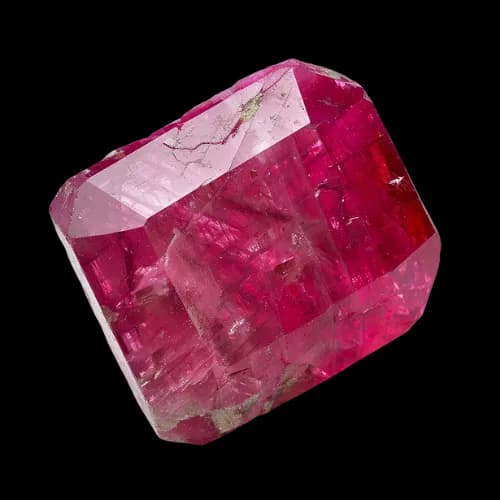
Ask most people what color a ruby is and you get one word: red. But "red" covers a lot of ground. Ruby runs from light pink stones that are arguably not rubies at all to the pure, vivid pigeon's blood red at the top of every dealer's wish list, and where a stone sits on that chart decides more of its value than any other single factor. Ruby is the birthstone for July, and if you are thinking of buying one, learning to read its color is the best preparation you can do. This guide gives you the full chart, the chemistry behind each shade, and the questions to ask before you hand over money.
The Science Behind Ruby's Red Color
Ruby is corundum, aluminum oxide (Al₂O₃), the same mineral that gives us sapphire. Pure corundum is colorless. Swap a tiny fraction of the aluminum atoms for chromium and the crystal turns red, and that single element is the entire difference between a ruby and a white sapphire. As a rule, more chromium means a stronger red.
Chromium rarely works alone, though. Iron in the crystal pulls the color toward brown or purple. Titanium nudges it purplish. Vanadium can add a purplish or orangish cast. And the light source matters more than most buyers expect: the same ruby can look noticeably different in daylight than under incandescent bulbs, which is why careful dealers examine stones under both.
One more piece of chemistry worth knowing: corundum is 9 on the Mohs hardness scale, second only to diamond among the classic gems. Whatever color your ruby is, it will keep it, and its polish, for generations.
Ruby Color Chart: The Complete Spectrum
Ruby colors run from light pink to deep red, with every undertone in between. Here is the chart, ordered from most valuable to least:
| Color Name | Description | Value |
|---|---|---|
| Pigeon's Blood Red | Pure, vivid red with a hint of blue, considered the finest ruby color | Highest |
| Burma Red | Rich red with excellent saturation, slightly less blue than pigeon's blood | Very High |
| Blood Red | Deep red with excellent saturation, slightly darker than pigeon's blood | High |
| Crimson Red | Bright red with a slight purplish tint | High |
| Raspberry Red | Red with a stronger purplish tint | Medium-High |
| Thai Ruby Red | Darker red with brownish or purplish undertones | Medium |
| Pinkish Red | Medium-toned red with noticeable pink undertones | Medium |
| Pink Ruby | Light to medium pink, borderline between ruby and pink sapphire | Lower |
| Orangish Red | Red with noticeable orange undertones | Lower |
| Brownish Red | Red with brown undertones, often due to iron content | Lowest |
Note: Color descriptions are approximations. Actual ruby colors can vary based on lighting conditions, cut, and other factors.
Two things jump out of that chart. First, a hint of blue is a good sign; the most valuable reds carry one. Second, brown is the enemy. It usually means iron, and it drags value down faster than any other tint.
"Pigeon's Blood" Ruby: The Benchmark Red
"Pigeon's blood" has been used for centuries to describe the most coveted ruby color. The term comes from Myanmar (formerly Burma), source of the finest rubies ever mined, and it describes a pure, vivid red with a hint of blue. The name means exactly what it says: the color was supposedly matched to the first drop of blood from a freshly killed pigeon's nose. Macabre to modern ears, but it stuck, and it remains the standard term for the best red a ruby can show.
For most of that history, "pigeon's blood" had no agreed definition, which suited sellers fine. That changed in 2015, when the Gemological Institute of America (GIA) formalized the designation in its ruby reports and defined the specific color parameters a stone must meet to earn it. Our advice follows directly: if a dealer calls a ruby pigeon's blood, ask whether a laboratory report says so too. On a certificate, the phrase means something. In a sales pitch, it often does not.
Factors Affecting Ruby Color
Five things determine how a ruby's color actually reads in the hand.
1. Hue
Hue is the basic color. Ruby's primary hue is red; the usual secondary hues are purple, orange, or pink. The most valuable stones come as close to pure red as corundum gets, though a slight purple or pink secondary is acceptable even in fine stones.
2. Tone
Tone is how light or dark the color sits. The sweet spot is medium to medium-dark: dark enough to read as truly red, light enough that the stone still returns light. Too dark and the ruby looks blackish. Too light and you are drifting toward pink sapphire territory.
3. Saturation
Saturation is the intensity or purity of the color, and it is where the money is. Highly saturated rubies show vivid, intense red. Low saturation reads grayish or brownish, and neither size nor clarity rescues a washed-out red.
4. Distribution
Distribution is evenness. Ideally the color spreads uniformly across the stone, with no zoning, the visible patches of stronger and weaker color that record how the crystal grew. Rotate a ruby under a lamp and zoning gives itself away quickly.
5. Fluorescence
Fluorescence is ruby's party trick. Many fine rubies fluoresce red under ultraviolet light, and ordinary daylight contains enough UV to switch the effect on outdoors, so the stone appears to glow from within. That glow is chromium physics, not marketing, and it adds to a ruby's value as well as its charm.
Ruby Color by Origin
Where a ruby was mined often shows in its color.
Myanmar (Burma)
Burmese rubies, above all those from the famed Mogok Valley, set the standard: pure red with a hint of blue and strong red fluorescence that makes the color look lit from inside. Chemistry helps explain it; Burmese material is low in iron, and iron is what mutes the glow elsewhere. These are generally considered the finest rubies in the world, and they are priced like it.
Thailand
Thai rubies run darker, a more garnet-like red with brownish or purplish undertones, and their higher iron content suppresses the fluorescence Burmese stones are famous for, so they glow less. What they offer instead is practical: often excellent clarity, and availability in larger sizes.
Mozambique
Mozambique is the newer force in the ruby market; its deposits were only discovered in the early 2000s. The best Mozambique stones show a rich, slightly purplish red that approaches Burmese quality, often with good transparency and fewer inclusions than material from other sources. If you want fine color without the full Burmese premium, this is where to look.
Madagascar
Madagascar produces the widest spread of ruby colors, pinkish red through deep red. The top stones can rival Burmese color, though their inclusions look different under magnification, one of the clues gemologists use to tell sources apart.
Vietnam
Vietnamese rubies, particularly those from Luc Yen, can show an intense red close to fine Burmese material. Some have been described as "traffic light red": bright, vivid, and hard to look away from.
The Pink-Red Boundary: When Is It Ruby vs. Pink Sapphire?
Ruby and pink sapphire are the same mineral, corundum, colored by the same element, chromium. The entire distinction is a line drawn through a color gradient: red corundum is ruby, pink corundum is pink sapphire, and nature does not label the boundary.
Where that line falls has varied by era and by geography. In parts of Southeast Asia, even light pink corundum has traditionally been called ruby. Western markets draw the line more strictly. Most gemological laboratories now use defined color parameters to make the call, but those standards are not identical from lab to lab, so a borderline stone can come back with different names from different labs.
The reason anyone argues about this is money. A stone graded "ruby" typically commands a higher price than a "pink sapphire" of equal quality, even when the visual difference is subtle. Our honest take: buy the stone in front of you, not the word on the label, and if the certificate says pink sapphire, pay pink sapphire money.
Color Treatments in Rubies
Many rubies on the market have been treated to improve their color, and you should assume treatment until a report says otherwise. The common methods:
Heat Treatment
Heat is the most common and most widely accepted treatment. Heating dissolves the fine rutile inclusions the trade calls "silk" and improves how the chromium red presents. The result is permanent and stable, and heated rubies are the market norm rather than the exception.
Diffusion Treatment
Diffusion goes further: the ruby is heated together with color-causing elements such as chromium, which diffuse into the stone's outer layer and intensify the color. Because the added color may sit only in that surface layer, gemological testing can detect it, and it should always be disclosed and priced accordingly.
Glass Filling
Some heavily fractured rubies are filled with lead glass to improve their appearance and durability. This changes the value significantly, and the filling itself is fragile: heat, household chemicals, or an ultrasonic cleaner can damage it. A glass-filled ruby is fine at a glass-filled price. It is not fine sold as anything else.
Untreated rubies with fine color are extremely rare, and they command serious premiums over treated stones of similar appearance.
How to Evaluate Ruby Color When Purchasing
When you are actually at the counter, work through this list:
- Examine under different lighting: daylight-equivalent lamps, incandescent light, and real daylight if you can get it. The color that survives all three is the color you own.
- Look for color zoning: rotate the stone and watch for patches of stronger or weaker color.
- Consider size: color concentrates in larger stones, so a small ruby needs exceptional color to look vivid at all.
- Check for windowing: a poorly cut stone shows a pale "window" in the center where light passes straight through instead of reflecting back.
- Ask about treatments: directly, and get the answer in writing. Heat, diffusion, or glass filling each change what a fair price looks like.
- Request certification: for any significant purchase, get a report from a reputable laboratory such as GIA. It will state the color characteristics and every detected treatment.
Our Honest Take on Ruby Red
The chart at the top of this page orders rubies by price. It does not order them by beauty. A slightly purplish Mozambique stone or a bright Vietnamese red can be a joy to wear, costs a fraction of a certificate-grade Burmese pigeon's blood, and nobody across the dinner table will ever spot the difference.
So use the chart the way dealers do, as a pricing tool, and then trust your eye. Color is the biggest factor in what a ruby is worth, but the best ruby is the one whose particular red stops you when you see it. Get the treatments disclosed, get paperwork for anything expensive, and let the collectors argue over the last few degrees of hue.
Wondering how it stacks up against every other gem? Compare values in our gemstone price guide and toughness on the sortable Mohs hardness table.