Ruby vs Sapphire: Why They Are the Same Gem, and Where the Line Between Them Actually Falls
Most "ruby vs sapphire" articles set the two stones up as opponents, like they are picking a fight between a red gem and a blue one. That framing gets the single most important fact backwards. Ruby and sapphire are not two stones. They are one stone, wearing two names.
We spend a lot of time on this site pulling apart gems that look alike but are secretly unrelated. Garnet and ruby share a colour but are completely different minerals. Citrine and amethyst are the same quartz in different moods. Ruby and sapphire sit at the strange opposite end of that spectrum: they look nothing alike, one is fire-engine red and the other is deep ocean blue, and yet under the microscope they are the same material down to the atom. Almost everything people find confusing about comparing them comes from not knowing that.
So let us do this the honest way. We will lay out what ruby and sapphire actually are, why the difference between them is a colour decision rather than a mineral one, exactly where that colour line gets drawn (and where it gets argued over), how they compare on hardness and price and treatment, where emerald fits into the classic three-way question, and our real opinion on which one you should buy. No mysticism, no counter patter, just the chemistry and the money.
The One-Sentence Difference
Here is the whole thing in a single line, and it is the opposite of the garnet story.
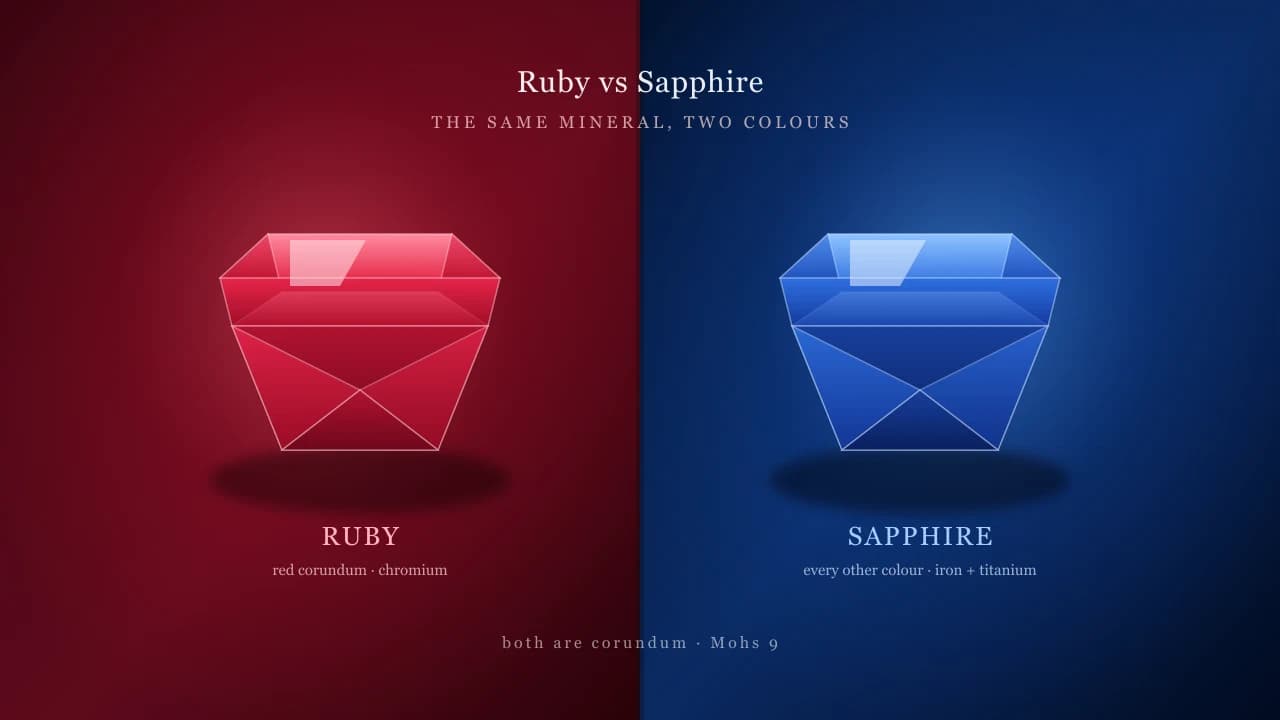
Ruby and sapphire are the same mineral, corundum. Ruby is the red variety. Sapphire is every other colour of corundum there is.
That is not a simplification or a metaphor. It is the actual definition the gem trade uses. Corundum that is red enough gets called ruby. Corundum in any other colour, blue, yellow, pink, green, purple, orange, colourless, gets called sapphire. Blue is simply the most famous and most common sapphire colour, which is why most people think "sapphire" means "blue." It does not. Blue is just sapphire's headline act.
So when you ask "ruby vs sapphire," you are really asking about two colours of one gem, the way you might compare a green apple to a red one. Same fruit. Different skin. Once that clicks, the hardness, the durability, the tests, the price logic, all of it falls into place, because the two stones share a mineral and therefore share most of their behaviour.
What Corundum Actually Is
Corundum is crystalline aluminium oxide, two aluminium atoms to three oxygen atoms, and in its pure form it is completely colourless. That pure, colourless corundum does exist, and the trade calls it white sapphire, which we compared to diamond in our white sapphire vs diamond guide. Everything colourful that corundum does, it does because tiny amounts of other elements sneak into that aluminium oxide lattice.
Corundum sits at 9 on the Mohs hardness scale. That number matters more than any other single fact in this comparison, because it applies to ruby and sapphire equally. There is no "which is harder, ruby or sapphire," the way there genuinely is with garnet versus ruby. They are the same mineral, so they are both a 9, both second only to diamond and moissanite among stones you will actually meet in jewellery, and both exceptionally tough as well as hard. This is why corundum, in either colour, is the go-to gem for engagement rings and heirloom pieces that get worn every single day for decades. Durability is not a tiebreaker here, because there is no tie to break. Ruby and sapphire are exactly as rugged as each other.
Corundum is also, in fine quality, genuinely rare. It forms in specific metamorphic and igneous settings, the gem-quality material is scarce, and clean crystals of good colour and size are scarcer still. That rarity is what puts ruby and sapphire, together with emerald and diamond, into the small club traditionally called the "big four" precious stones. Two of that four are the same mineral. We still find that quietly remarkable.
So Where Exactly Is the Line?
If ruby is red corundum and sapphire is every other colour, the obvious question is: what happens at the edge of red? Where does a red stone stop being ruby and start being sapphire? And this is where "ruby vs sapphire" stops being simple and gets genuinely interesting, because the honest answer is that the line is drawn by human judgement, not by nature, and different people draw it in different places.
The contested zone is pink. A vivid, saturated red corundum is unambiguously a ruby. A pale, delicate pink corundum is unambiguously a pink sapphire. But between those two there is a whole band of pinkish-reds and reddish-pinks where the label, and therefore the price, comes down to a call. And because "ruby" commands far more money than "pink sapphire," there is real incentive in that call.
Different labs and different countries have historically drawn the boundary in different spots. Broadly, Western gem labs have tended to be stricter, reserving "ruby" for stones with genuinely strong red saturation and calling lighter or more pastel stones pink sapphire. Some Asian trading centres have historically been more generous, extending "ruby" further into the pink range. Neither is lying, exactly. There is no universal law that says "at this precise saturation, pink becomes red." It is a convention, and conventions vary. What it means for you as a buyer is simple and worth taking seriously: for any pinkish-red corundum near the borderline, the word on the label is a judgement, and a modern report from a respected lab is the only thing that turns that judgement into something you can trust. A borderline stone called "ruby" by the seller and "pink sapphire" by an independent lab is not a rare event. It is one of the most common ways buyers overpay in this entire category.
There is even a beloved corner of the sapphire world that lives right on this edge: padparadscha, the rare pink-orange sapphire named after a lotus blossom, which is one of the most valuable sapphire colours of all and sits in constant, delicate argument with both pink sapphire and ruby over exactly which delicate hues qualify. If a colour this specific can start trade disputes, you can see why the plain red-to-pink border does too.
Our take: the pink border is the single most useful thing to understand about ruby versus sapphire, because it is the only place the two names actually touch, and it is exactly where money changes hands on a technicality. Everywhere else, telling them apart is as easy as noticing a colour.
Why Ruby Is Red and Sapphire Is Blue
Same mineral, wildly different colours, so the colour has to come from the impurities, and it does. This is a lovely bit of chemistry and it explains the family resemblance that hides behind the colour difference.
Ruby's red comes from chromium. Swap a few aluminium atoms in the corundum lattice for chromium and the crystal starts absorbing green and blue-ish light and glowing red. That same chromium does something magical on top: it fluoresces, throwing back extra red under light, which is why a fine ruby can look lit from within, as if it has a small red lamp inside it. We went deep on that glow and the whole colour range in our ruby colour chart.
Blue sapphire's colour comes from iron and titanium together. When both of those elements sit in the lattice, light passing through gets a fraction of its energy handed between the two (gemologists call it intervalence charge transfer, but you do not need the term), and the result is that rich cornflower-to-royal blue. Change the recipe and you change the colour: iron alone tends toward yellow and green, chromium in smaller doses than ruby gives pink, a particular blend gives the pink-orange of padparadscha, and various colour centres and trace elements produce purple, and even colour-change sapphire that shifts from blue in daylight to purple under lamplight.
So here is the family secret hiding in plain sight: the very same element that makes a ruby red, chromium, is what makes a pink sapphire pink. A ruby and a pink sapphire are not just the same mineral, they are coloured by the same impurity, in different amounts. They are separated by a dose of chromium and a naming convention, and nothing else. We think that is the single most quietly astonishing fact in this whole comparison.
Side by Side: What Actually Differs
Because they share a mineral, ruby and sapphire agree on far more than they disagree on. Here is where the two genuinely differ in ways that change a buying decision, and, just as usefully, where they do not.
Mineral and chemistry. Identical. Both are corundum, aluminium oxide. Every gemological property that flows from the mineral itself is shared.
Hardness and durability. Identical again, both a Mohs 9 with excellent toughness. Neither is the "tougher" pick. Both are outstanding daily-wear stones, which is exactly why sapphire and, less commonly, ruby both make superb engagement-ring centre stones. If a jeweller tells you a sapphire is more durable than a ruby or vice versa, they are mistaken.
Colour. This is the real difference, and it is the whole difference. Ruby is red, full stop. Sapphire is anything else, with blue as the classic. If you want red, you want ruby. If you want blue (or yellow, or pink, or that lotus-blossom padparadscha), you want sapphire. The choice between them is, at heart, a choice of colour.
Rarity and price. Here they part company. Fine ruby is generally the rarer and more expensive of the two. Large, clean, vividly red rubies with no treatment are among the scarcest gems on earth, and top Burmese "pigeon blood" stones have sold for more per carat than comparable diamonds. Fine blue sapphire is also precious, but good blue sapphire is somewhat more available across sizes, so, colour for colour and quality for quality, you generally get more sapphire for your money than ruby. The giant exceptions are the elite sapphire colours, untreated Kashmir blue and fine padparadscha, which can rocket past ruby prices. We ranked where both land against every birthstone in our most expensive birthstones guide.
Treatment. Both are usually heat-treated to improve colour, and that is a normal, stable, accepted practice for each. They differ in their problem treatments, though. Ruby's cautionary tale is the glass-filled composite, low-grade cracked corundum flooded with lead glass to fake clarity. Sapphire's is lattice diffusion, where elements are cooked into the surface to force or deepen colour, sometimes only skin-deep. For both stones the rule is the same: at any serious money, buy from a seller who discloses treatment and insist on a lab report.
Birthday and anniversary. Ruby is the July birthstone and the traditional 40th-anniversary gem. Blue sapphire is the September birthstone and the 45th-anniversary gem. If you are buying a birthstone gift, the calendar quietly makes the ruby-or-sapphire decision for you, no gemology required.
Notice how short the "differs" list really is: colour, price, and which specific treatment to watch for. Everything else is shared, because everything else comes from the mineral, and the mineral is the same.
Which Costs More, Ruby or Sapphire?
This is one of the most-searched corners of the whole comparison, so let us give it a straight answer rather than a shrug.
As a general rule, fine ruby costs more than fine blue sapphire of equal quality. The reason is pure geology: gem-quality red corundum is rarer than gem-quality blue corundum, especially in larger, cleaner, untreated stones. A top unheated ruby is one of the most expensive things you can buy by weight, gem or otherwise.
But "ruby is more expensive" is a rule with real exceptions, and they matter if you are shopping at the top:
- Kashmir sapphire, the legendary velvety blue from a long-exhausted Himalayan source, is so rare that fine examples can outprice most rubies at auction.
- Padparadscha sapphire, the pink-orange lotus colour, carries a huge rarity premium and can sit well above ordinary ruby.
- At the everyday end, both stones are affordable, and here sapphire usually gives you more colour and size per pound, partly because blue sapphire is more available and partly because fancy sapphire colours like yellow and green can be excellent value.
So the honest summary is: at the very top, ruby usually wins the price crown but elite sapphires can beat it, and at the sensible end, sapphire tends to be the better value simply because there is more good blue corundum to go around than good red. If your decision is being driven by budget rather than by colour preference, that asymmetry is worth knowing.
Ruby vs Sapphire vs Emerald: Where the Third Stone Fits
A lot of people do not ask "ruby or sapphire," they ask "ruby vs sapphire vs emerald," lining up the three great coloured stones together. It is a good question, and the corundum fact makes it much easier to answer, because it reveals which of the three is the odd one out.
Ruby and sapphire, as we have hammered home, are the same mineral. Emerald is not. Emerald is the green variety of beryl, a completely different mineral (a beryllium aluminium silicate), coloured by chromium or vanadium. That single fact drives every practical difference:
- Durability. Ruby and sapphire are both Mohs 9 and tough. Emerald is softer at around 7.5 to 8 and, more importantly, it is brittle and typically riddled with inclusions (the trade politely calls that internal garden the "jardin"). Corundum shrugs off daily wear. Emerald needs babying, protective settings, and no ultrasonic cleaner. On pure ruggedness, the two corundums win comfortably.
- Treatment. Ruby and sapphire are usually heated. Emerald is almost always oiled to fill its fissures, an ancient and accepted practice, but one that needs occasional re-doing over the years. We covered that fully in our emerald meaning and colours guide.
- Clarity expectations. With ruby and sapphire you can reasonably hope for an eye-clean stone. With emerald, a flawless cheap example is a red flag, because natural emerald is expected to have inclusions. The whole clarity mindset flips.
- Price. All three can be extremely expensive at the top. Fine ruby is generally the priciest per carat, top emerald and top sapphire trade places depending on origin and colour.
So the neat way to hold the trio in your head: ruby and sapphire are the durable, heat-treated, same-mineral pair, and emerald is the softer, oiled, different-mineral outsider. If you want a coloured stone for an engagement ring you will wear every day and never think about, both corundums beat emerald on toughness. If it is the green you are after, emerald is its own thing entirely, and worth reading up on before you buy. All three are birthstones, ruby for July, sapphire for September, emerald for May, which is a rather elegant coincidence for a family portrait.
Fancy Sapphires: The Colours Ruby Simply Cannot Offer
One underappreciated point in the ruby-versus-sapphire question is that it is not a fair one-colour-each fight. Ruby gets exactly one colour: red. Sapphire gets the entire rest of the corundum rainbow. That is not a knock on ruby, whose single colour is one of the most desirable in all of gemology, but it does mean sapphire offers range ruby never can.
Beyond the classic blue, sapphire comes in yellow (often superb value and a cheerful, durable alternative to yellow diamond), pink (the ruby-adjacent colour we spent so long on above), padparadscha (the prized pink-orange), purple and violet, green, white/colourless, and even colour-change sapphire that swaps blue for purple as the light changes, a party trick that pairs nicely with the far pricier alexandrite we wrote about elsewhere. All of these are real sapphire, all are Mohs 9, all are as durable as the blue.
Our honest opinion: fancy-colour sapphires are one of the best-value corners of the entire coloured-stone world. You get corundum's unbeatable durability and a genuinely precious pedigree, often for a fraction of what the equivalent "name" stone (yellow diamond, say, or fine ruby for the pinks) would cost. If you love the idea of sapphire's toughness but blue is not your colour, the fancy sapphires deserve a proper look. Ruby, for all its glory, cannot play in that space at all.
Star Ruby and Star Sapphire
One more shared trick worth knowing, because it shows up in both stones for exactly the same reason. When corundum contains fine needle-like inclusions of rutile (the trade calls it "silk") arranged along the crystal's structure, and the stone is cut as a smooth dome (a cabochon) rather than faceted, light bounces off those needles to form a bright, moving star, usually with six rays.
Because ruby and sapphire are the same mineral with the same crystal structure, you get star ruby and star sapphire by the same mechanism. A star ruby is a red corundum showing the effect, a star sapphire is a blue (or other colour) corundum showing it. Same phenomenon, same cause, colour is again the only difference. Fine star stones of either colour, with a sharp centred star and good body colour, are lovely and collectable, and it is a nice reminder that whatever ruby can do optically, sapphire can usually do too, and vice versa, because they are one material.
Lab-Grown Ruby and Sapphire
Both stones have a century-old lab-grown side, and it works identically for each, again because they are the same mineral. Lab-grown ruby and lab-grown sapphire are real corundum, chemically and optically identical to the mined versions, just crystallised in a factory rather than in the ground. They are inexpensive, they are genuinely durable (still a Mohs 9), and there is nothing wrong with owning one that is honestly sold as lab-grown.
The only sin is a lab stone sold at a natural stone's price. A grown ruby or sapphire should cost a small fraction of its mined equivalent, and for both stones the protection is the same: disclosure and, at any real money, a report. We laid out the whole grown-versus-mined trade-off across every birthstone in our lab-grown vs natural birthstones guide, and it applies to red and blue corundum in exactly the same way.
Which Should You Actually Buy?
After all that, the decision is refreshingly clean, precisely because the two stones share almost everything except colour.
Buy ruby if you want red, want the most storied and prestigious of the corundums, and your budget can carry what is generally the pricier of the two. It is the July birthstone, the historic "king of gems," and nothing else delivers that particular lit-from-within red with a Mohs 9 to back it up. Read our piece on ruby, the king of gems for the history, and the ruby colour chart before you spend, because the jump from a decent red to a true pigeon blood is vast in both look and price. And watch the pink border: make sure your "ruby" is a ruby by an independent lab's standard, not just the seller's.
Buy sapphire if you want blue, or frankly any colour other than red, want the same unbeatable durability for often better value, and like the idea of a stone that comes in a whole spectrum. Blue is the September birthstone and the classic choice for a sapphire engagement ring, which we covered in depth in our sapphire engagement rings guide and our September sapphire guide. Explore the fancy colours too, because yellow, pink, and padparadscha are some of the best-value precious stones going.
Either way, you are buying corundum, which means you are buying one of the toughest, most wearable gems on the planet. The durability decision has already been made for you the moment you pick either stone. All that is left is colour, budget, and, if you are anywhere near the red-pink border, a lab report you can trust.
Our Verdict
Ruby and sapphire are the same mineral pretending, thanks to a naming convention, to be two. Ruby is corundum that turned red because of chromium. Sapphire is corundum that turned any other colour, most famously blue because of iron and titanium. They share a hardness, a toughness, a rarity class, a treatment-heavy market, and even, in the pink zone, a colouring element and a genuinely disputed border. The only real difference is the colour you want and, at the fine end, the price you pay for it, with ruby usually costing more except when an elite sapphire steals the crown.
So the next time you see "ruby vs sapphire" written up as a contest, you will know the truth underneath it. It is not red gem versus blue gem. It is one gem, choosing a colour. Pick the colour you love, respect the pink border where the two names blur, insist on disclosure and a report when the money is real, and you cannot go far wrong, because whichever you choose, the earth made it out of exactly the same stuff.
If you are weighing coloured stones more broadly, three of our other comparisons use this same no-loyalty approach: garnet vs ruby for the opposite case, two different minerals sharing a colour, white sapphire vs diamond for what colourless corundum can and cannot do, and the most expensive birthstones ranked for where ruby, sapphire and emerald all land on price. And if the meaning and lore side is what draws you, our talismans and amulets guide covers the centuries of power both red and blue corundum were believed to carry.
Wondering how it stacks up against every other gem? Compare values in our gemstone price guide and toughness on the sortable Mohs hardness table.