Tanzanite vs Sapphire: Two Blue Gems That Are Opposites in Almost Every Way
Put a fine tanzanite and a fine blue sapphire side by side on a jeweller's tray and a lot of people cannot say which is which. Both are a deep, saturated blue. Both are cut into the same shapes, set into the same rings, and sold under the same lighting designed to make blue look its best. So the cross-shopping is completely understandable, and "tanzanite vs sapphire" is one of the most common questions we get about blue stones.
Here is the thing though. That surface similarity is almost the only thing these two gems have in common. Once you get past "they are both blue," tanzanite and sapphire turn out to be opposites on nearly every axis that actually decides a purchase: what mineral they are, how hard they are, where they come from, how long they have been on the market, how they are treated, and, most confusingly of all, how their price and their rarity relate to each other. If you only remember one thing from this article, make it this: the rarer of these two stones is the cheaper one, and that fact tells you almost everything about why they are not really substitutes.
So let us do this properly and honestly. We will lay out what tanzanite and sapphire each actually are, walk through hardness and durability (which is where the real decision lives), untangle the rarity-versus-price knot that trips up half the buyers online, cover colour and treatment and the fakes to watch for, show you how to tell the two apart by eye, and then give you our genuine opinion on which one belongs in your ring. No mysticism, no counter patter, just the geology and the money.
The One-Sentence Difference
Here is the whole comparison compressed into a single line, and it is worth reading twice.
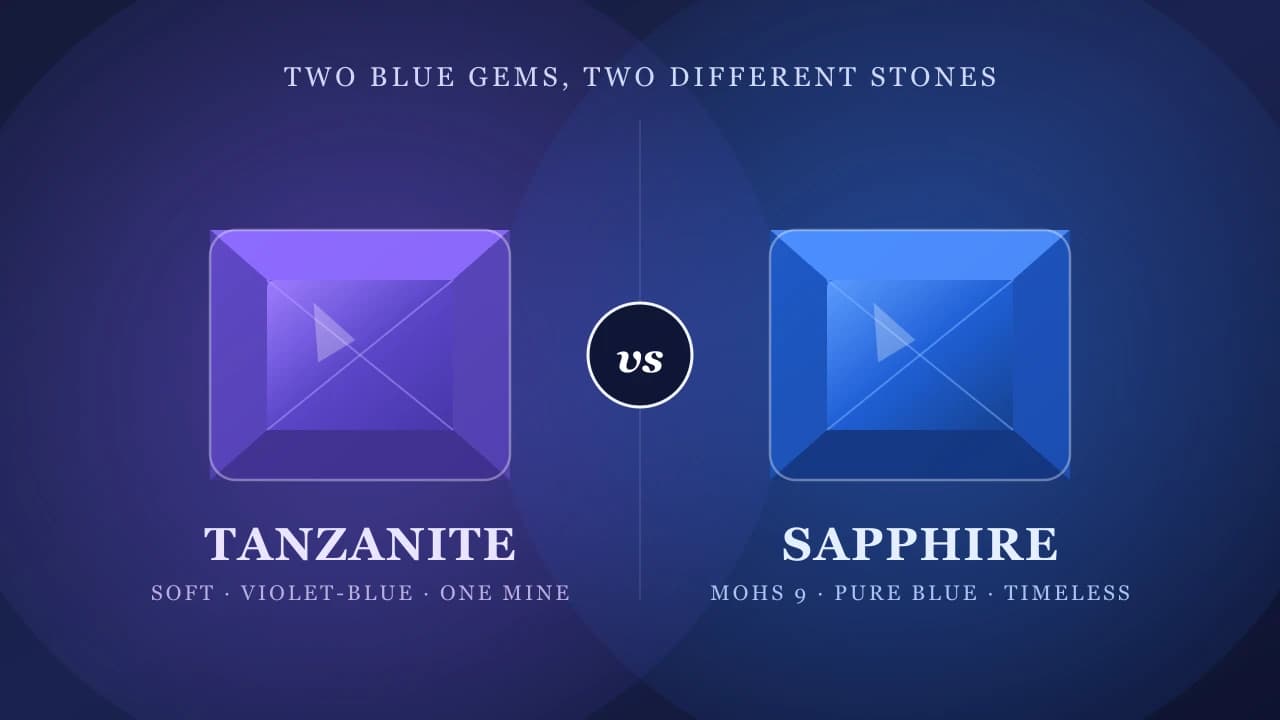
Sapphire is one of the hardest, toughest, most time-tested gems on Earth and it is found in many countries. Tanzanite is a soft, fragile, brand-new gem found in exactly one place on the planet. They only look alike.
Everything else in this article is a footnote to that sentence. Sapphire is the "buy it once, wear it for fifty years, hand it down" blue. Tanzanite is the "buy it for that unbelievable violet-blue and treat it gently" blue. They serve different jobs, and pretending they are interchangeable is how people end up disappointed, usually when a tanzanite ring they wore every day picks up a chip.
What Sapphire Actually Is
Sapphire is gem-quality corundum, which is crystalline aluminium oxide. It is the same mineral as ruby. Corundum that is red gets called ruby; corundum in any other colour, including its famous blue, gets called sapphire. We wrote a whole piece on that surprising fact in ruby vs sapphire, and it matters here because it explains sapphire's headline property: corundum is brutally hard. It sits at 9 on the Mohs scale, second only to diamond among natural gems, with no cleavage plane for a knock to split along. That combination, high hardness plus good toughness, is why sapphire is the gemologist's default answer for a stone that has to survive daily life on a hand.
Sapphire has also been treasured for thousands of years. It shows up in ancient jewellery, in crown jewels, in engagement rings on some very famous fingers. It has a track record. When you buy a sapphire, you are buying into a market that has been stable for centuries and a stone whose behaviour is completely understood. Blue is the classic colour, running from the light "cornflower" through "royal" blue to the velvety, slightly hazy blue that made Kashmir sapphires legendary, but sapphire also comes in yellow, pink, green, orange, purple, and the pink-orange padparadscha. It is September's birthstone, and we go deep on it in our September birthstone sapphire guide.
What Tanzanite Actually Is
Tanzanite is gem-quality zoisite, a calcium aluminium silicate. That is a completely different mineral family from corundum, and the difference shows up everywhere. Zoisite is much softer, sitting around 6.5 on the Mohs scale, and it has cleavage, an internal plane along which a sharp knock can cleave the stone cleanly in two. It is also sensitive to sudden temperature changes and to some chemicals. In durability terms, tanzanite lives in the fragile camp alongside opal, moonstone, and emerald, not the tank camp where sapphire sits.
The other headline fact about tanzanite is its origin, and it is genuinely remarkable. Tanzanite is found in exactly one place on Earth: a small patch of the Merelani Hills, near Mount Kilimanjaro in northern Tanzania. Nowhere else, despite sixty years of looking. It was only discovered in 1967, which makes it one of the youngest gems in the trade, and it was named and marketed by Tiffany and Co, who reportedly thought "blue zoisite" sounded too much like "blue suicide" and went with "tanzanite" instead. Its colour is the thing people fall for: a blue that leans violet, with flashes of purple and sometimes a warm burgundy, richer and warmer than sapphire's cooler blue. It became December's newest birthstone when it was added in 2002. We cover the full story in our tanzanite meaning and colours guide.
Hardness and Durability: Where the Real Decision Lives
If you take nothing else from this comparison, take this section, because for most buyers the durability gap is the entire decision and everything else is aesthetics.
Sapphire at Mohs 9 with no cleavage is one of the most wearable coloured stones you can buy. You can put it in a ring, wear it every single day for decades, knock it against door frames and kitchen counters, and it will shrug most of that off. It is safe in an ultrasonic cleaner. It resists the slow scratching from everyday dust that dulls softer stones over the years. This is not a small advantage. It is the reason sapphire is the classic coloured engagement-ring stone, and it is a genuine, structural, physics-level fact, not marketing.
Tanzanite at Mohs 6.5 with cleavage is a different animal. It is perfectly fine in jewellery, but it needs to be treated as the delicate stone it is. A hard, direct knock at the wrong angle can chip or cleave it. Everyday grit slowly scratches it. Sudden temperature swings can crack it. It should never go in an ultrasonic or steam cleaner. In practical terms, that means tanzanite is a wonderful choice for earrings, pendants, and brooches, where it lives a sheltered life, and a fine choice for a cocktail ring or occasional-wear ring, but a risky choice for an engagement ring you plan to wear through gardening, washing up, and gym sessions for the next thirty years.
Our honest take: if the piece is a daily-wear ring, sapphire wins the durability question and it is not close. If the piece is earrings or a pendant, the durability gap mostly disappears and you can choose on colour and price alone. Do not let a jeweller talk you into a tanzanite solitaire for daily wear without being very clear about the trade-off. If you want to sanity-check any stone against this scale, our gemstone hardness tool lays out where every popular gem falls.
The Rarity Paradox: Why the Rarer Stone Costs Less
This is the part that confuses almost everyone, and it is where a lot of tanzanite selling gets slippery, so let us be blunt about it.
Tanzanite is, by any honest measure, far rarer than sapphire. Sapphire is mined in Sri Lanka, Madagascar, Myanmar, Thailand, Australia, Montana, and more. Tanzanite comes from one hillside in Tanzania that is expected to be mined out within a generation. You will see it advertised as "a thousand times rarer than diamond," and in terms of how much of it exists in the ground, that is basically true.
And yet, carat for carat, fine tanzanite is usually cheaper than fine blue sapphire. A good one-carat tanzanite costs meaningfully less than a good one-carat sapphire of comparable colour. So the rarer stone is the cheaper stone, which feels like it breaks the rules.
It does not break the rules. It just shows that rarity is not price. Price is driven by demand, durability, tradition, and confidence, and on every one of those, sapphire wins. Sapphire has thousands of years of prestige, universal recognition, hardness that guarantees an heirloom, and a deep, liquid global market. Tanzanite has sixty years of history, real fragility, and a supply story that, while genuinely scarce, is also the single most heavily marketed thing about the stone. The "one mine, running out" narrative is true, but it is also doing a lot of sales work, and it has been "running out any day now" in advertising copy for decades.
Our opinion, plainly: do not buy tanzanite because it is rare. Rarity you cannot see is not a feature you are wearing. Buy tanzanite because you genuinely love that violet-blue colour, which is a real and gorgeous thing. If your reason for choosing it over sapphire is "it will be worth more one day because the mine will close," treat that as a hope, not an investment thesis. Tanzanite has a weak resale market, and single-source scarcity has not historically translated into strong secondhand prices. For where both stones sit on the overall value ladder, see our most expensive birthstones ranked.
Colour: The One Place Tanzanite Can Genuinely Win
Everything above tilts toward sapphire, so let us be fair, because there is one arena where tanzanite is not just competitive but arguably better: its colour.
Sapphire's blue is a cooler, purer blue. The finest examples are a vivid, velvety royal or cornflower blue with no other colour mixed in, and that purity is exactly what the market prizes. It holds its colour beautifully at any size, from a tiny accent stone to a large centre.
Tanzanite's blue is a warmer, violet-leaning blue with genuine purple in it. Top tanzanite has an almost electric blue-violet glow that no sapphire can quite reproduce, because it is a fundamentally different colour, not just a different shade. Tanzanite is also famously trichroic, meaning the raw crystal shows three different colours (blue, violet, and a brownish burgundy) depending on which direction you look through it. The cutter chooses how to orient the stone to bring out the most blue or the most violet, which is part of why tanzanite has such personality.
There is a catch, and it is an honest one. Tanzanite generally needs some size to show its best colour. Small tanzanites, under about half a carat, often look pale or greyish, while a two- or three-carat stone can be spectacularly saturated. Sapphire does not have this problem to the same degree. So if you want a small blue stone with punchy colour, sapphire is the safer bet; if you want a larger stone with a warm violet glow and a great colour-per-dollar ratio, tanzanite is hard to beat.
Treatment: Both Are Almost Always Treated, But Differently
Neither of these stones usually reaches you untouched, and the treatments are different enough to matter.
The vast majority of blue sapphire on the market is heat-treated, a process that improves and stabilises its colour. This is completely standard, accepted across the trade, permanent, and undetectable to the naked eye. It does not make the stone "fake." Unheated sapphire with top natural colour exists and commands a large premium, verified by lab report, but for most buyers heated sapphire is simply what sapphire is. The treatments to actually watch for on the low end are lattice diffusion, where colour is baked into only a thin surface layer, and glass-filled or heavily fracture-filled material sold cheaply as sapphire. Those are the traps; ordinary heat is not.
Tanzanite is even more universally treated: well over 90 percent is heat-treated, usually taking a brownish or khaki-coloured raw zoisite and turning it the blue-violet everyone wants. Nature occasionally does this itself, which is where the Maasai legend of lightning setting the hills alight and turning brown stones blue comes from. This heat is stable, standard, and nothing to worry about, and you should not pay an "unheated" premium unless a lab report proves it. The important difference is what the fakes look like. With tanzanite, the danger is not a bad treatment, it is an outright simulant: synthetic forsterite, coated quartz, glass, and synthetic sapphire or spinel are all sold as "tanzanite." There is essentially no honest lab-grown tanzanite market the way there is for, say, sapphire or emerald, so anything cheap and suspiciously perfect deserves scrutiny. For a valuable tanzanite, insist on a report from a recognised lab. If you are weighing lab-created against natural in general, our lab-grown versus natural birthstones guide breaks down when each makes sense.
How to Tell Tanzanite and Sapphire Apart by Eye
If you have a loose blue stone and no paperwork, here are the practical tells, roughly in order of usefulness. None is foolproof, but together they point clearly.
- Look for violet. This is the biggest one. Tilt the stone in good light. Tanzanite almost always throws a purple or violet flash from some angle, because of its strong pleochroism. A pure blue sapphire stays a cool, consistent blue and does not flash purple. If you see clear violet winking in and out as you rotate it, lean tanzanite.
- Judge the temperature of the blue. Sapphire blue reads cool and slightly steely. Tanzanite blue reads warm, with that plummy, violet undertone. Once you have seen them side by side, the "warm versus cool" difference is surprisingly easy to call.
- Feel the weight. Sapphire is denser than tanzanite, so for two stones cut to the same size, the sapphire will feel a little heavier in the hand. Useful as a supporting clue, not a lone verdict.
- Check clarity. Fine tanzanite tends to be very clean, eye-clean and glassy. Natural sapphire more often shows faint inclusions or silk. A blue stone that is flawless and cheap is a reason to ask questions of either.
- A dichroscope settles it. This is the gemologist's tool. Through a dichroscope, tanzanite shows its multiple colours dramatically. It is the closest thing to a definitive at-home test, if you own one.
For anything expensive, none of this replaces a lab report. But for telling which drawer a stone belongs in, the violet flash alone gets you most of the way.
Quick Comparisons: Tanzanite vs the Other Blue and Purple Stones
Tanzanite gets cross-shopped against more than just sapphire, so here are the short versions for the other comparisons people search for.
Tanzanite vs blue topaz. Most blue topaz on the market is colourless topaz that has been irradiated and heated to that electric Swiss or London blue, and it is one of the cheapest faceted stones there is. Next to tanzanite it looks colder and more uniformly "blue," with none of tanzanite's violet. Blue topaz is also denser and, like tanzanite, has perfect cleavage, so neither is a toughness champion. If a "tanzanite" is startlingly cheap and a very even, bright blue, suspect treated topaz or glass. We cover topaz's split personality in our topaz meaning and colours guide.
Tanzanite vs amethyst. Both can be a rich purple, but amethyst is quartz (Mohs 7, no cleavage, tougher for daily wear) and is far cheaper, while tanzanite leans more blue and carries that pleochroic flash. A purple stone that is inexpensive and very durable is more likely amethyst; the bluer, pricier, more fragile one is tanzanite. Our February amethyst guide has the full picture on amethyst.
Tanzanite vs emerald. These almost never get confused by colour, but they get compared as "soft precious-adjacent stones." Both are on the fragile side and both are nearly always treated, but emerald is green beryl, usually oiled rather than heated, and generally more expensive. If you love a saturated coloured stone but need to respect its fragility, the care rules for tanzanite and emerald are broadly similar: gentle cleaning, protective settings, no ultrasonic.
Meaning and Birthstone Month
The two stones sit in different months, which settles the question for anyone buying a birthstone gift. Sapphire is the September birthstone, with a long association with wisdom, loyalty, truth, and royalty. Tanzanite is one of December's birthstones, added in 2002 alongside the older blue zircon and turquoise, and it is linked in modern lore with transformation, intuition, and spiritual awareness, which is unsurprising for a stone only discovered in the 1960s and given most of its symbolism by the trade that named it. Both connect to the throat in chakra traditions. We are gentle sceptics on the healing claims, as always, and we say a bit more about how gem symbolism gets built in our piece on talismans and amulets.
So Which Should You Buy?
Here is our genuine, no-hedging opinion, sorted by what you are actually making.
For an everyday engagement ring or a ring you will wear constantly, buy sapphire. The durability difference is real and it is the whole ballgame for a stone that has to survive decades on a hand. Sapphire's hardness, toughness, prestige, resale market, and centuries of track record all point the same way. It is the safe, timeless, heirloom-grade choice, and its cooler blue is iconic for a reason.
For earrings, a pendant, a brooch, or an occasional-wear cocktail ring, tanzanite is a beautiful and often smarter buy. In a sheltered setting the fragility barely matters, and you get that warm violet-blue glow that no sapphire can match, usually at a lower price per carat and in a larger, more saturated stone. Buy it because you love the colour, not because it is rare.
If you want tanzanite in a ring you will wear often, mitigate the fragility: choose a protective setting like a bezel or a halo that shields the stone's edges, keep the carat weight sensible, and take it off for anything rough. It can absolutely be done, plenty of people wear tanzanite rings happily, but go in knowing the trade-off rather than being surprised by it later.
And the two things not to do: do not buy tanzanite purely on the "rarer than diamond, mine is closing" pitch, because rarity you cannot see and a weak resale market do not add up to value; and do not put a soft stone in a hard-wearing role and expect sapphire-level toughness from it. Match the stone to the job and both of these gems are wonderful. Mismatch them and you will be disappointed in whichever one you chose.
Quick Answers
Is tanzanite worth more than sapphire? Usually no. Despite being geologically much rarer, fine tanzanite typically costs less per carat than fine blue sapphire, because sapphire's durability, prestige, and demand drive its price higher. Rarity and price are not the same thing.
Which is better, tanzanite or blue sapphire? For durability and long-term value, sapphire. For a warm violet-blue colour and colour-per-dollar in a protected setting, tanzanite. Neither is "better" overall; they suit different pieces.
Why is tanzanite cheaper than sapphire if it is rarer? Because price follows demand, durability, and tradition, not scarcity in the ground. Sapphire is harder, more prestigious, and has a deeper resale market, so it commands more even though there is more of it.
Who should avoid a tanzanite ring? Anyone who wants a low-maintenance stone they can wear every day without thinking about it. Tanzanite's softness and cleavage make it better for earrings, pendants, or occasional-wear rings than for a rugged daily band.
Can you tell them apart at home? Roughly, yes. Tanzanite flashes violet when you tilt it and reads warmer; sapphire stays a cool, pure blue and feels slightly heavier. For anything valuable, get a lab report.
Are both stones treated? Almost always. Most sapphire is heat-treated and most tanzanite is heat-treated, both standard and stable. The things to actually watch for are glass-filled sapphire and outright tanzanite simulants, not ordinary heat.