Topaz: Meaning, Colours, and the Stone That Borrowed Its Own Name
Topaz has one of the most confused identities of any gem on the birthstone calendar, and we mean that as a compliment, because the confusion is genuinely interesting. Ask most people to picture topaz and they think of a warm golden glow, the colour of cognac and autumn light. Ask them again and they think of a bright sky-blue stone they saw in a mall window for not very much money. Both pictures are real topaz, and yet the two could hardly be further apart in rarity, in price, or in how they came to look the way they do.
Then there is the deeper twist, the one almost nobody knows. The famous "topaz" of the ancient world, the golden stone the Greeks and Romans wrote about and prized, very probably was not topaz at all. For most of recorded history the name belonged to a different gem entirely. Topaz is the stone that borrowed its own name from somewhere else, and once you understand that, the rest of its story makes a lot more sense.
This is the honest, complete guide. What topaz actually is, where its name really comes from, its full colour range and which colours are precious and which are pocket money, the treatment story behind the blue topaz everyone owns, what the stone means and why November claims it, how it can be one of the hardest gems you can buy and still chip in your hand, what it is worth, and how to buy and wear it well. We like topaz a great deal, partly because it is so misunderstood, so let us untangle it properly.
Topaz Meaning in One Sentence
If you only want the quick answer: topaz is the stone of strength, clarity, and abundance, a gem associated with confidence, calm communication, and the focus to turn intention into action. Golden topaz in particular has long been tied to the sun, to vitality and manifestation, while blue topaz carries cooler associations with honesty, clear thinking, and peaceful expression.
That is the symbolism in a line. But topaz has more than one personality, and the meaning shifts a little with the colour, which is part of what makes it such a rewarding stone to actually understand rather than just wear. We will come back to the full symbolism below, treatments and colours first, because with topaz the physical facts shape the meaning more than usual.
What Is Topaz?
Topaz is a silicate mineral, specifically an aluminium fluorosilicate, and chemically it has nothing to do with quartz, despite the fact that yellow quartz (citrine) has been sold as "topaz" for centuries. It is a genuinely distinct, denser, harder mineral that grew in cavities in igneous rocks like granite and rhyolite, and it forms in large, clean crystals more readily than most gems, which is one reason fine topaz can be cut into big, eye-clean stones for relatively little money.
In its pure form topaz is colourless. Every colour you have ever seen in a topaz, the blue, the gold, the pink, the sherry-brown, comes either from tiny natural impurities and structural quirks or, very often, from human treatment. That single fact, that topaz starts as a blank colourless canvas, is the key to understanding both its beauty and its bargains, and we will lean on it repeatedly.
On hardness, topaz scores an impressive 8 on the Mohs scale, harder than quartz, harder than emerald, second only to corundum and diamond among common gems. That sounds like fantastic news for daily wear, and in terms of scratch resistance it is. But topaz hides a serious catch that most articles gloss over, and it is the most important practical thing to know about the stone: it has perfect basal cleavage, a built-in plane of weakness along which a single sharp knock can split or cleave it cleanly, even though nothing could scratch it. So topaz is the classic example of a gem that is hard but not tough. Hold that thought, because it changes how you should set and wear it.
The Name That Belonged to Another Stone
Here is the piece of topaz history we find genuinely delightful, and it is the same kind of honest disambiguation we love telling about spinel, the great impostor that spent six hundred years masquerading as ruby.
The word "topaz" comes from Topazios, the ancient Greek name for a small island in the Red Sea, now usually identified as Zabargad (also called St John's Island), off the coast of Egypt. Classical writers, including Pliny the Elder, described a beautiful golden-green gem mined there and called it topazos. The trouble is that Zabargad is one of the most famous historical sources of an entirely different stone: peridot, the olive-green August birthstone. The "topaz" of antiquity, the glowing golden gem the ancients prized, was almost certainly peridot, not topaz as we now define it.
So the name we attach to November's birthstone is, in a real sense, a label that originally belonged to peridot. The chemistry that distinguishes the two minerals was not worked out until comparatively modern times, and by then the name had stuck to the wrong stone and could not be unstuck. It is a wonderful tangle, and it means that a great deal of the ancient lore you will read about "topaz", the strength it gave Greek warriors, its power to cool boiling water, its sun symbolism, was lore originally attached to peridot and quietly inherited by topaz later. If you want the other half of that story, our August peridot section sits inside the most expensive birthstones guide, and the family resemblance in the lore is striking once you know to look for it.
We think this matters, and not just as trivia. It is a reminder that gem history is messier and more human than the tidy "meaning of topaz" lists suggest, and that a little honesty about where a tradition really comes from makes wearing the stone more interesting, not less.
The Colours of Topaz: Precious at One End, Pocket Money at the Other
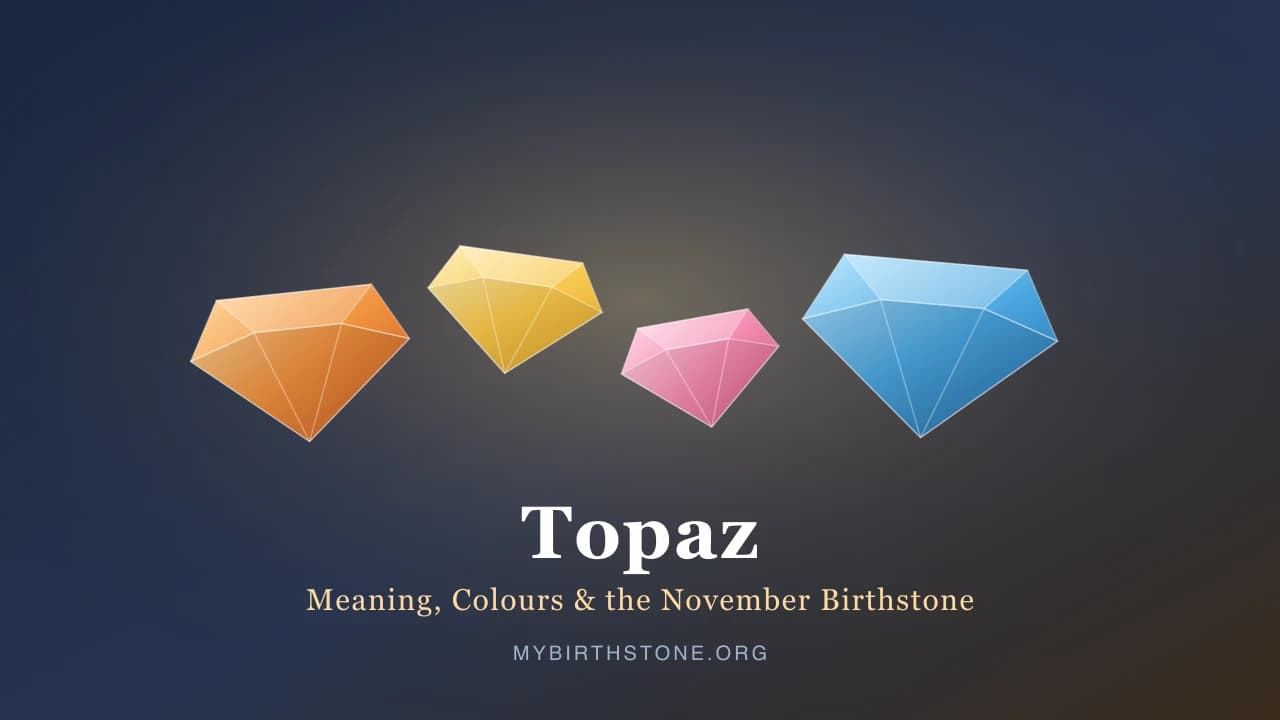
Because pure topaz is colourless, the gem spans an enormous range, and the single most important thing to understand is that the price runs from genuinely precious to among the cheapest faceted gems on earth, all under one name. Here is the honest map.
Imperial topaz is the aristocrat of the family and the one worth getting excited about. It is the rare natural pinkish-orange to reddish-gold topaz, most famously from Ouro Preto in Brazil, with the very finest stones showing a glowing "sherry" or peachy-orange flushed with pink. Good imperial topaz is genuinely valuable, often many times the price of any treated topaz of the same size, and it is the material that earns topaz its precious reputation. The name supposedly honours the Russian tsars, who once reserved the pinkish topaz from the Ural Mountains for the royal family. If a jeweller shows you real imperial topaz, slow down and look properly, because most people never see it.
Pink and red topaz sit at the same precious end. Natural pink topaz is rare and lovely; some pink topaz on the market is produced by gently heating certain yellow-to-brown material, which is a long-established and accepted treatment. True natural red topaz is one of the rarest colours of all and prices accordingly.
Yellow, golden, and sherry-brown topaz is the classic "topaz colour", the warm honeyed tone the name conjures. Some is natural, some is the product of treatment, and the better golden stones carry real warmth and presence for sensible money. This is the colour most people mean when they say topaz.
Blue topaz is the one almost everyone actually owns, and here is the blunt truth: natural blue topaz is rare and usually very pale, while the vivid blue topaz that fills jewellery counters is colourless topaz that has been irradiated and heated to force the colour. The trade names tell you the depth: "Sky Blue" is the lightest, "Swiss Blue" a bright electric blue, and "London Blue" a deep inky steel-blue. All three are treated, all three are abundant, and blue topaz is, frankly, one of the cheapest faceted gemstones you can buy. There is nothing wrong with it, the colour is permanent and stable and often beautiful, but you should never pay a precious-gem price for it. We will explain the treatment, including the part that surprises people, in the next section.
White or colourless topaz is the raw, untreated stone, occasionally sold as a cheap diamond substitute. It is bright and clean but, like all low-dispersion colourless stones, it lacks diamond's fire, the same honest limitation we explained about white sapphire versus diamond.
Mystic topaz, the rainbow-sheened stone that flashes green, purple, and blue like an oil slick, deserves a clear warning. That effect is not natural and not even a colour inside the stone. It is a microscopically thin metallic coating applied to the surface of colourless topaz, usually a titanium film. It is genuinely pretty, but the coating is delicate and can scratch, wear, or flake off over time, especially on a ring, and once it goes the magic goes with it. Buy mystic topaz for fun and for very little money, set it where it will not be knocked, and never treat it as a serious gemstone.
The Blue Topaz Treatment Story Nobody Explains
This is the part we promised, and it is one of those facts that is genuinely interesting and almost always left out.
To turn cheap colourless topaz into that vivid Swiss or London blue, the stone is bombarded with radiation, typically in a nuclear reactor or with an electron-beam or gamma source, and then heated to stabilise the colour. The irradiation is what creates the blue; the heating fixes it so it will not fade.
Here is the bit that surprises people: freshly irradiated blue topaz can carry a small amount of residual radioactivity immediately after treatment. It is not dangerous in the long run, but the material has to be set aside and allowed to "cool down" until that residual activity decays to a safe, legal level before it can be sold. In the United States this is regulated, and reputable blue topaz is held and tested before it reaches the market, so the stone in a shop has long since settled to background levels and is completely safe to wear. We mention it not to alarm you, the blue topaz you can buy is fine, but because it is a real part of how the stone is made, and because it explains why "natural untreated blue topaz" is a meaningfully different and rarer thing than the bright blue you see everywhere.
Our honest takeaway on blue topaz: it is an abundant, treated, inexpensive, perfectly lovely stone. Enjoy it for exactly that. Do not let anyone sell it to you as rare, and do not pay imperial-topaz money for a London Blue.
Topaz Meaning and Symbolism
With the physical facts in place, the symbolism makes more sense, because topaz's meanings cluster around the qualities its colours and history suggest.
- Strength and confidence, the oldest association, inherited (as we saw) partly from the golden gem of antiquity. Topaz has long been a stone people reach for to feel steadier, bolder, and more sure of themselves.
- Clarity and wisdom, a stone of clear thinking, good judgement, and seeing a situation honestly, fitting for a gem that is so often transparent and bright.
- Abundance and manifestation, especially golden and imperial topaz, tied to the sun, to vitality, ambition, and the focus to turn an intention into a result. This is topaz as a "success" stone.
- Calm and honest communication, especially blue topaz, associated with speaking your truth gently, easing tension, and peaceful expression, the cooler, quieter side of the topaz personality.
- Love and loyalty, a softer thread running through the gem's history, which is part of why blue topaz became a popular romantic gift.
Topaz also has a place in the calendar of milestones: blue topaz is the traditional gem for the 4th wedding anniversary, and imperial topaz for the 23rd. Its November birthday ties it to the turn towards the year's end, a season of gratitude and reflection that suits the stone's themes of clarity and abundance.
Our honest position is the same one we hold for every gem on this site. These are cultural and symbolic meanings, not physical powers. A topaz will not literally make you braver or sharpen your judgement or bring you wealth. What it genuinely offers is a beautiful, personal piece of symbolism you can carry with you, a warm golden or cool blue reminder of strength, clarity, or calm, and that is a real and human reason to wear a stone. If the deeper question of how gems came to carry meanings at all interests you, our piece on talismans and amulets in gemstone lore traces where that whole tradition began.
Is Topaz a Birthstone?
Yes. Topaz is one of the two birthstones for November, sharing the month with citrine. Topaz is the older and more traditional of the two; citrine was added in the twentieth century as a more affordable golden alternative, which is exactly why the two stones get so tangled together.
If you have a November birthday, you get a real choice, and it is a more interesting one than most months offer. Our full November birthstone guide covers both stones and the month in depth, and because topaz and citrine look so alike in their golden forms and confuse almost everyone, we wrote a dedicated topaz vs citrine comparison to untangle them properly, including the centuries-old trade-name trick where citrine is sold as "Madeira topaz" or "Spanish topaz" with no topaz in it at all. If you are leaning towards the golden quartz instead, our citrine meaning and colours guide is the companion to this one. And if you specifically want the long history of how topaz travelled from those Red Sea mines into modern jewellery boxes, our topaz history deep dive walks the whole timeline.
The short version of the choice: topaz is the harder, denser, more colour-versatile stone with a precious top end, while citrine is the softer-priced, tougher-in-daily-wear quartz. Different strengths, same birthday.
How Hard Yet Fragile Topaz Really Is
We need to come back to the durability paradox, because it is the single most practical thing about owning topaz and it trips up buyers constantly.
Topaz is hard: at Mohs 8 it strongly resists scratching, harder than quartz, beryl, or garnet. Day to day, a topaz keeps its polish and shrugs off the dust and grit that would slowly frost a softer stone. On that measure it is an excellent jewellery gem.
But topaz is not tough, because of that perfect basal cleavage we flagged earlier. A sharp knock at the wrong angle, the kind a ring takes against a door frame or a kitchen counter, can split or chip a topaz along its cleavage plane, even though the same knock would barely mark a tougher stone like sapphire or even quartz. Hardness and toughness are different properties, and topaz is the textbook case of a gem that has plenty of one and not much of the other.
There is one more colour-specific quirk: some topaz, particularly certain imperial, pink, and brownish-yellow stones, can fade with prolonged exposure to strong sunlight or heat. The treated blue topaz is colour-stable, but the rarer natural warm tones can lose saturation if you leave them baking on a sunny windowsill for years. It is the same gentle warning we give for citrine and amethyst: a stone you wear and store sensibly is fine, but do not cook it.
The upshot for buyers: topaz makes a wonderful pendant, earring, or occasional-wear ring, and a slightly risky everyday knockabout ring unless you protect it. Which brings us to setting and care.
What Topaz Is Worth
Topaz prices are best understood as two completely separate stories sharing a name.
At the affordable end, blue topaz, colourless topaz, mystic topaz, and most ordinary yellow topaz are inexpensive. Blue topaz in particular is one of the best value-for-size faceted gems you can buy, because the rough is abundant, the crystals grow large and clean, and the colour is manufactured rather than mined. You can own a big, bright, eye-clean blue topaz for a very modest sum, and that is genuinely one of the nicest things about the stone. Just buy it knowing what it is.
At the precious end, imperial topaz, fine natural pink topaz, and rare red topaz command real money, with top imperial stones reaching into the serious-gemstone bracket per carat. The premium goes to natural colour, to the glowing pink-flushed orange of fine imperial material, and to size in those rare colours. We placed topaz accordingly in our most expensive birthstones ranked, and the honest summary is that "how much is topaz worth" has no single answer, it depends entirely on which topaz you mean. Blue topaz is pocket money; imperial topaz is a treasure.
Our practical opinion: blue and golden topaz are some of the best value in the whole gem world if you want maximum visible stone for your budget, and imperial topaz is one of the most underrated genuinely-precious gems, quietly beautiful and far less hyped than ruby or sapphire. Both are good buys for the right buyer, as long as you know which one you are holding.
How to Buy and Care for Topaz
When buying, in order of priority:
- Decide which topaz you actually want. This is the first and biggest decision. Maximum size and sparkle for little money points you to treated blue or golden topaz. A rare, natural, genuinely precious stone points you to imperial or fine pink topaz, at a very different price. Knowing which game you are playing protects you from both overpaying and disappointment.
- Assume blue topaz is treated, and price it as the bargain it is. Treated blue is permanent and safe, so just enjoy it, but never pay a rare-gem premium for it.
- For imperial and pink topaz, ask about natural colour and get it in writing. This is where real value and real money sit, and where a lab report or a written guarantee of natural, untreated colour is worth having on an expensive stone.
- Treat mystic topaz as decorative. Lovely, cheap, coated, and not durable. Buy it for fun, set it safely, expect the rainbow finish to wear eventually.
- Choose the setting for protection. Because of the cleavage, a protective setting, a bezel or a halo and well-placed prongs, and earrings or pendants over hard-knock rings, will dramatically extend a topaz's life.
Caring for topaz, because the cleavage and colour quirks demand a little attention:
- Avoid sharp knocks. This is the big one. A topaz will not scratch easily, but a hard blow at the wrong angle can chip or split it along its cleavage. Take rings off for sport, gardening, and heavy housework.
- Skip the ultrasonic and steam cleaners. The vibration and sudden heat can find that cleavage plane. Clean topaz gently with warm (not hot) water, mild soap, and a soft brush, then pat dry, the same gentle routine we recommend for more fragile gems.
- Keep the warm colours out of prolonged sun and heat. Treated blue is stable, but imperial, pink, and some yellow topaz can fade if left baking in strong light for long periods. Store them away from sunny windowsills.
- Store it separately. Topaz is hard enough to scratch most of your other gems, and a stray harder stone (or a knock against a diamond) can chip it. Give it its own pouch or compartment.
Treat topaz as what it genuinely is, a hard but cleavable stone with a warm or cool beauty and a precious top end, and it will serve you beautifully for a lifetime.
The Bottom Line
Topaz is November's golden birthstone, and very little about it is what it first appears. Its name was borrowed from peridot, the ancient golden stone the classical world actually prized. Its most common form, the bright blue everybody owns, was colourless until it spent time in a reactor, and is one of the cheapest faceted gems there is. And its rarest form, imperial topaz, is a genuinely precious treasure that most people never see.
Our summary: love topaz for its honest range and its warm, versatile beauty, and buy it with three facts firmly in mind. Decide which topaz you want, because blue topaz and imperial topaz are different worlds sharing a name. Respect the cleavage, because this is a hard stone that can still chip, so set it protectively and keep it away from ultrasonic cleaners and sharp knocks. And know what you are paying for, treating bright blue topaz as the lovely bargain it is and reserving real money for the rare natural colours. Do that, and you will own one of the most underrated and interesting stones in the case.
If topaz drew you in, the natural next stops are its golden twin in our citrine meaning and colours guide, the side-by-side in our topaz vs citrine comparison, the full month in our November birthstone guide, and the wider value picture in our most expensive birthstones ranked, where topaz, fittingly, lives at both ends of the list at once.
Wondering how it stacks up against every other gem? Compare values in our gemstone price guide and toughness on the sortable Mohs hardness table.