Tanzanite: Meaning, Colours, and the Gem Found in Only One Place on Earth
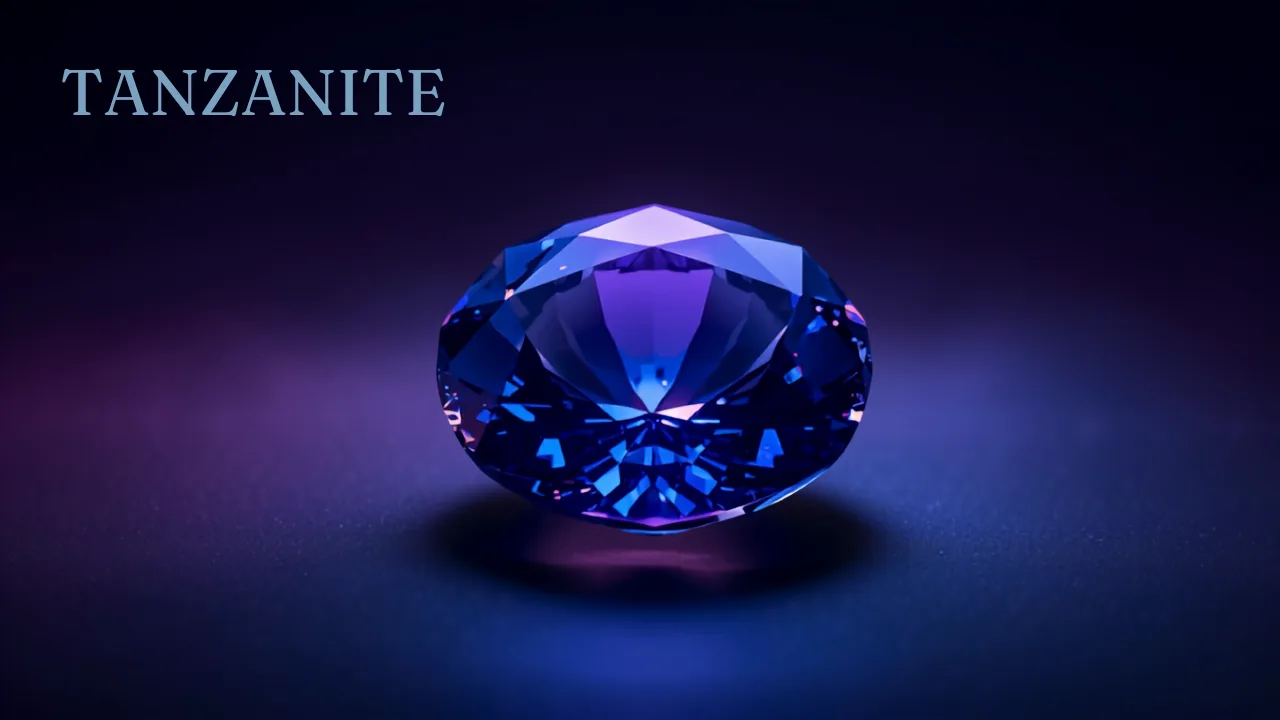
Tilt a fine tanzanite under a lamp and it does something almost no other gem does. The blue deepens, then a wash of violet rises through it, and at certain angles a flash of burgundy glows in the depths. It is a soft, velvety, almost electric blue-violet that looks like twilight caught in a stone, and once you have seen a good one lit properly it is very hard to forget. Sapphire is the grand old aristocrat of blue gems, but tanzanite has a warmer, more romantic, more modern kind of beauty.
It also has the single most remarkable backstory of any stone on the entire birthstone calendar, and we mean that literally. Tanzanite is found in exactly one place on Earth: a strip of ground a few kilometres long at the foot of Mount Kilimanjaro in northern Tanzania. Not "mostly" there, the way emeralds are mostly Colombian or rubies mostly Burmese. There. Full stop. No other deposit has ever been found anywhere on the planet in nearly sixty years of looking. That one fact shapes everything about what tanzanite is, what it costs, and why it carries the scarcity story it does.
This is the honest, complete guide. What tanzanite actually is, the genuinely extraordinary one-mine story, its real colour range and the trichroism that makes it special, why almost every tanzanite you will ever see has been heated, what the stone means and why that meaning is so new, how it became December's third birthstone in 2002, what it is worth, how fragile it really is, and how to buy one without overpaying or cracking it on the first knock. We love tanzanite, and we also think it is one of the most misunderstood gems in the case, so let us be straight with you about all of it.
Tanzanite Meaning in One Sentence
If you only want the quick answer: tanzanite is the stone of transformation, intuition, and calm dignity, a gem associated with spiritual insight, higher awareness, and a sense of new beginnings. It is often called a "stone of transformation," which is fitting on two levels, because the rough crystal itself physically transforms from a dull brown to vivid blue when it is heated, and because the gem only entered the world in living memory.
That last point matters, and we will be honest about it where most articles are not. Tanzanite's "meaning" is genuinely modern. This is not a stone with five thousand years of Egyptian, Persian, or biblical lore behind it. It was discovered in 1967. Every symbolic association it carries was assigned to it within the last sixty years, mostly by the modern crystal and jewellery world. That does not make the meanings less lovely to wear, but it does make tanzanite the rare gem whose entire mythology you can watch being written in real time.
What Is Tanzanite?
Tanzanite is the blue-to-violet variety of a mineral called zoisite. Zoisite itself is not rare and is not usually a gem at all, it is an ordinary rock-forming mineral that normally turns up in dull greens, browns, and greys. What makes tanzanite special is a tiny trace of vanadium in the crystal, which, with a little help from heat, produces that unmistakable blue-violet colour. So tanzanite is, strictly speaking, "gem-quality blue zoisite," and that original name matters to the story, as you will see in a moment.
The mineral grew under very specific, very unusual geological conditions around 585 million years ago, when the tectonic plates that built Kilimanjaro cooked and folded the rock in just the right way. Geologists who have studied it estimate the odds of that exact combination of pressure, heat, and chemistry occurring were something like one in a million. That is the technical reason it exists in only one spot: the recipe was almost impossible, and it only happened once.
On the practical side, here is the fact you most need to carry with you: tanzanite is soft and fragile. It sits at roughly 6.5 on the Mohs hardness scale, well below sapphire at 9 and even below quartz at 7, and it has a distinct cleavage direction along which it can split from a sharp knock. It is also sensitive to sudden temperature changes and to harsh chemicals. We will come back to this in detail under care, because it is the single biggest thing that separates a happy tanzanite owner from a heartbroken one. For now, file it away: this is a beautiful stone, but it is not a tough one.
The One-Mine Story: How Tanzanite Was Discovered and Named
Tanzanite's origin reads more like folklore than mineralogy, and the lovely part is that it is recent enough to be largely true.
The popular account is that in 1967, lightning struck the dry grassland of the Merelani Hills near Arusha and set the brush on fire. When the local Maasai herders returned, they found that the dull brown crystals scattered across the ground had turned a brilliant blue, transformed by the heat of the fire. A prospector named Manuel de Souza is generally credited with registering the first claims that same year, believing at first he had found sapphire, then something stranger.
The mineral was identified as blue zoisite, and here is where the modern world stepped in. Tiffany & Co. recognised it as a sensation and became its first major champion in 1968. The story goes that Tiffany did not love the name "blue zoisite," partly because it sounded uncomfortably like "blue suicide," and so they renamed the gem tanzanite, after Tanzania, the only country on Earth where it is found. It was a brilliant piece of branding, and it is why this stone carries the name of an entire nation. Tiffany's famous line at the launch was that tanzanite could be found in just two places, "in Tanzania and at Tiffany's."
We find this history genuinely charming, and it is also the heart of the gem's appeal. Most precious stones are ancient and anonymous. Tanzanite has a birthplace, a discovery date, a naming, and a single national home, and that makes it feel less like a commodity and more like a story you can wear.
The Colours of Tanzanite, and Its Trichroism Trick
Tanzanite's colour is its whole reason for existing, and it is more complicated and more interesting than "blue."
The desirable range runs from a pure, deep sapphire-like blue, through the classic blue-violet, to a softer violet-purple that leans towards lavender in lighter stones. Most tanzanite sits somewhere in the blue-to-violet band, and the trade generally prizes the deeper, more saturated, more blue-dominant stones most highly, because pure blue tanzanite is scarcer than violet. The very finest material shows an intense, velvety royal blue with flashes of violet and is sometimes graded "AAA," though be warned that these grading letters are marketing terms, not a regulated standard.
Now the genuinely special part: trichroism. Tanzanite is one of the few gems that is strongly pleochroic, meaning it shows different colours when viewed from different crystal directions. Look at a rough tanzanite crystal down one axis and it is blue, down another it is violet, and down a third it can be a brownish burgundy or red. This is not a flaw or an illusion, it is built into the crystal's optics. The cutter's job is to orient the stone to bring out the most blue and violet and hide the brownish axis, which is why a well-cut tanzanite is a small triumph of craftsmanship. It also means a single tanzanite can flash subtly different colours as you move it in the light, a quiet, living quality that flat single-colour gems simply do not have. We think this is one of the most underrated pleasures of owning one.
One practical note on colour: tanzanite needs size to show its best colour. Small stones, under about half a carat, often look pale, greyish, or washed out, because there is not enough depth of material for the colour to build. The rich, saturated blue-violet people fall in love with really starts to appear in stones of a carat or more. If you want the colour that sells the gem, you generally have to buy a little size to get it.
Why Almost Every Tanzanite Is Heated, and Why That Is Fine
Here is the fact that surprises most buyers: the overwhelming majority of tanzanite, well over ninety percent, is heat-treated, and the colour you are buying was almost certainly created in an oven, not the ground.
In its raw natural state, most tanzanite rough is a murky brownish, greenish, or yellowish zoisite. Gentle heating, typically to around 500 to 600 degrees Celsius, drives the vanadium chemistry to shift and unlocks the blue-violet colour. This is exactly what that lightning-fire legend describes nature doing by accident, and it is what the trade now does deliberately and routinely to nearly every stone.
We want to be completely fair about this, because the internet has a habit of treating any treatment as a scandal, and here it really is not. Heating tanzanite is:
- Near-universal. Assume any tanzanite you see has been heated. Genuinely unheated, naturally-blue tanzanite exists but is rare and commands a real premium.
- Permanent and stable. A heated tanzanite will not fade or revert. The colour is there for good under normal wear.
- Accepted and standard. This is not a treatment the trade hides or apologises for. It is simply how tanzanite is made ready for the jewellery case, and it has been since the beginning.
So what should you do with this? Mostly, relax, the same advice we gave for heated citrine. For essentially everyone, a heated tanzanite is exactly what you want and what you will get, and there is nothing dishonest about it. The honesty rule is the same as ever: do not pay an unheated-rarity premium unless the seller can actually prove the stone is unheated, ideally with a gem-lab report. That "natural unheated" claim is the one place real money and real misrepresentation can creep in. For a normal buyer, heated tanzanite is the stone, full stop.
A separate and more important warning concerns fakes and simulants, which is a different issue from heating. Because fine tanzanite is valuable, it gets imitated by synthetic blue spinel, synthetic forsterite, coated quartz, glass, and even synthetic sapphire, all sold to the unwary as tanzanite. There is no significant market in lab-grown tanzanite the way there is for lab sapphire or emerald, so the trap here is not an honest synthetic, it is an outright substitute. The defence is simple: for anything expensive, insist on an independent gem-lab report, and treat a suspiciously cheap "tanzanite" as a stone that probably is not one.
Tanzanite Meaning and Symbolism
Because tanzanite is so young, its symbolism was assembled in the modern era rather than inherited from antiquity, and it clusters around a few consistent ideas:
- Transformation and new beginnings, the headline meaning, drawn directly from the way the stone itself transforms from brown to brilliant blue under heat. Tanzanite is the gem people reach for to mark change, a fresh chapter, a turning point.
- Intuition and higher awareness, often linked in crystal traditions to the so-called third-eye and crown chakras because of the deep blue-violet colour, tanzanite as a stone of insight, perception, and spiritual connection.
- Calm and dignity, a cool, composed, quietly regal stone, associated with stress relief, emotional balance, and a sense of poise.
- Truth and communication, the blue-gem association shared with sapphire, tanzanite as a stone for speaking honestly and clearly.
Its modern jewellery role has also made it a popular gift for the 24th wedding anniversary, and its December birthday connection ties it to the year's end, a natural season for reflection and fresh starts.
Here is our honest position, the one we hold for every stone on this site. These are cultural and symbolic meanings, not physical powers, and with tanzanite that distinction matters more than usual, because the meanings are demonstrably recent inventions rather than ancient wisdom. A tanzanite will not literally sharpen your intuition or transform your life. What it genuinely offers is a beautiful, personal piece of symbolism, a deep blue-violet reminder of change, calm, or a new chapter, and that is a real and human reason to wear a gem. If the deeper history of how stones came to carry meanings at all interests you, our piece on talismans and amulets in gemstone lore traces where that whole tradition began, long before tanzanite ever existed.
Is Tanzanite a Birthstone?
Yes, and its birthstone story is as modern as everything else about it. Tanzanite is one of the three modern birthstones for December, sharing the month with turquoise and zircon. It was officially added to the United States birthstone list in 2002 by the American Gem Trade Association, and that was a genuinely historic moment: it was the first new stone added to the official birthstone list in about ninety years, since the list was last revised in 1912.
So if you have a December birthday, tanzanite is the newest, most modern option available to you, the blue-violet alternative to traditional turquoise and to sparkling blue zircon. Our full December birthstone guide walks through all three stones and how to choose between them, and our December birthstone pillar page covers the month in full. If you are weighing tanzanite against December's oldest stone, our dedicated turquoise meaning and colours guide lays out the opposite end of the December spectrum: an ancient, opaque, earthy stone versus this brand-new, transparent, electric-blue one. They could hardly be more different, and that contrast is part of what makes December such an interesting birthstone month.
Tanzanite vs Sapphire: The Comparison Everyone Makes
The question we get asked most about tanzanite is how it stacks up against sapphire, because they occupy the same blue-gem territory and shoppers constantly weigh one against the other. Here is the honest breakdown.
Sapphire wins on durability, and it is not close. Sapphire is corundum at Mohs 9, one of the hardest and toughest gems you can buy, perfectly happy in an everyday engagement ring. Tanzanite at Mohs 6.5 with a cleavage plane is, frankly, delicate by comparison. If you want a blue stone for a ring you will wear and bash about every day for decades, sapphire is the sensible answer, and our September sapphire guide covers it in full.
Tanzanite wins on colour and value, in its own way. Tanzanite's blue is warmer, more violet, and more velvety than most sapphire, with that trichroic flash sapphire cannot match. And carat for carat, fine tanzanite generally costs less than fine sapphire, so for the same money you can buy a larger, more vividly coloured tanzanite than you could a top sapphire. There is also the rarity paradox to enjoy: tanzanite is geologically far rarer than sapphire, since it comes from one tiny deposit, yet it sells for less, because it is softer, younger, and lacks sapphire's millennia of prestige.
Our practical take: choose sapphire if the piece is an everyday ring that needs to survive hard wear, and choose tanzanite if you want the most beautiful possible blue-violet colour for the money in a piece you will treat gently, earrings, a pendant, an occasion ring. They are not really rivals so much as two different answers to "I want a blue gem," and which is right depends entirely on how you will wear it.
What Tanzanite Is Worth
Tanzanite's price is driven almost entirely by colour and size, in that order. The premium goes to deep, saturated, blue-dominant stones, with the pure royal-blue material commanding the most, violet-dominant stones a little less, and pale or greyish stones much less. Because colour only really blooms with size, larger stones command a disproportionately higher per-carat price, and a fine 5-carat tanzanite costs far more per carat than a fine 1-carat one.
Where tanzanite sits on the value map is genuinely interesting. We ranked the birthstones by price in our most expensive birthstones guide, and tanzanite lands in the middle: nowhere near the eye-watering heights of alexandrite, ruby, or fine sapphire, but well above the truly cheap stones like citrine, amethyst, and blue topaz. For a stone this rare, that mid-market price is arguably a bargain, and it is exactly why tanzanite has become so popular, you get a rare, beautiful, story-rich gem for sane money.
The scarcity factor adds a real wrinkle. Because tanzanite comes from a single, finite deposit, there is a long-running and much-repeated prediction that the supply could be largely exhausted within a generation. We would treat that with some caution, because "buy now before it runs out" is also a marketing line that sells stones, and estimates of how long the deposit will last vary wildly. But the underlying fact is genuine: there is only one source, and one source can flood, run short, or hit political and mining disruptions in a way that a globally-sourced gem like sapphire cannot. That single-source fragility is a real, structural part of tanzanite's value, and it does mean prices have generally trended upward over the decades. The surging interest we see in the search data, with "tanzanite birthstone" demand up sharply year on year, suggests the gem's profile is still rising.
How to Buy and Care for Tanzanite
When buying, in order of priority:
- Colour first, and favour depth and blue. Look for a rich, saturated blue-violet that glows rather than a pale or greyish stone. Deeper, more blue-dominant colour is more desirable and more valuable. View it in a few different lights to enjoy the trichroism and check it holds its colour.
- Buy enough size to show the colour. Because small stones look washed out, a carat or more is usually where tanzanite starts to look like itself. If budget is tight, a smaller but deeply coloured stone beats a larger pale one.
- Assume it is heated, and pay accordingly. Treat heat-treatment as the default and a fair price as the norm. Only pay a premium for "unheated natural" tanzanite if the seller can prove it with a gem-lab report.
- Insist on a lab report for anything expensive. This protects you against simulants and substitutes far more than against honest heating. A suspiciously cheap "tanzanite" is the warning sign.
- Choose the setting for protection. Given how soft the stone is, a protective setting, a bezel or a halo, and earrings or pendants over knockabout rings, will dramatically extend its life.
Caring for tanzanite is where you must pay attention, because this is a genuinely delicate gem. The rules are firm:
- Never use an ultrasonic or steam cleaner. This is the big one. The vibration and heat can crack tanzanite along its cleavage. This is the same camp as opal and the fragile feldspars, gems that simply cannot take aggressive cleaning, a point we make in our guides to opal value and moonstone too.
- Clean it gently with warm (not hot) water, mild soap, and a soft brush, then pat dry.
- Avoid sudden temperature changes and keep it away from harsh chemicals, household cleaners, and even prolonged hairspray or perfume contact.
- Wear it thoughtfully. Tanzanite is a wonderful occasion and dress stone, and a questionable everyday-ring stone. Last on, first off, and store it on its own, away from harder gems like sapphire and diamond that will scratch it.
Treat tanzanite the way you would treat something genuinely precious and a little delicate, because it is exactly that, and it will reward you with a colour almost nothing else can match.
The Bottom Line
Tanzanite is the velvety blue-violet gem from a single small patch of ground at the foot of Kilimanjaro, the only place on Earth it has ever been found. Discovered in 1967, named by Tiffany, and made December's third birthstone in 2002, it is the most modern major gem there is, and one of the most beautiful, with a trichroic flash of blue, violet, and burgundy that sapphire cannot copy. It is also soft, fragile, and almost always heated, and an honest guide has to say all of that plainly.
Our summary: love tanzanite for what it genuinely is, a rare, romantic, story-rich gem that gives you extraordinary colour for mid-market money, and buy it with three facts firmly in mind. Assume it is heated and do not overpay for an unproven "unheated" claim. Buy enough size and depth of colour to let the stone glow. And treat it gently for life, never near an ultrasonic cleaner, set protectively, worn with care. Do that, and you will own one of the most singular gems in the world, the only birthstone that comes from one mine, in one country, with a colour you will not find anywhere else.
If tanzanite's blue drew you in, the natural next stops are its December companions in our December birthstone guide and the ancient end of the month in our turquoise meaning and colours guide, its great blue rival in our September sapphire guide, or the wider value picture in our most expensive birthstones ranked, where tanzanite sits, fittingly, somewhere right in the middle.
Wondering how it stacks up against every other gem? Compare values in our gemstone price guide and toughness on the sortable Mohs hardness table.