A friend of mine spent $1,800 on a natural ruby last year for an anniversary ring. Beautiful stone. Two months later her cousin showed up wearing a lab-grown ruby of the exact same color and clarity that cost $180. Same chemistry, same hardness, same fire under restaurant lighting. The only thing the extra $1,620 bought was a story about where the stone came from.
That gap is the most important thing happening in the birthstone world right now. Lab-grown gemstones have gone from a curiosity in 2018 to a mainstream option in 2026, and the price gap on colored stones is now wider than it ever was with diamonds. Interest in lab-grown ruby, sapphire, emerald, and aquamarine is rising sharply. The shift is happening whether jewelers admit it or not.
This is the working guide I wish someone had handed me the first time I tried to compare a lab-grown sapphire and a Sri Lankan one in a shop in Hatton Garden. We'll go month by month, because the answer is genuinely different for every birthstone.
What "Lab-Grown" Actually Means
Lab-grown gemstones are not fakes. That single sentence settles 80 percent of the arguments online.
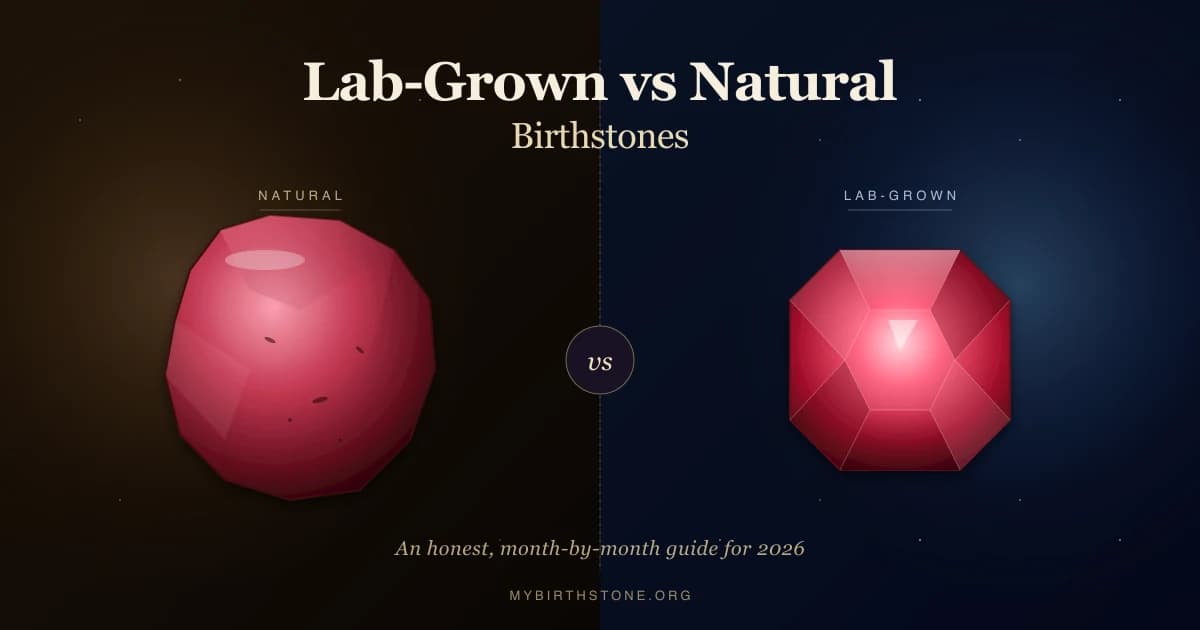
A lab-grown sapphire and a mined sapphire have the same chemical formula (Al₂O₃), the same crystal structure, the same hardness of 9 on the Mohs scale, and the same refractive index. A gemologist can tell them apart only under a microscope, by looking at the kind of inclusions inside. Lab stones tend to have curved growth lines or tiny gas bubbles. Natural stones have mineral inclusions and angular zoning. Neither one is "more real."
The cheaper imitations people get burned by are different things entirely. Cubic zirconia is not lab-grown diamond. Glass-filled ruby is not lab-grown ruby. "Simulated" or "synthetic" on a label sometimes means imitation, sometimes means lab-grown. Always look for the words "lab-grown," "lab-created," or the specific growth method (flux, hydrothermal, Czochralski, HPHT, CVD).
My take: the labeling industry is a mess on purpose. If a vendor will not put the growth method in writing, walk away.
The Price Reality (And Where the Savings Hide)
The savings are not 10 percent. They are not 50 percent. On the stones that matter for birthstones, lab-grown runs 70 to 95 percent cheaper than natural at comparable color and clarity.
A 1-carat natural ruby of decent quality is $2,000 to $5,000. A 1-carat lab-grown ruby of the same color is $80 to $300. A natural untreated 1-carat blue sapphire from Kashmir is collector territory. A lab-grown 1-carat blue sapphire of indistinguishable color is the price of a takeaway dinner.
Here is the part that matters: that price gap does not exist for every stone. Some birthstones have almost no commercial lab-grown supply (pearl, alexandrite, peridot at gem quality). Some have lab versions that look obviously different to the naked eye (opal). For the others, you are essentially choosing whether to pay for provenance or pay for the stone in your hand.
Month-by-Month: Where Lab-Grown Wins, Loses, or Draws
I rate each month on three things. Quality match is whether the lab version looks the same to a normal person. Savings is how much cheaper the lab version is. My pick is what I would actually buy.
January: Garnet
- Quality match: Draw. Both look the same.
- Savings: Small. Garnets are already cheap.
- My pick: Natural.
Garnet is one of the most affordable mined birthstones already. A natural pyrope or almandine garnet of bracelet quality costs $20 to $80 per carat. Lab-grown garnets exist (mostly YAG, which is technically a different material) but the price difference is so small that you might as well buy natural. This is the rare case where lab does not really win.
Read more on the January birthstone for the history.
February: Amethyst
- Quality match: Tie. Most amethyst on the market is already lab-grown, and most people do not know it.
- Savings: 30 to 70 percent.
- My pick: Lab-grown if you want big and clean. Natural if you want African or Uruguayan provenance.
This is the dirty secret of the amethyst trade. A large amount of the amethyst sold in mall jewelry has been hydrothermally grown for decades, and you have probably owned some without knowing. The lab versions are flawless, deeply saturated, and almost free at scale. Natural Brazilian amethyst is also abundant and cheap, so the gap is smaller than it is for sapphire or ruby. For an amethyst pendant, I genuinely think lab is the better buy. For a serious collector piece, look for Uruguayan natural with documented origin.
See how amethyst forms for more on the geology.
March: Aquamarine
- Quality match: Tie at small sizes. Lab loses at larger sizes because the color saturation reads slightly different in person.
- Savings: 60 to 80 percent at gem-quality grade.
- My pick: Natural under 1 carat. Lab over 2 carats.
Aquamarine is one of the stones where natural is genuinely beautiful and not crazy expensive at small sizes. A nice 0.5 carat natural aquamarine is $40 to $100. But if you want a statement aqua pendant of 3 to 5 carats, natural starts to climb fast. Lab-grown aquamarine in those sizes is where the math flips. I would never tell someone to buy lab for a March engagement ring, but for a chunky pendant for someone's grandmother, lab is the smart move.
I covered the full picture in our March birthstone guide and our aquamarine engagement rings post.
April: Diamond
- Quality match: Indistinguishable. Even gemologists need a machine.
- Savings: 60 to 80 percent for white diamonds in 2026.
- My pick: Lab-grown unless you are buying for resale.
This is the big one. Lab-grown diamonds are now mainstream. The price gap on a 1 carat round brilliant has gone from 30 percent in 2020 to about 75 percent in 2026. Optically, physically, chemically identical. The mining industry has spent two decades trying to convince people that one comes with a soul and the other does not. I think that argument has lost. The only honest reason to buy a natural diamond in 2026 is if you specifically value the provenance story or you think you will sell it later (you almost certainly will not, and you will lose 50 percent either way).
May: Emerald
- Quality match: Strong tie. Hydrothermal lab emeralds look like Colombian emeralds, sometimes better.
- Savings: 80 to 95 percent.
- My pick: Lab-grown for jewelry. Natural for heirlooms with paperwork.
Emerald is the stone where lab-grown has the most dramatic case. Natural emerald is almost always heavily included and treated with oil. A clean natural emerald of 1 carat is rare and expensive. Lab-grown hydrothermal emeralds (Tairus, Russian methods) are clean, deeply green, and a fraction of the price. They are real emerald (beryl with chromium). The only thing they lack is the Colombian or Zambian story. Walk into any jewelry shop in Bangkok and most of the "emeralds" under $500 are lab-grown anyway. You might as well buy lab knowingly.
June: Pearl and Alexandrite
- Quality match: Pearls are a special case. Alexandrite: tie.
- Savings: Pearls are not really a lab vs natural story. Alexandrite: 95 percent.
- My pick: Cultured pearl. Lab-grown alexandrite, no contest.
Pearls deserve their own paragraph. Almost every pearl sold today is "cultured," which means a human inserted a nucleus into a mollusk and the mollusk grew the pearl. That is not the same as lab-grown. There is essentially no commercial gem-quality pearl that is fully synthetic. Cultured Akoya, Tahitian, and South Sea pearls are the real product. Imitation pearls (glass beads with coating) are the cheap option to avoid.
Alexandrite is the opposite extreme. Natural alexandrite that genuinely changes color from green in daylight to red under incandescent light is one of the rarest stones on earth. A 1-carat top-quality natural alexandrite is $15,000 to $50,000. Lab-grown alexandrite shows the same color change for $100 to $400 per carat. Almost every "alexandrite" sold under $1,000 is lab-grown anyway. If you want the optical effect, buy lab with no shame.
More on this in our June birthstone guide.
July: Ruby
- Quality match: Indistinguishable to the eye.
- Savings: 90 to 95 percent.
- My pick: Lab-grown for almost any use.
Ruby is the textbook case for lab-grown. Natural ruby of pigeon-blood red color, untreated, from Burma, is the most expensive gemstone per carat on earth at top grade. The vast majority of "natural" rubies in retail jewelry are heat-treated, glass-filled, or lead-treated, which lowers the actual purity to something less than fully natural anyway. Lab-grown rubies are pure corundum with chromium, the exact same chemistry. They glow under UV. They cut and polish identically. A 1-carat lab ruby is $80 to $250. A 1-carat natural ruby of equivalent color is $1,500 to $8,000.
If your July birthstone budget is under $2,000, lab is almost mathematically the right answer. The market has clearly figured this out, and demand for lab-grown ruby is rising fast.
Pair this with our July birthstone guide and our ruby color chart post.
August: Peridot
- Quality match: Lab versions are extremely rare. Most "lab peridot" is actually a different lab material.
- Savings: Not really applicable.
- My pick: Natural. Always.
Peridot is the unusual one. Natural peridot is so abundant and cheap (a 1-carat natural peridot is $50 to $150) that there has never been much commercial demand to grow it in a lab. The few attempts at lab-grown peridot are not really mainstream. If you see a cheap "peridot," it is more likely a glass imitation than a lab-grown stone. For August, the answer is simple: buy natural, buy from Arizona or Pakistan, look for an apple-green color with no brown tones.
September: Sapphire
- Quality match: Indistinguishable to the naked eye. Even loupes are not always conclusive.
- Savings: 85 to 95 percent.
- My pick: Lab-grown unless you are buying Kashmir or Ceylon with paperwork.
Sapphire is the second textbook case after ruby (they are actually the same mineral, corundum, with different trace elements). Lab-grown blue sapphire of 1 carat is $30 to $100. Natural sapphire of comparable cornflower-blue color from Sri Lanka is $1,000 to $4,000 per carat. The difference in real life is invisible.
The argument for natural sapphire only starts to matter at the top of the market, where Kashmir and Burmese sapphires are bought as investments. For everyday September birthstone jewelry, lab is the obvious choice. Visit our September birthstone hub for the full breakdown.
October: Opal and Tourmaline
- Quality match: Opal: lab versions look obviously different. Tourmaline: tie.
- Savings: Opal: 80 percent but you can see the difference. Tourmaline: 50 to 70 percent.
- My pick: Natural opal, lab-grown tourmaline.
Opal is the one birthstone where I will tell you to buy natural even on a tight budget. Lab-grown opal (the most common kind is sold under names like "Gilson opal") has a regular, almost too-perfect color pattern that experienced eyes recognize immediately. Natural opal has chaotic fire that has never quite been replicated. If your budget is $200, buy a small natural Australian opal rather than a big synthetic one. The play of color is what people fall in love with, and the synthetic version misses it.
Tourmaline is the opposite. Lab-grown tourmaline matches natural well in pink, green, and watermelon variants, and the savings are real. For October jewelry, I would mix: a natural opal centerpiece, lab-grown tourmaline accents.
See opal colors and how valuable is an opal for the deeper dive.
November: Topaz and Citrine
- Quality match: Tie.
- Savings: Small. Both are cheap natural.
- My pick: Natural for both.
This is the other month where lab-grown does not have a strong case. Natural citrine and natural topaz (especially the blue topaz on the market) are already affordable. A 1-carat natural blue topaz is $20 to $50. A 1-carat natural citrine is $20 to $80. Lab-grown versions exist but the price difference is not meaningful. Buy natural and put the savings into the metal of the setting instead.
A side note that surprises most buyers: almost all the bright blue topaz sold in jewelry is naturally colorless topaz that has been irradiated and heat-treated to turn blue. It is still "natural topaz" by trade definition, but it is not what came out of the ground. Same for most citrine, which is heat-treated amethyst.
December: Turquoise, Tanzanite, and Zircon
- Quality match: Turquoise: lab loses. Tanzanite: weak tie. Zircon: not really lab-grown commercially.
- Savings: Variable.
- My pick: Natural turquoise (American), lab-grown tanzanite if you must, natural zircon.
Tanzanite is the one to watch. Natural tanzanite comes from a single mining region in Tanzania, and the consensus is that the mine will run out in 10 to 20 years. Lab-grown tanzanite is starting to appear, but the optical properties (pleochroism, the way it shows three colors from different angles) are hard to match. Honestly, lab tanzanite is not great yet. Natural tanzanite is also relatively affordable ($200 to $600 per carat) compared to ruby or emerald. Buy natural while you can.
Turquoise is the trickiest. Lab-grown or "reconstituted" turquoise is everywhere and most of what is sold under that name in fast jewelry is dyed howlite, magnesite, or chalk pressed with epoxy. Real American turquoise from Sleeping Beauty or Kingman is a national treasure. Always buy natural turquoise, always ask for the mine.
How to Actually Tell Them Apart
If a seller refuses to specify origin or growth method, assume the worst.
The credible certifications for natural stones are GIA, AGL, SSEF, and Gübelin. For lab-grown, the report itself should say "laboratory-grown" or "synthetic." A piece under $300 will rarely come with a full lab report and that is fine, but the vendor should still tell you which is which in writing. A reputable jeweler will hand you that information without being asked.
The three quick checks I use in person:
- Ask for the growth method by name. A vendor who says "I do not know" is selling you something they cannot vouch for.
- Check the price against the average for that stone at that size. If a 2-carat "emerald" is $80, it is lab or treated. If it is $4,000, it is natural and you want paperwork.
- Use UV light if you have it. Many lab rubies fluoresce more strongly than natural ones. Many lab emeralds fluoresce differently from natural. This is not conclusive but it is a signal.
When the "Natural" Story Is Worth the Premium
I am pro-lab on most stones, but I want to be honest about the cases where natural still wins.
Provenance with paperwork holds value. A Kashmir sapphire, a Burmese ruby, a Colombian emerald, a no-heat Sri Lankan sapphire. These have collector markets and can hold or grow in value. Lab-grown stones do not hold value (they are a manufactured product, prices drop as production scales).
Some people genuinely care that the stone came out of the earth. That is a real preference and not silly. A wedding ring that will be passed down for four generations has a different emotional weight if it came from a place rather than a factory. I would not buy it myself for the price difference, but I understand it.
And then there is the environmental argument, which cuts both ways. Mining has obvious costs (land disruption, labor concerns, carbon). Lab growth uses significant electricity, sometimes coal-powered. The honest answer is that for most colored stones in 2026, lab-grown has a lower total footprint per carat, but it is not zero.
My Practical Buying Rules
These are the rules I follow when I am buying for myself or recommending to a friend.
Under $300 of budget: lab-grown almost every time. The savings are too significant to ignore.
$300 to $2,000: depends on the stone. Lab for ruby, sapphire, emerald, alexandrite, white diamond. Natural for opal, peridot, citrine, topaz, turquoise, garnet.
Over $2,000: only buy natural with documented origin from a reputable seller (GIA report or equivalent). If the dealer cannot produce paperwork, do not spend the money.
Engagement and wedding rings: lab is now my default for diamond. For colored stones, depends on what the recipient values. Ask. Some people care about the natural story, some do not.
Daily-wear pieces: lab. There is no reason to wear a $4,000 sapphire to type at a keyboard.
The Bigger Shift That's Happening
Lab-grown gemstones are doing to colored stones what they did to diamonds five years ago. The big retailers have not caught up to it yet. Most mall jewelry stores still treat lab as a budget option you have to ask about. The independent jewelers and the online specialists are already on the other side, designing collections around lab-grown center stones because the design budget can go further.
If you are buying a birthstone piece in 2026, you have an option set that did not exist for your mother. A 2-carat lab-grown ruby pendant for $250 was simply not on the menu in 2010. The aesthetic ceiling is higher and the price floor is lower at the same time, which is unusual in any market.
My take: the next two years are going to look strange in retrospect. We will look back at the price gap on natural rubies and sapphires in 2024 and wonder why anyone paid it. The collectors and the heirloom buyers will keep buying natural, and that is fine. Everyone else will quietly move to lab. The savings are too large to ignore once the stigma fades, and the stigma is fading fast.
What to Do Next
If you are shopping for a specific birthstone, start with the month hub on this site for the birthstone chart and the birthstone jewelry collection. If you are buying for a mother, our custom birthstone necklace for mom guide walks through the layout and metal choices that matter most. For a wearable piece, the birthstone bracelet buyer's guide covers the format choices.
And if you want a one-line rule to take with you: for ruby, sapphire, emerald, alexandrite, and diamond, buy lab. For opal, peridot, pearl, turquoise, and tanzanite, buy natural. The money saved on the first five is enough to buy the better ones from the second five.
Sources / Further Reading
- GIA's primer on laboratory-grown gemstones (gia.edu)
- Tucson Gem Show 2026 trend reports on lab-grown colored stones
- Our own birthstone history overview for context on why these twelve stones became "official"
Wondering how it stacks up against every other gem? Compare values in our gemstone price guide and toughness on the sortable Mohs hardness table.