Fair warning: opal will ruin other gemstones for you. A diamond is one color. An emerald is green, and it stays green. A good opal shows red, blue, green, and violet at the same time, and the pattern rearranges itself every time you tilt the stone. No other gem on the calendar does that. This guide covers what actually creates opal colors, which colors command the highest prices, and how to judge the main types, black, white, crystal, boulder, and Ethiopian, like someone who has handled a few.
The Science Behind Opal Colors
Most gems get their color from trace elements. Chromium makes emerald green, iron gives amethyst its purple, and that is the whole story. Opal runs on different physics entirely.
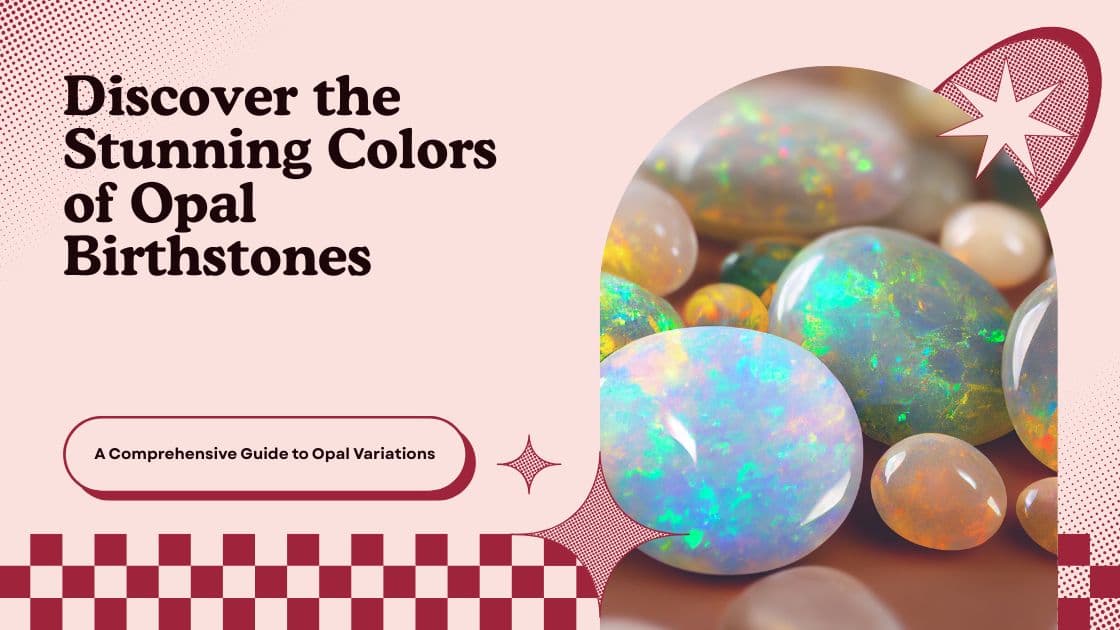
Precious opal is built from millions of microscopic silica spheres stacked in an orderly grid, something like the world's most organized ball pit. When light passes through that grid it diffracts, splitting into pure spectral colors that shift and slide as the stone moves. Gemologists call the effect play-of-color. It is a natural diffraction grating, the same physics that puts a rainbow on the back of a CD, and opal was doing it millions of years before we manufactured anything shiny.
Sphere size decides which colors you see. Smaller spheres, around 150 to 200 nanometers, diffract blues and violets. Larger spheres, roughly 250 to 350 nanometers, produce the coveted oranges and reds. Large, uniform spheres are far harder for nature to arrange, which is the entire economics of opal in one sentence.
And because no two stones grew with exactly the same sphere arrangement, no two opals ever show the same pattern. Every opal is a fingerprint.
The Opal Color Spectrum
Red: The Holy Grail of Opal Colors
Red demands the largest spheres in the most perfect arrangement, and geology rarely delivers both at once. That scarcity translates directly into money. Red-dominant opals command the top prices in the category, and an Australian black opal with strong red fire is the most expensive opal you can buy.
Red rarely travels alone. It usually flashes alongside orange and yellow in what dealers call fire patterns, sheets of warm color that move across the stone like actual flame when you turn it. That is probably why ancient cultures believed opals held fire from the gods. Look at a good fire pattern under lamplight and the theory writes itself.
Blue and Green: The People's Champions
Blue and green are the most common opal colors. Do not read common as boring. The range runs from electric neon blue to deep ocean green, saturated enough to make an emerald look reserved. The October birthstone often shows exactly these blue-green combinations, and they are the sensible entry point if you are buying your first stone.
The interest is in how the two colors behave together. Blue and green form peacock patterns, rolling waves of color, and what collectors call broadflash, where the entire stone lights up in one color at once, as if someone flipped a switch. Watch a broadflash opal roll from blue to green in a single motion and you understand why earlier centuries credited opals with supernatural powers.
Purple and Violet: The Moody Artists
Purple in opal behaves nothing like the steady, dependable purple of February birthstone amethyst. Opal purple is directional. It appears at certain viewing angles and vanishes at others, which makes purple-dominant stones the right pick for anyone who wants a gem that keeps something in reserve.
Violet play-of-color turns up most often in Ethiopian opals, the newer material that has been pressing the Australian fields hard since the 1990s. A good Ethiopian stone can run violet into blue into green in one smooth, continuous gradient, and no photograph does the transition justice.
Types of Opals and Their Color Personalities
Black Opal: The King of Opal Colors
Black opals are the undisputed kings of opal colors. The body tone runs from dark gray to jet black, and that dark background works like a lit stage: every flash of play-of-color reads brighter against it. Lightning Ridge in Australia produces the majority of the world's black opal, and the town's reputation rests on stones that photography genuinely cannot capture. The contrast between dark body and bright color dies on a camera sensor. You have to watch the stone move.
The most prized combination is red play-of-color over a black body, the "red on black" stones that top every dealer's price list. If you only ever see one exceptional opal in person, try to make it one of these.
White Opal: The Classic That Never Goes Out of Style
White opal reads quiet next to black opal, and that is its whole appeal. The body ranges from translucent to milky white, which softens the play-of-color into pastels. That gentler effect is why white opal fills so much vintage jewelry; our great-grandmothers knew exactly what they were doing.
Coober Pedy in Australia is the center of white opal production, cutting stones that look like a rainbow suspended in milk glass. If black opal is a spotlight, white opal is candlelight. Choose it when you want the drama kept subtle.
Crystal Opal: Color in Three Dimensions
Crystal opal is transparent to semi-transparent, and that transparency changes what you see. The play-of-color is not just a surface effect here. It floats at different depths inside the stone, layer behind layer, visible from multiple angles. The first time you focus into one and realize the color has depth, you will check the stone twice.
Transparency also gives the cutter options. Crystal opal can be shaped to pull light through the body and maximize the internal display, which is why a fine crystal opal looks deeper than its measurements say it should. This is the type that turns casual buyers into collectors, and collectors into people with empty savings accounts.
Boulder Opal: Color in the Host Rock
Boulder opal never separated from the rock it grew in, and the stone is better for it. The opal forms as thin veins and pockets inside ironstone, so a finished piece is dark brown rock shot through with lines of color, and the natural contrast does the same job a black opal's dark body tone performs.
The color follows the contours of the host rock. One piece carries a river of blue winding through brown ironstone; another scatters patches of multicolor flash like islands. None of it was planned, and every piece is strictly one of a kind, which is why boulder opal owners talk about their stones the way other people talk about paintings.
Ethiopian Opals: The Newcomers
Ethiopian opals entered the market in the 1990s and earned their place fast. Their defining quirk is hydrophane character: the stones can absorb water, which temporarily makes them more transparent and changes their play-of-color until they dry out again. It is the closest thing gemology has to a mood ring, except the effect is real and reversible.
The colors tend to be unusually vivid, and Ethiopian material produces patterns Australian opal rarely shows: honeycomb, digit patterns that look like colored fingerprints, and broad flash covering the entire face of the stone. Ethiopian opals also cost meaningfully less than comparable Australian stones, which puts a genuinely showy opal within reach of a normal budget. We think they are the best value in opal right now, provided you respect the care rules further down this page.
Pattern Play: When Colors Get Organized
Harlequin: The Rarest Pattern
Harlequin is the pattern collectors chase hardest: distinct patches of color arranged in a roughly geometric mosaic, as if someone tiled the surface of the stone by hand. True harlequin is genuinely rare. When you finally see one, nobody will have to point it out.
Pinfire: Points of Color
Pinfire looks exactly like its name: tiny points of color scattered across the stone like the world's smallest confetti. Each point can flash a different color, so the surface sparkles and shifts with every movement of your hand.
Ribbon: Bands of Color
Ribbon patterns run parallel bands of color that curve and flow across the stone, rainbow stripes laid down with a steady hand. They are at their best in boulder opals, where the bands trace the natural seams in the ironstone.
The Color Value Hierarchy
Not all opal colors are priced equally. The pecking order, from a dealer's point of view:
- Red: the most valuable color, full stop, and priced accordingly
- Orange: second place, still expensive
- Yellow: third, and nothing to apologize for
- Green: solid middle ground, often excellent
- Blue: the most common, though the right pattern can make it the star
- Violet/Purple: rarer than blue and usually adds value
Now the caveat that matters more than the list: a brilliant blue-green opal with a sharp pattern will outvalue a mediocre red opal every time. Color sets the baseline; brightness, pattern, and how hard the stone hits when it turns set the final price. Our advice is to trust your eye before the color chart. The stone you cannot stop turning over is the right stone.
Synthetic and Treated Opals: The Imposters
Synthetic opals exist, and they display real play-of-color. The tell is perfection. Natural opal grew over millions of years and carries quirks, dead zones, and irregular patterning; synthetic material looks machine-ordered, with color arranged in telltale columns or a lizard-skin texture that jumps out under magnification.
Price is the other giveaway. A "perfect" red-on-black opal offered for the cost of a nice dinner is not a bargain, it is a synthetic. Real red-on-black is the most expensive material in the opal world, and nobody who owns it needs to discount it. Walk away.
Watch for assembled stones too. A doublet is a thin slice of real opal glued to a dark backing, and a triplet adds a clear dome on top. Both are honest products at honest prices, but neither should be sold, or priced, as solid opal. Check the side of the stone for straight, suspiciously neat layer lines.
Caring for Opal Colors: Don't Mess This Up
Opals are demanding. They sit at 5.5 to 6.5 on the Mohs scale, soft by gemstone standards, and they can contain up to 20 percent water. Both facts drive every care rule:
- Avoid extreme temperatures: no hot cars, no saunas. Heat can dry an opal out and craze it with fine cracks
- Keep chemicals away: perfume, hairspray, and household cleaners all count
- Store them separately: soft cloth, own compartment, away from harder stones that will scratch them
- Skip ultrasonic cleaners: warm water, mild soap, and a soft cloth are the entire routine
- Give Ethiopian opals extra caution: their hydrophane nature means they absorb liquids and can temporarily change appearance
The Future of Opal Colors
New opal deposits are still being found, and each one widens the definition of what opal can look like. Recent finds in Ethiopia, Mexico, and Brazil added colors and patterns that were not in the reference books a generation ago. There is no reason to think the map is finished. The next significant strike could introduce a pattern nobody has named yet.
Technology is catching up as well. High-resolution photography and video now get close to what the eye sees, which makes buying and sharing opals online far less of a gamble than it used to be. Close is not equal, though. No screen matches a good opal turning in natural light, and we doubt one ever will.
Why Opal Colors Matter
Every opal pattern is the record of a specific accident: silica spheres settling into one arrangement, in one cavity, over millions of years, never repeated anywhere else on Earth. As the October birthstone, opal suits its month perfectly. October is when nature itself refuses to commit to a single color.
Maybe you want the red fire of black opal, maybe the pastels of white opal or the electric blue of an Ethiopian stone. The advice is the same either way. When someone hands you an opal, do not glance at it. Tilt it. Turn it under natural light and watch the pattern reorganize itself. That show took millions of years to build, and it will never run the same way in any other stone.
Wondering how it stacks up against every other gem? Compare values in our gemstone price guide and toughness on the sortable Mohs hardness table.