Every single page that ranks for "mother's ring" is a shop. Kay, Zales, Jared, Blue Nile, ArtCarved, Jewlr, and a Pinterest pin. Not one of them is trying to help you choose. They are trying to sell you the ring they already make.
So nobody tells you the thing that actually decides whether the ring is still being worn in ten years.
A mother's ring is the only category of jewelry where the stones are selected by birth date rather than by whether they can survive being a ring. Your children's birthdays are not negotiable. October's opal is Mohs 5.5 to 6.5 with poor toughness, and it is going on a hand, next to a July ruby at Mohs 9 that could not care less. That is the whole problem, and every retailer on page one quietly skips it.
This is the guide we wanted to exist. Which months are safe, which are not, what to set instead when a month hands you a fragile stone, what "simulated" means on a $129 ring, and how many stones you can realistically get across a finger.
What a Mother's Ring Actually Is
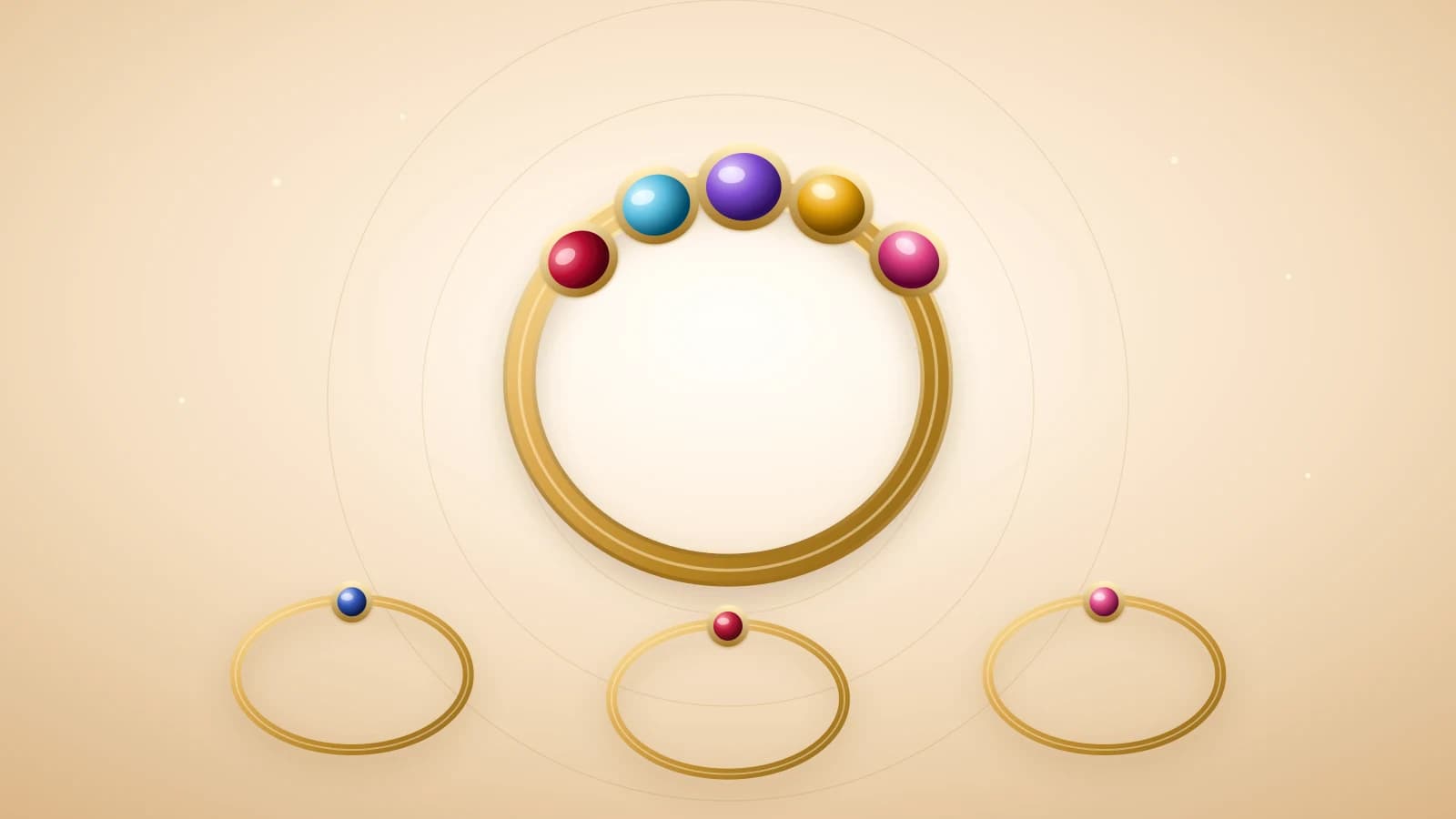
A band set with one gemstone for each child, in birth order. That is it. Everything else is styling.
The format dates to the 1950s and 1960s in the United States, arriving alongside the modern birthstone list that the jewelry trade had standardised a few decades earlier. It boomed in the 1970s as a wide yellow gold band with a row of identical square cut stones, which is the version most people picture and the reason the category spent twenty years feeling dated.
It came back because the underlying idea is genuinely good. It encodes a family on a hand, legibly to the wearer and invisibly to everyone else. What changed is the proportion. The rings selling now are slim bands with bezel set stones, stacking sets where each child gets a separate thin ring, or a single row of small round stones that reads as a fashion ring until you know what it is.
If you want the format on a chain instead, our 3 stone birthstone necklace guide and our custom birthstone necklace for mom guide cover the same decisions for pendants, where the durability maths is far kinder.
The Problem Nobody Selling You One Will Mention
Rings are the harshest place on the body to put a gemstone. A pendant hangs. Earrings dangle. A ring gets dragged across desks, door handles, steering wheels, kitchen counters and every grocery bag you have ever carried. Jewelers see more damage on rings than on every other category combined.
Normally you deal with that by choosing a durable stone. You cannot here. The stone is chosen for you by a birthday.
Two properties matter, and they are not the same thing:
Hardness is scratch resistance, measured on the Mohs scale from 1 to 10. The number that matters is 7, because airborne dust contains quartz at Mohs 7. Anything softer than 7 is being sanded, very slowly, by the air in an ordinary room. That is why a soft stone goes cloudy over years even if you never knock it into anything.
Toughness is resistance to chipping, cracking and cleaving. It is completely independent of hardness, which is the part that trips people up. Topaz is Mohs 8, harder than quartz, and it has perfect cleavage, so a single sharp knock on the right plane can split it cleanly in half. Jade is only Mohs 6.5 to 7 and is nearly impossible to break.
Our full gemstone hardness chart has both figures for thirty plus gems. The table below is the mother's ring version of it.
Every Birth Month, Rated for an Everyday Ring
This is the table the retailers do not publish. Hardness and toughness follow GIA's published gem data, and the verdict column assumes the ring is worn daily rather than kept for occasions.
| Month | Stone | Mohs | Toughness | Everyday ring? |
|---|---|---|---|---|
| January | Garnet | 6.5 to 7.5 | Good | Yes. Solid daily performer, and the red is deep enough to hold its own next to brighter stones. |
| February | Amethyst | 7 | Good | Yes, with one caveat. Fine structurally, but strong heat and long sun exposure can fade the purple. |
| March | Aquamarine | 7.5 to 8 | Good | Yes. One of the best behaved birthstones there is. |
| March (alt.) | Bloodstone | 6.5 to 7 | Excellent | Yes, but it is opaque dark green and disappears in a row of bright stones. |
| April | Diamond | 10 | Good | Yes. Nothing in daily life scratches it. |
| May | Emerald | 7.5 to 8 | Poor | No. See the next section. Almost all emerald is fracture filled and the filler is the weak point. |
| June | Pearl | 2.5 to 4.5 | Fair | No. Mohs 2.5 means a fingernail is close to scratching it. Perfume, hairspray and perspiration attack the nacre. |
| June (alt.) | Moonstone | 6 to 6.5 | Poor | No. Perfect cleavage in two directions, so it chips on impact. |
| June (alt.) | Alexandrite | 8.5 | Excellent | Yes, and it is the single best swap in the whole list. Natural stones are very expensive, lab created ones are not. |
| July | Ruby | 9 | Excellent | Yes. Second hardest natural gem and exceptionally tough. |
| August | Peridot | 6.5 to 7 | Fair | Borderline. Sensitive to acid and to sudden temperature change, and it abrades over years. |
| August (alt.) | Spinel | 8 | Good | Yes. The best kept secret on this list, and it comes in red, pink and blue. |
| September | Sapphire | 9 | Excellent | Yes. Same mineral as ruby, same excellent behaviour. |
| October | Opal | 5.5 to 6.5 | Poor | No. Heat and temperature change cause crazing, which is a network of internal fractures that cannot be undone. |
| October (alt.) | Tourmaline | 7 to 7.5 | Fair | Yes, with care. Pink tourmaline gives you October in a stone that can live on a hand. |
| November | Topaz | 8 | Poor | Risky. Hard, but perfect cleavage means one bad knock can split it. |
| November (alt.) | Citrine | 7 | Good | Yes, and it is the better November choice for a ring despite being the cheaper stone. |
| December | Turquoise | 5 to 6 | Fair | No. Porous, so it absorbs oils and soaps, and most commercial turquoise is stabilised or dyed. |
| December (alt.) | Tanzanite | 6.5 | Poor | No. Cleaves in two directions and dislikes heat. It is a pendant stone that got sold as a ring stone. |
| December (alt.) | Zircon | 6.5 to 7.5 | Fair | Yes, with care. Blue zircon gives you December's colour without December's fragility. |
Six months in that table are a straightforward yes at any budget: January, March, April, July, September and November if you take citrine. Six are a problem.
The Six Months That Hand You a Fragile Stone
Here is the part that changes what you buy.
May, June, October and December have a genuine alternative on the official list. This is not a workaround or a substitution the family has to be told about. GIA publishes multiple modern birthstones for those months, so a June alexandrite is exactly as correct as a June pearl. Nobody is being short changed.
- June: set alexandrite instead of pearl or moonstone. At Mohs 8.5 with excellent toughness it is the most durable non corundum gem on the list. Natural alexandrite is one of the most expensive stones on earth, so use lab created, which is chemically identical chrysoberyl and costs a fraction. See our June birthstone comparison for the full trade off.
- October: set tourmaline instead of opal. Pink tourmaline is the usual choice and it photographs beautifully next to garnet and amethyst.
- December: set blue zircon instead of turquoise or tanzanite. It has more fire than either and it survives.
- August: set spinel instead of peridot. Added to the official list in 2016, Mohs 8, good toughness, and available in a red that most people mistake for ruby.
- November: set citrine instead of topaz. Lower hardness, far better toughness, and in a ring toughness is what saves you.
May is the one month with no escape. Emerald is the only modern May birthstone, and roughly nine out of ten emeralds on the market are fracture filled with oil or resin to improve clarity. That filler is what fails: it dries out, it clouds, and it is driven out by the heat of any real cleaning. A May child in a daily ring means accepting either a stone that needs re oiling every few years, or a lab created emerald, or a green substitute that is not technically the birthstone at all. Our honest recommendation is lab created emerald. It is real beryl, the colour is right, and because it is grown clean it usually needs no filler at all.
That is the argument in one line: buy the month, not the myth. Nobody in the family will ever know that the June stone is alexandrite rather than pearl, and everybody will notice when the pearl goes grey and pitted after three years of hand cream.
Genuine, Lab Created or Simulated: The Word That Costs You $400
Open any Zales mother's ring listing and read the product name. It says "Mother's Simulated Birthstone Ring". Not once, but across the entire collection: simulated in the marquise version, simulated in the heart shaped version, simulated in the eleven stone version.
That word is doing enormous work, and almost nobody reads it.
The Federal Trade Commission's Jewelry Guides define exactly what these terms mean. The relevant rule, 16 CFR 23.25, is literally titled "Misuse of the words ruby, sapphire, emerald, topaz, stone, birthstone, gem, gemstone, etc." Three categories, and they are not shades of the same thing:
- Genuine (mined). The actual mineral, dug out of the ground. Carries the mineral's hardness, toughness, colour variation and resale value.
- Laboratory created. Under 23.25(c), a gem may only be called laboratory created or synthetic if it has "essentially the same optical, physical, and chemical properties as the stone named." A lab created ruby is corundum. It is Mohs 9. It behaves identically in a ring.
- Simulated or imitation. Something that merely looks like the stone. Usually glass, cubic zirconia, or synthetic spinel coloured to imitate a different gem. Under 23.25(b) the disclosure must appear "immediately preceded with equal conspicuousness" by the gem name, which is why it sits right there in the product title.
Now the part that is genuinely counterintuitive, and the opposite of what you would expect a birthstone site to say.
A simulated stone mother's ring is not automatically the wrong buy. If every stone in the ring is glass or CZ, then every stone has the same hardness, the same toughness and the same response to a cleaning machine. The October "opal" will not craze, because it is not opal. The June "pearl" will not lose its nacre, because it has none. The durability problem this entire article is about simply evaporates. You also get colours that actually coordinate, because they were dyed to match rather than mined in twelve different tones.
What you do not get is value, longevity of finish, or any meaning attached to the material itself. Simulated stones abrade and go dull. And they are worth nothing.
So the real choice looks like this:
| Type | Typical price | Durability | Worth anything later? | Buy it when |
|---|---|---|---|---|
| Simulated | $60 to $220 | Uniform, mediocre. Glass and CZ scratch and dull over years. | No | It is a gift for a specific season, or a child may still be added, or the budget is firm. |
| Lab created | $250 to $900 | Identical to the mined stone. Excellent for ruby, sapphire, alexandrite, emerald. | Very little | You want real gem material at a sane price. Our default recommendation. |
| Genuine | $500 to $4,000+ | Varies wildly by month. This is where the table above matters. | The metal, plus a little | It is a milestone piece and the birth months are durable ones. |
Our position, plainly: for a mother's ring worn every day, lab created stones in solid gold beat genuine stones in silver, every time. You get corundum hardness in the months that offer it, a setting that will still be there in twenty years, and you sidestep the entire emerald filler problem. More on the mined versus lab question in our lab grown vs natural birthstones guide.
The one thing we would push back on hard is a genuine stone ring set in sterling silver or plated brass. That combination sells constantly and it is backwards. You have paid for the stones and saved on the only part that holds them in place.
How Many Stones Actually Fit
Nobody tells you this either, and it is the most common regret after the ring arrives.
A standard women's ring finger takes a band of roughly 18 to 20mm across the top before the ring starts to look like a cuff and starts catching on everything. Work backwards from there:
- One to three stones. Comfortable in any style. Three is the sweet spot and the reason "3 stone mothers ring" is searched thousands of times a month. Stones can be 3mm to 4mm and still read clearly.
- Four to five stones. Workable, but the stones have to shrink to 2.5mm or so, or the design has to curve them into a wave or a crossover so they occupy more of the finger's length. This is where most mass market designs live.
- Six or seven stones. The stones are now 2mm, which is small enough that the colours stop being individually readable from arm's length. A dark garnet and a dark tourmaline become the same stone at conversational distance.
- Eight or more. Stop. Go to a stacking set, a wide band with two rows, or a pendant.
Our honest opinion is that anything over five stones belongs on a chain rather than a finger. A pendant has no width limit, takes a fraction of the abuse, and lets you use the fragile months without worrying. If the family is large, buy the birthstone necklace and stop fighting the geometry.
Size the finger properly before ordering, because a multi stone band fits differently to a plain one. Our ring size calculator converts between US, UK, EU and Japanese sizes and includes a measuring method. For a band wider than about 6mm, go up a quarter to a half size from your usual.
The Add a Stone Later Trap
This is the single biggest design mistake, and it is invisible at the moment of purchase.
Most mother's rings cannot be extended. A channel set band is machined for a fixed number of stones. A cast design with a set number of prongs is finished. Adding a seventh stone to a six stone ring means remaking the ring, which means paying for it twice.
There are exactly three designs that genuinely grow:
- Stacking sets. One thin band per child. Add a new band for a new child. Costs more per stone and looks busier, but it is the only format that scales indefinitely.
- Charm or slider styles on an open shank, where stones sit on a bar and more can be added along it.
- Nothing else. Assume a fixed band is fixed.
If the family might grow, and the recipient is under about forty, buy the stacking set. If you are buying for a grandmother, a fixed band is fine, but count the grandchildren generously and leave a space.
While we are on the subject of later modifications: resizing a mother's ring is not the routine job it is on a plain band. Heat travels, and a jeweler cannot take a torch near opal, pearl, emerald, tanzanite, peridot or topaz without removing them first. Unsetting six stones, sizing the shank and resetting them turns a $60 job into a $200 to $300 one. Our ring resizing cost guide breaks the pricing down. Get the size right the first time.
What Mother's Rings Actually Cost in 2026
Advertised ranges from the retailers ranking on page one, checked in September 2026:
| Retailer | Advertised range | What you are getting |
|---|---|---|
| Limoges Jewelry | from $59.99 | Simulated stones, base or silver settings |
| James Avery | from $69 | Sterling silver, simple designs |
| Kay | $132 to $216 | Sterling silver or 10K, mostly simulated stones |
| Jewlr | $139 to $177 | Silver and 10K, customisable |
| Zales | $119 to $1,599 | Simulated at the bottom, genuine stones and gold at the top |
| ArtCarved | $99 to $395 | Personalised, 2 to 6 stones |
| Slate & Tell | $219 to $659 | Silver, 10K and 14K, coloured stones |
| Blue Nile | $380 to $8,510 | Genuine stones, 14K and 18K gold |
Two things stand out.
The mass market clusters hard around $130 to $170, and at that price the ring is silver or 10K with simulated stones. That is not a scam, it is arithmetic. Five genuine calibrated stones and a 14K gold band cannot be built for $150 by anyone.
The second thing is worth pausing on. The single most visible mother's ring in Google Shopping, Kay's Family and Mother's Birthstone Crossover Ring at around $163, carries a customer rating of 2.9 out of 5 across 101 reviews. That is an unusually poor score for a mainstream jewelry product, and it is a useful signal about what this category delivers at that price.
Our budgeting rule of thumb, assuming you want the thing worn daily for a decade:
- Under $200: buy simulated stones in sterling silver and accept it as a lovely gift with a finite life. Do not pay extra for "genuine" at this price, because something else has been cut to pay for it.
- $300 to $700: lab created stones in solid 10K or 14K gold. This is the value zone and where we would spend.
- $900 and up: genuine stones, 14K or 18K, three to four stones rather than six. Fewer, better, bigger.
For what individual birthstones cost on their own, see our gemstone prices reference.
Metal: The One Place Not to Save Money
A mother's ring holds five or six small stones in small settings. Every one of those settings is a potential point of failure, and thin plated metal wears through at exactly the points that do the holding.
Avoid gold plated and gold vermeil entirely for this piece. Vermeil is a genuine standard, sterling silver with at least 2.5 microns of at least 10K gold, and it looks excellent for a year or two. But it is a surface, and when a plated surface wears through on a ring with six stones in it, you cannot simply re plate it. The strip chemicals, ultrasonic tank and warm plating bath used in a replating bench will destroy opal, pearl, emerald, turquoise, moonstone and tanzanite, so every fragile stone has to be unset first. Our gold plated vs gold filled vs vermeil guide has the full FTC thresholds and the per stone replating table.
Rank order for this specific piece:
- 14K gold. The right answer if the budget reaches. Hard enough to hold prongs, and it never needs refinishing.
- 10K gold. Harder than 14K, slightly less rich in colour, genuinely durable. Under rated.
- Sterling silver. Fine, and honest. It will tarnish and it is softer, so prongs need checking, but it can be polished forever.
- Gold filled. Acceptable. Far more gold than plating and it lasts years.
- Gold plated or vermeil. Not for this. Not on a ring with this many settings.
Cleaning a Ring With Six Different Stones In It
One rule, and it is the rule that most people get wrong: a multi stone ring is cleaned to the standard of its weakest stone.
A ring holding January garnet, June pearl and October opal is not a garnet ring. It is a pearl and opal ring that happens to contain a garnet. Garnet is perfectly happy in an ultrasonic cleaner. Put that ring in one and you will destroy two thirds of it.
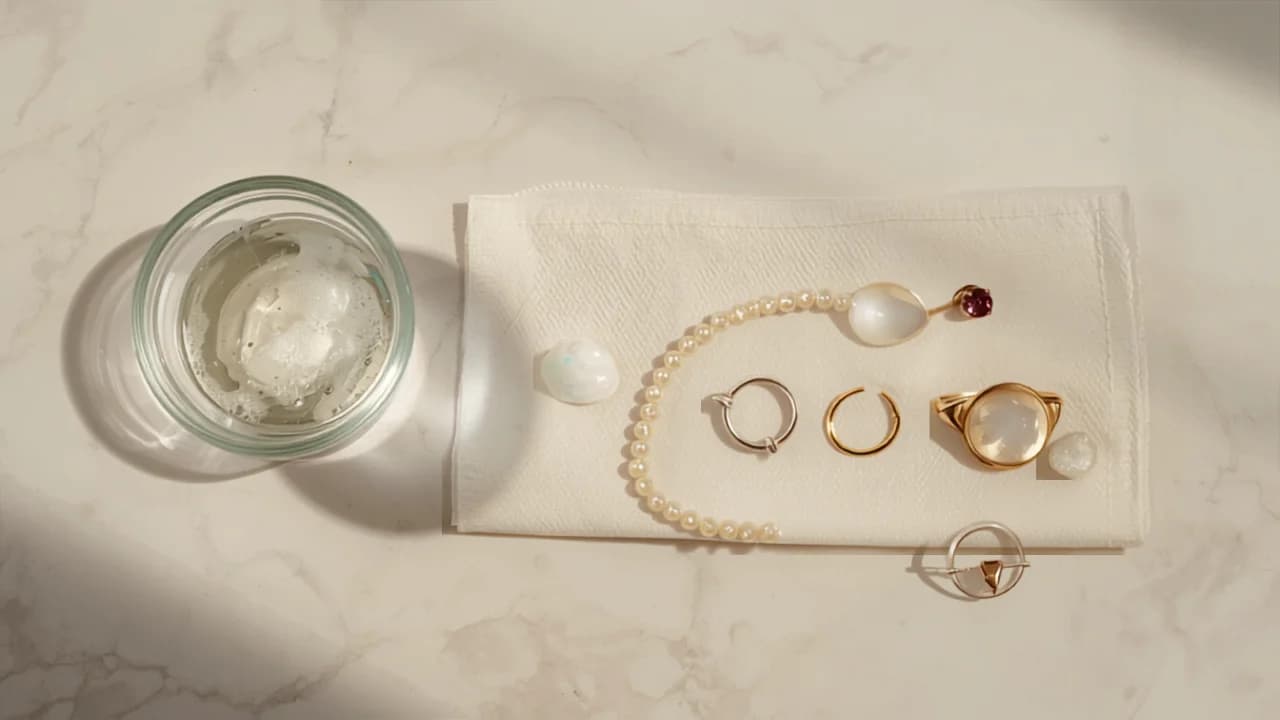
Warm water, two drops of plain dish soap, a soft brush around the settings, a rinse over a closed drain and a lint free cloth. That method is safe for every birthstone in every month with no exceptions. Never an ultrasonic, never steam, never boiling water, never anything with ammonia, unless you know for certain that every single stone in the piece can take it. Our birthstone jewelry cleaning guide has the full machine by machine, stone by stone matrix.
One more thing that matters more than the cleaning: have a jeweler check the prongs under magnification once a year. Small stones in small settings go missing quietly, and a mother's ring missing one stone is a much sadder object than a plain ring missing one.
Grandmother's Rings and the Large Family Problem
A grandmother's ring is the same format with more stones, usually grandchildren rather than children, and often seven or more. Everything above applies, plus two things.
The count will keep rising. A stacking set is almost always the right answer here, because a grandmother who gets a sixth band for a sixth grandchild is receiving a gift every time, rather than being told the ring is now full.
And the odds of catching a fragile month go up with every stone. With three stones you have a reasonable chance of avoiding June, May, October and December entirely. With eight, you will hit at least one. That makes the substitution list in this article more useful the bigger the family gets, not less.
What We Would Actually Buy
Stripping out everything above into decisions:
- Three stones or fewer, budget under $200: sterling silver, simulated stones, bezel set. Buy it knowing it is a five year piece and enjoy it.
- Three to five stones, budget $300 to $700: 14K gold, lab created stones, and use the substitution list for June, October and December. This is the version we would buy for someone we loved.
- Any budget, six or more children or grandchildren: a pendant, not a ring. Or a stacking set if it has to be a ring.
- A May child in a daily ring: lab created emerald, and tell nobody, because there is nothing to hide.
- A June child: lab created alexandrite. It is the best stone on the entire birthstone list for a ring and it is the one people never pick.
The ring that gets worn for thirty years is not the expensive one. It is the one that was built out of stones that could take a hand, in metal that holds them, sized right the first time.
Not sure which stones you are working with? Start with the full birthstone chart, or look up a single month on the find your birthstone page.