Pearl: Meaning, Colours, and the Honest Truth About June's Living Gem
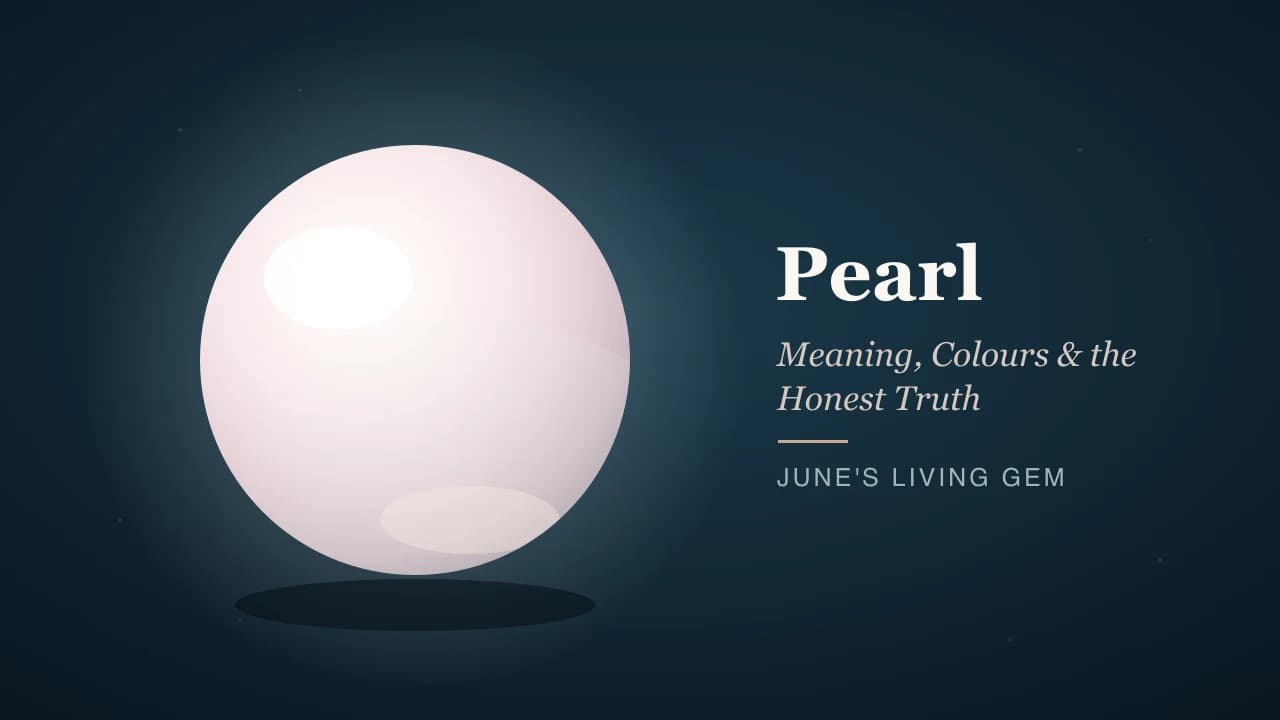
Pearl is the odd one out on the entire birthstone calendar, and that is exactly why we love it. Every other gem is a mineral, a crystal that grew slowly inside rock and had to be mined, cut, and polished before it looked like anything. Pearl is none of that. It is the only gem that was made by a living creature, grown whole and finished inside a soft animal, and it comes out of the shell already lustrous and round and ready to wear. No cutting, no faceting, no polishing. It is a gem that was alive.
That single difference explains almost everything about pearl: why it is so soft and needs such gentle care, why it has been treasured for longer than any faceted stone, and why it is surrounded by more confusion than any other gem on the list. Because here is the thing nobody tells you plainly: almost every pearl sold today is cultured, and most people have no idea what that actually means. They assume cultured means fake. It does not. Getting that one distinction straight is the single most useful thing you can learn about pearls, and it is the reason we wrote this guide.
This is the honest, complete take on the real gem. What pearl means and where its symbolism comes from, what a pearl actually is and how a living animal makes one, the true difference between natural, cultured, and imitation pearls, how to tell a real pearl from a plastic imposter in five seconds, what the colours from classic white to peacock black to golden really are, the four types of cultured pearl and which is best value, what drives the price, and how to care for the most delicate gem you will ever own. Pearl is June's oldest birthstone, and we think it is badly underrated by people who only know it as their grandmother's necklace. Let us give it a proper hearing.
Pearl Meaning in One Sentence
If you only want the quick answer: pearl is the stone of purity, wisdom, and calm, a gem long tied to the sea and the moon, to integrity and honest character, and to the quiet dignity that comes with age and experience. It has been called both "the queen of gems and the gem of queens," and almost all of its meaning flows from two ideas, the purity of something flawless born from a humble shell, and the serene, moonlit calm of the sea it comes from.
That meaning fits the stone unusually well. A pearl looks like a small captured moon, soft and glowing rather than sparkling, and its lore has the same quiet, luminous quality. It is not a gem of fire or drama. It is a gem of composure, of grace, and of wisdom earned over time, which is a rather lovely thing to carry. We will come back to the full symbolism below, but first the part that makes pearl unlike anything else on the calendar, the fact that it was alive.
What Is a Pearl?
A pearl is made of nacre, the same shimmering substance that lines the inside of certain mollusc shells, the stuff you know as mother-of-pearl. When an irritant of some kind lodges inside an oyster or a mussel, the animal defends itself by coating the intruder, layer after microscopic layer, in nacre. Given enough time, those thousands of translucent layers build up into a pearl. Nacre is mostly a mineral called aragonite, a form of calcium carbonate, bound together by an organic glue, and it is the way light bounces around inside those stacked layers that gives a pearl its soft, deep, glowing shine, the quality the trade calls lustre.
So a pearl is an organic gem, or a biogenic one, meaning it was made by a living thing rather than formed geologically. Only a small handful of gems can say that, amber and coral and jet among them, and pearl is by far the most important. This is the fact to hold on to, because everything practical about pearl follows from it.
The most important practical consequence is that pearl is extraordinarily soft. On the Mohs hardness scale it sits at roughly 2.5 to 4.5, which makes it softer than almost anything else you would ever call a gem, softer than a copper coin, soft enough to be scratched by dust, and vulnerable to acids, heat, and chemicals in a way no crystal is. We will come back to care later, but understand it now: a pearl is not a diamond you can knock about, it is a delicate organic thing that needs looking after. That is the price of being the only gem that was once alive, and we think it is a price worth paying.
The Open Secret: Natural, Cultured, and Imitation Pearls
Here is the single most important section in this guide, and the one that will save you the most money and confusion. There are three completely different things all being sold under the word "pearl," and the difference between them is enormous.
Natural pearls form entirely by accident, with no human help at all, when a wild oyster or mussel happens to coat a natural irritant. They are staggeringly rare. For most of human history, natural pearls were among the most valuable objects on Earth, precisely because you had to open thousands of wild oysters to find a single good one. Genuine natural pearls still exist, but they are essentially a collector and auction item now, museum-grade, priced accordingly, and almost nobody reading this will ever buy one. If a shop is selling affordable "natural pearls" by the strand, they are misusing the word.
Cultured pearls are the answer to that rarity, and they are what you are almost certainly buying. A pearl farmer carefully inserts a tiny nucleus, a bead or a scrap of tissue, into a living oyster or mussel, and then the animal does exactly what it would do with a natural irritant: it coats the nucleus in real nacre, over months or years, and produces a real pearl. This is the part people get wrong. A cultured pearl is a genuine, real pearl. The nacre is real, the lustre is real, the gem is real. The only thing a human did was start the process that nature would otherwise have done by chance. Cultured pearls were perfected in Japan in the early twentieth century, largely by Kokichi Mikimoto, and today they are the overwhelming majority of every pearl on the market. When you buy pearls, assume they are cultured, and do not think of that as a compromise. It is simply how real pearls are grown now.
Imitation pearls are the actual fakes, and these are the ones to watch for. An imitation pearl is not a pearl at all. It is a bead of glass, plastic, or shell, dipped in a pearly lacquer or coating to mimic the look. Names like "faux pearl," "shell pearl," "Majorca or Mallorca pearl," and "glass pearl" all describe imitations. Some are quite convincing to the eye and perfectly fine as costume jewellery, sold honestly and cheaply. The problem is only when an imitation is passed off, or priced, as a genuine cultured pearl.
Our honest position is the same one we take on cultured diamonds and heated gems: cultured is real, imitation is not, and the trick is simply never to pay real-pearl money for a lacquered bead. Cultured pearls are one of the great honest bargains of the gem world, real gems made affordable. The parallel we keep coming back to is lab-grown versus natural gems, where "grown with human help" and "fake" are two entirely different things that people constantly muddle. Pearl is the oldest example of exactly that distinction.
How to Tell a Real Pearl from a Fake
Because imitation pearls are everywhere, it helps to know the home tests. None is perfect on its own, but together they are very reliable.
- The tooth test. This is the famous one, and it genuinely works. Gently rub the pearl against the biting edge of your front tooth. A real pearl, natural or cultured, feels slightly gritty or sandy, because real nacre has a fine microscopic texture. An imitation pearl, being coated glass or plastic, feels smooth and slick, like a bead. It is a five-second test and it catches most fakes.
- Temperature. Real pearls are cool to the touch when you first pick them up and warm slowly. Plastic imitations feel roughly room temperature straight away and warm almost instantly.
- Weight. Real pearls have a certain heft. Very light, hollow-feeling beads are usually plastic. Glass imitations can feel heavier than real, so weight is a hint, not a verdict.
- Look at the drill hole. Under a loupe, a real pearl's drill hole has crisp, clean edges and you can often see the layered nacre. An imitation frequently shows a coating that has chipped or flaked around the hole, revealing a glass or plastic bead underneath.
- Surface and matching. Real pearls, even fine ones, have tiny individual irregularities and no two are identical. A strand of absolutely flawless, perfectly matched, mirror-smooth "pearls" at a low price is almost always imitation.
We think the tooth test alone settles most cases, and it is worth doing on any pearls you inherit or buy secondhand. For anything genuinely valuable, a jeweller or gem lab can confirm not just that a pearl is real but whether it is natural or cultured, which is the distinction that actually moves the price.
The Colours of Pearl, and the Honest Truth About Them
Pearls come in a far wider range of colours than most people expect, and understanding pearl colour means understanding two separate things at once.
Every pearl has a body colour, its main overall colour, and many also have an overtone, a subtle secondary tint that floats over the surface, plus sometimes orient, a faint iridescent shimmer of rainbow colour. A classic white pearl with a rose overtone, for instance, reads as white but has a delicate pink glow over it, and that overtone is a large part of what makes fine pearls so beautiful. When you judge a pearl's colour, you are really judging body colour and overtone together.
The main colours run roughly like this:
- White and cream is the classic, from bright silvery-white through soft ivory. The most prized whites carry a rose or pink overtone, which is the traditional gold standard for a fine Akoya strand.
- Pink, peach, lavender, and other pastels appear naturally in freshwater pearls especially, soft and pretty and usually affordable.
- Black, grey, and peacock is the dramatic end, and this is where Tahitian pearls live. A fine "black" pearl is rarely flat black. It is a deep, dark body colour shot through with green, blue, purple, or the coveted peacock mix of overtones, and it is genuinely spectacular.
- Golden is the luxury colour, the deep, warm yellow-to-gold of the finest South Sea pearls, among the rarest and most expensive of all.
- Silver, blue, and other exotics round out the range, some natural, some the result of treatment.
A word of honesty about colour, because it matters. Some pearl colour is natural and some is enhanced. A good deal of inexpensive black or dyed-colour pearl on the market has been treated or dyed to achieve its colour, which is fine when disclosed and priced accordingly, but is not the same as a naturally coloured Tahitian or golden South Sea pearl. Cheap "black pearls" are very often dyed freshwater pearls, not natural Tahitians. As always, the rule is simple: know which one you are looking at, and do not pay natural-colour prices for dyed stones.
Since it is one of the most searched questions, the meaning attached to the black pearl specifically is worth a line. Where the white pearl symbolises purity and innocence, the black pearl has come to stand for mystery, independence, strength, and a kind of powerful, unconventional beauty. It is the pearl for someone who finds the classic white strand a little too demure, and we rather admire it for that.
The Four Types of Cultured Pearl
Almost all pearls sold today fall into one of four types, defined by the animal and the water they grow in. Knowing them tells you most of what you need about quality and price.
- Freshwater pearls are grown in mussels in lakes and rivers, mostly in China, and they are by far the most common and the best value pearls today. They come in a huge range of shapes, sizes, and pastel colours, and modern freshwater quality has improved enormously, with round, lustrous strands now rivalling more expensive types for a fraction of the price. If you want real pearls without spending much, this is where to look, and we recommend them without hesitation for everyday wear.
- Akoya pearls are the classic saltwater pearl, grown in Japan and China, and they are what most people picture as the traditional pearl necklace: round, white, mirror-bright, with that crisp rose-tinted lustre. Akoya are prized above all for their sharp, reflective lustre, and a fine white Akoya strand is the timeless choice for a formal string of pearls.
- South Sea pearls are the largest and most expensive, grown in big oysters in the waters off Australia, Indonesia, and the Philippines. They come in white, silver, and the famous deep golden colour, they are large, and they carry a soft, satiny lustre. These are luxury pearls, priced to match.
- Tahitian pearls are the naturally dark ones, grown in the black-lipped oyster of French Polynesia, and they produce the black, grey, and peacock colours no other pearl does naturally. A fine Tahitian with strong peacock overtones is one of the most striking gems you can wear.
Our take, if you are choosing: freshwater for genuine value and everyday wear, Akoya for the classic white formal strand, and South Sea or Tahitian when you want a real showpiece and have the budget for it. There is no wrong answer, only different jobs.
Pearl Meaning and Symbolism
Pearl has one of the oldest and most consistent bodies of symbolism of any gem, and it clusters around a few clear themes:
- Purity and innocence. More than any other gem, pearl symbolises purity, which is why it has such a strong association with brides and wedding jewellery. A flawless, luminous pearl born from a rough shell is a natural emblem of something pure emerging from something plain.
- Wisdom and integrity. Pearls have long been linked to wisdom gained through experience, to honesty, and to integrity of character, the sense of a person who has quietly become better with time.
- The sea and the moon. As a gem of the water with a soft, moonlike glow, pearl carries deep associations with the sea, the moon, the tides, and the calm, reflective, feminine qualities tied to them.
- Calm, protection, and emotional balance. In lore across many cultures, pearls were worn to bring calm, to soothe the emotions, and to protect the wearer, a steadying rather than energising influence.
- Tears. There is an older, bittersweet thread too, an old superstition that pearls represent tears, which is why some traditions were cautious about pearls at weddings even as others embraced them for their purity. We mention it because it is part of the lore, not because we take it seriously.
Its modern roles fit the theme. Pearl is the June birthstone, and it is the traditional gift for both the 3rd and the 30th wedding anniversaries, the second of which nicely matches pearl's association with a bond that has grown wise and lustrous over time.
Here is our standard and sincere position, the one we hold for every gem. These are cultural and symbolic meanings, not physical powers. A pearl will not literally make you wiser or calmer or protect you from harm. What it genuinely offers is one of the most graceful and coherent bodies of symbolism in the whole gem world, thousands of years of association with purity, wisdom, and quiet dignity, wrapped in a gem that looks exactly like what it means. You can enjoy every bit of that without believing the pearl is doing anything but glowing softly and carrying a very old and lovely story.
Is Pearl a Birthstone?
Yes. Pearl is a birthstone for June, and it is the oldest of June's stones by an almost comical margin. June is one of the rare months with more than one birthstone, and it has three: pearl, the ancient organic classic; alexandrite, the rare colour-change gem discovered in the 1830s; and moonstone, the glowing feldspar. Pearl is the traditional and most widely worn of the three, the stone most people mean when they talk about June.
If you have a June birthday, you are genuinely spoiled for choice, and the three stones could hardly be more different. Our full guide to choosing between June's pearl and alexandrite walks through that decision in detail, our moonstone meaning and colours guide covers the glowing third option, and our alexandrite guide covers the rare and pricey one. The June birthstone pillar page pulls the whole month together. Pearl is the one we would reach for first for its history, its softness of look, and its unbeatable value in cultured form, but all three are worth knowing.
What Pearl Is Worth
Pearl pricing runs on a different logic from faceted gems, because there is nothing to cut and no clarity grade in the diamond sense. Instead, value comes down to a handful of quality factors, and one of them matters far more than the rest.
Lustre is king. The single most important thing about any pearl is the quality of its lustre, the depth, sharpness, and glow of the light coming off it. A pearl with high lustre looks almost lit from within, with sharp reflections you could nearly see your face in. A pearl with poor lustre looks chalky, flat, and dull, like a painted bead. Lustre is the make-or-break factor, and it is worth more than size or even colour. If you learn to judge only one thing about pearls, learn to judge lustre.
After lustre, the factors are, roughly in order: nacre thickness (thicker nacre means better lustre and durability, and it is why some cheap cultured pearls with wafer-thin nacre look dull and wear badly), surface quality (fewer spots, bumps, and blemishes is better, though no natural surface is perfect), shape (perfectly round is rarest and priciest, but baroque and other shapes have their own charm and value), colour (rarer natural colours like fine golden South Sea and peacock Tahitian command more), size (bigger is rarer and dearer, dramatically so for South Sea), and matching (a strand of well-matched pearls is worth more than the sum of mismatched ones).
Put together, this makes pearl one of the more accessible gems at the everyday end and one of the more serious at the top. A lovely lustrous freshwater strand is genuinely affordable, real gems for modest money, while a large, round, high-lustre golden South Sea or peacock Tahitian strand is a major purchase. In our most expensive birthstones ranked guide, fine natural pearls sit near the top for rarity, while cultured pearls of ordinary quality are among the friendliest buys on the calendar. That enormous range, all under one word, is exactly why understanding lustre and the natural-cultured-imitation split matters so much.
How to Buy and Care for Pearl
When buying, in order of priority:
- Judge the lustre first. Hold the pearl under good light and look at the reflections. You want sharp, bright, deep glow, not a dull chalky sheen. High lustre is the whole game, so weight your decision on it above all else.
- Assume cultured, and be glad of it. Nearly all pearls you can afford are cultured, and that is exactly right, because cultured pearls are real pearls. Only be suspicious if someone claims cheap "natural" pearls, and only pay natural prices with lab documentation.
- Do the tooth test. A quick rub against your tooth tells you gritty (real) from slick (imitation). Do it on anything secondhand or suspiciously cheap.
- Ask about colour treatment. Especially with black and vividly coloured pearls, ask whether the colour is natural or dyed. Dyed is fine if disclosed and priced as such, but a dyed freshwater pearl is not a natural Tahitian.
- Match the type to the job. Freshwater for value and daily wear, Akoya for the classic white strand, South Sea and Tahitian for a showpiece. Buy the type that fits how you will actually wear it.
Caring for pearls, because they are the most delicate gem you will ever own:
- Last on, first off. Put your pearls on after your make-up, perfume, hairspray, and lotion, and take them off before you undress. Pearls are attacked by the acids and chemicals in cosmetics, perfume, and even sweat, so keeping them off your skin's chemistry as much as possible is the golden rule.
- Wipe them after wearing. Give pearls a gentle wipe with a soft, slightly damp cloth after each wear to remove oils and residue. That one habit does more to keep them beautiful than anything else.
- Never use ultrasonic cleaners, steam, or chemical dips. These will damage or destroy pearls. Warm water, the mildest soap, and a soft cloth are all you should ever use, and even then sparingly.
- Store them apart and flat. Pearls scratch against harder gems and metal, so keep them in their own soft pouch or a lined compartment, laid flat rather than hung, so the silk thread does not stretch over time.
- Wear them, and restring occasionally. Pearls actually benefit from being worn, since a little contact with your skin keeps them from drying out, but a strung necklace should be restrung every so often, ideally with knots between the pearls so a broken string does not scatter them and so they do not rub against each other.
Treat pearls as the soft, living-born gems they are, with a little care and a lot of wearing, and a good strand will glow for generations. Many of the finest pearls in existence are heirlooms passed down for exactly that reason.
The Bottom Line
Pearl is the outlier of the birthstone calendar, and the more you understand it the more you appreciate it. It is the only gem grown by a living animal, finished and lustrous straight from the shell, the softest gem there is, and the oldest treasured of them all. It is June's classic birthstone, the gift for a 3rd and a 30th anniversary, and a symbol of purity, wisdom, and quiet dignity that fits its soft, moonlike glow perfectly.
Our summary: buy pearls with three things in mind, and wear them far more than you probably do. Judge lustre above everything, because that inner glow is what separates a beautiful pearl from a dull bead. Understand that cultured means real, not fake, so honest cultured pearls are one of the great bargains in gems and only imitation glass-and-plastic beads are the thing to avoid. And treat them gently, last on and first off, because a gem this soft needs care that a diamond never will. Do that, and you will own a real, living-born gem with thousands of years of grace behind it, in a glow that no faceted stone can imitate.
If pearl's soft glow drew you in, the natural next stops are its glowing June cousin in our moonstone meaning and colours guide, the rare colour-change third June stone in our alexandrite guide, the full picture of the month in our June birthstone guide, the deeper roots of why gems carry meaning at all in our talismans and amulets guide, and the wider value map in our most expensive birthstones ranked, where pearl spans almost the entire range from bargain to museum piece.
Wondering how it stacks up against every other gem? Compare values in our gemstone price guide and toughness on the sortable Mohs hardness table.