Turquoise: Meaning, Colours, and How to Tell Real Turquoise From the Dyed Howlite Flooding the Market
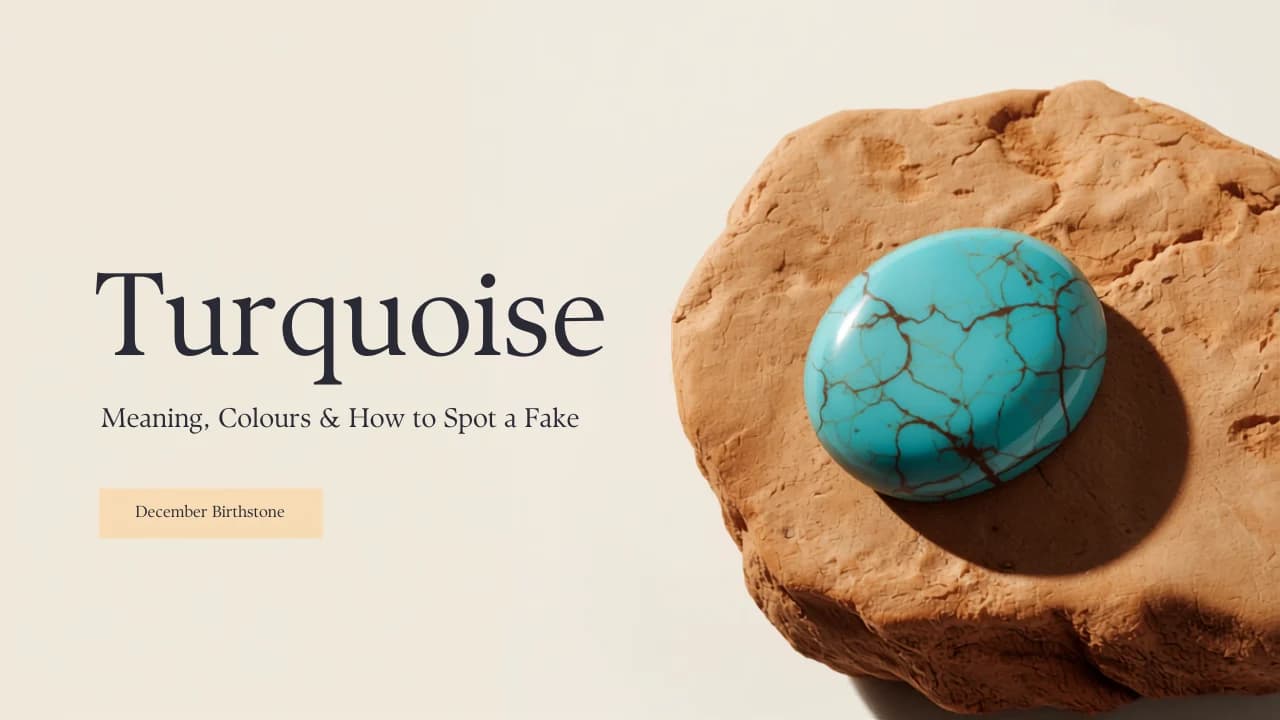
Almost every other stone on the birthstone calendar is prized for being clear, faceted, and sparkly. Turquoise is the odd one out, and that is exactly why people who love it love it so much. It is opaque, it is cut into smooth domes and beads rather than glittering facets, and its whole appeal is a single unmistakable colour: that warm robin's-egg sky blue, often laced with a web of brown or black veining, that has been worn on human bodies for at least seven thousand years. No other gem looks remotely like it, and no other gem carries quite so much history.
It is also, and we are going to be blunt about this from the very first paragraph, the most faked and most treated gemstone you can buy. The cheerful turquoise-coloured beads you see strung on market stalls and sold for a few dollars are, more often than not, not turquoise at all. They are dyed howlite, or pressed turquoise powder glued back together with resin, or in many cases just plastic. Even a great deal of the genuine turquoise in the trade has been stabilised, soaked in resin to harden it. None of that makes turquoise a bad buy. It makes turquoise a stone you have to understand before you spend, and that is what this guide is for.
This is the honest, complete version. What turquoise actually is, its real colour range, what that matrix veining tells you, the protection lore that spans three continents, why it is one of December's birthstones, the fakes and treatments and exactly how to spot them, what turquoise is worth and why famous mines like Sleeping Beauty command a premium, and how to buy and care for a stone that, uniquely, changes with the person who wears it. Turquoise is one of our favourite gems on the whole site, precisely because it is so human, and the trick is knowing what you are really holding.
Turquoise Meaning in One Sentence
If you only want the quick answer: turquoise is the stone of protection, healing, and good fortune, the ancient guardian gem believed to shield the wearer from harm, bring wisdom and calm, and connect earth to sky. Of all the gemstones, turquoise has the most consistent meaning across the most cultures. Persians, Egyptians, Tibetans, and the Native American peoples of the Southwest, peoples who never met and never traded, all independently landed on turquoise as a stone of protection and blessing. When that many separate civilisations reach the same conclusion about a stone, it is worth paying attention to.
That meaning grew out of the colour itself, the colour of a clear sky and clean water, the two things every ancient culture associated with life and safety. But to understand turquoise properly, and to shop for it without being fooled, you have to start with what it physically is, because its softness and its porous nature explain both its biggest care challenge and its single most magical quality.
What Is Turquoise?
Turquoise is a hydrated phosphate of copper and aluminium, and that copper is the source of its famous blue. It forms in a very particular and rather unglamorous way: in dry, desert regions, slightly acidic water percolates down through copper-rich rock, dissolves a cocktail of minerals, and deposits turquoise in the cracks and cavities of the host stone over enormous spans of time. This is why turquoise is found in deserts, the American Southwest, Iran, the Sinai, northern Mexico, China, and why it so often comes attached to the brown or black rock it grew in. That host rock is the matrix, and we will come back to it because it matters enormously.
Two physical facts define everything about owning turquoise. First, it is soft, sitting at only 5 to 6 on the Mohs hardness scale, well below the quartz at 7 that we usually treat as the daily-wear threshold. That means turquoise can be scratched by sand, dust, and harder stones, and it needs more care than a sapphire or a citrine. Second, and this is the genuinely special part, natural turquoise is porous. It has microscopic holes throughout, like a very fine sponge, and that porosity is why turquoise behaves like no other gem.
Because it is porous, turquoise slowly absorbs oils, lotions, sweat, and skin chemistry from the person wearing it. Over years of wear, a piece of natural turquoise can gradually shift colour, often deepening from sky blue towards green, picking up a patina that is completely unique to its owner. Some people are horrified by this and some people are enchanted by it, and which camp you fall into should genuinely shape what you buy. We are firmly in the enchanted camp. A turquoise that has greened with decades of wear is, to us, a far more meaningful object than a flawless blue stone fresh from the mine, because it carries the literal chemistry of a life lived. No other gem does this. It is the closest thing in the mineral world to a stone that grows old alongside you.
The Colours of Turquoise
Turquoise colour runs along a single axis from pure sky blue to green, and where a stone sits on that line is the first thing that sets its price and character:
- Sky blue and robin's-egg blue. The classic, most prized colour, a clean, bright, slightly soft blue with no green and no grey. This is the colour people picture when they hear the word turquoise, and the finest pure-blue material, historically the great Persian turquoise and the American Sleeping Beauty mine, is the most sought-after and the most expensive.
- Blue-green and teal. A blue that leans towards green, often very beautiful and a little more affordable than pure sky blue. Much American turquoise falls here, and many people genuinely prefer it.
- Green. Turquoise with a higher iron content, or that has greened naturally over time, ranges from a fresh apple green to a deep avocado. Once dismissed as inferior, green turquoise has its own strong following today, and some prized mines produce it specifically.
- Yellow-green and "lime." The most unusual end, rare and collectable in certain mines.
Running through and across all of these is the matrix, the veining of host rock left in the stone. A fine, even, brown or black web on a blue background is called "spiderweb" turquoise, and a beautiful, tight spiderweb pattern can make a stone more valuable, not less, even though it is technically an inclusion. This is one of the lovely contradictions of turquoise: in most gems an inclusion is a flaw, but in turquoise the right matrix is a feature people pay extra for, because it is a signature of where the stone was born and proof that it is natural.
The single most useful thing to understand about turquoise colour is that even, consistent colour and an attractive matrix matter more than chasing the "best" hue. A clean, evenly coloured blue-green stone with a handsome web is a better buy than a patchy, chalky sky blue. Buy the stone that looks balanced and alive in normal daylight, not the one whose colour name sounds the grandest.
The Big Problem: Fakes, Stabilisation, and How to Tell Real Turquoise
This is the section that matters most, so here it is laid out plainly. The turquoise market is a minefield, and the deception runs across several levels, from completely fake to genuinely real but treated. You need to know all of them.
Outright fakes (not turquoise at all):
- Dyed howlite or magnesite. This is the big one. Howlite is a cheap white mineral with natural grey veining that, when dyed blue, looks startlingly like turquoise, matrix and all. The overwhelming majority of cheap "turquoise" beads, bracelets, and tumbled stones sold online and in tourist shops are dyed howlite. It is not turquoise in any sense.
- Reconstituted or "block" turquoise. Powdered scraps of real turquoise (or other minerals) mixed with resin or plastic, dyed, and pressed into a solid block that is then cut into beads. It contains some turquoise, but it is essentially a man-made composite.
- Plastic and glass imitations. The cheapest of all, often given away in their too-perfect, too-uniform colour.
Real turquoise, but treated:
- Stabilised turquoise. Genuine but soft, porous, lower-grade turquoise that has been impregnated with clear resin to harden it and stabilise the colour so it does not change with wear. This is extremely common, it is real turquoise, and it is perfectly acceptable for everyday jewellery. It is also much cheaper than untreated natural turquoise, and it should be.
- Natural or untreated turquoise. Real turquoise hard enough and stable enough to be cut and worn with no treatment at all. This is the rare, expensive, top of the market, and it is the only material that will develop that personal patina over time, because it is the only material still porous enough to do so.
Here is our honest position. We are not snobs about stabilisation. For a piece you intend to wear hard every day, stabilised natural turquoise is sensible, durable, and good value, and we would happily buy it. What we object to is stabilised or reconstituted stone sold at untreated natural prices, and dyed howlite sold as turquoise at all. The honesty rule is exactly the one we apply to every gem on this site: pay the treated price for a treated stone, and only pay the natural-rarity premium when the "natural, untreated" claim is actually backed up.
How to Tell If Turquoise Is Real
You cannot always be certain by eye, and only a gem lab is definitive, but there are strong, practical tells:
- Price is the loudest signal. A large, deep-blue "turquoise" bead necklace for a few dollars is dyed howlite or block, full stop. Genuine untreated turquoise of good colour is not cheap, and it never has been. If the price feels too good for the colour and size, it is.
- Look at the matrix. Real matrix sits within the stone and feels integral to it. On dyed howlite, dye often pools and concentrates in the veining, so the "matrix" looks like it has been painted on or is unnaturally dark and even. Suspiciously perfect, identical veining across every bead in a strand is a red flag.
- The fingernail and back of the stone. On strung beads, look at the drill holes and the backs, places where dye concentrates or where you might see white howlite peeking through a worn surface.
- Uniform perfection is suspicious. Natural turquoise varies, bead to bead and across a single stone. A strand where every bead is the identical flawless blue is almost certainly man-made.
- The acetone test (do this gently and only on a stone you are willing to risk). A cotton bud dipped in acetone or even nail-polish remover, rubbed on an inconspicuous spot, will often lift blue dye off dyed howlite onto the cotton. Real turquoise will not bleed colour. This is destructive to fakes and harmless to genuine stone, which tells you something in itself.
The single best protection, as always, is a reputable seller who will tell you plainly whether a stone is natural, stabilised, or reconstituted. A dealer who answers that question comfortably and specifically is worth more than any home test.
Turquoise Meaning and Symbolism: The Great Protection Stone
Turquoise lore is unusually deep and unusually unanimous, because so many separate cultures arrived at the same beliefs. The headline meaning everywhere is protection.
- Persia (ancient Iran) gave turquoise its reputation as a guardian stone and even, by one popular account, its name, with the word eventually reaching English through the French for "Turkish stone," because Persian turquoise reached Europe through Turkey. Persians wore it for protection and believed it could warn of danger by changing colour, and they set it into daggers, horse bridles, and turbans.
- Ancient Egypt mined turquoise in the Sinai over six thousand years ago and used it lavishly. Tutankhamun's famous burial mask is inlaid with it. To the Egyptians it was a stone of life and protection in this world and the next.
- The Native American peoples of the Southwest, the Navajo, Zuni, Hopi, and Pueblo nations, hold turquoise as sacred, a piece of the sky fallen to earth, a stone of protection, health, and connection to the spirit world, and the heart of a silver-and-turquoise jewellery tradition that remains one of the most recognisable and respected in the world.
- Tibet prized turquoise alongside coral as a protective and sacred stone, worn for health and good fortune and set into ritual objects.
From that shared root of protection, the meanings branch out the familiar way:
- Healing and well-being, turquoise as the great "master healer," a stone of calm, balance, and recovery.
- Wisdom and communication, often linked to the throat chakra, turquoise as a stone of honest, clear expression.
- Good fortune and friendship, a traditional gift of blessing, and in some traditions specifically powerful only when given rather than bought for oneself.
Here is our honest position, the one we hold for every stone on this site. These are cultural and symbolic meanings, not physical powers. A turquoise will not literally deflect harm or heal an illness. What it genuinely offers is something quieter and, we think, more durable: a tangible link to one of the oldest and most universal human instincts, the wish to carry protection and blessing with you, an instinct so deep that civilisations who never met all expressed it through this one blue stone. That is a real and ancient reason to wear a gem. If the deeper history of how stones came to carry these meanings interests you, our piece on talismans and amulets in gemstone lore traces exactly where it began.
Is Turquoise a Birthstone?
Yes. Turquoise is one of the modern birthstones for December, sharing the month with tanzanite and blue zircon. December is unusual in having three official birthstones, all of them blue, and turquoise is by far the oldest and most storied of the trio. Where tanzanite was only discovered in 1967 and zircon is often overlooked, turquoise has been treasured since before recorded history, which makes it a wonderful choice for a December baby who wants a stone with genuine ancient weight behind it.
If you are a December baby choosing between the three, the honest trade-offs matter. Tanzanite is a gorgeous violet-blue but very soft and delicate; zircon is brilliant and underrated but little known; turquoise is the most distinctive and meaningful but the softest and most care-intensive of all. We walk through all three in detail in our full December birthstone guide, and the December birthstone pillar page lays out the colours and history. The short version: if you want a stone with thousands of years of human meaning behind it and you are willing to look after it, turquoise is the soulful pick.
Types and Sources: Why Sleeping Beauty and Persian Turquoise Cost More
Unlike most gems, turquoise is often sold and valued by the specific mine it came from, because each deposit produces a recognisable colour and matrix. A few names carry real weight:
- Persian (Iranian) turquoise. The historic gold standard, an intense, even sky blue, often with little or no matrix. For centuries this was the finest turquoise in the world, and "Persian grade" is still used as a quality term even for stones from elsewhere.
- Sleeping Beauty (Arizona). The most famous American mine, prized for a pure, clean, even robin's-egg blue with almost no matrix. The mine closed to turquoise production in 2012, which means no new Sleeping Beauty turquoise is coming out of the ground, and existing stock has climbed steadily in price ever since. When you see a premium on Sleeping Beauty, that closed-mine scarcity is the reason.
- Kingman (Arizona). A large, long-running source producing a huge range of colours and matrices, from high blue to spiderweb, and a great deal of the American turquoise in the trade.
- Bisbee (Arizona). A legendary closed mine known for a deep, high blue with a distinctive reddish-brown "chocolate" matrix, highly collectable.
- Chinese turquoise. China is now the largest producer of turquoise in the world by volume, in every grade from superb to very ordinary, and it supplies a huge share of the global market. Good Chinese turquoise is genuinely good; the country's output simply spans the full range.
The practical takeaway is that mine names are partly quality and partly romance. A famous closed-mine name like Sleeping Beauty or Bisbee carries a collector premium that is real but that you are paying partly for the story. If you simply want a beautiful, durable blue stone to wear, excellent unnamed or Chinese turquoise can be a far better value, and we would not hesitate to recommend it.
What Turquoise Is Worth
Turquoise pricing is wider and stranger than almost any other gem, because it depends so heavily on the interaction of colour, matrix, treatment, and provenance. A stabilised Chinese turquoise cabochon might cost a few dollars, while a top-grade untreated natural Sleeping Beauty or fine Persian stone of real size can run into hundreds or thousands of dollars per carat. They are, in a sense, two completely different markets wearing the same name.
What this means in practice:
- Treatment is the biggest price lever. Untreated natural turquoise commands a large premium over stabilised, which in turn is worth far more than reconstituted block, which is worth more than dyed howlite, which is worth nothing as turquoise. Knowing which one you are buying is the whole game.
- Pure, even, high blue is the classic premium colour, but a beautiful tight spiderweb matrix can lift a stone's value, and green turquoise has its own strong and growing market. Evenness and life matter more than a single "ideal" hue.
- Famous closed-mine provenance adds a collector premium that is real but partly romantic. Decide whether you are buying a gem to wear or a piece of mining history.
Because so much affordable turquoise is treated, it follows the same logic we apply to the other accessible stones: for everyday jewellery, a well-set stabilised turquoise in solid silver or gold is sensible and good value, and you put your money into honest material and good craftsmanship rather than chasing a name. If you want the full picture of how natural, treated, and man-made stones compare in value across the birthstones, we cover it in lab-grown vs natural stones, and you can see where turquoise sits against the genuinely rare gems in our most expensive birthstones ranked.
How to Buy and Care for Turquoise
Turquoise asks more of you than almost any other gem, but the care rules are simple once you accept that this is a soft, porous, sensitive stone, not a tough one.
When buying, in order of priority:
- Establish the treatment first. Before colour, before anything, find out whether the stone is natural untreated, stabilised, reconstituted, or an outright fake. Everything else depends on this answer, so buy from a seller who will give it to you plainly.
- Colour and matrix second. Choose an even, lively blue or blue-green you genuinely love, and treat an attractive, integral matrix as a plus rather than a flaw.
- Match the stone to the use. For a ring or a bracelet that will take knocks, choose a stabilised, more durable stone. Save delicate untreated natural turquoise for earrings, pendants, and pieces that live a gentler life.
- Pay the right price for the right grade. Do not pay natural-untreated money for stabilised stone, and never pay turquoise money for dyed howlite.
Caring for turquoise is mostly about what to keep away from it. Because it is soft and porous, turquoise is genuinely vulnerable, so:
- Never use an ultrasonic or steam cleaner. They can crack the stone and drive moisture into the pores. Clean only with a soft, slightly damp cloth and dry it immediately.
- Keep it away from chemicals, oils, and cosmetics. Perfume, hairspray, lotion, sunscreen, and household cleaners can all stain or discolour porous turquoise. The old jeweller's rule applies perfectly here: turquoise should be the last thing you put on and the first thing you take off.
- Protect it from heat and strong sunlight, which can dry the stone and fade the colour over time.
- Store it separately, away from harder gems that will scratch it.
And remember the magical exception to all this fussiness: if your turquoise is genuinely natural and untreated, it will slowly change colour as it absorbs the oils of the person wearing it, drifting from blue towards green over the years. With a stabilised stone, sealed in resin, this will not happen. So decide which turquoise you actually want, a stable, unchanging blue you can wear without a thought, or a living stone that will quietly record your life in its colour. Both are valid. We just think the choice is one of the loveliest decisions in all of gem buying.
The Bottom Line
Turquoise is the ancient one, the opaque sky-blue stone that humans have worn for protection and blessing for seven thousand years, the sacred gem of the Persians, Egyptians, and the Native American Southwest, and one of December's three birthstones. It is soft, porous, distinctive, and deeply human, the rare gem that genuinely ages along with the person who wears it. For anyone who wants a stone with real history and real meaning rather than mere sparkle, nothing else comes close.
Our summary: love turquoise for exactly what it is, an ancient, soulful, soft, and sensitive stone, and shop for it with one fact firmly in mind, that most cheap "turquoise" is dyed howlite or resin-bound block, and even much genuine turquoise has been stabilised. None of that is a dealbreaker. It just means you must establish the treatment before you pay, buy an even colour with an honest matrix, choose stabilised stone for hard wear and save delicate natural material for gentle pieces, and then protect it from chemicals, heat, and the ultrasonic cleaner for life. Do that, and you will own one of the oldest and most meaningful objects a person can carry.
If turquoise drew you in, the natural next stops are its two December companions in our full December birthstone guide, the deeper story of protective gem lore in talismans and amulets, the wider value picture in most expensive birthstones ranked, and the colour-by-colour tour of the whole calendar in birthstone colours by month.
Wondering how it stacks up against every other gem? Compare values in our gemstone price guide and toughness on the sortable Mohs hardness table.