June's Two Birthstones: Why You Get Pearl and Alexandrite (and How to Choose Between Them)
If you were born in June you do not have a birthstone. You have a buffet.
Most months get a single stone. June gets two officially recognised ones, pearl and alexandrite, and they sit at opposite ends of every spectrum that matters. Pearl is the oldest gem in human history, soft, organic, found in oysters, and worn by Cleopatra and your grandmother for roughly the same reasons. Alexandrite was discovered in 1831, is harder than topaz, changes colour under different light, and costs more per carat than most diamonds.
Our short answer, if you only read this far: pick pearl if you want a stone with quiet history and you actually plan to wear it. Pick alexandrite if you want a stone almost nobody else has and you do not flinch at the price. Now the long answer.
Why June Has Two Birthstones In the First Place
The short version: the modern birthstone list was standardised by the Jewelers of America in 1912, and June was assigned pearl alone. Alexandrite was added later, somewhere around the 1950s by most accounts, partly because pearl is fragile and partly because alexandrite was already trending as a status stone in the United States.
There is a third stone, moonstone, often listed as an alternative June birthstone in older charts and in the United Kingdom. We have left it out of the headline because it never made the official Jewelers of America list, but if you are drawn to the milky blue sheen of a good rainbow moonstone, you are well within the historical tradition. Most jewellers will sell you a June moonstone piece without raising an eyebrow.
For the wider context on how these lists got drawn up in the first place, see our breakdown of birthstone origins from the breastplate to the 1912 list.
Pearl: The Birthstone Older Than the Idea of a Birthstone
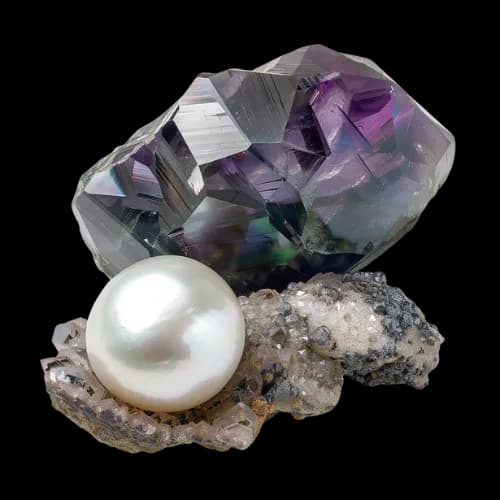
Pearl is the only major gem that is not a stone. It is biological. An oyster, mussel, or other mollusc reacts to an irritant inside its shell by coating it in layer after layer of nacre, and a few years later you have a pearl.
This matters more than it sounds. Because pearls are organic, they have been part of human ornament for at least 6,000 years, predating cut gems by a comfortable margin. There is no "discovery story" for pearl in the way there is for diamond or emerald. People have always known about pearls.
George Frederick Kunz, our regular primary source from his 1913 book The Curious Lore of Precious Stones, spent dozens of pages on the lore around pearls and almost no time arguing for their importance. He took it for granted. In one memorable passage he describes the pearl-fishers of Borneo preserving "every ninth pearl they find" in a bottle stoppered with a dead man's finger, in the belief that the saved pearls would breed more. We mention this not because we recommend the practice but because it tells you how seriously the stone was taken when it was still genuinely rare.
What Pearl Actually Symbolises
The traditional list of associations is long. Purity. Wisdom gained through experience. The moon. Tears, both of joy and grief. The pearl as the "queen-gem" to the diamond's "king-gem", which is Kunz's own framing.
Our honest take: most of these symbolic readings come from the fact that pearls are slow. An oyster takes between two and seven years to produce a gem-quality pearl. Slowness is the actual symbol. Everything else is decoration.
Pearl's Big Weakness, And Why It Still Wins
Pearl ranks 2.5 to 4.5 on the Mohs hardness scale, which puts it just above a fingernail and well below glass. Hairspray will dull it. Vinegar will dissolve it. (Pliny's story of Cleopatra dissolving a pearl in wine to win a bet with Mark Antony is almost certainly exaggerated, but the underlying chemistry is real. Pearls hate acid.)
If you wear a pearl ring every day, you will eventually notice the nacre wearing thin where it meets the setting. This is the case against pearl as an engagement stone and the case in favour of pearl as a necklace or earring.
We are still in favour of pearls. The wear is part of the point. A pearl that has been worn for forty years against the same neck has a soft glow that no new pearl can fake, and that is exactly the kind of patina the stone is supposed to develop. It is the only birthstone that quietly becomes more itself the longer you own it.
Alexandrite: The Stone Born With a Tsar
Now the other end of the spectrum.
The first alexandrites were found in 1831, in the Ural Mountains of Russia, in the emerald mines on the Takovaya river. Kunz reports the date specifically: the gem was discovered on the day Alexander II, then heir-apparent to the Russian throne, came of age. The mineralogist Nils Nordenskjold named the new stone after him. It became, almost immediately, the unofficial national gem of Imperial Russia, in part because it conveniently displayed the Tsar's colours: bright green under daylight, deep red under candlelight.
It is one of the few stories in gem history where the origin myth and the documentary record line up almost exactly. We find that pleasing.
For more on stones that earned their fame through historical accident rather than ancient tradition, see our birthstone history hub.
The Colour Change, Explained Without the Hand-Waving
Alexandrite's signature trick is that it appears green in daylight and red, purplish-red, or raspberry under incandescent (warm) artificial light. Jewellers call this the "alexandrite effect".
The physical explanation is straightforward enough. Alexandrite is a chromium-bearing variety of chrysoberyl. Chromium absorbs light in the yellow part of the spectrum and lets through both green and red almost equally. Daylight is rich in blue and green wavelengths, so the stone reads green. Candlelight and incandescent bulbs are rich in red and orange, so the stone reads red. Your eye does the rest.
A genuine, strong colour change is what separates a great alexandrite from a mediocre one. The trade phrase is "emerald by day, ruby by night", and Kunz quotes it word for word. He also notes, drily, that very few alexandrites actually live up to it. Most look greenish-grey by day and brownish-red at night.
How to Tell If An Alexandrite Is Actually An Alexandrite
This is the practical part. The synthetic alexandrite trade is enormous, and a great deal of "alexandrite" jewellery sold in the United States is in fact synthetic colour-change sapphire or lab-grown alexandrite, both of which are perfectly legitimate stones if disclosed and a problem if not.
Three quick tests we recommend before parting with serious money:
- Look at the stone under fluorescent office lighting (cool, blue-rich) and then under a household incandescent bulb (warm, red-rich). The shift should be obvious and clean, not muddy.
- Ask for the source. Russian Ural alexandrite is largely tapped out; today's gem-quality material mostly comes from Brazil, Sri Lanka, or East Africa. Any seller who cannot answer this is winging it.
- Get the certificate. For a stone over one carat, you want a GIA or AGL report that explicitly names the stone as natural alexandrite and grades the colour change.
For broader buying guidance across all gems, our birthstone jewelry hub is the place to start.
The Price Reality
Here is where we have to be honest. Natural, untreated, strong-colour-change alexandrite over one carat trades at somewhere between $15,000 and $70,000 per carat at retail, with the absolute top of the market well above that. It is genuinely one of the most expensive gemstones in the world per carat, often more than diamond, sometimes more than ruby.
If that number stops you in your tracks, you have three real options. Buy a smaller stone (under half a carat, prices drop sharply). Buy lab-grown (a fraction of the cost, and frankly indistinguishable to the eye). Or buy a different colour-change stone such as colour-change garnet or colour-change sapphire and accept that it is not quite the real thing but performs the same trick.
We do not think there is anything wrong with the lab-grown option. The colour change is real, the chemistry is real, the only difference is geography of origin. The Tsar would not have known the difference either.
Pearl vs Alexandrite: A Side-By-Side That Actually Helps
| Pearl | Alexandrite | |
|---|---|---|
| Age of the tradition | 6,000+ years | Since 1831 |
| Hardness (Mohs) | 2.5 to 4.5 | 8.5 |
| Origin | Oysters, mussels (worldwide) | Originally Russia, now Brazil and East Africa |
| Defining feature | Iridescent lustre | Colour change green to red |
| Wearable every day? | Earrings yes, rings carefully | Yes, any setting |
| Price for a good 1ct stone | $50 to $1,000+ | $15,000 to $70,000+ |
| Lab-grown widely accepted? | Cultured pearls are the market standard | Lab alexandrite is real and good |
| Best occasion | Heirloom necklace, classic earrings | Engagement ring, statement piece |
Our blunt opinion: most people who think they want alexandrite are actually shopping for the idea of alexandrite, not for the stone itself. A modest natural alexandrite over one carat with a real colour change is a tens-of-thousands purchase. If you have that budget and you understand what you are buying, it is a remarkable gem. If you do not, a beautiful pearl set well will outlive both the trend and the loan.
How To Choose Yours In Practice
We have boiled it down to three questions.
Are you buying for an everyday piece or a special-occasion piece? Pearl earrings and pearl necklaces are workhorses. A pearl ring is more of a Sunday piece. Alexandrite is fine on any day in any setting because the stone is genuinely hard.
What is the budget, honestly? Under $2,000, you cannot really buy a natural alexandrite that performs the colour change well. You can buy an exceptional pearl piece, or you can buy a beautiful lab-grown alexandrite. Both are good answers. Pretending otherwise is how people end up with disappointing stones.
Do you actually wear jewellery? If yes, pearl rewards wear. The nacre develops, the lustre deepens, the piece becomes yours in a way no other gem manages. If you mostly want a stone that lives in a safe and gets brought out for portraits, alexandrite is, frankly, more of a portrait stone.
For the full June birthstone hub, including symbolism, care guidance and product collections, head to our June birthstone page. If you are gifting and not sure of the recipient's preference, we generally lean pearl, and the birthstone jewelry section has a few quietly excellent pearl pieces we like.
Sources and Further Reading
- George Frederick Kunz, The Curious Lore of Precious Stones, 1913. The pearl chapters run from roughly p. 105, and alexandrite is discussed in the chrysoberyl section.
- Our summary of the Kunz book, if you want the overview before reading the original.
- For the wider history of how the modern birthstone list got drawn up, see our piece on birthstone origins and the 1912 list.
- Comparing across months and stones in general, the birthstone chart is the fastest way to see the lineup at a glance.
If you are still on the fence, the simpler test is this: pearl is the stone you grow into, alexandrite is the stone you grow up to afford. June is one of the few months that lets you choose either, and there is no wrong answer.
Wondering how it stacks up against every other gem? Compare values in our gemstone price guide and toughness on the sortable Mohs hardness table.