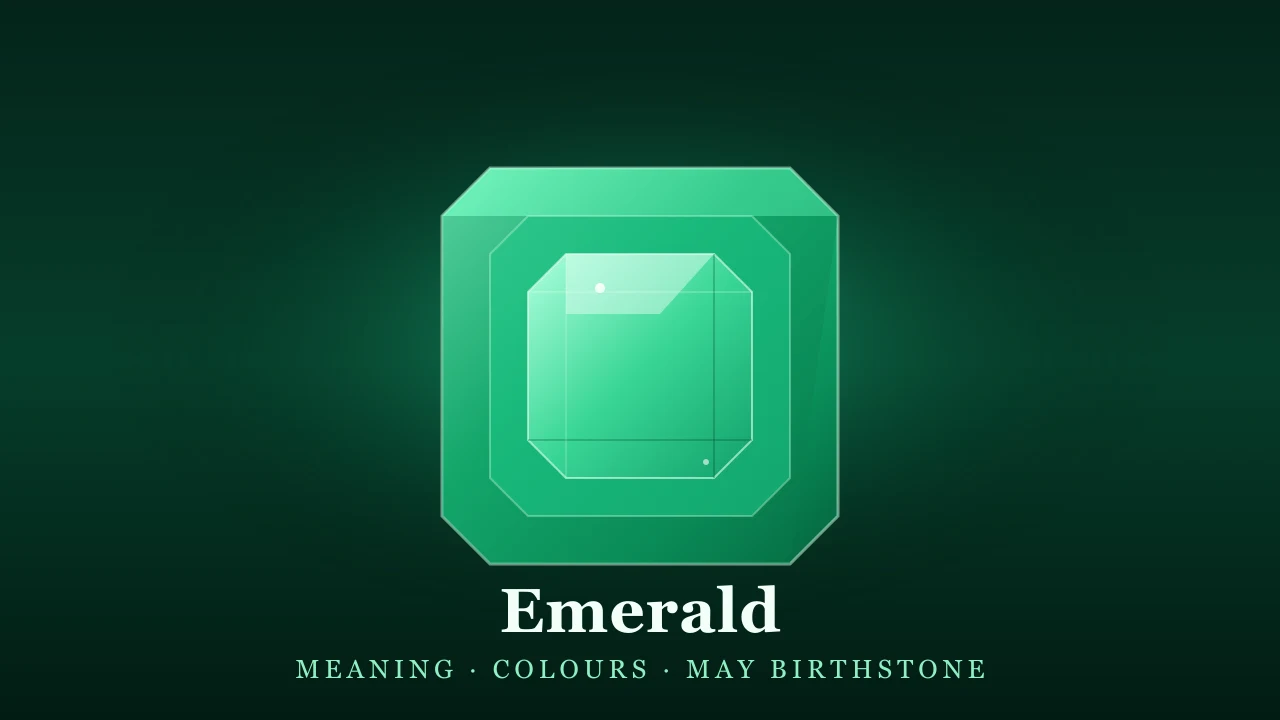
Emerald: Meaning, Colours, and the Honest Truth About May's Green Fire
Emerald is the one gem on the whole calendar that lives or dies by a single quality, and that quality is colour. A diamond is graded on four things at once, a pearl on its lustre, a ruby on a balance of factors. An emerald is judged, more than any other stone, on whether it hits one exact, impossible shade of pure vivid green. Get that green right and almost everything else is forgiven, including a stone full of tiny internal cracks and a coating of oil. Get it wrong and no amount of clarity will save it. That is emerald in a sentence: green first, and green almost last as well.
This is the part most people never quite understand, and it is why emerald is so surrounded by confusion. Because here is the thing the trade does not always say plainly: your emerald almost certainly has visible inclusions, and it has almost certainly been oiled, and both of those facts are completely normal and completely accepted. An emerald without inclusions is not a triumph, it is a warning sign. Getting your head around that one idea is the single most useful thing you can learn about this stone, and it is why we wrote this guide.
So this is the honest, complete take on May's green gem. What emerald means and where four thousand years of symbolism come from, what an emerald actually is and why it is emerald's cousin to aquamarine and morganite, the famous "garden" of inclusions and why it is a feature, the open secret of oiling, what the colours from Colombian to Zambian really tell you, how to tell a real emerald from glass or a suspiciously perfect fake, what drives the price, and how to care for a gem that is hard but not tough. Emerald is May's birthstone, and we think it is the most romantic and the most demanding stone on the list. Let us do it justice.
Emerald Meaning in One Sentence
If you only want the quick answer: emerald is the stone of rebirth, love, and truth, a gem tied since antiquity to spring and renewal, to loyal and successful love, and to wisdom and honesty so complete that it was once believed to reveal lies and betray a false lover. Almost all of its meaning flows from one obvious source, the colour green itself, the colour of new leaves, of spring, of life returning after winter.
That meaning fits the stone unusually well, because there is no green in the gem world quite like a fine emerald. It is not the pale mint of a beryl or the yellowish green of a peridot. It is a deep, saturated, living green that looks lit from inside, and it is very easy to see why every culture that found it decided the stone must mean growth, fertility, and the renewal of life. We will come back to the full symbolism below, but first the part that explains everything practical about emerald, what it is and why it behaves the way it does.
What Is an Emerald?
An emerald is the green variety of a mineral called beryl. That is worth pausing on, because it means emerald has famous relatives. Pure beryl is colourless. Add a trace of iron and you get aquamarine, the pale blue March birthstone. Add a trace of manganese and you get morganite, the pink stone. And add a trace of chromium, or vanadium, or both, and you get emerald, the green one. So emerald, aquamarine, and morganite are the same mineral wearing three different costumes, which is a rather lovely piece of gem trivia and also genuinely useful, because it tells you emerald sits at the deep, saturated, precious end of a family that is otherwise known for being pale and gentle.
That family connection is exactly why emerald behaves so differently from its siblings, and the difference comes down to how it grows. Aquamarine forms in big, clean, calm crystals, which is why it is usually clear and cheap. Emerald forms under violent geological stress, squeezed between fluids and rock, and the chromium that gives it that astonishing colour is also chemically awkward to get into the crystal. The result is that emerald grows fast, cracked, and full of trapped bubbles, fluids, and mineral fragments. In other words, the very same process that gives emerald its unmatched green also fills it with inclusions. You essentially cannot have one without the other. Hold that thought, because it is the key to the whole stone.
On the Mohs hardness scale emerald sits at a respectable 7.5 to 8, which sounds durable, and in one sense it is. It resists scratching well. But hardness and toughness are two different things, and emerald is the classic proof of it. All those internal cracks make emerald brittle, prone to chipping and splitting from a knock in a way a sapphire never would. Emerald is hard but not tough, and that single distinction drives every care rule further down this guide.
The Jardin: Why Emerald's Flaws Are a Feature
Here is the section that sets emerald apart from every other gem you will read about, and the one that saves people the most worry. In almost every gemstone, inclusions are flaws. A clean diamond is worth more than an included one, a clean sapphire more than a cloudy one. Clarity is a straightforward virtue. Emerald throws that rule out entirely.
Emerald's inclusions are so expected, so universal, and frankly so beautiful under magnification that the trade gave them their own affectionate name: the jardin, French for "garden." Look into a natural emerald under a loupe and you will see a tiny, tangled world of fissures, veils, bubbles, and mineral crystals that really does look like a miniature garden growing inside the stone. Rather than hiding it, the trade celebrates it. A jardin is proof of a natural stone with a real geological life story, and it is part of an emerald's character.
The practical consequences are enormous, and they run backwards from every other gem:
- A completely flawless emerald is a red flag, not a prize. If someone offers you a large, eye-clean, crack-free "emerald" at a good price, your first thought should not be "what a bargain," it should be "this is probably glass, synthetic, or another green stone entirely." Real, fine natural emeralds of any size are almost never flawless, and the ones that genuinely are cost fortunes and come with paperwork.
- You judge an emerald by eye, not by loupe. For most gems, clarity is graded under 10x magnification. For emerald, the standard is simply whether it looks clean and bright to the naked eye. A stone can be full of jardin under the loupe and still be a superb, glowing emerald face-up. That is the grade that matters.
- The trade-off is colour versus clarity, and colour wins. A slightly more included stone with knockout green colour will usually beat a cleaner stone with weaker colour, every time. We think that is exactly the right instinct. You buy an emerald for its green.
Once you accept the jardin, emerald stops being frustrating and starts being fascinating. You are not buying a flawless crystal. You are buying a captured piece of green fire that happens to carry its own garden inside it.
The Open Secret: Oiling and Emerald Treatment
This is the second thing nobody tells beginners plainly, and it is the natural partner to the jardin. Because emeralds are so full of surface-reaching fissures, the overwhelming majority of them, by most estimates well over ninety percent, have been oiled. Traditionally this means the stone is soaked in a colourless cedarwood oil that seeps into the tiny cracks. The oil has almost exactly the same optical density as emerald, so it makes the fissures far less visible and the stone look cleaner and more transparent. It does not change the colour. It just fills the gaps.
Here is our honest position, the same one we take on heat-treated sapphire and cultured pearl: standard oiling is normal, accepted, ancient, and fine. People have been oiling emeralds for centuries. Assume any emerald you buy has been oiled unless a lab report says otherwise, and do not think of it as being cheated. It is simply how emeralds are prepared for the world.
But there is a line, and it matters:
- Minor to moderate oiling with colourless oil is standard and expected. This is the good, honest kind, and it is what most stones have.
- Heavy treatment, resin, or coloured filler is the kind to watch for. Some stones have badly fractured material stabilised with hardened resin, or worse, oil or resin that has been tinted green to fake better colour in a pale or dead stone. That crosses from "preparing a natural gem" into "hiding a bad one," and it should be disclosed and priced far lower.
- Oiling is not permanent. Over years, cedar oil can dry out or wash away, and an old emerald can start to look cloudier as its fissures reappear. This is normal and fixable, a jeweller can re-oil it, but it is a reason never to clean an emerald in a way that strips the oil, which brings us straight to the care rules later.
So when you buy, the honest questions are simply: has it been oiled (assume yes), how much (minor or moderate is ideal), and with what (colourless, not tinted resin). A reputable seller will tell you, and a lab report will confirm it. This is one of those cases where knowing the open secret protects you completely.
The Colours of Emerald, and the Honest Truth About Them
Since colour is the entire game with emerald, this is the section that matters most, and the good news is that judging emerald colour comes down to three simple things: hue, tone, and saturation.
Hue is the actual colour. A true emerald is green, but the finest emeralds have a whisper of blue in that green, a slightly bluish-green rather than a yellowish one. A pure grassy green is beautiful, a bluish green is classic and prized, and a distinctly yellowish or brownish green is less desirable. Note that there is a genuine rule here: to be sold as "emerald" rather than just "green beryl," a stone has to reach a certain depth of green. A pale, washed-out green beryl is not really an emerald at all, it is just green beryl, and honest sellers make that distinction.
Tone is how light or dark the stone is. You want it dark enough to be rich and saturated, but not so dark that it goes murky and loses its glow. The ideal sits in the medium to medium-dark range, deep and vivid but still alive with light.
Saturation is the intensity or purity of the colour, and this is the one that separates a good emerald from a great one. The finest emeralds have an almost electric, pure saturation with no grey or brown muddying it. That vivid, glowing quality is what people mean when they talk about "emerald green," and it is the single most valuable thing a stone can have.
Put simply, the dream emerald is a vivid, pure, slightly bluish green of medium-to-medium-dark tone with strong saturation and no grey. Get near that and you have something special. The classic reference point for exactly this colour is Colombian material, which brings us to origin.
Where Emeralds Come From, and Why Origin Matters
Unlike most gems, emerald is one where the country of origin genuinely affects both the look and the price, because the different sources produce recognisably different greens.
- Colombian emeralds are the historic gold standard, and "Colombian" is almost a colour description in the trade as much as a place. The famous mines of Muzo and Chivor produce a warm, pure, slightly bluish green with a soft, glowing quality that many consider the finest emerald colour on Earth. This is the green that set the standard everyone else is measured against, and fine Colombian stones command a premium to match. The term "colombian emerald" is searched constantly for exactly this reason.
- Zambian emeralds are the great modern rival, and we rather love them for honest value. Zambian material tends to be a slightly darker, cooler, bluer green with more iron in the mix, and it is often somewhat cleaner than Colombian, with a less busy jardin. A fine Zambian emerald is a superb stone, frequently at a friendlier price than an equivalent Colombian, and for a lot of buyers it is the smart choice.
- Brazilian emeralds are typically a touch lighter and yellower, and they cover a huge range of quality, from commercial to genuinely fine. There is also newer material from Afghanistan (the Panjshir valley) and Ethiopia producing some beautiful stones.
Our honest take: chase the colour, not the passport. A gorgeous Zambian emerald beats a tired Colombian one every day of the week, and paying a premium purely for the word "Colombian" on a mediocre stone is a mistake. Origin is a useful clue to the likely look and a real value factor at the very top of the market, but for most buyers the stone in front of you matters more than the country behind it. If origin genuinely matters to you at the fine end, insist on a lab report that states it.
How to Tell a Real Emerald from a Fake
Because emerald is expensive and heavily imitated, it helps to know what you are looking at. The traps fall into three groups, and only one of them is really dangerous.
Synthetic (lab-grown) emeralds are real emerald, chemically identical, grown in a lab rather than the ground. They are perfectly legitimate and often lovely, they are just far cheaper and must be disclosed. Names like Chatham and Gilson signal lab-grown material. This is the same distinction we make everywhere: grown with human help is not the same as fake. A lab emerald is a real, honest, affordable gem, and the only problem is if it is sold as natural. Our full take on that lives in our lab-grown versus natural birthstones guide.
Outright imitations are the ones to avoid: green glass, dyed green quartz, green cubic zirconia, cheap green garnet, or "emerald" doublets (a thin slice of real stone glued over glass). These are not emerald at all. The home tells:
- Look for the jardin. This is the single most useful test, and it flips the usual logic. Under a loupe, a natural emerald shows that tangled internal garden of fissures and crystals. Glass shows round gas bubbles and swirls instead, and cheap fakes are often suspiciously, unnaturally clean. If a large "emerald" is flawless and dirt cheap, be very suspicious.
- Check the colour under different light. Real emerald holds its green. Some dyed or glass fakes look slightly off, too uniform, or oddly bright.
- Feel the temperature and weight. Glass warms up faster in the hand and can feel different in weight to a real stone, though this is a hint, not proof.
- Mind the price. A large, clean, vivid "emerald" for very little money is almost never a real natural emerald. Fine emerald is genuinely valuable, and the price is the loudest tell of all.
For anything of real value, none of this replaces a gem lab report, which will confirm natural versus synthetic, the degree of oiling, and often the origin. For a serious emerald purchase, we would always want one.
Emerald Meaning and Symbolism
Emerald has one of the oldest and richest bodies of symbolism of any gem, and it clusters around a few clear and rather beautiful themes, almost all growing from that colour of green:
- Rebirth, spring, and renewal. Green is the colour of new life, and emerald has meant fresh starts, growth, and the renewal of the seasons for as long as people have worn it. It is the gem of spring made solid.
- Love, loyalty, and successful relationships. Emerald has long been called a stone of loyal, lasting, and successful love, associated with the goddess Venus and with the kind of deep, faithful devotion that grows over time rather than the quick spark of romance.
- Truth and honesty. This is our favourite thread. Because emerald was believed to be so pure, medieval lore held that it could reveal the truth and expose lies, and, memorably, that an emerald would shatter or change if a lover was false. It was a truth stone, a lie detector in gem form, and you can read the full strange history of that belief in our emerald history and lore guide.
- Wisdom, foresight, and clarity of mind. Emerald was also thought to sharpen wit, aid memory, and grant its wearer insight and even glimpses of the future, a gem of the clear, seeing mind.
- Healing and the eyes. Its calm green was believed to rest and heal the eyes, which is why lore is full of people gazing into emeralds to soothe their sight.
Its modern roles fit the theme neatly. Emerald is the May birthstone, the perfect match for a green spring month, and it is the traditional gift for both the 20th and the 55th wedding anniversaries, milestones of a love that has lasted and deepened, which is exactly what emerald has always stood for.
Here is our standard and sincere position, the one we hold for every gem. These are cultural and symbolic meanings, not physical powers. An emerald will not literally detect a lie, heal your eyes, or show you the future. What it genuinely offers is one of the most coherent and romantic bodies of symbolism in the entire gem world, four thousand years of association with rebirth, love, and truth, wrapped in the most beautiful green nature makes. You can enjoy every bit of that story without believing the stone is doing anything but glowing gloriously green.
Is Emerald a Birthstone?
Yes. Emerald is the birthstone for May, and unlike some months, May keeps it simple. Where June has three stones and several other months have two, May has essentially one classic answer, emerald, as both its modern and its traditional birthstone. If you were born in May, this is your gem, no choosing required.
That makes May one of the more enviable birthday months, because emerald is a genuinely precious, historically grand stone, one of the traditional "big four" gems alongside diamond, ruby, and sapphire. Our emerald history and lore guide covers the four-thousand-year backstory, from Cleopatra's mines to those medieval truth stones, and if you are thinking of an emerald ring specifically, our emerald engagement ring buyer's guide goes deep on colour, cut, setting, and the care an emerald ring really needs. The May birthstone pillar page pulls the whole month together.
What Emerald Is Worth
Emerald value runs on a logic that is almost the reverse of a diamond, and once you understand the jardin and oiling, the pricing makes perfect sense. Colour is worth more than clarity, by a wide margin. The single biggest driver of an emerald's price is the quality of its green, that vivid, pure, slightly bluish, medium-dark saturation we described above. A stone that nails the colour can carry a busy jardin and still be worth a great deal.
After colour, the factors run roughly like this: clarity (judged by eye, not loupe, so "eye-clean" is the goal, not "flawless"), cut (a good cut brings out the colour and protects the brittle stone, which is exactly why the "emerald cut," that rectangular step cut with clipped corners, was invented for this gem), carat (fine emerald gets dramatically more expensive with size, because large clean-coloured crystals are rare), treatment (minor oiling holds value, heavy resin or dyed filler slashes it), and origin (fine Colombian commands a premium at the top of the market).
Put together, this makes emerald one of the more serious gems on the calendar. Fine emerald is genuinely precious, and top Colombian material can rival or exceed diamond per carat. But there is real value to be found, especially in Zambian stones and in honest lab-grown emeralds, both of which give you that glorious green for a fraction of the top price. In our most expensive birthstones ranked guide, fine emerald sits near the very top, while commercial and lab-grown emerald is far more attainable. That enormous range, all under one green name, is exactly why understanding colour, the jardin, and oiling matters so much before you spend.
How to Buy and Care for Emerald
When buying, in order of priority:
- Judge the colour first, and by eye. Look for vivid, pure, slightly bluish green of medium-to-medium-dark tone with strong saturation and no grey or brown. This is ninety percent of the decision. Trust your eye in normal light.
- Expect the jardin, and do not chase flawless. Eye-clean is the goal. A little visible garden is completely normal and even reassuring. A large, cheap, perfectly clean "emerald" should make you suspicious, not excited.
- Ask about oiling and treatment. Assume the stone is oiled. Minor or moderate colourless oil is standard and fine. Ask specifically whether there is resin or any coloured filler, and price accordingly. Get it in writing.
- Chase colour, not just origin. A beautiful Zambian stone beats a tired Colombian one. Do not overpay for the word "Colombian" on a mediocre gem. If origin matters at the fine end, insist on a lab report.
- Get a report for anything valuable. A gem lab report confirms natural versus synthetic, the degree of oiling, and often origin. For a serious emerald, it is not optional.
Caring for emerald, because it is hard but not tough:
- Never use ultrasonic or steam cleaners. This is the golden rule, and it is doubly important for emerald. The vibration and heat can worsen the fissures and, crucially, they can strip out the oil, leaving your stone looking suddenly cloudy and worse than when you bought it. Warm water, mild soap, and a soft brush are all you should ever use.
- Protect it from knocks. Because emerald is brittle, a sharp blow can chip or crack it even though it resists scratching. Take an emerald ring off for sports, gardening, and heavy work, and favour protective settings like bezels or halos for anything worn daily.
- Keep it away from heat and chemicals. Heat, harsh cleaners, and prolonged sunlight can all dry out or damage the oil and the stone. Put emerald on after cosmetics and perfume, and store it away from hard gems that could scratch it.
- Re-oil occasionally. If an older emerald starts to look cloudier over the years, its oil may simply have dried out. A jeweller can clean and re-oil it, and it will look reborn. This is normal maintenance for the stone, not a sign that anything is wrong.
Treat emerald as the demanding, glorious thing it is, with a little care and a protective setting, and it will hold its green fire for generations. The most famous emeralds on Earth are centuries old and still glowing, which tells you it can be done.
The Bottom Line
Emerald is the most colour-obsessed gem on the calendar, and the more you understand it the more its quirks make sense. It is green beryl, cousin to aquamarine and morganite, grown under such violent geological stress that the same process giving it that unmatched green also fills it with the jardin of inclusions that defines it. It is hard but not tough, almost always oiled, and judged by eye on the quality of its green above all else. It is May's birthstone, the gift for a 20th and a 55th anniversary, and a four-thousand-year-old symbol of rebirth, love, and truth.
Our summary: buy emerald with three ideas firmly in mind, and never clean it the wrong way. Judge colour above everything, because that vivid pure green is the whole point and the whole value. Expect inclusions and oiling as normal, so a busy jardin is character and a suspiciously flawless cheap stone is a warning, not a bargain. And treat it gently, no ultrasonic, no steam, protective settings, because a gem this brittle and this oiled needs care a sapphire never will. Do that, and you will own the most romantic green in the natural world, a stone that has meant new life and true love since the pharaohs.
If emerald's green drew you in, the natural next stops are its four-thousand-year backstory in our emerald history and lore guide, the practical ring decision in our emerald engagement ring buyer's guide, its pale blue sibling in our aquamarine meaning and colours guide, the deeper roots of why gems carry meaning at all in our talismans and amulets guide, and the wider value map in our most expensive birthstones ranked, where emerald sits proudly near the top.
Wondering how it stacks up against every other gem? Compare values in our gemstone price guide and toughness on the sortable Mohs hardness table.