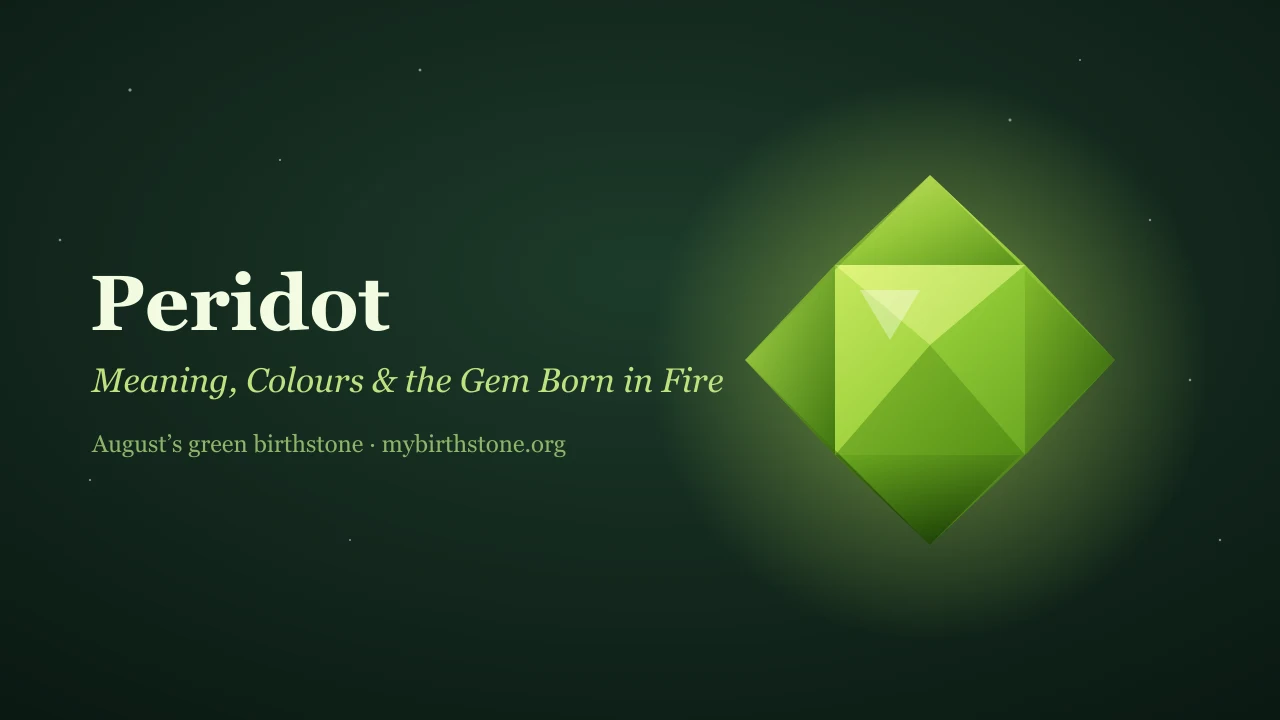
Peridot: Meaning, Colours, and the Green Gem Born in Fire and Fallen From Space
Peridot does not get the respect it deserves, and we have a theory about why. It is cheap, it is cheerful, it comes in one colour, and for a long time it was the stone you got in a department-store August birthstone ring without ever stopping to ask where it came from. So most people file it under "nice green stone, nothing special" and move on.
That is a mistake, and an interesting one to correct, because peridot has a backstory that quietly beats almost every gem on the calendar. It forms not in the crust like nearly everything else you wear, but far deeper, in the Earth's mantle, and it gets to the surface by hitching a ride on volcanoes. It is one of only a tiny handful of gemstones ever found inside meteorites, genuine peridot that formed in space and fell to Earth. And the gem that ancient miners pulled out of a fog-shrouded island in the Red Sea, the stone they called by another name entirely, was very likely the real green behind some of antiquity's most famous "emeralds," Cleopatra's included.
This is the honest, complete guide to the real stone. What peridot actually is, why it is the same grassy green in candlelight and noon sun when other gems shift and fade, why it is one of the very few gems almost never treated or faked with chemistry, the truth about the meteorite and the mantle, how to tell a good peridot from glass and from a too-dark dud, what the stone means, and how to buy and wear it without chipping it. We like peridot a great deal, partly because so few people give it a fair hearing, so let us put that right.
Peridot Meaning in One Sentence
If you only want the quick answer: peridot is the stone of light, renewal, and good cheer, a gem long tied to the sun, to warding off fear and night terrors, and to bringing the wearer prosperity, confidence, and a fresh, optimistic start. The Egyptians called it the gem of the sun, and across its long history peridot has carried a consistently sunny, protective, life-affirming kind of symbolism rather than a brooding or mystical one.
That is the meaning in a line, and it suits the stone. Peridot is one of the few gems that is the same vivid green whether you hold it to a window or a candle flame, and its symbolism has the same steady, daylight quality. We will come back to the full lore below, but first the part that makes peridot genuinely unusual: where it comes from.
What Is Peridot?
Peridot is the gem-quality form of a very common mineral called olivine, and that single fact explains most of what makes the stone special. Strictly, peridot is olivine that lands in the right part of the chemical range, a magnesium-iron silicate, cut and polished into a gem. The mineral olivine is everywhere on Earth and beyond, it is one of the most abundant minerals in the planet's interior, but gem-quality, transparent, clean olivine large enough to facet is genuinely scarce, and that is what we call peridot.
Two facts define the stone as a gem. First, peridot is idiochromatic, which is a long word for a simple and rather lovely idea: its colour comes from iron that is a built-in part of the mineral itself, not from a trace impurity dropped in by chance. In most coloured gems the colour is an accident of chemistry, a pinch of chromium turning beryl into emerald, a touch of iron and titanium turning corundum into sapphire. Peridot is green because of what it fundamentally is. That is why it only ever comes in green, never blue or pink or yellow, and why the colour is so reliable and stable.
Second, on hardness peridot sits at about 6.5 to 7 on the Mohs scale, which is fine for jewellery but not bulletproof, and it has only fair toughness with a tendency to chip on a hard knock and a real sensitivity to acids and sudden temperature change. So peridot is bright and wearable but wants a little care, a theme we will return to. Hold those two facts together, self-coloured green and a certain delicacy, and you have the whole personality of the stone.
Born in Fire: The Mantle and the Volcanoes
Here is the first thing that sets peridot apart from almost everything else in your jewellery box. Most gems form in the Earth's crust, the thin outer shell. Peridot mostly forms far deeper, down in the mantle, in the hot rock tens of kilometres below the surface, and it only reaches us because volcanoes and rising magma drag chunks of that deep rock up and out.
This is not a poetic flourish, it is literally how the stone arrives. On the Big Island of Hawaii there is a beach, Papakōlea, that is famously green, and the green is peridot: countless tiny olivine crystals weathered out of volcanic rock and washed into the sand. The peridot from the San Carlos Apache reservation in Arizona, which supplies a huge share of the world's commercial stones, comes straight out of volcanic deposits. Peridot is, in a real sense, a gem born in fire, a piece of the deep Earth that volcanoes hand up to the surface.
We find this genuinely stirring, and it is exactly the kind of fact that should rescue peridot from its bargain-bin reputation. The cheerful green stone in an everyday August ring is a fragment of the planet's molten interior. Not many gems can say that.
Fallen From Space: The Meteorite Connection
And then there is the part that sounds made up but is not. Peridot is one of an extremely small number of gemstones that have been found inside meteorites.
Certain meteorites called pallasites are a striking mix of iron-nickel metal and embedded olivine crystals, and some of that olivine is gem quality. It formed out in the solar system, at the boundary of the core and mantle of a shattered ancient planetesimal, drifted through space inside a chunk of metal, and fell to Earth. Cutters have faceted gem peridot from pallasite meteorites, which means it is entirely possible to own a green gemstone that is not from this planet at all.
Extraterrestrial peridot is rare, collectable, and priced accordingly, so this is more a wonderful fact than a shopping tip for most buyers. But it is true, and it is the kind of thing that ought to be common knowledge about peridot and somehow is not. The August birthstone is a gem that forms both in the fire of the Earth's interior and in the cold of deep space. That is a stranger and grander origin story than diamonds get, and diamonds have a much better publicist.
The Island, the Wrong Name, and Cleopatra's "Emeralds"
Peridot also sits at the centre of one of the great gem-naming muddles, and it ties neatly into a confusion we have written about before.
In antiquity, much of the finest peridot came from a small, remote, often fog-bound island in the Red Sea, known to the Greeks as Topazios and later as Zabargad or St. John's Island. Pliny the Elder wrote about the gem from this island under the name topazos, and for centuries that ancient "topaz" was, in fact, peridot. As we explain in our guide to topaz, this means a great deal of ancient "topaz" lore actually belongs to peridot, and the modern stone we call topaz inherited a name that originally described the green gem from Topazios. Two stones, one borrowed name, centuries of confusion.
It runs deeper still. Egypt was famous in the ancient world for its "emeralds," and a good number of those celebrated green stones, quite possibly including some attributed to Cleopatra, were almost certainly peridot from Zabargad rather than true emerald. The two gems are both green, the old mines were Egyptian, and the ancients did not classify stones the way we do. Our piece on the history and lore behind emerald and Cleopatra digs into how tangled the "emerald" record really is. The short version: peridot has been quietly mistaken for grander, costlier gems for thousands of years, much as spinel was mistaken for ruby in the crown jewels of Europe. Peridot is a serial victim of mistaken identity, always cast as the cheaper understudy, when in truth it was often the real stone in the famous setting all along.
The Colours of Peridot
Peridot is the rare gem that essentially comes in one colour, and we think that is a feature, not a limitation. What varies is the exact shade and richness within that single green range:
- Yellowish green is the most common face of peridot, a bright, lively, slightly lime-tinted green that is cheerful and unmistakable. Most everyday peridot, including much of the Arizona material, sits here.
- Pure grassy green is the ideal and the most valuable, a vivid, saturated green with the yellow and brown pulled back to a minimum. The finest stones, historically from the Red Sea island and today from Pakistan, reach this rich, glowing green.
- Olive and brownish green is the lower end of the range. When peridot tips too far toward brown or goes muddy and dark, it loses life, and this is the colour to avoid when buying.
The single most important thing to understand about peridot's colour is that it is stable and consistent. Because the green is built into the mineral itself, peridot does not fade in sunlight the way some treated stones can, and crucially it shows almost no colour shift between daylight and artificial light. Many green gems go a little flat, grey, or brownish under warm indoor lighting. Peridot mostly holds its green, which is why it was historically prized for evening wear and earned the old nickname "evening emerald." You buy the colour once and it stays the colour. After writing about so many gems whose colour is heated, irradiated, coated, or prone to fading, we find peridot's honesty about its own green genuinely refreshing.
Olivine: The Everyday Mineral Behind the Gem
It is worth pausing on the mineral name, because "olivine" turns up far more often than "peridot" once you start looking, and the relationship confuses people.
Olivine is the mineral. It is one of the most common minerals in the Earth, a major ingredient of the mantle and of basalt lava, and it is found across the solar system, on the Moon, on Mars, in meteorites, and in the dust around forming stars. Most olivine is small, included, or simply not pretty enough to cut. Peridot is the gem-quality exception: transparent, clean, richly coloured olivine good enough to facet and wear.
So every peridot is olivine, but only a sliver of the world's olivine is ever peridot. We mention this partly because you will sometimes see peridot sold or described as "olivine" or "chrysolite," an older varietal term, and partly because it reinforces the point about origin. The reason peridot can turn up in volcanic sand and inside meteorites is precisely that its parent mineral is one of the fundamental building blocks of rocky worlds. Your August birthstone is a clear, lucky offcut of the stuff planets are made of.
Why Peridot Is Almost Never Treated
Here is a fact that should count strongly in peridot's favour, and almost nobody mentions it. Peridot is one of the very few popular gemstones that is essentially never treated or enhanced.
Think about how unusual that is. Blue zircon is heated, most tanzanite is heated, most ruby and sapphire are heated, most blue topaz is irradiated, much "citrine" is baked amethyst, emeralds are nearly all oiled. Treatment is the norm across coloured stones, not the exception. Peridot stands almost alone in being sold, overwhelmingly, exactly as it came out of the ground. There is no routine heating to improve its colour, no irradiation, no oiling, no coating. What you see is what nature made.
This puts peridot in the small, honest club alongside garnet and spinel, gems whose colour you can simply trust. It matters for two reasons. First, you never have to worry about a treatment fading, leaching, or being damaged by an ultrasonic cleaner, because there is no treatment to lose. Second, you should never pay an "untreated" premium for peridot, because untreated is simply what peridot is. If a seller makes a fuss about a peridot being natural and untreated as though it were special, they are selling you the default. We think the absence of treatment is one of peridot's quiet virtues, and a real point in its favour against flashier, fussier stones.
The Real Traps: Glass and Going Too Dark
If peridot is not treated and not radioactive and not faked with clever chemistry, what should you actually watch for? Two things, both straightforward.
The first is glass imitation. Cheap green glass has been sold as peridot for a long time, and it is the main outright fake. The tells are gettable. Real peridot is strongly doubly refractive, so if you look through a clean faceted stone with a loupe you can often see the back facet edges appear slightly doubled, a soft two-of-everything effect, the same birefringence trick that gives away real zircon. Glass shows no such doubling. Glass also tends to contain tiny round bubbles, where natural peridot more often shows its characteristic flat, disc-like "lily pad" inclusions. And glass feels warmer and lighter in the hand. If a "peridot" is suspiciously large, flawless, cheap, and perfectly uniform, suspect glass.
The second trap is not a fake at all, it is just bad buying: a peridot that is too dark, too brown, or too olive. Because peridot is so affordable, there is plenty of dull, muddy material on the market, and a dark brownish-green stone looks lifeless next to a bright grassy one for very little price difference. The fix is simple. Buy for colour, not size. A smaller, vivid, lively green peridot beats a bigger murky one every time, and the price gap between fine colour and mediocre colour is small enough that there is no reason to settle.
Peridot Meaning and Symbolism
Peridot's lore is old, sunny, and remarkably consistent, which is part of its charm. Because the stone has been worn since ancient Egypt, its symbolism accumulated the slow way, and it clusters around light and renewal rather than mystery:
- The gem of the sun. The ancient Egyptians associated peridot with the sun and its life-giving power, and the stone has carried solar, light-bringing symbolism ever since. Its bright, daylight-stable green fits the role perfectly.
- Protection from fear and night terrors. One of peridot's most persistent old associations was with driving away fears, bad dreams, and the terrors of the night, especially, in some lore, when set in gold. It was a stone of reassurance and calm.
- Renewal, growth, and fresh starts. Green is the colour of new growth, and peridot has long stood for renewal, optimism, and turning a fresh page, a fitting meaning for a late-summer birthstone.
- Prosperity, confidence, and good cheer. Peridot is widely held to be a stone of abundance, warmth, and easy confidence, a sunny, sociable kind of symbolism rather than a heavy or solemn one.
Its modern role keeps it tied to late summer as the August birthstone, and it is also the traditional gift for a 16th wedding anniversary.
Here is our standard and sincere position, the one we hold for every stone. These are cultural and symbolic meanings, not physical powers. A peridot will not literally banish your nightmares or fatten your bank account. What it genuinely offers is a warm, optimistic, sun-soaked piece of symbolism and one of the oldest continuously worn gem traditions there is. If the deep roots of how stones came to carry meaning at all interest you, our piece on talismans and amulets in gemstone lore traces that tradition back to its beginnings, and peridot, ancient and sunny, sits comfortably inside it.
Is Peridot a Birthstone?
Yes, and unusually it holds the month almost on its own. Peridot is the modern birthstone for August, and it is by far the dominant one. August also lists sardonyx as its older, traditional stone and spinel as a third option added in 2016, but peridot is the green gem the month is built around, the one almost everyone means by "August birthstone."
So if you have an August birthday, peridot is your stone, and it is a good one to be given. Where spinel offers August a harder, rarer, connoisseur's choice in a range of colours, peridot offers something spinel cannot: a single, reliable, sunlit green with a planet-spanning origin story and an ancient pedigree. Our full August birthstone guide walks through all three of the month's stones and how to choose between them, and our August birthstone pillar page covers the month in full. Peridot is the one we would reach for first, partly for the colour and partly because no other August stone can claim to have arrived by both volcano and meteorite.
What Peridot Is Worth
Peridot is, refreshingly, one of the genuine bargains of the gem world, and that is a large part of why we recommend it so happily. Price is driven mainly by colour, size, and clarity, in that order.
Fine, pure grassy green with strong saturation and no brown commands the most, especially in larger sizes, and the very finest material, historically from the Red Sea island and today from the high mountains of Pakistan, can reach respectable prices per carat for a large, clean, vivid stone. But ordinary good peridot, bright and lively and eye-clean, is inexpensive and widely available, and you can buy a large, beautiful stone for a modest sum. Brownish, dark, or murky peridot is cheaper still, and not worth even its low price.
In our most expensive birthstones ranked guide, peridot lands firmly at the affordable end, which is exactly where it belongs and exactly what makes it such a smart buy. You get a self-coloured, never-treated, daylight-stable green gem with one of the most remarkable origin stories in the mineral kingdom, for a fraction of what the precious "big four" cost. For anyone who wants a real, natural, characterful coloured stone without a precious-stone price tag, peridot is one of the best-value gems on the entire birthstone calendar, and the meteorite-and-volcano story is thrown in for free.
How to Buy and Care for Peridot
When buying, in order of priority:
- Chase the green. Colour is everything with peridot. Look for a vivid, lively grassy green and steer away from anything brown, olive, or muddy. A smaller stone with great colour beats a bigger dull one every time, and the price difference is small.
- Buy eye-clean. Fine peridot should be transparent and free of obvious inclusions to the naked eye. The flat, disc-shaped "lily pad" inclusions are characteristic and harmless in moderation, but heavy clouding kills the brightness.
- Check for the doubling. Through a loupe, look for the slightly doubled back facet edges that prove you are holding real, doubly refractive peridot and not glass. No doubling, plus tiny round bubbles, points to glass.
- Do not pay an "untreated" premium. Peridot is essentially never treated, so natural and untreated is simply what it is. Pay for colour and size, not for a treatment status that comes as standard.
- Mind the cut. A well-cut peridot returns plenty of bright light. Because the rough is affordable, there is no reason to accept a sleepy, poorly cut stone.
Caring for peridot needs a gentle, sensible routine, because it is bright but a touch delicate:
- Protect it from knocks. At Mohs 6.5 to 7 with only fair toughness, peridot can chip or scratch from a hard impact. For rings, a protective setting such as a bezel or a halo pays off, and earrings and pendants live an easier life. This puts peridot in the careful-wear camp alongside opal.
- Avoid ultrasonic and steam cleaners. Peridot dislikes sudden temperature changes and harsh vibration, which can worsen inclusions or cause fractures. Clean with warm water, mild soap, and a soft brush, then pat dry.
- Keep it away from acids and harsh chemicals. Peridot is sensitive to acids, so keep it clear of household cleaners, and put it on after perfume and hairspray rather than before.
- Store it separately. Harder stones will scratch peridot, so give it its own pouch or compartment rather than letting it rattle against other jewellery.
Treat peridot as the bright, sunny, slightly delicate gem it is, and it will reward you with a green that never fades and never shifts, for a price that makes the whole thing faintly ridiculous.
The Bottom Line
Peridot is far more interesting than its bargain-bin reputation suggests. It is gem-quality olivine, the self-coloured green stone born deep in the Earth's mantle and carried up by volcanoes, the gem that turns up inside meteorites that fell from space, and the real stone that masqueraded for centuries as ancient "topaz" and Egyptian "emerald." It is the August birthstone, the same vivid green in any light, almost never treated, almost never faked with chemistry, and one of the best values on the entire calendar.
Our summary: buy peridot with three things in mind, and enjoy it without reservation. Chase the colour, a vivid grassy green over anything dark or brown, because colour is what separates a lovely peridot from a dull one. Trust that it is natural and untreated, which is simply what peridot is, and never pay extra for that as though it were special. And wear it with a little care, protecting it from knocks, acids, and ultrasonic cleaners, because it is bright but not tough. Do that, and you will own a real, natural, daylight-stable green gem with an origin story that runs from the Earth's molten interior to the depths of space, for a price the world has not yet caught up with.
If peridot's green drew you in, the natural next stops are its companions in our August birthstone guide, the harder August alternative in our spinel guide, the tangled green history it shares with emerald and Cleopatra, the name it lent to topaz, and the wider value picture in our most expensive birthstones ranked, where peridot sits, fittingly, near the friendly end of the scale.
Wondering how it stacks up against every other gem? Compare values in our gemstone price guide and toughness on the sortable Mohs hardness table.