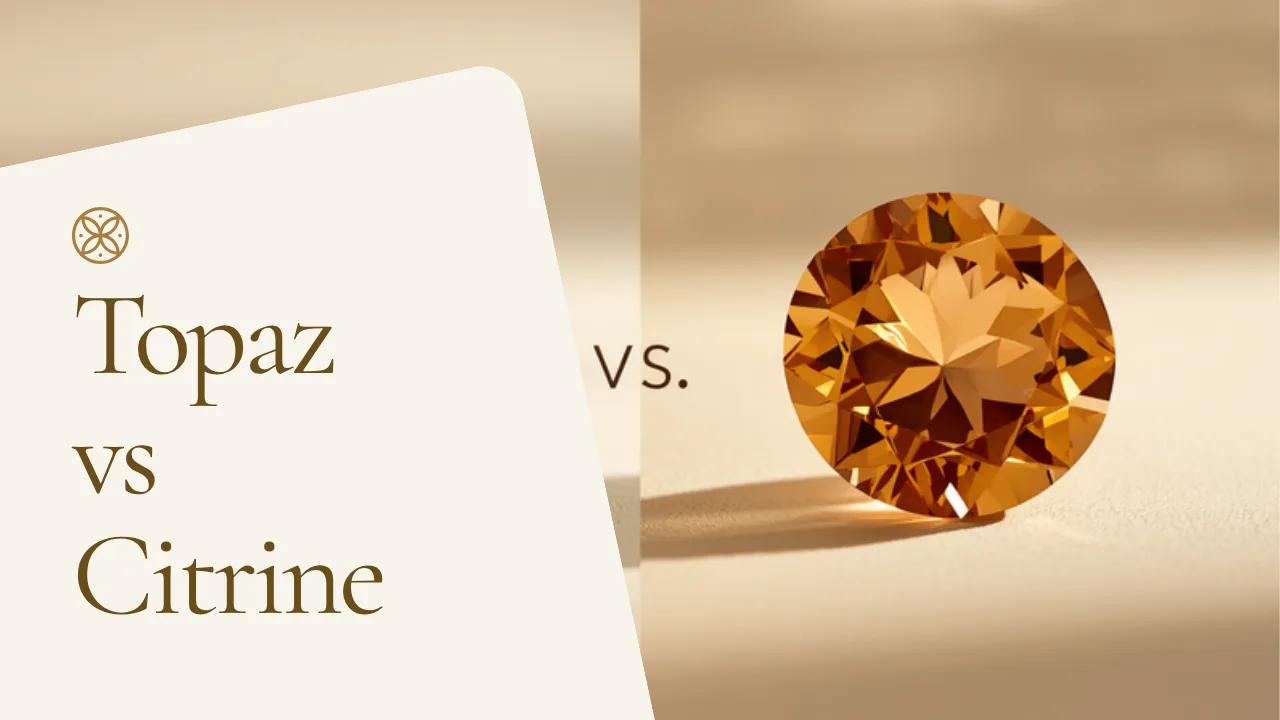
If you were born in November you get two birthstones, topaz and citrine, and almost nobody can tell you cleanly what the difference is. That is not your fault. The two stones have been mixed up, mislabelled and sold as each other for so long that the confusion is baked into the jewellery trade itself. There is antique "topaz" jewellery sitting in display cases right now that is actually citrine, and there are "topaz" trade names on modern listings that describe a stone with no topaz in it at all.
So we are going to untangle it properly. The short version is that topaz and citrine are completely different minerals that happen to overlap in one colour, a warm honey-gold, and that single overlap is responsible for two hundred years of muddle. Once you separate the colour from the mineral, everything else, the hardness, the price, the durability, the treatments, falls into place.
This is the comparison we wish more of the jewellery blogs would write honestly, because the usual version skates over the two things that actually matter: the softer stone is the tougher buy, and "which is more valuable" has completely opposite answers depending on which topaz you mean. No mysticism, no loyalty to either stone, just the facts that decide what ends up on your hand.
The One-Sentence Difference
If you remember nothing else, remember this. Citrine is yellow quartz, cheap and cheerful and genuinely tough for daily wear. Topaz is a different, denser mineral that comes in every colour, is harder but more fragile, and ranges from one of the cheapest gems on earth (blue topaz) to one of the genuinely valuable ones (imperial topaz).
That is the whole comparison in two sentences. They look alike only in their golden forms, and that golden overlap is the entire source of the confusion. Everything below is just detail on top of that.
Why They Get Confused in the First Place
Here is the part most articles leave out, and it is the most interesting bit of the whole story.
For a very long time, the word "topaz" simply meant a yellow stone. Any yellow stone. Yellow quartz, what we now call citrine, was routinely sold as "topaz" because the two looked the same to the naked eye and nobody was doing chemistry on jewellery in 1850. The result is that a huge amount of antique and Victorian "topaz" jewellery is, in fact, citrine. If you have inherited a golden "topaz" ring from a great-grandparent, there is a very real chance it is quartz.
The trade never fully cleaned this up. Even today you will see citrine sold under names that borrow topaz's prestige: "Madeira topaz," "Rio topaz," "Spanish topaz," "gold topaz," "Bahia topaz." Every one of those is citrine. There is no topaz in them. It is the same trick we flagged with garnet, where "Cape ruby" and "Arizona ruby" are not ruby at all, and it works for the same reason: the fancier name sells the cheaper stone.
Our blunt opinion on this: if a listing uses the word "topaz" with a place name in front of it and the price looks low, assume it is citrine until proven otherwise, and do not pay a topaz premium for it. A reputable seller will call citrine citrine.
What Citrine Actually Is
Citrine is quartz, the same mineral family as amethyst, rose quartz and rock crystal. Its colour, a pale lemon through to a deep amber or reddish-orange, comes from traces of iron in the crystal. It sits at 7 on the Mohs scale, which is the threshold where a stone is hard enough to shrug off everyday knocks and dust without scratching easily.
Now the part the listings rarely volunteer: most citrine on the market is heat-treated amethyst. Natural citrine exists, but it is fairly scarce, so the trade takes cheap purple amethyst, heats it, and out comes golden "citrine." This is a stable, permanent, completely standard treatment, and we are not warning you off it, the vast majority of citrine jewellery sold today is exactly this and that is fine. But it is worth knowing, partly because it explains why citrine is so affordable, and partly because heated amethyst tends toward a slightly orange or brownish-gold, while rarer natural citrine leans a softer, paler yellow. If you want to nerd out on the chemistry, we wrote about how amethyst forms and the same crystal is what gets cooked into most of the citrine you will ever see.
What citrine has going for it is honesty of price and genuine wearability. It is cheap, it is widely available in big clean stones, the colour is warm and friendly, and crucially it has no cleavage, which (as you will see in a second) makes it a better everyday ring stone than its harder rival. It is the February birthstone's golden cousin, chemically speaking.
What Topaz Actually Is
Topaz is a completely separate mineral, an aluminium silicate with fluorine and hydroxyl in it, and it has nothing to do with quartz beyond a passing colour resemblance. It is 8 on the Mohs scale, harder than citrine, and noticeably denser, which becomes one of the easiest ways to tell them apart.
Topaz comes in a wide range of colours, and this is where the value story splits in two, hard:
- Blue topaz is everywhere, and almost all of it is treated. Natural blue topaz is rare and pale; the vivid "Swiss blue" and "London blue" stones you see in mall jewellery are colourless topaz that has been irradiated and heated to force the colour. It is one of the cheapest faceted gemstones you can buy, full stop. There is nothing wrong with it, it is just abundant and inexpensive, and you should not pay a lot for it.
- Imperial topaz is the opposite end of the universe. This is the rare natural pinkish-orange to reddish-gold topaz, mostly from Brazil, and good imperial topaz is genuinely valuable, often many times the price of citrine of the same size. This is the topaz worth getting excited about.
- Yellow and golden topaz sit in the middle and are the ones most directly confused with citrine, because side by side in that colour they can look almost identical.
- Colourless topaz is common and cheap, and is the raw material for most of that treated blue.
So when someone asks "is topaz more valuable than citrine," the honest answer is: imperial topaz, yes, easily; blue topaz, no, it is often cheaper than citrine. The word "topaz" on its own tells you almost nothing about value, which is exactly why it gets used so loosely.
The Hardness Paradox: Why the Softer Stone Is the Tougher Choice
This is the single most useful thing in this article, and it is the thing the "topaz is harder so topaz is better" crowd gets backwards.
Topaz is harder than citrine, an 8 against a 7, so topaz resists scratching better. But hardness is not the same as toughness. Topaz has perfect cleavage, meaning it has a built-in plane of weakness running through the crystal, and a sharp knock in the wrong direction can make it split or chip cleanly along that plane. Citrine, being quartz, has no cleavage; when it does break it fractures awkwardly rather than splitting, and in practice it is far more forgiving of the daily abuse a ring takes.
What that means in real life: citrine is the better choice for a ring you wear every day, and topaz, despite being harder, wants a more protective setting or a lower-impact role like a pendant or earrings, where it is not getting banged against door handles and desks. The jewellers' forums are full of exactly this advice, and it matches what we would tell a friend. Do not let "but topaz is harder" talk you into a daily-wear topaz ring with an exposed stone, because hardness will not save it from a clean knock along the cleavage.
This is one of those cases where the simple number (Mohs hardness) points you the wrong way, and the slightly more advanced concept (toughness and cleavage) points you right. It is worth understanding before you spend money.
Side by Side: The Differences That Actually Matter
Theory aside, here is how the two differ in the ways that change a buying decision.
Mineral. Citrine is quartz (silicon dioxide). Topaz is aluminium silicate. Completely different materials, which is why every test below works.
Hardness vs toughness. Topaz is harder (Mohs 8 vs 7) but has perfect cleavage and chips or splits more easily. Citrine is softer but has no cleavage and takes daily knocks better. For an everyday ring, citrine wins on durability despite losing on paper.
Density and heft. Topaz is denser. Two stones cut to the same size will not weigh the same; the topaz feels heavier in the hand. This "heft test" is one of the quickest informal tells.
Colour range. Citrine runs yellow to amber to reddish-brown, and that is essentially it. Topaz spans blue, colourless, yellow, pink, sherry-orange and the prized imperial reddish-gold. They only truly overlap in the golden-yellow band, which is, again, why that is where the confusion lives.
Treatment. Most citrine is heat-treated amethyst. Most vivid blue topaz is irradiated and heated colourless topaz. Both treatments are standard and stable. Natural untreated examples of either (genuine natural citrine, genuine natural imperial topaz) are the rarer, pricier stones.
Price. Citrine is consistently affordable. Topaz is all over the map: blue topaz is dirt cheap, golden topaz is moderate, imperial topaz is genuinely expensive. There is no single "topaz price."
Best use. Citrine: everyday rings, big bold cocktail stones, anything that takes knocks. Topaz: pendants, earrings, occasional-wear rings, or imperial topaz as a collector-grade centre stone in a protective setting.
How to Tell Them Apart on Your Hand
You will not have a lab, so here are the tells that actually work for a normal person looking at a set or loose stone, ordered from most to least practical.
1. The heft test. Pick it up, or compare two similar-sized stones. Topaz is noticeably denser and feels heavier for its size than citrine. Gem dealers genuinely use this as a first-pass sort, and for golden stones of similar size it is surprisingly reliable. A stone that feels suspiciously light for its size is leaning citrine.
2. Look at the colour character. Heat-treated citrine (which is most of it) tends toward a warm, slightly orange or brownish gold and is usually very evenly coloured. Topaz golds can be cleaner and more lemon, and natural topaz often shows more life. Neither is a hard rule, but extreme, uniform amber-orange is a citrine lean.
3. Check for colour zoning. Citrine, especially the heated kind, sometimes shows uneven patches or zones of colour when you look closely under good light. It is not a dealbreaker, but visible zoning points toward quartz.
4. Mind the trade name. This is a documentation tell rather than a physical one, but it is the most decisive. If the stone is being sold as "Madeira topaz," "Spanish topaz," "Rio topaz" or "gold topaz" at a friendly price, it is citrine. Real topaz is sold as topaz, or as imperial topaz, and a trustworthy seller will say so plainly.
5. Get a report for anything pricey. None of the home tests reliably separate fine golden topaz from fine citrine at a glance, and they certainly will not value an imperial topaz for you. If you are spending real money, especially on anything sold as imperial topaz, insist on a gemmological report. At that price the certificate is the cheap part, the same advice we give for anything sold as a precious stone.
If two or three of these line up, you will usually have your answer for everyday purposes. For money that matters, let a lab settle it.
Which Should You Actually Buy?
Here is how we steer people when they ask, and it depends entirely on what you want the stone to do.
Buy citrine if you want a warm golden stone for an everyday ring, you like big bold colour for little money, or you want the toughest of the two for daily wear. It is cheap, it is widely available in clean stones, and its lack of cleavage makes it genuinely practical. Just buy it as citrine, at a citrine price, and do not let a "topaz" trade name talk you into paying more. It is, in our view, the most underrated affordable cocktail-ring stone going.
Buy blue topaz if you want a bright, inexpensive splash of colour and you understand it is treated and abundant. It is a perfectly nice stone for the money, it just is not a luxury one, so pay accordingly and enjoy it for what it is. Keep it in a pendant or earrings, or a ring you do not wear daily, to respect its cleavage.
Buy imperial topaz if you want a genuinely special, collectible stone with real rarity and real value, and you are prepared to pay for it and protect it. This is the topaz that earns its reputation. Get a report, choose a protective setting, and treat it as the centre piece it is.
Buy golden topaz over citrine if you specifically want topaz's denser feel and slightly different lustre and you are happy to pay the modest premium, but be honest with yourself that in that colour, most people genuinely cannot tell the difference across a room, and citrine gives you nearly the same look for less with better everyday durability.
There is no universally "better" stone here, which is exactly why November gets to keep both. Citrine is the friendly, tough, affordable golden quartz. Topaz is the denser, harder, more fragile mineral that runs from bargain-bin blue to collector-grade imperial. The mistake is treating them as interchangeable, or worse, paying topaz money for a stone wearing a topaz costume.
Our Verdict
Topaz and citrine get confused for one reason and one reason only: they overlap in a single warm golden colour, and the trade has spent two centuries blurring the line on purpose because the topaz name sells. Strip that away and they are not close. Citrine is yellow quartz, cheap, tough, and the smarter everyday ring stone despite being softer on paper. Topaz is a denser, harder, more brittle mineral whose value swings wildly from throwaway blue to genuinely precious imperial.
If you are buying for daily wear on a budget, citrine is the quietly sensible pick, and you should refuse to pay topaz prices for it. If you want something special and you understand what you are paying for, imperial topaz is the real prize in the topaz family, while blue topaz is a fun, cheap splash and nothing more. And if you have inherited a golden "topaz" heirloom, get it checked, because there is a fair chance your family has been calling a citrine "topaz" for a hundred years, and honestly, that little plot twist is our favourite thing about this whole comparison.
Tell them apart by weight first (topaz feels heavier), by colour character second, and by the trade name third (place-name "topaz" is citrine). Then buy with your eyes open. November is lucky to have two such different stones to choose from, and now you know which is which.
If you are working through November's stones or comparing gems honestly, these go deeper on the same no-loyalty approach: our full November birthstone guide for meaning, history and care of both stones, how amethyst forms for the crystal that becomes most citrine, garnet vs ruby for another pair of stones the trade loves to muddle, and white sapphire vs diamond for the same honest treatment of clear stones. Whichever golden stone you choose, choose it knowing exactly what it is, which is the entire point of a comparison like this one.
Wondering how it stacks up against every other gem? Compare values in our gemstone price guide and toughness on the sortable Mohs hardness table.