Peridot vs Emerald: Two Green Gems With Almost Nothing in Common
Line up a bright peridot next to a fine emerald and the first thing you notice is that they are both, unmistakably, green. That surface resemblance is the whole reason "peridot vs emerald" gets typed into a search bar in the first place, and it is also the reason the two stones have been muddled together for literally thousands of years. People see green, they think emerald, and peridot spends its whole life being mistaken for the more famous gem.
Here is the thing though, and it is the point of this entire article: once you get past the colour, peridot and emerald have almost nothing in common. They are different minerals, born in different places by different processes, priced worlds apart, treated in opposite ways, and even their green is a different green for a different reason. If ruby and sapphire are the same mineral wearing two colours, peridot and emerald are the reverse case entirely. They share a colour and share basically nothing else.
So let us do this properly. We will lay out what each stone actually is, get into the genuinely fascinating reason peridot is always green and emerald only sometimes is, cover the mistaken-identity history that runs all the way back to Cleopatra, tackle durability and treatment and price honestly, show you how to tell the two apart on a table without any equipment, and then give you our real opinion on which green gem belongs in your ring. No mysticism, no sales patter, just the geology and the money.
The One-Sentence Difference
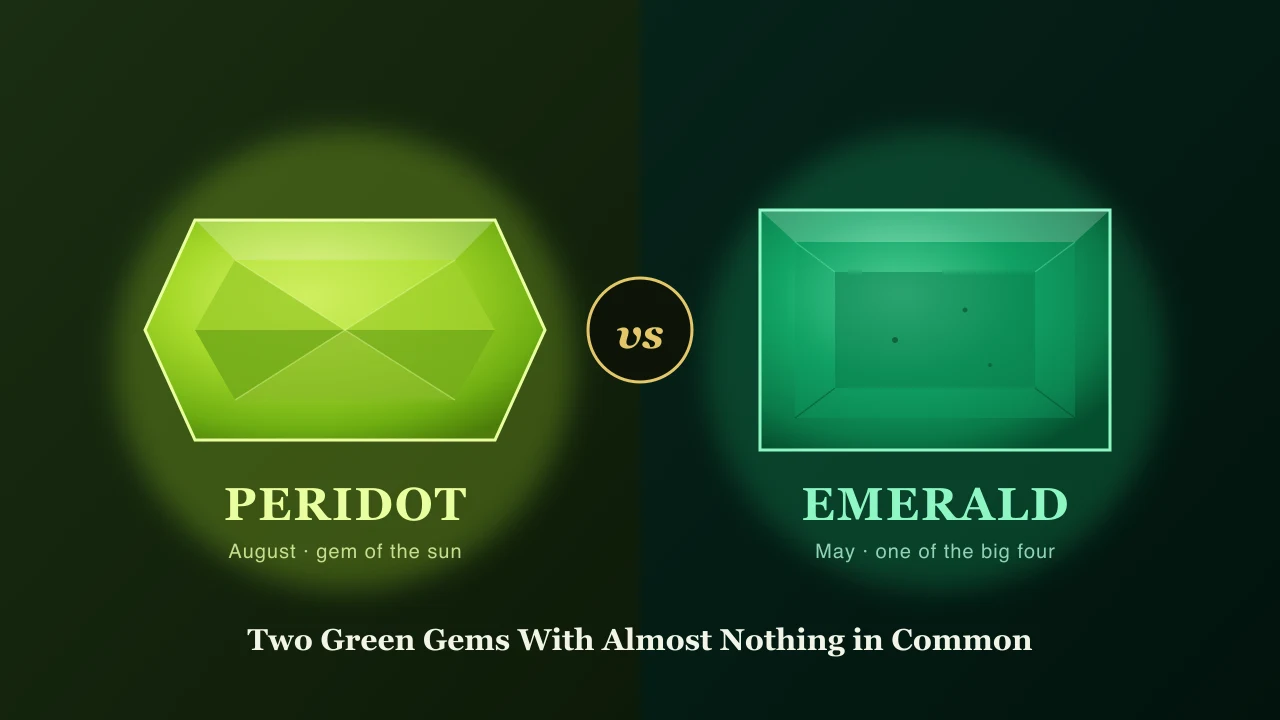
Here is the whole comparison compressed into a single line worth reading twice.
Emerald is a rare, expensive, fragile, nearly-always-oiled crustal gem that is one of the "big four" precious stones. Peridot is an abundant, affordable, honest, almost-never-treated gem that literally forms in the mantle and rains down from space. They only look alike.
Everything else here is a footnote to that sentence. Emerald is the storied, high-status green, the one in crown jewels and auction catalogues. Peridot is the cheerful, lime-green underdog that most people underrate precisely because it is cheap and easy to get. Pretending they are two grades of the same thing, which is how they often get sold, is how buyers end up either overpaying for a "cheap emerald" or dismissing a lovely peridot as a lesser stone. They are not competing for the same job.
What Emerald Actually Is
Emerald is the green variety of beryl, a beryllium aluminium silicate. Pure beryl is colourless. Emerald gets its green from traces of chromium, and sometimes vanadium, sneaking into the crystal structure. That detail matters more than it looks, and we will come back to it, because it is the key to the whole comparison.
Beryl needs beryllium to form, and beryllium is a genuinely rare element in the Earth's crust. Chromium and vanadium, the things that colour it green, are usually found in completely different geological settings from beryllium. For an emerald to exist, these normally-separated ingredients have to meet in the same place at the same time under the right conditions, which is a geological fluke. That rarity is the foundation of emerald's price and its status as one of the four classic precious stones alongside diamond, ruby, and sapphire. It is May's birthstone, and we go deep on its colour and character in our emerald meaning and colours guide and its long history in emerald history, lore, Cleopatra and the truth stones.
The other headline fact about emerald is its clarity, or rather its lack of it. The violent, crowded conditions that grow emeralds also fill them with inclusions: fissures, crystals, and wispy veils that the trade affectionately calls the jardin, French for garden. An emerald is expected to have a jardin. A completely flawless, cheap "emerald" is not a triumph, it is a red flag that you are looking at glass or a synthetic. That inverts the usual clarity logic, and it is one of the most important things a first-time emerald buyer can understand.
What Peridot Actually Is
Peridot is gem-quality olivine, specifically the magnesium-iron silicate the mineral world calls forsterite-fayalite. That is a completely different family from beryl, and the differences cascade from there. Olivine is one of the most common minerals on the planet, it makes up a huge fraction of the Earth's upper mantle, and gem-quality crystals of it are what we call peridot. It is August's birthstone, and we cover it fully in our peridot meaning and colours guide.
Now for the part that genuinely delights us, and that every thin retailer article skips. Peridot does not form in the crust like almost every other gem. It forms deep in the mantle and rides to the surface on volcanoes. You can walk a green-sand beach in Hawaii (Papakolea) that is green because it is littered with tiny peridot grains, or collect it from the volcanic terrain at San Carlos in Arizona. And it gets better: peridot is one of only a small handful of gems that have been found in meteorites. Stony-iron meteorites called pallasites contain gem-quality peridot crystals suspended in metal, which means some of the peridot on Earth is genuinely extraterrestrial, formed in the mantle of a shattered baby planet and delivered by a falling star. There is no other mainstream birthstone you can honestly say that about. When a Reddit gem thread lit up over "why is peridot so underrated," that mantle-and-meteorite origin was the fact people kept circling back to, and rightly so.
Unlike emerald, peridot is typically clean. Good peridot is eye-clean and glassy, and while it can carry a characteristic disc-shaped "lily pad" inclusion, it does not have a jardin and does not need one. So the clarity rules are the exact opposite of emerald's: with peridot, clean is normal and expected, not suspicious.
Why Peridot Is Always Green and Emerald Is Only Sometimes
This is the single best fact in the whole comparison, and it is the one that turns "they are both green" from a coincidence into a real, structural difference. It comes down to a word most gem articles never use: idiochromatic.
Emerald is allochromatic, which means "coloured by another." Beryl itself is colourless, and it only becomes green emerald when trace chromium happens to be present. Change the impurity and beryl becomes something else entirely: iron makes it blue aquamarine, manganese makes it pink morganite, and with no impurity at all it stays clear. Green is not built into beryl. It is a lucky guest. That is why emerald is rare, and it is why the same mineral gives you aquamarine and morganite too.
Peridot is idiochromatic, which means "coloured by itself." The iron that makes peridot green is not a trace impurity, it is a fundamental, structural part of the olivine crystal. You cannot have olivine without iron, so you cannot have peridot that is not green. Every peridot that has ever existed is some shade of green, from yellowish lime to a deep olive, and it never fades, because you cannot remove the colouring agent without destroying the mineral. Peridot has exactly one colour, forever, and that colour is baked into its chemistry.
So here is the poetry of it. Emerald is green by accident and peridot is green by nature. That one distinction quietly explains almost everything downstream: why emerald is rare and peridot is common, why emerald is expensive and peridot is cheap, and why peridot's green is a warm, sunny, yellowish lime while emerald's is a cooler, bluish, velvety green.
The Mistaken Identity That Lasted Millennia
Because they are both green and peridot is far easier to find, history is full of "emeralds" that were almost certainly peridot. The most famous example: many historians believe that Cleopatra's celebrated emeralds were actually peridot, mined from a fog-shrouded island in the Red Sea the ancients called Topazios, known today as Zabargad or St John's Island. That island was a legendary peridot source for thousands of years, and the Egyptians called peridot the "gem of the sun."
The confusion did not stop in antiquity. For centuries, large green stones in European church treasuries and royal collections were catalogued as emeralds when they were really peridot. Some of the "emeralds" decorating the Shrine of the Three Kings in Cologne Cathedral, one of the most important reliquaries in Europe, turned out to be peridot. This is the same kind of serial mistaken-identity story we told about spinel masquerading as ruby in the crown jewels, in our piece on spinel, the great impostor. Green got called emerald, red got called ruby, and gemology as a science is largely the story of untangling those mix-ups.
There is a nice knock-on fact here too. The old name "topaz," taken from that same Topazios island, most likely originally referred to peridot, not to the stone we now call topaz. So peridot did not just get mistaken for emerald, it also lent its ancient home's name to an unrelated gem. It is one of the most quietly confused stones in the whole history of jewellery, which is a strange fate for a gem this straightforward.
Durability: A Draw, Not a Win
You might expect the pricier stone to be the tougher one. It is not, and this is where a lot of comparison articles get lazy. Neither emerald nor peridot is a carefree daily-wear gem, and for interestingly different reasons.
Emerald sits at 7.5 to 8 on the Mohs scale, which sounds hard, and in terms of scratch resistance it is. But hardness is not toughness. All those jardin inclusions and internal fissures make emerald brittle: it resists scratching but a sharp knock can chip or crack it along an existing flaw. Emerald has genuinely poor toughness for its hardness, which is why it lives in the fragile-care camp.
Peridot sits lower, at 6.5 to 7 on the Mohs scale, so it scratches more easily than emerald and can pick up a slow dulling from everyday grit over the years. It has no cleavage, which helps, but it is sensitive to sudden temperature changes and, notably, to acids, including some of the mild ones in sweat and household products over long exposure. So peridot is softer than emerald but not necessarily more fragile, and both stones share the same care rules.
The practical upshot is that both belong in the protective-setting, gentle-cleaning, never-ultrasonic group, right alongside opal and moonstone. Neither one is the stone you knock around without a thought. If you want a green gem that genuinely shrugs off daily life, honestly, the answer is neither of these, it is something like a green sapphire or a green garnet. You can sanity-check any stone against the scale with our gemstone hardness tool. For an engagement ring in either emerald or peridot, choose a bezel or halo that shields the edges and take it off for anything rough.
Treatment: The Honest Stone Versus the Oiled One
This is a real, decision-shaping difference, and it is one of the biggest reasons we have a soft spot for peridot.
The vast majority of emerald on the market, well over 90 percent, is oiled. Colourless cedar oil or a modern resin is worked into the stone's fissures to fill them, hide them, and improve apparent clarity. This is ancient, standard, and accepted across the trade, and a lightly-oiled emerald is not a "fake" emerald. But it has consequences a buyer needs to know: oiling is not permanent. It can dry out or be stripped by heat and harsh cleaning, at which point the jardin reappears and the stone needs re-oiling. The bad version of the treatment is a heavily resin-filled or, worse, green-tinted-filler emerald that is hiding serious cracks and borrowed colour. So with emerald, treatment is something you have to think about at purchase and manage for the life of the stone.
Peridot is, refreshingly, almost never treated. What you see is what the stone actually is: its colour and clarity are natural, straight out of the ground, with no oil, no heat, no irradiation in the normal course of things. It sits in the small, honest club of gems, along with garnet and spinel, where "untreated" is simply the default and you should never pay a premium for it. This is a genuine, underrated virtue. With peridot there is no treatment to dry out, no re-oiling appointment, no wondering what is holding the colour together. It is one of the most straightforward gems you can buy, and in a market full of enhancement disclosures, that honesty is worth something. If treatment and lab-versus-natural questions matter to you generally, our lab-grown versus natural birthstones guide lays out when each makes sense.
Price: The Hundred-to-One Gap
There is no gentle way to say this: emerald and peridot are not in the same price universe, and the gap is enormous.
Fine peridot generally runs somewhere around $50 to $450 per carat depending on size and colour, with the top Pakistani and Burmese material at the upper end and everyday commercial peridot near the bottom. It is one of the best value-for-money coloured gems in the trade, and larger clean stones stay surprisingly affordable because peridot forms in big, clean crystals.
Fine emerald runs into the thousands of dollars per carat, and top Colombian material with vivid, untreated colour can reach five figures per carat and beyond. A superb one-carat Colombian emerald can cost more than a hundred times what a superb one-carat peridot costs. This is not a small premium, it is a different asset class, and it is driven by exactly the rarity and status we described at the top. For where both stones land on the overall value ladder, see our most expensive birthstones ranked, where emerald sits near the top and peridot near the value end.
Our blunt opinion: the price gap is real and it is earned by genuine rarity, but it also means peridot is one of the smartest ways to wear a beautiful green gem without a serious budget. If you love green and do not need the emerald name, peridot delivers a huge amount of colour and character per dollar. If you want emerald specifically, spend on colour above all, because a pale, greyish, cheap "emerald" is worse value than a vivid peridot at a fraction of the price.
How to Tell Peridot and Emerald Apart by Eye
If you have a loose green stone and no paperwork, here are the practical tells, roughly in order of usefulness. None is foolproof alone, but together they point clearly.
- Read the green. This is the fastest one. Peridot is a warm, yellowish, lime-to-olive green, cheerful and slightly sunny. Emerald is a cooler, bluish, deeper green, richer and more velvety. Once you have seen them side by side, "warm yellow-green versus cool blue-green" is a call you can make across a room.
- Judge the clarity. A green stone that is glassy and eye-clean is far more likely to be peridot. A green stone with a visible internal "garden" of fissures and crystals is behaving like an emerald. Flawless and cheap points to glass or synthetic for either.
- Look for doubling. This is the gemologist's favourite peridot tell. Peridot has strong birefringence, meaning it splits light into two rays. Look through the table of a peridot with a loupe at the back facet edges and you will often see them appear doubled, as if slightly out of register. Emerald does not show noticeable doubling. Strong facet doubling in a green stone is a near-giveaway for peridot.
- Use the price as evidence. A large, clean, vivid green stone offered cheaply is almost certainly peridot, glass, or synthetic, never a natural emerald. Emerald simply does not come large, clean, vivid, and cheap.
- Watch for the oil. Under magnification, emerald often shows the tell-tale flash and wispy filling of oiled fissures. Peridot has nothing to fill and so shows none of that.
For anything valuable, none of this replaces a lab report. But for telling which drawer a stone belongs in, the colour temperature and the doubling together get you most of the way.
Meaning and Birthstone Month
The two stones sit in different months, which settles the matter for anyone buying a birthstone gift. Emerald is the May birthstone, tied for millennia to rebirth, spring, loyal love, wisdom, and truth. Medieval lore even cast it as a lie-detector that would shatter in the presence of a false lover. Peridot is the August birthstone, the ancient Egyptian "gem of the sun," linked to warmth, renewal, protection from night terrors, and prosperity. In astrological traditions both green stones get associated with Mercury, which is part of why the two come up together in "which should I wear" questions in the first place.
We are gentle sceptics about the healing and astrological claims for any stone, as always. What we will happily say is that both carry genuinely old and rich symbolism, and that a green birthstone is a lovely, meaningful gift either way. If you enjoy the lore side, we dig into how gem symbolism actually gets built in our piece on talismans and amulets.
So Which Should You Buy?
Here is our genuine, no-hedging opinion, sorted by what you are actually after.
If you want the storied, high-status green and have the budget, buy emerald. There is nothing else quite like a fine emerald's deep, cool, bluish-green glow, and it is one of the four classic precious stones for good reason. Just go in knowing what you are signing up for: spend on colour first, accept the jardin as normal, expect the stone to be oiled, treat it gently, and be prepared to re-oil it down the years. Buy the best colour you can afford even if it means a smaller stone, because with emerald colour is the entire game.
If you want a beautiful green gem, an honest one, and real value, buy peridot. It gives you a warm, lively, always-green colour that never fades, it comes clean without any oiling games, it is almost never treated, and it costs a fraction of emerald. It also comes with the best origin story in the entire birthstone calendar: a gem from the mantle that sometimes falls from the sky. For a August birthday, a green stone on a sensible budget, or anyone who values a gem being exactly what it appears to be, peridot is genuinely hard to beat.
For either stone in a ring you will wear often, respect the fragility both share: pick a protective bezel or halo setting, keep the cleaning gentle, skip the ultrasonic, and take it off for rough work. Neither is a knock-around daily stone, and matching the setting to that reality is what keeps a green gem looking good for decades.
The one thing not to do is treat these two as interchangeable. Do not pay emerald money for a "premium" green expecting peridot-level toughness or honesty, and do not dismiss peridot as a lesser emerald when it is really a different, and in some ways more remarkable, stone. Match the gem to what you actually want and both of these greens are wonderful.
Quick Answers
Is peridot the same as emerald? No. Emerald is green beryl coloured by trace chromium, and peridot is gem-quality olivine coloured by its own essential iron. They are different minerals that merely share a green colour, and they differ in rarity, price, durability, and treatment.
Why is peridot so much cheaper than emerald? Because olivine is one of the most abundant minerals on Earth while gem emerald needs a rare geological coincidence to form. Peridot is common and clean; emerald is rare and expensive by nature.
Is peridot stronger than emerald? It is a draw, not a win. Emerald is harder (Mohs 7.5 to 8 versus 6.5 to 7) but brittle from its inclusions, while peridot is softer but has no cleavage. Both are fragile-care stones that need protective settings and gentle cleaning.
How can I tell peridot from emerald at home? Peridot is a warm, yellowish lime-green, usually clean, and shows visible facet doubling through a loupe. Emerald is a cooler, bluish-green with a visible internal "jardin" of inclusions and no doubling. A large, clean, cheap green stone is not a natural emerald.
Were Cleopatra's emeralds really peridot? Very likely, at least some of them. Many historians believe Cleopatra's famous "emeralds" were peridot from Zabargad (St John's Island) in the Red Sea, a legendary ancient peridot source. Green gems were routinely called emeralds long before mineralogy could tell them apart.
Which is the better birthstone gift? Emerald for a May birthday, peridot for August. Both are green and meaningful; emerald is the prestige choice, peridot the honest, affordable, and geologically fascinating one.