Emerald History and Lore: From Cleopatra's Mines to Medieval Truth Stones
In the eastern desert of Egypt, about 800 kilometres south of Alexandria, there is a worked-out mountain called Mons Smaragdus. The Romans named it. It means, literally, the Emerald Mountain. Cleopatra owned it.
That single fact gives you most of what you need to know about emerald's place in history. Before it was May's birthstone, before "emerald cut" meant anything to a jeweller, this was the stone a Ptolemaic queen put her personal stamp on. She mined it. She gave it as state gifts. She had her own likeness carved into it and shipped to foreign dignitaries who needed reminding who they were dealing with.
We find that genuinely interesting, because the modern emerald has been softened into something pretty and slightly sentimental. The old emerald was a power move.
A Stone Older Than the Pharaohs
Egyptians were mining emerald, or something they called emerald, somewhere between 1500 and 1300 BC. George Frederick Kunz, our usual primary source, notes that the mines at Mount Zabarah (the same Mons Smaragdus) were in use "before the beginning of our era," and that emeralds appear consistently in Egyptian amulets and grave goods from the New Kingdom onward.
The Hebrew word bareketh, which the Septuagint and the Vulgate both render as smaragdus, is one of the twelve stones on the high priest's breastplate in Exodus. On it was engraved the name of the tribe of Levi. Whether the stone in the original breastplate was strictly the green beryl we now call emerald or some other green stone (Kunz suspects green feldspar, the Egyptian uat) is genuinely up for grabs. But by the time the Greek translators got to it, smaragdus meant emerald, and emerald meant Egypt.
If you want to read along, here is Kunz's full 1913 book on the Internet Archive: The Curious Lore of Precious Stones (PDF). We've also put together a summary of the whole book here if you want the abridged tour.
Cleopatra's Mines (and Her Vanity Stones)
The "Cleopatra's emeralds" story is one of the few pieces of gemstone folklore that turns out to be mostly true. The mines at Mons Smaragdus were active under the Ptolemies, and Cleopatra VII expanded the operation. We know from Pliny and from Roman commercial records that emeralds from the Egyptian eastern desert flowed into the Mediterranean throughout the first century BC.
The vanity carvings are also documented. Cleopatra commissioned engraved emeralds bearing her own portrait and gave them out as diplomatic gifts. There is a small irony in this. Most of the Egyptian emeralds were, by modern standards, mediocre stones, cloudy, heavily included, and brittle. The queen wasn't issuing them for sparkle. She was issuing them for branding.
Our honest take: the modern jewellery industry has spent a hundred years suggesting that a "good" emerald is a flawless one. Cleopatra would have disagreed. For most of the stone's history, the green colour and the political weight were the point. Clarity was a bonus.
Nero and the Burning Glass
There is a persistent story, traced back to a passage in Pliny, that the emperor Nero watched gladiatorial combat through a polished emerald. Modern writers have made this into a "Nero's emerald sunglasses" headline, with the suggestion that Nero was nearsighted and the emerald acted as a corrective lens.
This is almost certainly wrong. The Latin word Pliny uses, smaragdus, was a broad bucket that covered any number of green stones, including green beryl, malachite, and possibly polished green glass. A flat slab of green stone held up to the eye would have acted as a colour filter, not a corrective lens. The most plausible reading is that Nero, like a modern footballer in a tight shirt, simply wanted the green tint to take the glare off a sun-blasted arena.
We mention the story not because it's true but because of the type of belief it represents. From very early on, emerald was credited with doing something to vision. The Arabs picked this up and ran with it.
Teifashi's Viper Experiment (Yes, This Happened)
In 1242 the Arabian gem dealer Ahmed Teifashi decided to test, empirically, the medieval belief that a snake could not look at an emerald without losing its sight. He bought vipers from a snake charmer, attached an emerald to a stick with wax, and held it in front of one viper's eyes. He reports, in entirely sincere detail:
I heard a slight crepitation and saw that the eyes were protruding and dissolving into a humor. After this the viper was dazed and confused.
We do not, obviously, recommend trying this. We don't actually believe it happened the way Teifashi reports it, either; what's interesting is that a serious 13th-century gem trader thought it was worth setting up the experiment. The "emerald destroys snake eyes" myth was widespread enough to be tested rather than just repeated. That tells you something about how seriously the stone's powers were taken.
The Lover's Lie Detector
Of all the medieval claims for emerald, our favourite is the one that gets cited most often by Albertus Magnus and Marbodus: the stone revealed the truth or falsity of a lover's oaths. Wear an emerald, the thinking went, and you would know whether the person facing you across the table actually meant it.
The most famous illustration of this is the story of King Bela IV of Hungary (reigned 1235-1270). Bela had an exceptional emerald set in a ring. According to Albertus Magnus, when the king embraced his wife while wearing the ring, the stone shattered into three pieces.
The chroniclers framed it as evidence that emerald could not tolerate sexual passion, even between a married couple. (Albertus also notes, slightly defensively, that emerald is commonly assigned to Venus and yet "was often regarded as an enemy of sexual passion.") The simpler reading, our reading, is that Bela's stone had an inclusion right through the middle and split along its natural cleavage at exactly the wrong moment. Emerald is famously brittle. It is the gemstone most likely to break under a sudden squeeze. The mystics weren't observing morality. They were observing material science and reaching for a story.
The Truth Stone, the Memory Stone, the Wits Stone
Pull together the medieval lore and you get a stone that did roughly the following:
- Sharpened the wits. Cardano, writing in the 16th century, said emerald "sharpens the wits and quickens the intelligence" and made the wearer more honest, because "dishonesty is nothing but ignorance, stupidity, and ill-nature." We love this. It is the most Renaissance sentence ever written.
- Strengthened the memory. A useful gem for students, in theory.
- Conferred riches. Cardano himself was sceptical here, noting from "the experience of others as well as his own" that emerald was not, in fact, a reliable wealth charm.
- Predicted future events. To activate this property, the stone had to be placed under the tongue. We trust you will not do this with a four-figure gem.
- Drove away enchantments. Magicians' spells were said to fail in the presence of an emerald. This made it a popular amulet for people who suspected they were being cursed, which in the medieval period was approximately everyone.
The talismanic emerald of the Mughal emperors of Delhi, a 78-carat stone Kunz personally inspected, carries an inscription around its edge in Persian: He who possesses this charm shall enjoy the special protection of God. That is a lot of weight to put on a single inclusion-prone hexagonal crystal. People did it anyway.
Solomon's Four Stones
In rabbinical legend, God gave King Solomon four precious stones whose combined ownership made him master of all creation. One of the four was the emerald. Kunz suggests the other three were probably the carbuncle (red), lapis lazuli (blue), and topaz (yellow), one for each cardinal direction.
Whether or not you take the legend at face value, the structural point is clear: emerald is the green corner of the medieval colour cosmos. Where red stones signalled courage and blue stones signalled heaven, the green stone signalled growth, fertility, and the renewing of life. May, which the modern list assigns to emerald, sits at the same point in the year as that symbolism. There is a reason this stone ended up here.
Why Emerald Won May
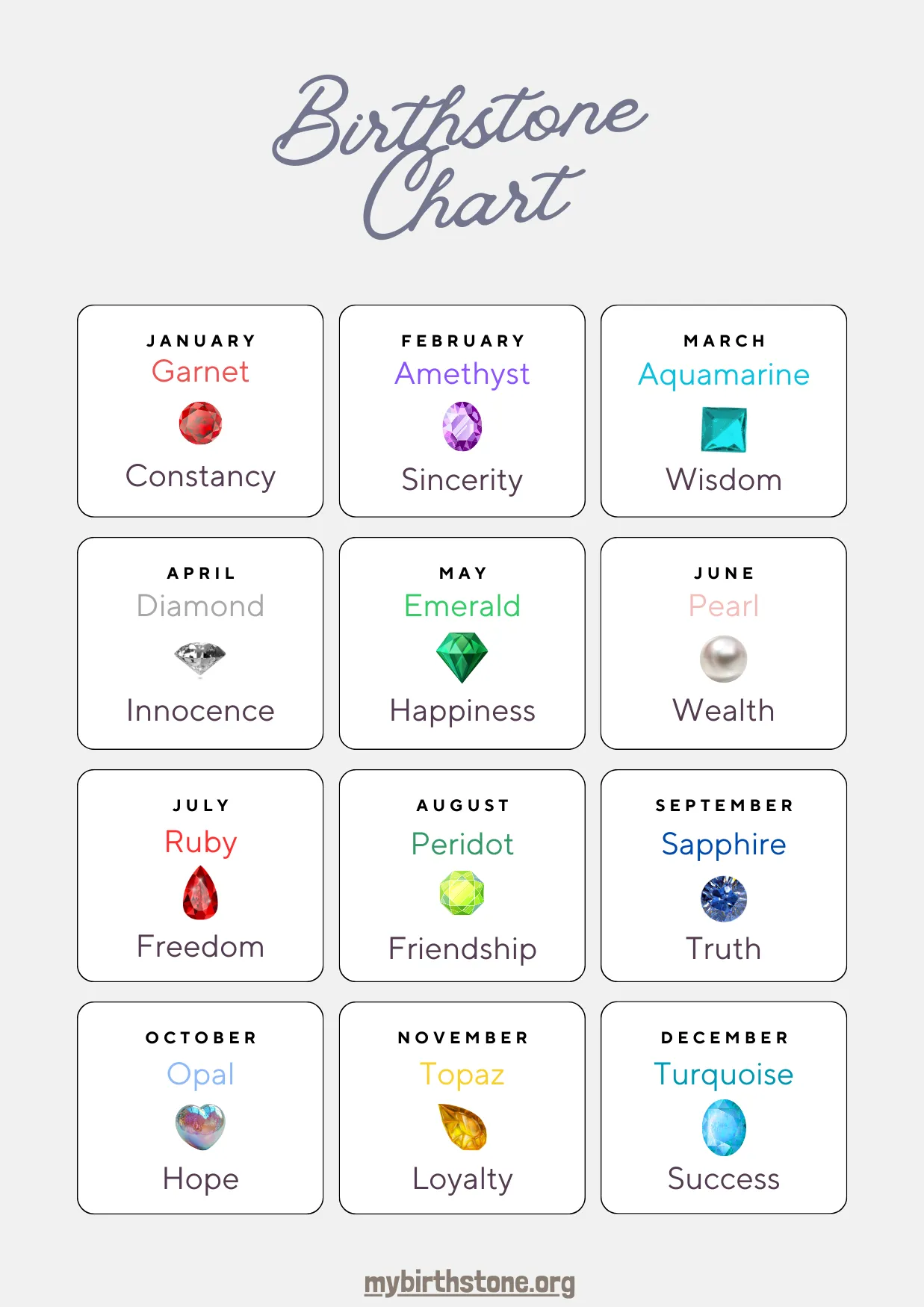
The 1912 list adopted by the American National Association of Jewellers (the basis of nearly every modern birthstone chart, including ours) didn't pick emerald for May at random. Three things converged:
- A thousand years of green-stone-equals-renewal symbolism. May is northern-hemisphere spring. Emerald is the green stone. The match was already made.
- Available supply. By 1912, Colombian emerald mining (Muzo and Chivor had been worked since the Spanish conquest in the 1530s) and Russian Ural emeralds were both producing commercial quantities. You can't standardise a stone nobody can sell.
- The lore halo. Cleopatra, Solomon, the Mughals, the medieval truth-revealing folklore. None of this hurt when a trade body had to pick a stone with enough cultural weight to feel inevitable.
Kunz, writing in 1913, was openly nervous about how commercial the new list was. He worried that picking a "marketable" stone for each month would hollow out the centuries-old folk meaning. Looking back, our honest take is that emerald is the one where the commercial and the folkloric line up cleanly. The stone people wanted for May in 1912 was, more or less, the stone people had wanted for renewal and rebirth since the New Kingdom of Egypt.
For the full standardisation story, our birthstone origins history article walks through the breastplate, the zodiac stones, and the 1912 list in order.
What This Means If You're Born in May
If you're shopping for a May birthday, or you're a May baby thinking about your own jewellery, here's the practical advice we'd give a friend.
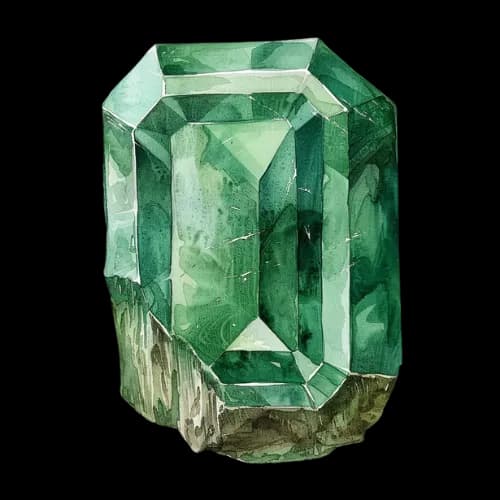
- Don't pay flawless-diamond prices for a flawless emerald. Emeralds are almost universally included. The trade calls the internal patterning jardin, "garden", and treats it as part of the stone's identity. Heavily included emeralds were the historical norm. Asking for an eye-clean one is fine, asking for a loupe-clean one will cost you a fortune and isn't historically faithful.
- Treatments are nearly universal. Most commercial emeralds are oil-filled or resin-filled to mask surface-reaching fractures. This is industry standard, not fraud, but you should be told about it. Ask. The honest sellers will volunteer the information.
- Care matters. Emerald is Mohs 7.5 to 8 but brittle, and the filling treatments break down in ultrasonic cleaners and hot soapy water. Clean with a soft cloth and lukewarm water. Don't wear it gardening, even though that feels symbolically wrong to type.
- Consider Colombian if you want the colour. Muzo and Chivor have the deepest green. Zambian emeralds (commercially significant since the 1970s) lean slightly bluer and often have better clarity. Both are legitimate. Brazilian and Russian Ural stones are out there in the secondary market.
- Lab-grown emeralds are real emeralds. Chemically identical, often visibly cleaner, and a fraction of the price. We've written about lab-grown versus natural here if you want a fuller picture. The medieval lore was attached to being green and being beryl, not to having come from a Colombian mountainside.
For the canonical May page, see our May birthstone hub. And if you'd like to browse settings, the birthstone jewelry collection or the full birthstone history are good next stops.
Sources and Further Reading
- George Frederick Kunz, The Curious Lore of Precious Stones (1913), especially the chapters on the talismanic use of stones (emerald section, around pp. 76-79), ominous and luminous stones, and the high priest's breastplate. Scanned PDF: Internet Archive.
- Pliny the Elder, Naturalis Historia, book 37, on smaragdus and the Nero passage.
- Ahmed Teifashi, Fior di pensieri sulle pietre preziose (1242, Florence reprint 1818), for the viper experiment.
- Albertus Magnus, De Mineralibus, on King Bela IV's emerald ring; 14th-century Italian manuscript reproduced in Kunz.
- Cardano, Philosophi opera quaedam (Basel, 1585), De gemmis, on emerald and intelligence.
If you found this useful, the rest of our Kunz lore series on the blog is working slowly through the full book. Next up in the series: the strange afterlife of ruby's reputation as the king of gems.
Wondering how it stacks up against every other gem? Compare values in our gemstone price guide and toughness on the sortable Mohs hardness table.