April's Diamond Myths: Invincibility, Poison, and Why Diamond Won April
In 1538, the goldsmith Benvenuto Cellini was in prison and convinced he was being murdered with his own dinner. He bit into something gritty, spotted a glinting splinter on his plate, and assumed the worst: diamond dust, the assassin's favourite. He prayed, made peace with dying, then on a hunch tried to crush the fragment against a stone window-sill. It powdered. Cellini lived. The gem-cutter hired to grind a real diamond into his food had pocketed the stone and substituted citrine instead.
That story is a useful place to start, because it tells you exactly how people felt about April's birthstone five centuries ago. Diamond wasn't a sentimental token. It was a weapon, a guardian, and a piece of pharmacology rolled into one.
Diamond Was Powerful Long Before It Was Pretty
We tend to talk about diamond as if it has always been the centrepiece of an engagement ring. It hasn't. For most of recorded history, diamonds were too hard to cut convincingly, so the rough crystal was prized for what it could do, not what it looked like.
George Frederick Kunz, writing in 1913, sums up the medieval view in one sentence: "the virtues ascribed to this stone are almost all directly traceable either to its unconquerable hardness or to its transparency and purity." Hard meant invincible. Clear meant honest. Those two ideas drove most of the folklore that follows.
If you want to read along, the Internet Archive has the full scanned book here: The Curious Lore of Precious Stones (1913) PDF. It's our primary source for the lore in this article, and we summarised the whole book here if you'd like the broader context.
The Invincibility Myth: Diamond as a Knight's Amulet
The Greek word adamas means "unconquerable." That single linguistic root carried more weight than any marketing campaign De Beers ever ran. If the stone couldn't be broken, the thinking went, neither could the person wearing it.
Marbodus, an 11th-century French bishop and gem writer, called diamond a magic stone of great power that drove away night terrors when set in gold and worn on the left arm. St Hildegard of Bingen took it a step further: the devil personally hated diamond, she wrote, because it resisted him "by day and by night." An anonymous Orphic poem from the second century put it more dramatically:
The Evil Eye shall have no power to harm Him that shall wear the diamond as a charm, No monarch shall attempt to thwart his will, And e'en the gods his wishes shall fulfil.
This is the bit I find genuinely interesting. The diamond's modern reputation as a symbol of forever-love is, in historical terms, a recent invention. For most of its career, diamond was a battle charm. Look at a knight's tomb effigy and the ring on the left hand isn't a sentimental keepsake. It's armour.
The Poison Panic: When Diamond Dust Was the Worst Thing in a Pantry
Here is where it gets darker. From roughly the 14th to the 17th century, large parts of Europe and Asia were convinced that powdered diamond was an undetectable, fatal poison. There is no chemistry behind this. Diamond is carbon. It passes straight through you. But belief outran science by a wide margin, and the body count is real.
Kunz catalogues a small gallery of victims and near-victims:
- Sultan Bejazet II (1447–1512) was reportedly murdered by his son Selim, who mixed pulverised diamond into his food.
- Paracelsus (1493–1541), the Swiss physician, was rumoured by his own disciples to have died of diamond dust. Kunz, sensibly, calls this a cover story for a master who'd promised eternal life and then failed to manage forty-eight.
- Sir Thomas Overbury, imprisoned in the Tower of London in 1613, was indeed slowly poisoned at the behest of the Countess of Essex. The court records show she literally asked an apothecary, "What say you to powder of diamonds?" before the recipe was finalised. He lasted three months. (The diamond probably wasn't what killed him; mercury and corrosive sublimate were also in the mix.)
Why did the legend hold? Two reasons, in our reading. First, the diamond mines were guarded in legend by venomous serpents, so the stone had a built-in association with deadly things. Second, the Portuguese physician Garcias ab Orta noted in 1563 that slaves in the Indian mines routinely swallowed diamonds to hide them and recovered them, as he politely put it, "in a natural way." Garcias was trying to debunk the myth. It didn't take. The story was simply too useful.
Hindu Caste Diamonds and the Six-Sided Lucky Stone
India was the world's only commercial diamond source until Brazilian deposits opened in the 1720s, so the deepest folklore is Indian. The treatise of Buddhabhatta, cited by Kunz, classifies diamonds by the four castes:
- Brahmin diamond: white as a shell or rock-crystal; brought power, friends, riches, luck.
- Kshatriya diamond: brown as a hare's eye; prevented old age.
- Vaisya diamond: petal-coloured; brought success.
- Sudra diamond: the sheen of a polished blade; all-purpose good fortune.
Shape mattered enormously, because almost no Indian diamonds were faceted then. A triangular crystal caused quarrels. A square one inspired vague terror. A five-sided diamond was the worst: it brought death. Only a six-sided stone was genuinely lucky.
It's worth pausing on this. The cuts we treat as standard today, the round brilliant especially, are 20th-century inventions. For a millennium before that, the shape of the natural crystal was treated as a fingerprint of destiny. Diamond shopping was closer to astrology than retail.
"It Must Be Given, Not Bought"
One more piece of folklore that we genuinely love: a diamond's talismanic power, according to a widespread medieval belief, vanished the moment it was purchased. Only a gift could carry the magic. The "spirit" of the stone, people said, took offence at being treated as merchandise and simply left.
If you've ever wondered why diamond ended up as the standard engagement gift rather than, say, the standard self-purchase, that piece of lore is part of the long answer. The idea that a meaningful diamond is one that's given was already centuries old by the time advertising rediscovered it.
So Why Did Diamond Win April?
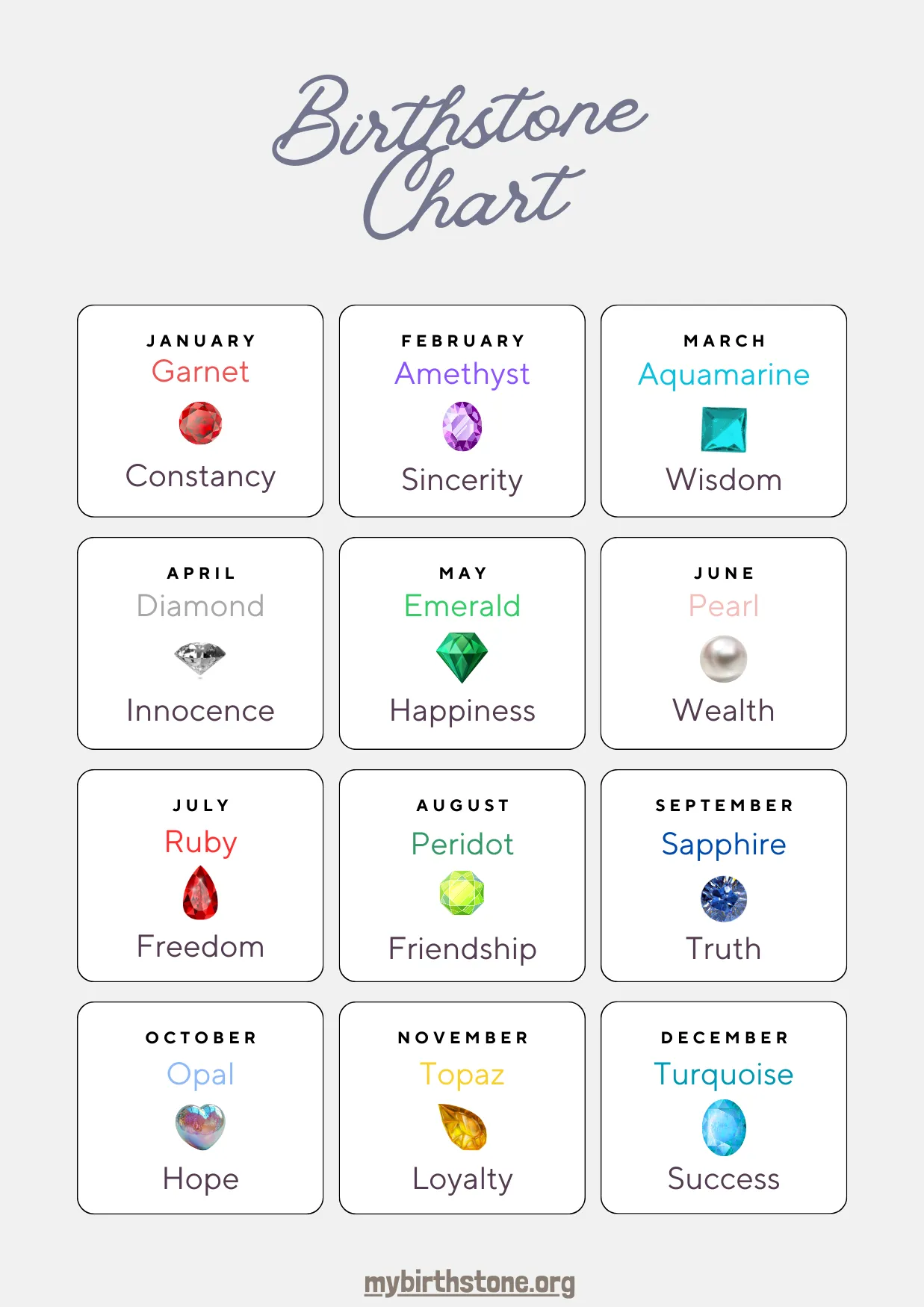
April's stone could plausibly have been bloodstone, sapphire (in some old lists), or even sard. The list of stones tied to months has shifted across the breastplate of Aaron, the Revelation foundation stones, planetary stones, and zodiacal stones. As Kunz noted, in August 1912 the National Association of Jewellers met in Kansas City and rubber-stamped a standardised list. That's the list nearly every jewellery shop still uses. (We dig into the full standardisation story in our birthstone origins history piece if you want the receipts.)
But the choice of diamond for April wasn't pulled out of a hat. Three forces converged:
- Adamas, the invincible. Diamond had a millennium of association with strength, courage, and protection. Tying it to spring births, the start of a new astrological year (Aries), made narrative sense.
- A real supply chain. Brazilian and later South African mining (Kimberley, 1867) made diamonds genuinely available at the time the modern list was being built. You can't standardise a stone nobody can buy.
- The 20th-century marketing engine. The 1912 list was the legal handshake. De Beers' 1947 "A Diamond Is Forever" campaign was the brand activation. Both leaned on lore that was already a thousand years old.
Kunz, writing one year after the 1912 list was adopted, was openly sceptical of the whole exercise. He worried that "the spirit of commercialism pure and simple" would dictate the list and that people would lose interest in birthstones altogether. Our honest take, a hundred years on, is that he was half right. The commercial layer is real. But the sentiment he was worried about losing has held up surprisingly well. People still want a stone tied to their month. They just don't know they're wearing a poison panic.
What This Means If You're Born in April
If you're shopping for an April birthday or considering an aquamarine engagement ring alternative (for a March-born partner) or sticking with the canonical diamond, here's the practical advice we'd give a friend:
- Don't overpay for symbolism alone. The "diamond means forever" idea is real, but it's also a marketing structure on top of much older folklore. Knowing the history lets you spend with your eyes open.
- Consider an heirloom or vintage stone. The "gift, not purchase" lore has a charm to it. A diamond passed down or rescued from an old setting carries genuine continuity in a way a brand-new mass-cut stone doesn't.
- If you want lore on your finger, look for older cuts. Old mine cuts, rose cuts, and table cuts predate the modern round brilliant and look the way diamonds actually looked when most of this folklore was written.
- Lab-grown is fine, if that's your conscience. We've written about lab-grown versus natural here. The historical magic was attached to the stone's hardness and clarity, not its origin in a particular kimberlite pipe.
For more on the modern April lineup, see our April birthstone hub. And if you want to browse stones tied to other months, the birthstone jewelry collection and the full birthstone history are good next stops.
If the Myths Got You Curious About the Real Thing
The modern diamond questions are less romantic but more useful. If you are weighing a purchase, our moissanite vs diamond and lab-grown vs natural diamond guides cover the two comparisons buyers actually face now, and the diamond price calculator gives you a realistic figure before a jeweler does.
Sources and Further Reading
- George Frederick Kunz, The Curious Lore of Precious Stones (1913), especially the chapters on the talismanic use of stones, ominous and luminous stones, and birth-stones. Scanned PDF: Internet Archive.
- Garcias ab Orta, Aromatum historia (1563), on the diamond-as-poison debunking.
- Court minutes of the Overbury trial, summarised in Andrew Amos, The Great Oyer of Poisoning (London, 1846).
- Buddhabhatta's gem-treatise, via Finot, Les lapidaires indiens (Paris, 1896).
If you found this useful, we'd love your eyes on the rest of the Kunz lore series on the blog. The book is over 400 pages of this stuff and we are, slowly, working through all of it.