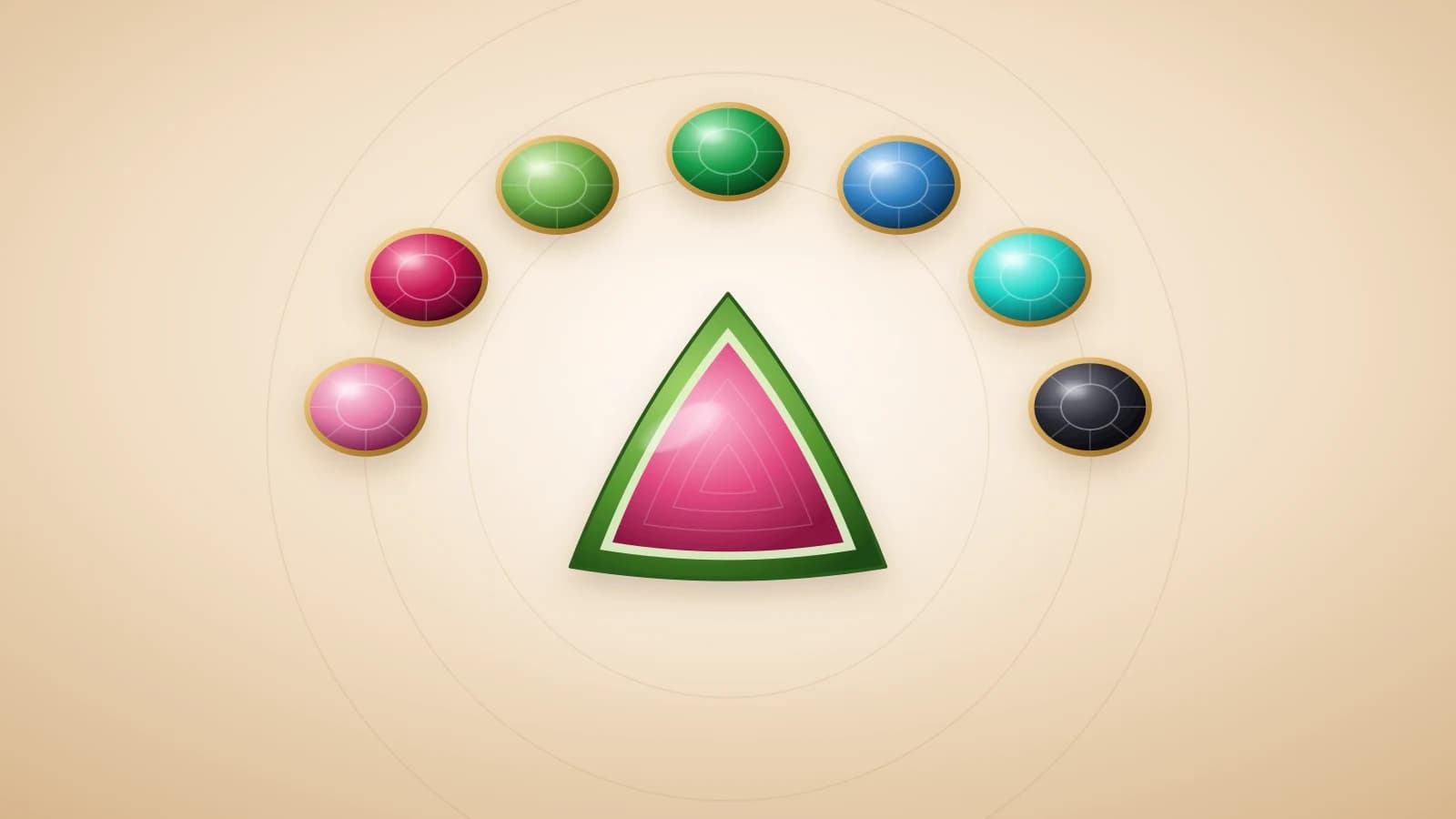
Most gems have one colour that everybody pictures. Ruby is red, emerald is green, sapphire is blue. Tourmaline has no colour like that. It comes in pink, red, green, blue, neon teal, honey, black, colourless, and several of those at once in the same crystal. Gemmologists generally agree it has the widest colour range of any gemstone.
That is great if you are choosing a stone and a nuisance if you are trying to understand one. A pink tourmaline at $120 and a neon Paraíba at $20,000 per carat are the same mineral family with different trace elements. Every colour has its own trade name, its own price band and its own way of catching buyers out.
Tourmaline is the modern October birthstone, sharing the month with opal. This is our guide to what it means, what each colour is called and costs, which ones we think are good value, and how to wear it without cracking it.
Tourmaline Meaning at a Glance
Tourmaline is associated with balance, emotional healing and protection. In crystal circles it gets described as a stone that settles the mind and keeps negative energy away, and each colour carries its own version of that idea. We have a section on the colour meanings further down.
Worth knowing before you read any crystal site: tourmaline's symbolism is young. The stone was traded for centuries under other names and was only recognised as a distinct mineral in the 1800s, so it has no ancient body of lore the way ruby or emerald do. Most of what you read about its "properties" was written in the last fifty years. We think that is fine. Just enjoy it as meaning you choose rather than a power the stone has.
What Is Tourmaline?
Tourmaline is a group of boron silicate minerals rather than a single mineral. The members share a crystal structure but swap different metals in and out: iron, magnesium, lithium, manganese, sodium, copper, chromium. Change the metal and you change the colour. That is the whole secret of the rainbow.
Almost all gem tourmaline belongs to a member called elbaite, which is lithium rich and produces the pinks, greens, blues and multicolours. The black stuff sold as a crystal is schorl, the iron-rich member, which makes up most of the tourmaline on Earth. Brown and yellow stones are usually dravite, the magnesium member.
A few physical facts matter for anyone wearing it:
- Hardness: 7 to 7.5 on the Mohs scale, just harder than quartz. Everyday dust will not scratch it.
- Toughness: fair. It has no easy cleavage plane, unlike topaz, but it is brittle enough that a hard knock can chip a facet edge.
- Pleochroism: strong. Tourmaline shows a different colour, or a darker version of the same colour, depending on which direction you look through the crystal. Down the length of a green crystal it can look almost black.
- Electric charge: tourmaline is pyroelectric and piezoelectric, meaning it builds up a static charge when warmed or squeezed. More on why that matters below.
Crystals grow as long, striated columns with a rounded triangular cross-section. If you have ever seen a pencil-shaped crystal with fine lines running along its length at a mineral show, it was probably tourmaline.
Tourmaline Colors and What They Are Called
The trade uses variety names for the main colours. They are useful, and a couple of them get misused, so it is worth learning them. The prices below are rough per-carat ranges for decent, eye-clean commercial stones of one to three carats. Treat them as a sense check rather than a quote. Exceptional stones go well above them.
| Trade name | Colour | Caused by | Rough price per carat |
|---|---|---|---|
| Pink tourmaline | Pale to medium pink | Manganese | $50 to $400 |
| Rubellite | Deep pink to red that holds in any light | Manganese | $200 to $1,500 |
| Verdelite (green) | Mint to forest green | Iron, titanium | $50 to $400 |
| Chrome tourmaline | Vivid emerald green | Chromium, vanadium | $200 to $1,000 |
| Indicolite | Blue to greenish blue | Iron | $200 to $1,500 |
| Paraíba | Neon blue, teal, green | Copper | $2,000 to $50,000+ |
| Watermelon / bicolour | Pink and green in one stone | Changing chemistry during growth | $50 to $600 |
| Dravite | Honey, amber, brown | Magnesium, iron | $20 to $150 |
| Schorl (black) | Opaque black | Iron | Under $30 |
| Achroite | Colourless | No colouring element | Collector pricing |
Pink tourmaline
This is the stone most people mean when they say "October birthstone." When the Jewelry Industry Council added tourmaline to the American list in 1952, pink was the shade it was sold under, and it still dominates October jewellery. Pastel pinks are plentiful and cheap. The more saturated the colour, the more it costs.
Rubellite
Rubellite is the name for the deep pink to red stones, and it is where buyers get overcharged most often. In the trade, a true rubellite keeps its rich colour under both daylight and warm indoor light. A stone that looks red in a sunny shop window and brownish or pale pink under a lamp is really a pink tourmaline with a better name on the tag. Before paying rubellite prices, look at it under both kinds of light.
Rubellite has fooled people for centuries. One famous red pendant in the Russian crown treasures, long known as "Caesar's Ruby," was later found to be a rubellite. Spinel has the same history, and our spinel guide tells that story.
Red and pink tourmaline almost always has visible inclusions, and GIA says that is expected in strongly coloured stones. Do not hold a rubellite to the clarity you would expect of an aquamarine.
Green tourmaline and chrome tourmaline
Green is the colour that started the confusion. In the 1500s a Spanish conquistador in Brazil washed a green tourmaline crystal and took it for emerald, and green tourmaline was sold as "Brazilian emerald" for a long time afterwards.
Most green tourmaline sits in a mint-to-olive range. It should be clean. GIA notes that green stones are expected to be free of visible inclusions, so a cloudy green tourmaline is worth much less than a cloudy pink one. Watch for dark stones. Because of the pleochroism, a lot of green tourmaline looks nearly black through the top unless the cutter oriented it well.
Chrome tourmaline, coloured by chromium or vanadium and mostly from East Africa, is the vivid, grass-to-emerald green. This is the one we'd pick if you want a green stone to wear every day. It gives you most of the look of an emerald with a harder stone and no oil treatment to maintain. Our emerald guide explains why emerald is so high-maintenance by comparison.
Indicolite (blue tourmaline)
Pure blue tourmaline is scarce. Most "blue" stones lean teal or greenish, and many are dark enough to need heat treatment to lighten them. A clean, bright, true blue indicolite is one of the rarer everyday tourmalines and is priced accordingly.
Paraíba tourmaline
In the late 1980s, miners digging in the Brazilian state of Paraíba found tourmaline in an electric, almost glowing blue-green that nobody had seen before. The colour comes from copper, which no other tourmaline source had produced. The stones sold out almost immediately, and prices went vertical.
Similar copper-bearing tourmaline was later found in Nigeria and Mozambique. The trade now uses "Paraíba" as a variety name for any copper-bearing tourmaline with that neon colour, wherever it was mined. That is officially accepted, but it means two stones sold as Paraíba can differ hugely in price depending on origin. Original Brazilian material commands a premium on top of the name.
Our view: never buy a Paraíba without a lab report from GIA, AGL, SSEF or Gübelin confirming the copper and stating origin if the price assumes Brazil. Also, a lot of Paraíba is heated to lift the colour, which is accepted practice, but it should be disclosed. If you love the colour and do not care about bragging rights, a Mozambique stone gives you the glow for a fraction of the Brazilian price. We would go that way.
Watermelon and bicolour tourmaline
As a tourmaline crystal grows, the fluid feeding it can change chemistry, so the colour changes partway through. Slice across a crystal with a pink core and a green rind and you get a watermelon tourmaline, the best-known multicolour stone. Cut along the length instead and you get a bicolour, pink at one end and green at the other.
Watermelon slices are thin and mostly polished flat rather than faceted, which makes them lovely in pendants and poor in rings. We'd put one on a chain every time.
Black tourmaline (schorl)
Black tourmaline is the most common tourmaline in the world and the most searched-for colour online. Almost all of that interest comes from the crystal world, where schorl is sold as a protection and grounding stone. It is inexpensive, opaque and matte to glassy.
It gets little attention in fine jewellery, which we think is a small mistake. A faceted or polished black tourmaline has a deep, clean black with more life than onyx, and it is harder than onyx too. For a black stone ring or signet on a budget, it is worth a look.
The rest: dravite and achroite
Brown and honey dravite is cheap and rarely set. Achroite, colourless tourmaline, is rare but in little demand, since a colourless stone with modest sparkle cannot compete with white sapphire or diamond. Both are collector territory.
The Meaning of Each Tourmaline Color
Each colour has taken on its own symbolism in modern crystal and gifting traditions:
- Pink tourmaline: love, compassion and emotional healing. It is the most romantic of the set and a popular gift from a partner or for a new mother.
- Rubellite: passion, courage and energy, a stronger version of pink.
- Green tourmaline: growth, vitality and renewal. It is sometimes linked with the heart and with nature.
- Blue tourmaline (indicolite): calm, clear communication and honesty.
- Watermelon tourmaline: balance, especially between opposites. With pink inside green, it is easy to see why.
- Black tourmaline: protection and grounding. This is the association you will see most often online, usually with advice to keep a crystal by the front door.
- Paraíba: joy and clarity, mostly on the strength of that colour.
Our position is the same one we take for every stone on this site. These meanings are cultural and symbolic, and a gem cannot change anything about your life. That doesn't make them worthless. A pink tourmaline given to mark a birth or a hard year carries real meaning because of the giving. Choose the colour that fits the sentiment, then choose the stone on quality.
Tourmaline History: Mistaken Identities and an Empress
For most of history, nobody knew tourmaline was one thing. It was sold as ruby, emerald, sapphire and anything else its colour suggested.
The name comes from the Sinhalese word toramalli, which GIA translates as "mixed gems." Dutch traders buying in Sri Lanka used the word for bags of multicoloured, water-worn pebbles from the island's gem gravels, which included tourmaline alongside other stones. The Dutch also found that the stones, once warmed, would pull ash out of a pipe bowl, and nicknamed them aschentrekker, or ash puller. That was the pyroelectric charge at work, centuries before anyone could explain it.
Mineralogists only separated tourmaline out as its own species in the 1800s. In the United States, Maine became an early source, and tourmaline is now Maine's state mineral. California's San Diego County was the other great American source around 1900, and much of its pink and red output was shipped to China. According to GIA, that was because the Dowager Empress Cixi was especially fond of the colour. When she died in 1908, the Chinese market collapsed and several California mines closed.
Then came 1952 and the birthstone list. October had only ever had opal, and jewellers wanted an alternative for customers put off by opal's softness and its unlucky reputation. Tourmaline got the nod. Our October birthstone history page covers how both stones got there.
Is Tourmaline the October Birthstone?
Yes. October has two birthstones: opal, the traditional one, and tourmaline, the modern one added in 1952. Pink tourmaline is the shade most often sold for October, but any colour of tourmaline counts. Tourmaline is also the gift for the 8th wedding anniversary.
Choosing between the two comes down to looks and how the piece will be worn. Opal has play of colour, which nothing else has, but at 5.5 to 6.5 on the Mohs scale with poor toughness it is a fragile stone to wear on a hand. Tourmaline is harder, much tougher in practice and offers every colour. Our opal guide covers the other side, and the October birthstone page puts both stones side by side.
Our honest take: for a ring, choose tourmaline. For earrings or a pendant, choose whichever you love. That is the same advice we give in our mother's ring guide, where October is one of the months where the traditional stone is a poor choice for a hand.
Tourmaline is also claimed by both October zodiac signs, Libra and Scorpio.
How Much Is Tourmaline Worth?
Tourmaline covers a wider price range than almost any other gem. Colour drives most of it, then clarity, then size.
Colour. Saturated, bright colour is worth the most. Pale pastels and dark, closed-up stones are worth the least. Neon copper colour (Paraíba) sits in its own bracket entirely.
Clarity. This depends on the colour. Green and blue stones should be eye-clean, and visible flaws cut their value sharply. Pink and red stones are expected to have some inclusions, so a few visible ones matter less.
Size. Price per carat climbs with size for the fine colours, since large clean rubellite, indicolite and chrome stones are uncommon.
Treatment. Heat is common in blue, green and Paraíba stones. Pink and red tourmaline is often irradiated to deepen the colour, a treatment that is stable and usually cannot be detected. Rubellite and Paraíba are also sometimes clarity enhanced by filling surface-reaching fractures with resin, which is the one treatment that affects both value and care. Ask about it directly.
For comparison across the whole birthstone calendar, our most expensive birthstones ranked places tourmaline in the middle, with Paraíba as the exception near the top. The gemstone price guide has current bands for other stones too.
Where we would spend: a well-saturated pink or chrome green tourmaline of one to two carats is among the best buys on the birthstone list. You get a real, hard, bright gem for the price of a mid-range amethyst. We are much less keen on paying rubellite prices for stones that are not rubellite, or Brazilian prices for African Paraíba.
How to Tell Real Tourmaline From Glass and Lookalikes
Tourmaline is rarely faked outright, because genuine stones are cheap enough that faking them is not very profitable. Synthetic tourmaline exists only in labs and is not a commercial product, so you will not meet lab-grown tourmaline in a jewellery shop the way you might with sapphire or amethyst. What you will see is mislabelled material and glass sold as Paraíba.
Some simple checks:
- Turn it. Look through the stone from the top and then from the side. Tourmaline's strong pleochroism usually shifts the colour. Glass stays the same.
- Check the back facets with a loupe. Tourmaline is doubly refractive, so the facet edges at the back can look slightly doubled.
- Be suspicious of perfection. A large, flawless, bright red "rubellite" at a low price is more likely glass or a different stone.
- Get paperwork for expensive stones. For anything over a few hundred dollars, and for every Paraíba, a lab report is the only real answer. Our gemstone identification tool can help narrow down an unknown stone, but it cannot replace a lab.
If you are weighing natural against synthetic stones for other months, our lab-grown vs natural birthstones guide runs through which gems have realistic lab options.
Caring for Tourmaline
Tourmaline is easy to live with if you remember three things.
Skip the ultrasonic and the steamer. This surprises people because tourmaline looks tough on a hardness chart. GIA advises against both, because heat and vibration can crack stones with existing fractures, and fracture-filled rubellite and Paraíba can lose their filler. Warm water, a drop of washing-up liquid and a soft toothbrush is all it needs. Our birthstone jewellery cleaning guide has the full per-stone table.
Avoid sudden heat. Do not take a tourmaline ring from a hot kitchen into cold water, and keep it away from a jeweller's torch during repairs. Mention the stone if you have the ring resized.
Expect it to collect dust. Because tourmaline picks up a static charge when warm, a stone in a sunny window display can pull dust onto its surface faster than other gems. It is harmless and a quick wipe fixes it. It is also the quirk behind the Dutch ash puller story.
For rings, a bezel or a setting that protects the girdle and the corners is worth it, especially for step-cut stones with sharp edges. Store tourmaline apart from diamonds and sapphires, which will scratch it, and apart from opal and pearl, which it will scratch. Our gemstone hardness chart shows where it sits against every other birthstone.
What We Would Actually Buy
If you have an October birthday, or are buying for someone who does:
- For a ring worn daily: a saturated pink or chrome green tourmaline in a bezel or low protective setting. It costs less than you would expect and it will outlast an opal by decades.
- For a pendant or earrings: anything you love, including a watermelon slice, which looks its best hanging on a chain.
- For a statement piece: a true rubellite checked under warm light, or a Mozambique Paraíba with a lab report.
- For an inexpensive men's ring: polished black tourmaline, which we think deserves more attention than it gets.
What we would avoid: paying a premium for a name on a tag, whether that is "rubellite" on a pink stone or "Paraíba" without a report. With tourmaline, look at the colour itself and ignore the label.
The Bottom Line
Tourmaline is a large, varied family of gems that happens to share one mineral name. That is why it confuses buyers and also why it rewards a little homework. Learn the variety names, check pink and red stones under two kinds of light, ask about treatments, and keep it out of the ultrasonic.
Do that and you get October's birthstone in whatever colour suits you, hard enough to wear every day and at a price that leaves room for a good setting. We think it is the most practical choice on the October list and one of the better values on the whole birthstone calendar.
To keep going, compare tourmaline with its October partner in our opal colours guide, see every month's stones in the birthstone chart, or check which gems are truly safe for daily wear in the mother's ring buyer's guide.