Black Opal: What It Is, What It's Worth, and How to Spot a Fake
Black opal is the strangest stone in the jewellery case. It can cost $40 or $40,000. It can be the rarest opal in the world or a slice of Ethiopian opal that someone smoked over burning paper last month. Both get sold under the same two words.
That is the problem this guide solves. Most of the pages ranking for "black opal" belong to opal dealers, which is fine, but none of them have much reason to dwell on the fakes or tell you when to buy something else. We do not sell opal. So here is the plain version: what makes an opal black, how the price is really set, what black opal costs this week, the five imposters, and the cases where we think you should walk away.
If you are new to opal, our opal meaning and colours guide covers the stone itself, and the October birthstone page explains why the month shares opal with tourmaline.
What Makes an Opal "Black"
A black opal is not a black stone. It is a precious opal with play-of-colour, the shifting flashes of red, green and blue, sitting on a dark body tone. Body tone is the background colour of the stone with the play-of-colour ignored.
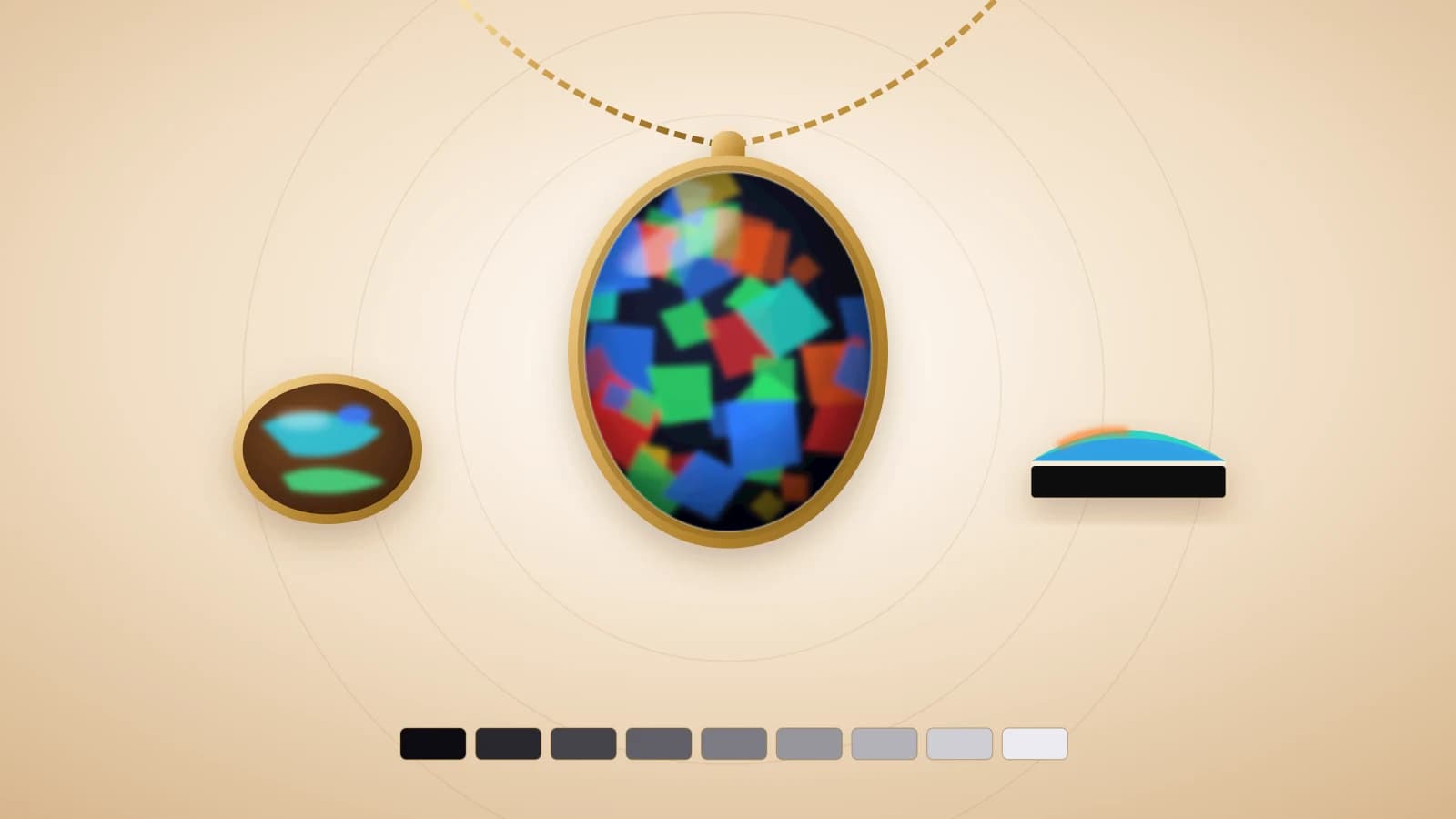
The Australian trade grades body tone on a scale from N1 to N9:
- N1 to N4 are black opal. N1 is jet black, N4 is dark grey.
- N5 and N6 are dark opal, often sold as semi-black.
- N7 to N9 are light opal. N9 is milky white.
That dark background works like a stage with the house lights off. The same play-of-colour that looks pastel in a white opal blazes against a black one. It is the reason black opal sits at the top of every opal price list, and the reason fakers work so hard to copy it.
Why it is dark
Opal is silica and water, made of tiny stacked spheres that split light into colours. In black opal, the body is darkened by trace carbon and iron sulphide minerals. Gem-A, the gemmological association of Great Britain, notes the colouring agents are thought to have formed with the help of microbes. In plain terms, the stone has a natural black lining built in.
The one test that tells you what you are looking at
Turn the stone over and look at its side. A solid black opal is dark through its body, and the colour sits inside the stone. If you see a perfectly straight line where a black layer meets the colour layer, you are looking at a doublet or triplet, not a solid black opal. We will get to those below, but remember this test. It catches more fakes than any other.
Lightning Ridge: The Town Built on Black Opal
Almost every story about black opal ends up in Lightning Ridge, a hot, dusty mining town in the far north-west of New South Wales, close to the Queensland border.
Opal was known in the area in the late nineteenth century, but black opal as a commercial gem dates to 1903. That year a miner named Charlie Nettleton and his partners pulled a good parcel of black opal out of the ground and went looking for a buyer. Accounts differ on the details, but they agree on the awkward part. The market was used to the white opal from White Cliffs, and buyers were not sure what to make of these dark stones. One of the people who took a chance was Tullie Wollaston, an Adelaide opal dealer who went on to sell black opal to London. Within a generation, the stone the market had shrugged at was the most expensive opal in the world.
Lightning Ridge still produces most of the world's fine black opal. Many miners work small claims by hand, and the supply depends on what they happen to find, which is one reason prices never settle the way diamond prices do. New South Wales made black opal its official gemstone emblem in 2008.
A few famous black opals
- Aurora Australis. A 180 carat black opal found at Lightning Ridge in 1938, with strong red harlequin colour. It was valued at about A$1 million in 2005.
- Halley's Comet. Found at Lightning Ridge in 1986, it weighs 1,982 carats uncut and is often described as the largest uncut black opal ever found.
- The Roebling Opal. A 2,585 carat rough black opal from Virgin Valley, Nevada, found in 1917 and now in the Smithsonian. It is proof that Australia does not have a total monopoly, although Virgin Valley opal is often too unstable to cut.
What Sets the Price of a Black Opal
Diamonds have the 4Cs. Opal has no single grading system, so each stone is judged by eye. In practice, five things set the price, and they matter in roughly this order.
1. Brightness
This is the one buyers underrate. Brightness is how intensely the colour flashes. A dull N1 opal can be worth less than a brilliant N4. When dealers talk about a stone "having life", this is what they mean.
Our opinion: if you have to choose, buy brightness over darkness every time. A bright semi-black stone will make you happier than a dull jet-black one, and it will cost less.
2. Dominant colour
Red is the rarest play-of-colour because it needs the largest, most perfectly stacked silica spheres. The usual pecking order runs red, then orange, then green, then blue and violet. A stone that shows red from every angle is priced in a different world from one that shows mostly blue.
3. Pattern
The arrangement of colour matters too. Harlequin, a mosaic of sharp, square-ish patches, is the most famous and among the most valuable. Broad flash, rolling flash and flagstone patterns are also prized. Pinfire, a scatter of tiny points, is pretty but sells for less. Our opal colours guide has more on how the patterns form.
4. Body tone
Darker is more valuable, but only when the brightness keeps up. Body tone is the frame. Brightness and colour are the picture.
5. Size, shape and soundness
Bigger stones cost more per carat, but less dramatically than with diamond. A well-domed cabochon with an even shape and no cracks or sand spots beats a thin, lumpy one. Any sign of crazing, fine cracks across the surface, slashes the value.
How Body Tone and Brightness Combine
This is the table we wish someone had handed us the first time we looked at black opal. The prices are rough per-carat ranges for solid natural stones, pulled together from dealer price guides, our own reading of current listings, and published ranges. They are a starting point, not an appraisal.
| Body tone | Dull or patchy colour | Bright colour | Brilliant colour, red or rare pattern |
|---|---|---|---|
| N1 to N2 (jet black) | $50 to $300 per ct | $800 to $4,000 per ct | $5,000 to $15,000+ per ct |
| N3 to N4 (black to dark grey) | $40 to $200 per ct | $500 to $2,500 per ct | $3,000 to $10,000 per ct |
| N5 to N6 (semi-black, dark) | $20 to $120 per ct | $200 to $1,200 per ct | $1,500 to $5,000 per ct |
| Treated or smoked Ethiopian, sold as black | $5 to $40 per ct | $15 to $150 per ct | Rarely above $200 per ct |
Read across a row and you see what brightness does. Read down a column and you see what body tone does. The jump from left to right is much bigger than the jump from bottom to top, which is exactly why we tell people to shop by brightness.
The very top of the market, museum stones with red harlequin patterns, has been reported at $20,000 a carat and more. You will not find those in a shop window. They sell privately and rarely.
What Black Opal Costs Right Now
Price ranges are useful, but it helps to see what is actually on sale. These are listings we found on Google's first page on 15 October 2026. We have not handled these stones and we are not recommending the sellers. The point is the spread.
| Where we found it | What it was | Listed price |
|---|---|---|
| GemSelect | Loose black opal, mostly small calibrated stones | $27 to $506 |
| Jake's Opal Shop | Loose black opals, mixed sizes | $150 to $1,820 |
| Absolute Opals and Gems | Cut Lightning Ridge black opal | From about $300 |
| Burton's Gems and Opals | Loose Lightning Ridge black opal, including a 3.76 ct stone | $115 to $3,880 |
| Black Opal Direct | Rough Lightning Ridge opal parcels | $400 to $5,000 |
Two things stand out. First, a real Lightning Ridge black opal for a normal piece of jewellery starts in the low hundreds and quickly climbs into the thousands. Second, anything sold as "black opal" for $20 is almost certainly something else, which brings us to the fakes.
For context on how black opal compares with every other birthstone, see our gemstone price guide and our ranking of the most expensive birthstones.
The Five Imposters Sold as Black Opal
None of these is a scam in itself. Each one is a legitimate product at the right price with the right label. The trouble starts when one of them is sold simply as "black opal".
| Imposter | What it really is | How to spot it | Fair to buy? |
|---|---|---|---|
| Doublet | A thin slice of real opal, a little over 2 mm, glued to a black backing | Straight glue line on the side, flat black back | Yes, at doublet prices, for fashion jewellery |
| Triplet | A wafer of opal, about 0.5 mm, between a black backing and a clear glass or quartz dome | Glassy, very even dome, glue lines from the side | Yes, cheap and scratch-resistant, keep it dry |
| Smoked Ethiopian opal | Pale porous Ethiopian opal darkened with soot | Black specks under a loupe, darkness collecting in cracks, very low price | Only if sold honestly as treated |
| Sugar-treated opal | Pale opal soaked in sugar then acid, leaving carbon in a thin surface layer | Black pepper-like specks near the surface under magnification | Only if sold honestly as treated |
| Lab-created opal | Opal made in a lab, Gilson and others, plus glass and resin simulants | Regular scaly "lizard skin" pattern in each colour patch, too-perfect colour | Yes, at lab prices, if labelled |
The doublet problem
Doublets are the most common black opal imposter because they look the part from above. The black backing gives the opal slice a dark body tone it does not really have. Set in a ring with a closed back, the side view that gives it away is hidden. If a black opal ring has a solid metal back and nobody will tell you why, ask.
The smoked Ethiopian problem
This is the one we see most often online. Ethiopian opal from the Wollo region is often hydrophane, which means it is porous and soaks things up. Wrap it in paper, smoulder the paper, and soot works into the pores. The result looks black, flashes nicely, and costs a fraction of the real thing. Gem-A notes the dark colour tends to collect in fine cracks that reach the surface, which is a useful clue.
There is also natural dark Ethiopian opal, found since about 2008. It is real, it is not treated, and it is still not Lightning Ridge black opal. It tends to be more fragile and can drink water, so we would keep it for earrings or pendants rather than rings.
The lab-created problem
Gilson began making synthetic opal in 1974, and lab opal has improved since. Gem-A points out that synthetic black opal is less convincing than synthetic white, which is good news for buyers. Under a loupe, look for a regular honeycomb or snakeskin texture inside each patch of colour. Natural opal patterns are messier. Lab opal is also very cheap, so a perfect-looking stone at a perfect-looking price is the biggest clue of all. Our lab-grown vs natural birthstones guide explains when lab stones make sense.
Black Opal vs Boulder Opal vs Dark Ethiopian
People who want the black opal look usually end up choosing between these three. Here is how we see them.
Solid Lightning Ridge black opal is the real thing. It is the most beautiful and the most expensive, and it holds whatever value opal holds better than the others. Buy it when the stone itself is the point.
Boulder opal comes from Queensland. It is thin seams of precious opal left on the brown ironstone they formed in. The dark ironstone does the job of a black body tone, so a good boulder opal can look as dramatic as a black opal costing several times more. The ironstone backing also makes it tougher. Honestly, for most people on a normal budget, boulder opal is the black opal we would actually buy.
Dark Ethiopian opal, natural and untreated, can be lovely and is the cheapest route to a dark opal look. It is also the most delicate of the three. Fine for an evening pendant. Not our choice for a ring.
Should You Put a Black Opal in a Ring?
Black opal has the same physical limits as every other opal. It sits around 5.5 to 6.5 on the Mohs scale, softer than the quartz in ordinary household dust, and its toughness is poor. You can see where it lands next to other stones on our gemstone hardness chart.
So the honest answer is: you can, but think about what you are risking. A $300 white opal ring that gets scuffed is a re-polish. A $6,000 black opal that chips is a very bad week.
If a ring is what you want, follow the same rules we lay out in our opal ring buyer's guide: a full bezel or a low protective setting, solid gold or platinum, and a habit of taking it off for the gym, the garden and the washing up. For a really valuable stone, we would rather see it in a pendant or a pair of earrings, where it can be admired without being knocked about.
How to Buy a Black Opal Without Getting Burned
This is our checklist. It is short because most mistakes come from skipping one of these steps.
- Get it in writing. Ask the seller to describe the stone as solid, natural and untreated, with the origin, on the receipt. A reputable opal dealer will do this without fuss.
- Look at the side. Before you pay, look at the profile of the stone. No straight glue lines, no black backing.
- Look in daylight and under a single light. Opal performs differently under different light. A stone that only comes alive under a shop spotlight will disappoint you at home.
- Rock it slowly. Turn the stone through every angle. Good black opal shows colour across most of its face from most angles. Dead spots, where the colour vanishes, lower the value.
- Check for crazing. Look for fine cracks across the surface with a loupe. Crazing cannot be fixed and it tends to get worse.
- Be very careful with bargains. Fine black opal is scarce and everyone in the trade knows what it is worth. A deep discount is a warning, not a gift.
- Get an appraisal on anything expensive. An independent appraisal protects you and lets you insure the piece. Our guides to jewellery appraisal costs and jewellery insurance cover what to expect.
If you are not sure what a stone even is, our gemstone identification tool can narrow it down, although nothing replaces a gemmologist for an expensive purchase.
Is Black Opal a Good Investment?
We get asked this a lot, and our answer is a polite no for most people.
Fine black opal has a long record of rising prices, supply is limited to a few small fields, and the best stones are genuinely rare. All true. But opal has no standard grading certificate, no central price list and no easy place to sell. When you sell, you sell to a dealer who needs a margin, at a price based on their eye, not yours. If you want to see how that works in practice, our guide on where to sell jewellery is a sobering read.
Buy black opal because you love it and want to wear it. If it happens to go up in value, that is a bonus.
Black Opal Meaning and Symbolism
Crystal shops sell black opal as a stone of protection, grounding and emotional strength, and sometimes link it to the zodiac sign Scorpio. These ideas are recent and there is no evidence behind them. If they add meaning to a gift, enjoy them. Just do not pay extra for them.
The older history is more interesting. For centuries opal was considered one of the luckiest stones there was. Its bad-luck reputation largely traces back to a single Walter Scott novel, Anne of Geierstein, published in 1829. Australia's own black opal boom a few decades later did a lot to rescue the stone's reputation, and today opal is Australia's national gemstone. We tell the whole story in our opal meaning guide and in the history of opal and tourmaline.
Caring for Black Opal
Solid black opal is easier to look after than its reputation suggests.
- Clean it with warm water, a drop of mild soap and a soft cloth. Dry it straight away.
- Never use an ultrasonic cleaner, a steamer or harsh chemicals.
- Keep doublets and triplets out of water. Soaking can loosen the glue and cloud the stone. A damp cloth is enough.
- Store it separately in a soft pouch, away from diamonds and sapphires that will scratch it.
- Avoid sudden heat and very dry places. Opal contains water, and sharp temperature changes can cause crazing. Do not leave it in a hot car or on a sunny windowsill.
Our birthstone jewellery cleaning guide lists the safe method for every stone if your piece mixes opal with others.
The Bottom Line
Black opal deserves its reputation. A bright Lightning Ridge stone, rocked under a window, is one of the most beautiful things the ground produces, and nothing else in the birthstone calendar comes close to it.
It also attracts more mislabelled stones than almost any other gem. Shop by brightness, not darkness. Look at the side of every stone. Get "solid, natural, untreated" in writing. And if the budget is tight, give boulder opal a fair look before settling for a smoked Ethiopian stone dressed up as black opal.
If you are still deciding which opal suits you, compare the types in our opal colours guide, check how opal stacks up against its look-alike in moonstone vs opal, or see what drives opal prices in general in how valuable is an opal.