We spend a lot of time on this site telling people to be careful with opal rings. We stand by that. Opal is soft, it chips, and a hand takes more knocks in a day than most people realise.
But we want to say the other half of it just as loudly. Opal around your neck or on your ears is a completely different story. Earrings and pendants almost never get banged against a doorframe or dragged across a granite worktop. The same stone we would hesitate to put on a daily ring can sit on an earlobe for thirty years and look the same as the day you bought it.
So if you love opal, this is where we would start. Below we cover which type of opal suits which piece, what opal necklaces and earrings cost right now, the details that separate good pieces from pretty listing photos, and how to look after them. We do not sell jewellery, so none of this is steering you towards a product.
If you are new to opal, our opal meaning and colours guide explains the different types first, and the October birthstone page covers why the month has opal and tourmaline.
Why Earrings and Necklaces Suit Opal Best
Opal sits at 5.5 to 6.5 on the Mohs hardness scale and its toughness is rated poor. In plain terms, everyday dust (which contains quartz, harder than opal) slowly dulls its polish, and a sharp knock can chip it. You can compare it with every other birthstone on our gemstone hardness chart.
What matters is how much of that wear a piece of jewellery actually sees. Here is how we would rank the common opal pieces, from easiest to hardest on the stone:
| Piece | Knock risk | Rubbing and dust | Our verdict |
|---|---|---|---|
| Stud earrings | Very low | Very low | The best way to wear opal every day |
| Pendant on a chain | Low | Low, unless it hangs against a buckle or zip | Excellent everyday choice |
| Drop or dangle earrings | Low to medium | Low | Great, choose a bezel or a closed back |
| Hoop earrings with opal inlay | Low | Medium, the inlay faces outward | Fine for dressing up, check inlay quality |
| Bracelet | High | High | Occasional wear only, the worst place for opal after a ring |
| Ring | Very high | High | Possible with care, see our opal ring guide |
That table is why our honest answer to "I want opal I can forget about" is a pair of studs. It is also why we are lukewarm on opal bracelets. "Opal bracelet" gets about 4,400 searches a month in the US and it is a lovely look, but a wrist hits desks, car doors and laptop edges all day. If you want one, treat it as an evening piece.
Which Opal Type Belongs in Which Piece
The word "opal" on a listing covers stones that behave very differently. The type matters more for an earring or pendant than most people think, mostly because of water and size.
| Opal type | What it looks like | Best in | Watch out for |
|---|---|---|---|
| Australian white or crystal opal | Light or see-through body with colour flashes | Studs, pendants, drops | Pale stones can look milky in small sizes |
| Black opal | Dark body, the brightest colour play of any opal | Pendants, statement drops | Price, and lookalike doublets |
| Boulder opal | Opal on brown ironstone, often freeform shapes | Pendants and drops | Shapes are irregular, so pairs are hard to match |
| Ethiopian (Welo) opal | Bright, often with big colour patches, very affordable | Pendants and studs | Hydrophane, it absorbs water and oils |
| Fire opal | Orange to red body, often faceted | Studs and pendants | Faceted edges chip, crazing in poor stones |
| Doublet or triplet | Thin slice of opal glued to a backing, or with a clear cap | Fashion pieces | Must stay dry, glue lines, often sold vaguely |
| Lab-created opal | Very even, bright colour in regular patches | Budget studs and charms | Fine if sold as lab, a problem if it is not |
A few of those deserve a bit more.
Ethiopian opal is the value pick, with one condition
Most opal studs under $500 that say "natural opal" are Ethiopian. The colour can be spectacular for the money. The catch is that a lot of Welo opal is hydrophane: it soaks up water like a sponge. Wet it and it can go clear or cloudy for a few days, then return to normal as it dries. Lotion, perfume and skin oils can also creep in over time and slowly change its look.
For earrings and pendants this is manageable. You put the jewellery on after your skincare and take it off before the shower. We would happily buy Ethiopian opal studs. We would not buy them for someone who sleeps and swims in their earrings.
Boulder opal is the pendant we would choose
Boulder opal is our favourite opal for a pendant, and it is underrated. The opal forms as thin seams on ironstone, and cutters usually leave the brown host rock attached. That gives each stone a natural, slightly wild shape and a dark backing that makes the colour pop, for a lot less than black opal.
It is a poor choice for matching earrings, because no two boulder stones look alike. For a single pendant, that is the whole point.
Doublets and triplets are fine if you know what you are buying
A doublet is a thin slice of real opal glued to a dark backing. A triplet adds a clear quartz or glass dome on top. Both give a lot of colour for the money, and a triplet's top is actually harder to scratch than solid opal.
The problem is water. Soak a doublet or triplet and moisture can get into the glue layer, leaving a grey, foggy look that you cannot fix. For earrings you wear on nights out, that is fine. For something you plan to wear every day for years, or pass on, we would rather you bought a smaller solid stone.
Opal Earrings: How to Choose
"Opal earrings" gets roughly 9,900 searches a month in the US and around 18,000 in October and December. Most of the results are shops, so here is what the shop pages tend not to tell you.
Studs first, drops second
If you only buy one pair, buy studs. They sit flat, they rarely get hit, and you can wear them every day. Look for 4mm to 6mm round or 6x4mm oval stones for everyday studs. Below 4mm, most opal stops showing much colour play from a normal viewing distance, so you end up paying for "opal" without seeing much of what makes it special.
Drops are where opal looks its best. Play-of-colour depends on the angle between the stone, the light and your eye. A stone that swings gives you a constantly changing flash, which is the reason people fall for opal in the first place. Our pick for a second pair is a bezel-set drop on a short lever back.
Matched pairs cost more than two single stones
This is the thing that surprises people. A good pair of opal earrings needs two stones with a similar body tone, similar colours and a similar pattern. With natural opal, finding two that match is hard work for a cutter, so matched pairs carry a premium over two random stones of the same size.
That is also why cheap opal earrings often have one stone that looks noticeably duller than the other. Photographs on a white background hide it. If you can, ask the seller for a photo or video of the pair side by side, in daylight, tilted. A seller who cares about their stones will send one. We would treat a refusal as an answer.
Setting and backs
For opal studs we like a full bezel or a four-claw setting with a slightly raised rim. Six claws look pretty but put more metal near the edge of a small cabochon.
Backs matter more than people think:
- Push backs (butterfly backs): standard and fine for studs, but cheap ones loosen. Check they grip firmly.
- Screw backs: the most secure. Worth paying for on any stone you would be upset to lose.
- Lever backs: our favourite for drops. They close fully and are hard to lose.
- Fish hooks: fine for light fashion pieces, but we would not hang a valuable opal on one without a rubber stopper.
Hoops
Opal inlay hoops are popular right now, and they are a good-looking way to wear opal. Inlay means crushed or thin opal set into a channel and sealed, and quality varies a lot. Good inlay is smooth and flush with the metal. Poor inlay has gaps, visible resin or edges you can catch a fingernail on. Most opal hoops under $100 use lab opal, which we think is perfectly fine for a hoop.
Opal Necklaces: How to Choose
"Opal necklace" gets about 12,100 searches a month in the US and over 22,000 at its October and December peak. "Gold opal necklace" alone gets around 2,900, rising to 8,100 in December. Gold is clearly what people want, and we think they are right.
Pendant shape and size
For a simple everyday pendant, an oval of 7x5mm to 8x6mm reads well on most people from across a room. A round solitaire of 5mm to 6mm gives a more delicate look. Larger stones are where boulder and black opal earn their keep, because their colour holds up as a single focal point.
Freeform pendants are often better value per carat than calibrated ovals. A cutter can keep more of the rough and more of the best colour when they do not have to hit an exact millimetre size. If you do not need a perfect oval, ask about freeform stones.
Setting
A full bezel protects the edge of the stone, which is where opal chips. A pendant can get away with claws more easily than a ring can, but we still prefer a bezel or a half bezel for anything over a few hundred dollars. Check the back of the setting too. An open back lets light in, which helps crystal and white opal. A closed back is normal for doublets and triplets, and it is also a place where a seller can hide one, which is worth knowing.
Chain length and the bail
Most opal pendants come on a 16 to 18 inch chain. For a small solitaire, 16 or 17 inches with an extender puts it near the collarbone, where it catches light. For a larger pendant, 18 to 20 inches lets it sit lower and flatter.
The bail (the loop that holds the pendant on the chain) should be big enough to slide smoothly. A tight bail on a fine chain twists, which turns the opal to face your neck half the day. It sounds minor until you own one.
Choosing the metal
| Metal | Looks best with | Our take |
|---|---|---|
| Yellow gold (14k or 18k) | White, crystal and fire opal | Our default for an opal necklace, it warms up pale stones |
| White gold or platinum | Black opal, blue-green colour play | Cool and modern, lets dark stones look darker |
| Rose gold | Pink-toned white opal, Ethiopian opal | Pretty and on trend, softer contrast |
| Sterling silver | Budget everyday pieces | Fine, but tarnish means more polishing near the stone |
| Gold vermeil or plated | Fashion pieces | Plating wears through, so expect a few years of daily wear |
What Opal Necklaces and Earrings Cost Right Now
We pulled current prices from the US Google results for "opal earrings" and "opal necklace" on 5 November 2026. These are listed prices on retailer pages, not appraisals, and they will change, but they show the shape of the market.
| Retailer | What they sell | Listed price range |
|---|---|---|
| Banter | Opal studs, drops and hoops, mostly lab and fashion | $20 to $245 |
| Zales Outlet | Opal necklaces | $50 to $1,200 |
| Linjer | Opal earrings | $55 to $1,583 |
| Zales Outlet | Opal earrings | $80 to $1,250 |
| Simple & Dainty | Dainty opal necklace, 16 inch with extender | $89 to $93 |
| Black Star Opal | Sterling silver earrings with solid, doublet and triplet Australian opal | $102 to $387 |
| WillWork Jewelry | Opal pendant necklaces in gold and silver | $189 to $362 |
| WWAKE | Natural, untreated opal necklaces | $240 to $9,295 |
| Rosec Jewels | Ethiopian opal earrings in 14k gold | $321 to $704 |
| Angara | Opal drop earrings, made to order | $710 to $1,952 |
| The Wind Opal | Australian boulder opal drop earrings in 18k gold | $1,239 to $1,289 |
Reading across those prices, we see four rough tiers:
- Under $60: almost always lab opal, glass or plastic imitation, or plated metal. Fine for a fun pair or a child's first birthstone earrings. Not a gift you expect to last.
- $60 to $250: small natural opal in sterling silver, or lab opal in gold vermeil and solid gold. Check the listing for "natural" and "solid" before you pay.
- $250 to $1,000: this is the sweet spot. Natural Ethiopian or Australian opal in solid 14k gold, often with small diamond accents. Most gift buyers should be looking here.
- $1,000 and up: matched Australian pairs, boulder opal, black opal and designer pieces. Here the stone itself becomes most of the price, and you should ask for the opal's type and origin in writing.
If you want to understand why one opal costs ten times another of the same size, read how valuable is an opal. Colour play comes first, body tone second, size a distant third.
Spotting Fakes and Vague Listings
Opal jewellery is one of the easiest places to get sold something that is not quite what you thought. Most of it is not outright fraud. It is vague wording. Here is what to look for.
"Opal" with no other word. A listing that just says "opal" may be natural, lab-created, a doublet or plastic. A trustworthy seller tells you which. "Created opal", "lab opal" and "synthetic opal" all mean made in a lab.
"Genuine opal" on a doublet. A doublet does contain genuine opal, so some sellers use the word. The question to ask is "is it solid opal?" Solid means one piece of natural opal with nothing glued to it.
The side view. If you can see the stone from the side, a doublet or triplet shows a straight line where the layers meet, often with a black backing beneath. Natural solid opal does not have a perfectly straight join.
Very regular patterns. Lab opal often shows colour patches arranged in a neat repeating pattern, sometimes called snakeskin or chicken-wire. Natural opal is messier. Our gemstone identification tool can help you narrow things down if you are unsure what a stone is.
Weight and warmth. Plastic imitation opal feels warm and very light in your hand, even compared with natural opal, which is already light.
Caring for Opal Earrings and Necklaces
Opal care is simple, and most of it is about what not to do.
- Put it on last, take it off first. Perfume, hairspray and lotion all leave a film, and Ethiopian opal can absorb them.
- No showers, pools or hot tubs. Chlorine and hot water are bad for doublets and hydrophane opal, and soap leaves a film on everything.
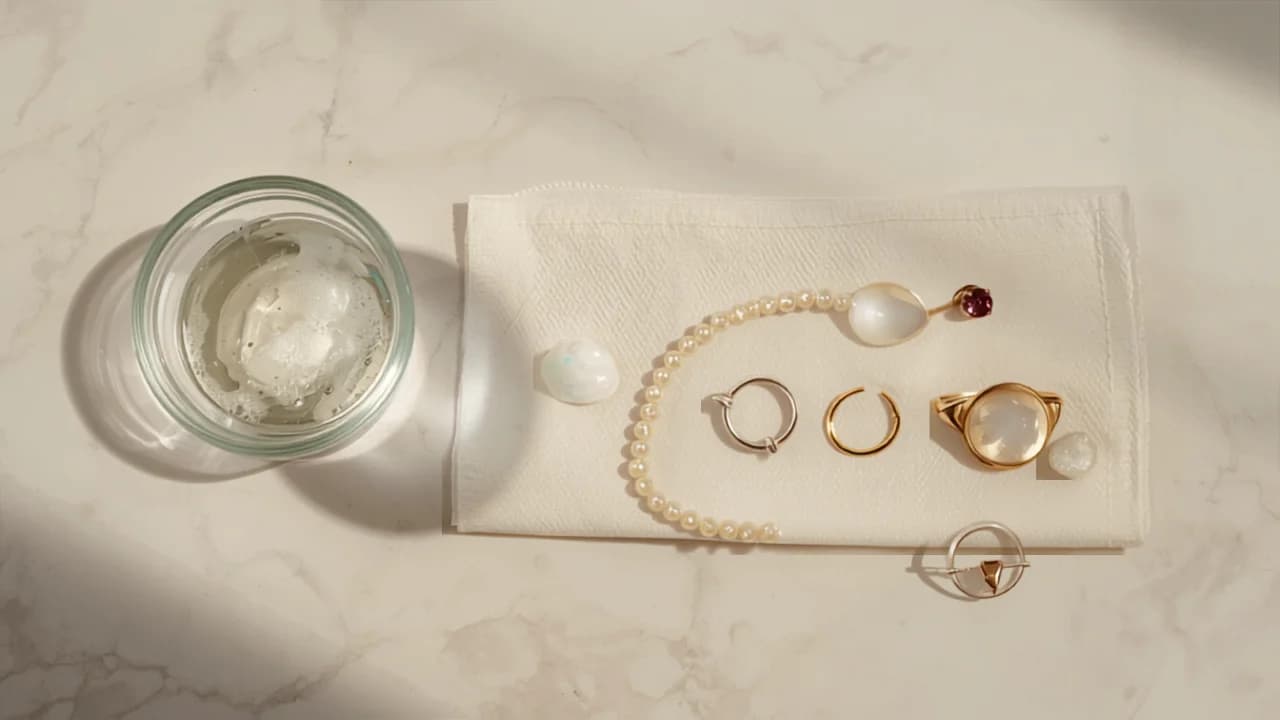
- No ultrasonic or steam cleaners. The vibration and heat can crack opal and loosen doublets. Clean with lukewarm water, a drop of mild soap and a soft cloth, then dry it straight away. Our birthstone jewellery cleaning guide covers every stone.
- Store pieces separately. A diamond or sapphire in the same pouch will scratch an opal. A small soft pouch for each piece is enough.
- Avoid sudden temperature changes. Going from a hot car straight into air conditioning will not usually hurt a solid opal, but sudden heat is one of the causes of crazing, the fine cracks that can form in poor stones.
The old advice to keep opal in water or oil is a myth for most stones. Solid opal does not need it, and oil will ruin a hydrophane stone.
For anything over about $1,000, we would get it appraised and insured. Our guides to jewellery appraisal cost and jewellery insurance cost cover what that involves.
Opal Necklaces and Earrings as Gifts
October and December are when opal jewellery searches peak, and it is not hard to see why. Opal is October's birthstone and it is one of the best-looking gifts you can put in a small box.
Our view is that a pendant or a pair of studs is a better opal gift than a ring for almost everyone. You avoid the ring-size guessing game, you avoid the durability worries, and the person can wear it every day without having to think about it. If you want something more personal, our custom birthstone necklace guide and our three-stone birthstone necklace guide cover family pieces that combine several stones.
If the person already owns opal, October's other birthstone is a good way to go. Pink tourmaline is much tougher than opal and looks lovely in a pendant. Our tourmaline guide explains the colours.
What We Would Actually Buy
If we were buying opal jewellery with our own money tomorrow, here is what we would do at each budget:
- Around $100: a pair of small natural opal studs in sterling silver with screw or firm push backs. Skip anything at this price that will not say whether the opal is natural or lab-created.
- Around $300 to $500: Ethiopian opal studs or a pendant in solid 14k yellow gold, bezel set. This is the best colour per dollar you can find in opal, as long as you keep it out of the water.
- Around $800 to $1,500: a boulder opal pendant on an 18 inch chain. One of a kind, tough for an opal and far more interesting than a calibrated oval.
- Above $1,500: a matched pair of Australian solid opal drops or a black opal pendant, bought from a specialist who will put the opal type, origin and any treatment in writing.
What we would skip: opal bracelets for daily wear, doublets sold as heirlooms, and any listing that calls itself "real opal" without telling you whether it is natural or lab-created.
The Bottom Line
Opal has a reputation for being delicate, and on a ring it earns it. On your ears and around your neck, most of that worry goes away. That is why we think opal earrings and necklaces are the best way to own opal, not the consolation prize.
Choose studs for everyday wear and drops for colour. Pick a bezel when you can, gold if you are unsure, and a solid stone over a doublet for anything you plan to keep. Ask what type of opal you are buying, ask to see a matched pair side by side, and keep it away from water. Do that, and an opal pendant or a pair of opal studs will look as good in twenty years as it does the day you open the box.