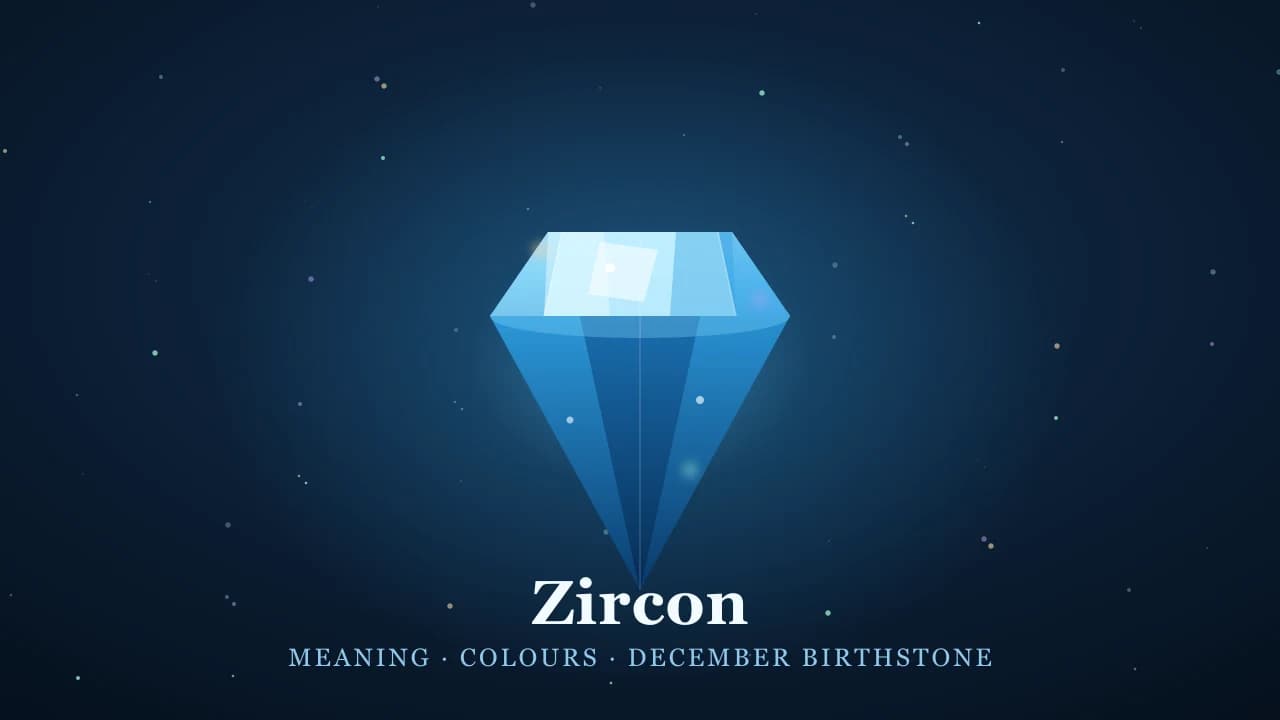
Zircon: Meaning, Colours, and the Real Gem Cubic Zirconia Gets the Blame For
Few gems have been done a worse injustice than zircon. Say the name to most people and you will watch their face fall slightly, because they think you mean cubic zirconia, the cheap sparkly stuff in costume jewellery, the famous fake diamond. They do not mean zircon, they mean something else entirely, and the mix-up has quietly libelled one of the oldest, most brilliant, and most genuinely interesting natural gemstones there is.
So let us clear the air right at the top, because it matters. Zircon is a real, natural gemstone that has been mined and treasured for thousands of years. Cubic zirconia is a man-made crystal invented in a laboratory in the 1970s. They share four letters at the start of a confusingly similar name and almost nothing else. Zircon is the December birthstone with diamond-like fire and a four-billion-year-old pedigree. Cubic zirconia is a perfectly fine diamond simulant with no history at all. Confusing them is like confusing a wolf with a stuffed toy because both are grey.
This is the honest, complete guide to the real stone. What zircon actually is, why it spent fifty years getting the blame for its synthetic near-namesake, its full colour range from electric blue to fiery red, why the blue is almost always heated, the fire and the strange double vision that mark a real zircon, the truth about its faint natural radioactivity, why a zircon crystal is the oldest piece of the Earth ever found, what the stone means, and how to buy and care for it. We like zircon enormously, partly because so few people give it a fair hearing, so let us put that right.
Zircon Meaning in One Sentence
If you only want the quick answer: zircon is the stone of wisdom, honour, and restful sleep, a gem long associated with clear thinking, prosperity, protection from harm, and a sense of grounded constancy. Medieval lore in particular tied zircon to peaceful sleep, to driving away nightmares and evil spirits, and to bringing the wearer wealth, wisdom, and good standing among others.
That is the symbolism in a line, and it is one of the older bodies of gem lore on the whole birthstone calendar, far older than the modern crystal trade and older than most people realise, because the stone itself is ancient and was prized long before anyone could spell "cubic zirconia." We will come back to the full symbolism below, but first the part everyone gets wrong.
What Is Zircon?
Zircon is a natural mineral, zirconium silicate, and it has been forming inside the Earth's crust for billions of years. It is not a treated quartz, not a glass, not a lab invention. It is a genuine gemstone with its own crystal structure, its own optical fireworks, and a geological story that frankly puts most flashier gems to shame.
Two physical facts define it. First, zircon has a high refractive index and strong dispersion, which in plain English means it bends and splits light beautifully, throwing off real fire and a bright, almost glassy-to-diamondy lustre. Before cubic zirconia and moissanite existed, colourless zircon was the natural diamond substitute, the stone jewellers reached for when they wanted diamond-like sparkle from a real, mined gem. That alone should tell you it is nothing like the costume material it gets mistaken for.
Second, on hardness zircon sits at about 6.5 to 7.5 on the Mohs scale, which is respectable but not invincible, and more importantly it can be a touch brittle, with facet edges that abrade if knocked about. So zircon is bright and hard enough for jewellery but needs a little care, a theme we will return to. File those two facts away, fire and a certain fragility, because together they are the whole personality of the stone.
Zircon vs Cubic Zirconia: The Name That Ruined Its Reputation
This is the section that matters most, because it is the single biggest thing standing between zircon and the respect it deserves, and we feel quite strongly about it.
Zircon is the natural gemstone described above: zirconium silicate, dug out of the ground, billions of years in the making, a December birthstone with genuine history.
Cubic zirconia, almost always shortened to CZ, is a completely different substance: zirconium dioxide, a synthetic crystal first grown in a laboratory by Soviet scientists in the 1970s and mass-produced ever since as an inexpensive diamond simulant. It has no natural source worth speaking of, no history before the disco era, and no relationship to zircon beyond a partial overlap in name and the element zirconium.
How did two such different things end up with names a heartbeat apart? Largely bad luck and marketing. Both contain zirconium, so both names derive from it, and when CZ exploded into the costume market in the 1980s, its name was everywhere and zircon's was not. The synthetic, far more famous than the natural stone, effectively swallowed the natural stone's identity in the public mind. Today most people have heard of cubic zirconia and assume "zircon" is just a posh abbreviation of it, when in fact it is the older, rarer, real gem that was here first.
Here is the honest comparison, because we have no interest in pretending zircon is something it is not. CZ is harder to scratch (about Mohs 8) and is cheaper still, and as a pure diamond lookalike it does a competent job. Zircon is the real gemstone, with more fire, a warmer character, real geological provenance, and a place on the birthstone list that CZ will never have. If you want a bottom-dollar diamond impersonator, CZ is fine, and if you genuinely want a diamond, a lab-grown diamond now does that job far better than either. But if you want a real, natural, history-rich gem with diamond-like sparkle of its own, you want zircon, and you should never let the cubic-zirconia confusion talk you out of it. For the wider question of natural versus synthetic stones, our guide to lab-grown versus natural birthstones lays out the honest trade-offs, and the same disambiguation logic powers our piece on moissanite versus diamond, another real stone that gets unfairly called a fake.
The Oldest Mineral on Earth
Now the fact that, for us, redeems zircon entirely and then some.
The oldest known piece of the Earth ever discovered is a zircon crystal. Tiny grains of zircon recovered from the Jack Hills of Western Australia have been dated to roughly 4.4 billion years old, formed within the first hundred million years or so of the planet's existence, when the Earth was barely cool enough to have a crust at all. Nothing else on the surface of the planet comes close. Those zircons are older than the oldest rocks, older than life, older than the oceans as we know them.
The reason zircon, of all minerals, holds this record comes down to its chemistry. Zircon crystals are extraordinarily tough survivors at the chemical level, and as they grow they trap tiny amounts of uranium while excluding lead. Because uranium decays into lead at a known, clock-steady rate, a zircon crystal becomes a sealed radioactive stopwatch. Geologists slice these grains open and measure the uranium-to-lead ratio to read off, with astonishing precision, exactly how long ago the crystal formed. Zircon is, quite literally, the mineral we use to tell the age of the Earth.
We think this is one of the most quietly spectacular facts attached to any birthstone. The December baby wearing a blue zircon is wearing a cousin of the single oldest thing humans have ever held from our own planet. Try getting that pedigree out of a cubic zirconia.
The Colours of Zircon
Zircon is naturally one of the more colourful gems, and its range surprises people who only know the blue.
- Blue is the modern star and the colour most associated with December. It runs from a soft sky-blue to a vivid, slightly electric "Cambodian" blue, named for the Southeast Asian source of much of the rough. This blue is, with very few exceptions, the product of heat treatment, which we will get to. It is the blue zircon you see in most December jewellery, and demand for it has been climbing steadily in recent years.
- Colourless or white zircon is the historic diamond substitute, bright and full of fire. Fine white zircon, well cut, has real sparkle and was once the go-to natural diamond alternative. It is a genuinely lovely and underrated stone, though it shares some of the practical traps of any colourless diamond alternative we discuss in our white sapphire guide.
- Golden, honey, and brown zircon, often called by the old varietal name, covers the warm end, from pale champagne to rich cognac. Much of the world's brown zircon rough is what gets heated into blue and colourless stones.
- Red and orange zircon carries one of the oldest gem names in the book: hyacinth or jacinth, a fiery red-to-orange variety prized since antiquity and named in old texts, including biblical ones. A fine red zircon is rare and beautiful and almost nobody knows it exists.
- Green zircon is the unusual one, and it ties into the radioactivity story below, because green colour in zircon is often a sign of a partly broken-down, "low" crystal structure. Fine clean green zircon is genuinely scarce and collectable.
For a stone so often dismissed as a fake diamond, that is a remarkably rich palette, and it is one more reason we wish more people knew the real gem.
Why Blue Zircon Is Almost Always Heated
Here is the fact most blue-zircon buyers never learn: the vivid blue you are admiring was almost certainly brown when it came out of the ground.
Most blue and colourless zircon on the market began as brownish or reddish rough, much of it from Cambodia and Thailand, which is then heat-treated to produce the blue and white colours buyers want. Heating to a few hundred degrees, sometimes in a low-oxygen environment, shifts the colour to that signature sky-to-electric blue. It is a long-established, routine part of how zircon reaches the jewellery case.
We want to be fair about this, the same way we are about heated tanzanite and heated amethyst sold as citrine, because treatment is not the scandal the internet sometimes makes it. Heating zircon is near-universal for blue stones, it is standard trade practice, and the resulting stone is still entirely natural zircon, simply coaxed into a more desirable colour. There is nothing dishonest about a heated blue zircon, and for almost every buyer it is exactly the stone they want.
There is one honest caveat worth knowing, and most articles skip it. The blue colour in some heat-treated zircon is not always perfectly stable: a minority of stones can fade or shift slightly with prolonged, intense ultraviolet exposure, such as years of strong direct sunlight. This is not common and not usually dramatic, but it is a small reason to keep a blue zircon out of permanent harsh sun and to buy from a seller who stands behind the colour. As ever, the rule is simple: assume blue zircon is heated, do not pay an "untreated" premium without proof, and treat the colour as the lovely, generally durable result of a standard process.
Fire and Double Vision: Zircon's Optical Signatures
If you ever want to prove to yourself that a stone is real zircon and not CZ or glass, the gem hands you two tells that are genuinely fun to spot.
The first is fire. Zircon's strong dispersion splits white light into spectral colours, so a well-cut zircon flashes little rainbow sparks of fire as it moves, much like a diamond. Colourless and pale zircon especially can put on a real show. This is why it earned its reputation as the natural diamond stand-in long before synthetics arrived.
The second is the more diagnostic one: double refraction, or birefringence. Zircon is strongly doubly refractive, which means a ray of light entering the stone splits into two. Look down into a faceted zircon through the table with a loupe, focus on the back facet edges, and you will often see them appear doubled, a slightly blurred, sleepy two-of-everything effect. Diamond does not do this. Cubic zirconia does not do this. Glass does not do this. That visible facet doubling is one of the cleanest amateur ways to confirm you are holding real zircon, and it gives some zircons a soft, dreamy look that collectors actually prize. We find it a small delight: the stone carries its own signature inside it, if you know where to look.
A Word About Zircon and Radioactivity
Because we mentioned uranium in those four-billion-year-old crystals, it is worth addressing the question directly and honestly, since a few alarmist corners of the internet make more of it than they should.
Zircon naturally contains tiny traces of uranium and thorium. Over vast geological time, the radiation from this slow decay can damage the crystal's own internal structure, breaking it down from a crisp, ordered "high" zircon into a partly disordered, lower-density "low" or metamict zircon. High zircon is the bright, fiery gem material; low zircon tends toward green, is softer and less brilliant, and is mostly of interest to collectors. The colour-change and density differences between high and low zircon are a real and unusual feature of the species.
Now the part that matters for you as a wearer: gem zircon is not a radiation hazard. The levels of natural radioactivity in cut gem-quality zircon are extremely low, far below any threshold of concern for someone wearing a ring or pendant. This is well-established and not seriously disputed by gemmologists. Occasionally a highly metamict stone is gently heated to repair some of its structure, and that is the extent of the practical issue. You do not need to worry about a zircon in your jewellery box any more than you worry about the trace potassium in a banana. We mention it only because the question comes up, and we would rather answer it plainly than let it become a reason to fear a perfectly safe and beautiful stone.
Zircon Meaning and Symbolism
Zircon's lore is genuinely old, which sets it apart from modern gems like tanzanite whose meanings were invented in living memory. Because the stone has been worn for thousands of years, its symbolism accumulated the slow way, through medieval lapidaries and ancient texts, and it clusters around a few consistent ideas:
- Wisdom, honour, and prosperity. Medieval sources held that zircon brought the wearer riches, wisdom, and good standing, a stone of worldly success and clear judgement.
- Restful sleep and protection from nightmares. One of zircon's most persistent old associations was with sleep, peace of mind, and warding off evil spirits and bad dreams. It was a stone you wanted by your bed as much as on your hand.
- Constancy and grounding. Zircon was linked to steadiness, honesty, and a settled, grounded spirit, fitting for a gem that is, after all, made of the oldest material on the planet.
- Purity and the red "hyacinth" tradition. The red-orange hyacinth variety carried its own line of meaning in older European and biblical lore, tied to faith, healing, and protection on journeys.
Its modern role keeps it tied to the year's end as a December birthstone, a natural season for reflection, rest, and looking ahead.
Here is our standard and sincere position, the one we hold for every stone. These are cultural and symbolic meanings, not physical powers. A zircon will not literally improve your sleep or guard your honour. What it genuinely offers is a beautiful, history-soaked piece of symbolism and one of the oldest gem traditions still worn today. If the deep roots of how stones came to carry meaning at all interest you, our piece on talismans and amulets in gemstone lore traces that tradition back to its beginnings, and zircon, ancient as it is, sits comfortably inside it.
Is Zircon a Birthstone?
Yes, and it has the strongest historical claim of December's three stones. Zircon is one of the modern birthstones for December, sharing the month with turquoise and tanzanite, and of that trio it is the oldest established as a birthstone. Turquoise is the ancient cultural stone, tanzanite is the modern newcomer added in 2002, and zircon is the brilliant, faceted, transparent option that has anchored December for far longer.
So if you have a December birthday, zircon is your sparkle. Where turquoise gives you an opaque, earthy, ancient cabochon and tanzanite gives you a soft velvety blue-violet, zircon gives you fire, transparency, and that electric blue flash, the most diamond-like brilliance of the three. Our full December birthstone guide walks through all three and how to choose between them, and our December birthstone pillar page covers the month in full. We think December may be the most interesting birthstone month of all precisely because its three stones are so wildly different from one another, and zircon is the one that brings the sparkle.
What Zircon Is Worth
Zircon is, refreshingly, one of the better-value coloured gems, which is part of why we recommend it so happily. Price is driven mainly by colour, size, and clarity.
Fine, vivid blue zircon in larger sizes commands the most, with the saturated electric "Cambodian" blue at the top of the everyday range. Colourless and golden zircon tends to be more affordable. The genuinely rare colours, fine red hyacinth and clean green zircon, can climb higher because so little good material exists, and they are mostly a collector's pursuit. Even so, zircon across the board sells for a fraction of the precious "big four," and you can buy a large, brilliant, fiery stone for sane money.
In our most expensive birthstones ranked guide, December's stones land at the affordable end, and zircon is squarely in best-value territory: a real, natural, history-rich gem with diamond-like fire that costs a tiny fraction of a diamond. For anyone who wants maximum sparkle and genuine geological romance without a precious-stone price tag, we think zircon is one of the smartest buys on the entire birthstone calendar, and the cubic-zirconia confusion only makes it better value, because the unfair reputation keeps prices low for the people who know better.
How to Buy and Care for Zircon
When buying, in order of priority:
- Decide on colour first. Electric blue is the December classic and the most popular; colourless gives diamond-like fire for less; golden is warm and cheap; red hyacinth and green are rare collector colours. Buy the colour you actually love, since all of them are good value.
- Look for life and fire. A well-cut zircon should flash real fire and brightness. Enjoy the double-refraction "doubling" of the back facets through a loupe as your proof it is the real stone, not CZ.
- Favour precision cutting. Because zircon is naturally brilliant, a good cut is what unlocks it. Poorly cut zircon can look sleepy or dull despite the material being fine.
- Assume blue and white stones are heated, and pay accordingly. This is standard and fair. Do not pay an untreated premium without proof, and buy blue zircon from a seller who stands behind the colour's stability.
- Mind the size-to-price sweet spot. Zircon is dense, so it looks a little smaller face-up than its carat weight suggests, but it is still excellent value in larger sizes.
Caring for zircon needs a gentle, sensible routine, because the stone is bright but a touch brittle:
- Protect the facet edges. Zircon's main weakness is that its facet junctions can abrade and chip if knocked against hard surfaces or other gems. For rings, a protective setting, a bezel or recessed mount, pays off, and earrings and pendants live an easier life.
- Avoid ultrasonic and steam cleaners as a precaution, especially for heat-treated stones. Clean with warm water, mild soap, and a soft brush, then pat dry. This puts zircon in the same careful-cleaning camp as our advice for opal and moonstone.
- Keep blue zircon out of permanent harsh sunlight to protect the treated colour over the long term.
- Store it separately. Zircon will scratch softer stones and can be scratched or chipped by harder ones, so give it its own pouch or compartment. This is also why zircon was traditionally sold "papered," wrapped individually so the stones could not abrade each other in parcels.
Treat zircon as the bright, characterful, slightly delicate gem it is, and it will reward you with fire and history that few stones at any price can match.
The Bottom Line
Zircon is the real one. It is a natural gemstone billions of years in the making, the December birthstone with diamond-like fire, a rich palette from electric blue to fiery red hyacinth, and the genuine distinction of being the oldest material ever found on Earth. It is not cubic zirconia, the man-made synthetic that borrowed a name close to its own and unfairly dragged its reputation down for fifty years. Once you know the difference, you cannot unsee how badly the real stone has been treated.
Our summary: buy zircon with three things in mind, and enjoy it without reservation. Choose the colour you love, since blue, white, golden, and the rare reds and greens are all genuine value. Assume the blue and white are heated, which is standard and fine, and do not overpay for an unproven "untreated" claim. And set and store it with a little care, protecting those slightly brittle facet edges, keeping it out of ultrasonic cleaners and permanent harsh sun. Do that, and you will own a real, natural, fiery gem with a four-billion-year pedigree, for a price the cubic-zirconia confusion keeps charmingly low.
If zircon's sparkle drew you in, the natural next stops are its December companions in our December birthstone guide, the ancient and modern ends of the month in our turquoise and tanzanite guides, the synthetic it gets confused with in our look at moissanite versus diamond, and the wider value picture in our most expensive birthstones ranked, where December's bright, affordable trio sits, fittingly, near the friendly end of the scale.
Wondering how it stacks up against every other gem? Compare values in our gemstone price guide and toughness on the sortable Mohs hardness table.