You want purple crystal names. Here they all are: the classic (amethyst), the one-source rarities (charoite, tanzanite), the quiet sleepers (lepidolite, sugilite, iolite), and the expensive one built for daily wear (purple sapphire). For each stone you get where it comes from, what actually makes it purple, and our honest take on whether it earns a place in your collection. No mysticism required, though we will tell you where the folklore comes from as we go.
Why Purple Crystals Are Having a Moment
Purple has meant royalty, spirituality, and wisdom for thousands of years, and the reason is supply. Ancient civilizations fought wars over purple dye because it was scarce and expensive; for most of history, wearing purple meant you could afford what almost nobody could. A purple stone carried the same signal, and it came straight out of the ground. Today you can buy that color for the price of a takeaway, which would have astonished every emperor who ever lived.
There is also the metaphysical layer. In crystal traditions, purple stones are tied to the crown chakra, the energy center associated with higher consciousness and spiritual connection. You do not have to believe any of that to enjoy these stones, and we take no position on chakras here. But it explains why purple dominates the meditation shelf, and why these crystals are everywhere right now.
The Big Three: Most Popular Purple Crystal Names
Amethyst: The Classic Purple Crystal
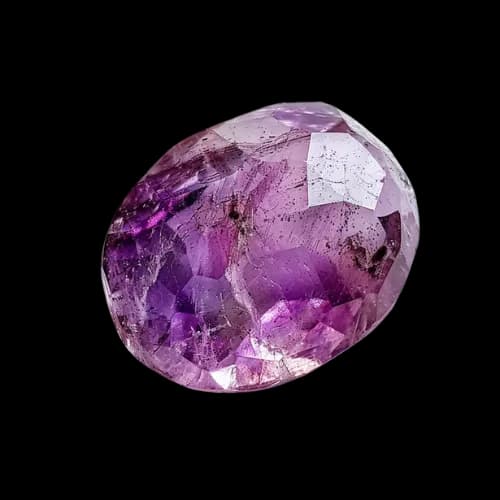
Start with amethyst, because everyone does. It is purple quartz, the February birthstone, and it runs from pale lavender to deep royal purple. The ancient Greeks believed it prevented drunkenness and carved wine goblets from it to test the theory. It does not work, though the placebo effect presumably did its best.
Amethyst forms inside geodes, hollow rock cavities lined with crystals, and it turns up all over the world, which is what keeps it affordable. Brazil and Uruguay produce the giants: geodes taller than a person, whole caves of purple crystal. If you buy one purple stone in your life, this is the sensible place to start.
Charoite: The One-Source Siberian Stone
Charoite is the swirled one. Where most purple stones hold a single color, charoite looks stirred: purple streaked through with lilac and violet in flowing patterns that are entirely natural. It comes from exactly one place on Earth, a deposit in Siberia near the Chara River that gives the stone its name, and it was only discovered in the 1940s, which makes it one of the newest names on this list.
One source, brutal Siberian collecting conditions, no substitute anywhere else: that is why genuine charoite is never bargain-priced. It is also why it is worth seeing in person at least once. Photographs flatten the swirl.
Lepidolite: The Lithium Crystal
Lepidolite is the calm one, and for once the claim has some chemistry behind it. This lilac mica contains real lithium, the same element extracted commercially for batteries and for mood-stabilizing medication. When crystal guides call lepidolite soothing, they are at least pointing at an element with a genuine pharmacological record, which is more than most healing claims can say.
To be clear, holding a rock is not a dose of anything. But lepidolite earns its spot regardless: the mica content gives it a soft, glittering sheen, as if the surface had been dusted with metallic powder, and the lilac color is unlike anything else in the cabinet.
The Sleepers: Lesser-Known Purple Crystal Names
Sugilite: The Rare One from South Africa
Sugilite is the collector's stone. It was discovered in 1944 by a Japanese petrologist named Ken-ichi Sugi, who gave it his name, and the material worth owning comes primarily from South Africa. The color runs from pale orchid to deep grape, often shot through with black manganese inclusions, so no two pieces read the same; good sugilite looks like abstract art that happens to be a rock.
It is genuinely rare, and priced accordingly. If you see it cheap, be suspicious. More on fakes below.
Purple Fluorite: The One That Grows in Cubes
Fluorite comes in nearly every color going, but the purple material is the one collectors chase, partly because of how it grows: fluorite crystallizes into cubes, actual sharp-cornered geometric cubes, straight out of the ground. The color ranges from pale lavender to deep violet, and some pieces carry banded color zoning, purple fading through lilac in visible layers.
The name is a clue to its best trick. Fluorite glows under ultraviolet light, and the word "fluorescent" was coined from this mineral, not the other way around. Put a purple fluorite under a blacklight and watch. One caution before you set it in a ring: fluorite is soft, around 4 on the Mohs scale, so treat it as a display stone rather than daily jewelry.
Iolite: The Viking's Compass
Iolite changes color depending on the angle you view it from: violet-blue from one direction, nearly clear from another, honey-yellow from a third. The effect is called pleochroism, and iolite is the textbook example of it.
The famous story is that Viking navigators used thin slices of iolite as polarizing filters to find the sun on overcast days. Historians still argue about whether that actually happened, but the optics are real; iolite does polarize light. True or very good Viking PR, it remains one of the most interesting purple crystals you can add to a collection without spending much.
The Rare Ones: Purple Crystals That'll Empty Your Wallet
Purple Sapphire: The One Built for Rings
Most people picture blue when they hear sapphire, but sapphire is corundum, the same mineral family as the blue September birthstone, and corundum comes in nearly every color. The purple stones get their color from trace amounts of vanadium or chromium, and the best material comes out of Sri Lanka and Madagascar.
What justifies the price is hardness. Corundum sits at 9 on the Mohs scale, and nothing else in this guide comes close. A purple sapphire will shrug off decades of daily wear that would destroy a fluorite and scratch an amethyst. If you want purple in an engagement ring or anything worn every day, this is the stone we would point you to. It looks expensive because it is.
Tanzanite: The Single-Source Gem
Tanzanite comes from one small area of northern Tanzania, and nowhere else on Earth. It was discovered in 1967 and went from unknown to one of the most sought-after gems in the world within a generation; it now sits on the official December list alongside the classic December birthstone options.
Its best feature is pleochroism, the same effect iolite shows, turned up. Rotate a tanzanite and you can catch blue, violet, and burgundy from different angles, three looks in one stone. Combine that with a single-source supply and the price starts to make sense.
Purple Crystals in the Wild: Where to Find Them
You do not have to buy everything. Some of the best purple crystal localities are places you can actually visit:
- Thunder Bay, Canada: spectacular amethyst deposits, with mines you can visit and dig yourself
- Four Peaks, Arizona: deep purple amethyst, at the end of a genuinely serious hike
- Uruguay: amethyst geodes so uniform and deeply colored they look manufactured (they are not)
- Madagascar: enormous output across nearly every crystal type, purple varieties included
A practical tip: join a local rockhounding group on Facebook. Members know where the productive spots are, and most are surprisingly happy to share them.
How to Spot Fake Purple Crystals
The crystal market is flooded with fakes, and popular purple stones are a favorite target. Four checks catch most of them:
- Too perfect = probably fake: natural crystals carry inclusions, variation, and flaws. If it looks like it came off a production line, it usually did.
- The price is too good: genuine charoite for $5 does not exist. Walk away; that is not how a one-source Siberian mineral gets priced.
- The color is too uniform: natural purple varies, piece to piece and within a piece. A batch of identical stones has usually been dyed.
- The bubble test: look closely with a magnifying glass. Bubbles mean glass, not crystal.
Caring for Your Purple Crystal Collection
Two rules keep a purple collection looking the way it did the day you bought it.
First, keep it out of the sun. Many purple crystals, amethyst and fluorite especially, fade under direct sunlight, and the fade does not reverse. Display them away from windows, or rotate pieces so nothing sits in the light for months at a stretch.
Second, clean gently. Lukewarm water and a soft brush handle most purple stones. Skip harsh chemicals and ultrasonic cleaners unless you know your specific crystal tolerates them, and check before you wet anything unusual: lepidolite, for one, is water-sensitive and would rather be dusted than dunked.
The Science Behind the Purple
The purple itself comes from a handful of different mechanisms, depending on the stone:
- Iron impurities + radiation = Amethyst's purple (the full step-by-step is in our amethyst formation guide)
- Manganese = Lepidolite's lilac hue
- Vanadium = Purple sapphire's violet tones
- Complex mineral inclusions = Charoite's swirling purples
The part worth sitting with is the dose. These coloring elements are present at parts-per-million levels; a few atoms in a million shift an otherwise colorless mineral to deep violet. Chemistry does a lot with very little.
Purple Crystals in Pop Culture
Purple crystals are all over the culture right now. Healing-crystal TikTok skews heavily purple, celebrities get photographed carrying amethyst, and even the skeptics concede that the stones photograph beautifully.
Video games worked this out decades ago. Count how many RPGs use a glowing purple crystal to mean "magic power." The shorthand works because the association is old: violet has signaled the mystical for as long as it has been rare, and game designers simply inherited the color code.
Building Your Purple Crystal Collection
If you are starting from zero, this is the order we would buy in:
- Start with amethyst: affordable, available everywhere, and it comes in more varieties than the rest of this list combined
- Add purple fluorite: natural cubes read as impossible until you are holding one
- Pick up lepidolite: the mica sparkle earns the spot on its own
- Hunt for charoite: even a small piece carries the full swirl
- Keep tanzanite on the list: every collection needs a long-term goal
The Bottom Line on Purple Crystal Names
If you only remember three names, make them amethyst, fluorite, and charoite: the affordable classic, the geometric oddity, and the one-source showpiece. Between them they cover most of what makes purple crystals worth collecting, and none of it depends on what you believe about chakras.
The list is not closed, either. Charoite surfaced in the 1940s, sugilite in 1944, tanzanite in 1967. Somewhere out there is probably another purple mineral nobody has dug up yet.
Until it turns up, collect the pieces that genuinely stop you, keep them out of direct sun, and never pay rare-stone prices without asking exactly what you are buying. That last rule is the whole hobby in one sentence.