Walk into most jewellery shops and ask about moissanite, and you will get one of two reactions. Either a slightly pained smile and a quick pivot back to the diamond case, or a flat "it is just a diamond simulant," said in the same tone you would use for a knock-off handbag. Both reactions tell you more about the shop's margins than about the stone.
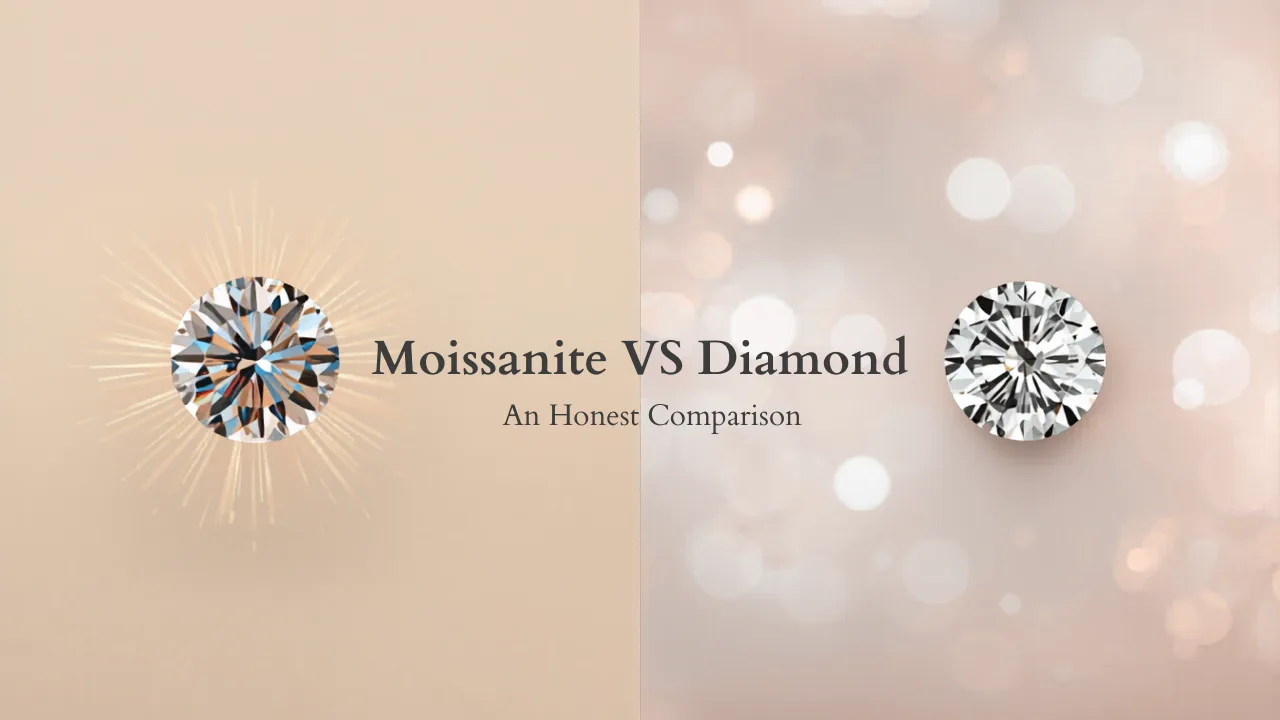
So let us do the thing the trade tends not to. Let us compare moissanite and diamond honestly, side by side, with no loyalty to either. We are going to tell you exactly what moissanite is, where it genuinely beats diamond, the one optical quirk that gives it away to a trained eye, how it compares to lab-grown diamond and cubic zirconia, what you should actually pay, and which stone makes sense for which buyer. No pretending moissanite is secretly a diamond, and no pretending it is worthless costume glass. The truth sits in between, and it is more interesting than either sales pitch.
What Moissanite Actually Is
This is the bit that clears up about half the confusion, so start here. Moissanite is not a diamond, and it is not a fake diamond. It is its own mineral, silicon carbide, which is a completely different material from diamond's pure carbon. Calling moissanite a fake diamond is a bit like calling a sapphire a fake ruby. They are simply different stones that happen to look similar to an untrained eye.
The origin story is genuinely good. In 1893 a French chemist named Henri Moissan was poking through rock from a meteor crater in Arizona and found tiny, glittering crystals he first mistook for diamonds. They turned out to be silicon carbide, a mineral nobody had catalogued in nature before. The stone was later named moissanite in his honour. Natural moissanite is so vanishingly rare, found in trace amounts in meteorites and a few odd geological spots, that you will never see it in a ring. Every moissanite you can actually buy was grown in a lab. That is not a dirty secret, it is the only way the stone exists in any usable size.
So when someone asks "is moissanite real," the honest answer is yes, it is a real, named mineral with real hardness and real brilliance. It is just almost always lab-grown, the same way almost all the vanilla you have ever eaten is made in a factory rather than scraped off an orchid. Real and lab-made are not opposites.
The Quick Verdict, For People in a Hurry
We will spend the rest of this guide on detail, but here is the short version, because we respect your time.
Moissanite sparkles more than diamond, costs roughly a tenth as much, and is hard enough to wear every single day for the rest of your life. In exchange, it throws noticeably more rainbow-coloured fire than diamond does, which some people adore and which can, in larger sizes and bright light, read as "not a diamond" to someone who knows what to look for. It also has essentially no resale value.
If that trade sounds good to you, moissanite is one of the smartest buys in jewellery. If the idea of anyone ever clocking it as a non-diamond would genuinely bother you, then no saving will make you happy, and you should buy a diamond, lab-grown or natural. Most of the rest is detail. Good detail, but detail.
Sparkle and Fire: Where Moissanite Genuinely Wins
Here is the thing the diamond trade really does not want front and centre. Optically, moissanite is not a budget compromise. By the raw numbers, it out-performs diamond.
Two measurements matter for sparkle. Brilliance is the white light a stone bounces back at you. Fire is the way it splits light into rainbow flashes. Moissanite scores higher than diamond on both. Its refractive index is higher, so it returns more light, and its dispersion, the fire number, is more than double that of diamond. In plain terms, a moissanite throws more sparkle and a lot more coloured flash than a diamond of the same size.
In our experience this is the single most important thing to understand before you buy, because it cuts both ways and it is entirely a matter of taste.
Some people see a moissanite catch the light, throw off little rainbows, and fall in love on the spot. It is livelier, flashier, more alive than a diamond. Other people see exactly the same effect and their gut says "that looks like a lot." Under bright direct light, especially in a stone above a carat or so, the extra fire can tip from "gorgeous" into what jewellers quietly call the "disco ball" or "rainbow" look, and that is the giveaway. It is not that moissanite looks cheap. It is that it looks like more, and a diamond's restraint is part of what people are unconsciously trained to read as "real."
Our honest take: in soft, indoor, everyday light, the vast majority of people cannot tell a good colourless moissanite from a diamond at arm's length. Under a jeweller's spotlight or bright sun, a trained eye often can, because of that fire. Whether that matters to you is a personal question only you can answer, and it is the real question at the heart of this whole comparison.
Durability: Moissanite Is Tougher Than You Have Been Told
The diamond trade leans hard on durability, and it has a point, but a much smaller one than the marketing implies.
Diamond is a 10 on the Mohs hardness scale, the hardest natural material there is. Moissanite is a 9.25. That sounds like a meaningful gap, but the Mohs scale is not linear, and in practical terms both stones are extraordinarily hard. To put the 9.25 in context, it is harder than sapphire and ruby, which sit at 9 and which the trade happily sells as "lifetime" stones for daily-wear rings. It is far above amethyst, garnet, or emerald.
What does that mean at the kitchen sink? A moissanite will resist scratches from almost everything it meets in daily life. It will not cloud, it will not scratch from dust and grit the way softer stones do, and it does not need babying. Diamond has a slight edge in absolute hardness and is the better choice if you genuinely want the single most scratch-proof option on earth. But the idea that moissanite is delicate, or that it will not survive everyday wear, is simply false. We would put a moissanite on the hand of someone who is rough on jewellery without a second thought, which is more than we would say for most coloured stones.
Moissanite vs Lab-Grown Diamond: The Comparison That Actually Matters Now
A few years ago the moissanite decision was simple. You wanted a diamond look, you could not afford a diamond, you bought moissanite. That world has changed, and any guide that ignores it is out of date.
Lab-grown diamonds have crashed in price. A lab diamond is, chemically and optically, a real diamond, grown in a reactor instead of underground, identical to a mined one in every measurable way except origin. As production scaled up, prices fell hard, and a lab diamond now costs a fraction of what the equivalent mined stone does. That puts real pressure on moissanite, because the gap that used to make moissanite the only affordable option has narrowed.
So here is how we frame it for friends who ask. If what you truly want is a diamond, a real diamond that tests as diamond, sparkles with diamond's specific restrained look, and that you will never have to explain, then a lab-grown diamond is now the sensible way to get one without paying mined-diamond prices. It is a diamond. Full stop.
Moissanite still wins on two things. First, price. Even after the lab diamond crash, moissanite is still cheaper, often considerably, especially as the stone gets bigger, because moissanite is priced almost flat by size while diamonds of any kind climb steeply with carat weight. A two carat moissanite is a shrug; a two carat lab diamond is still a real number. Second, the look. If you actually prefer that extra fire and brilliance, moissanite gives you something diamond does not, and you should buy it because you like it, not just to save money.
What we gently steer people away from is buying moissanite purely as "the cheap diamond," because lab diamond has partly taken that job. Buy moissanite because you want maximum size and sparkle for minimum money and you like the livelier look. Buy lab diamond because you want an actual diamond at a fair price. Both are honest answers. They are just answers to slightly different questions. We laid out the lab-versus-natural side of this in more depth in our lab-grown vs natural birthstones guide if you want to go deeper on the diamond half.
Moissanite vs Cubic Zirconia: Not Even Close
People lump moissanite and cubic zirconia together as "the fake diamonds," and that is lazy. They are not in the same league.
Cubic zirconia is soft, around 8 to 8.5 on the Mohs scale, and more importantly it is porous and prone to clouding. A CZ looks brilliant in the shop and then, over months and years of daily wear, picks up scratches, absorbs oils, goes slightly cloudy and grey, and eventually looks tired. It is genuinely a costume stone, lovely for a season, not built to last. That is why nobody re-sets a CZ from forty years ago. It did not survive.
Moissanite is a different animal. At 9.25 it shrugs off the scratches that dull CZ, it does not cloud, and a moissanite bought today will look the same in twenty years. It costs more than CZ for exactly that reason. If CZ is a rented tuxedo, moissanite is a well-made suit you actually own. When someone is choosing between the two to save money, our advice is almost always the same: stretch to moissanite if you possibly can, because the CZ will disappoint you and the moissanite will not. The only good reason to pick CZ is a deliberately temporary or very low-cost piece, like a travel stand-in or a costume.
Does Moissanite Pass a Diamond Tester?
This question comes up constantly, so let us be precise, because the popular answer is wrong.
Old-style diamond testers measure how a stone conducts heat. Moissanite happens to conduct heat very similarly to diamond, so on one of those older thermal testers, yes, moissanite reads as diamond. That single quirk is the source of a lot of internet drama about people being "fooled."
The trade caught on years ago. Modern combination testers also measure electrical conductivity, and on that measure moissanite and diamond differ. A proper moissanite-and-diamond tester will correctly tell the two apart every time. So if you are buying a stone represented as a diamond and want to be sure, the answer is not "use a diamond tester," it is "use a tester that checks for moissanite specifically," or simply buy from a seller who grades and certifies the stone. The fact that moissanite can slip past an old thermal pen is a fun bit of trivia, not a practical way to pass moissanite off as diamond to anyone who knows what they are doing.
Colour: Buy the Colourless Grade
Early moissanite, the stuff from fifteen or twenty years ago, had a reputation for a faint yellow or greenish tint, especially noticeable in bigger stones and certain light. That reputation has not fully caught up with the product.
Modern premium moissanite is graded for colour much like diamond, and the top grades are near-colourless to colourless, sitting in the equivalent of a diamond's D to F range. There is also warmer and less expensive material on the market that can show a tint. Our rule is simple. Buy a colourless or near-colourless grade, and pay particular attention to colour as the stone gets bigger, because any tint shows more in a larger stone exactly the way it does with diamond. A good colourless moissanite has no off-colour to apologise for. A cheap, ungraded one bought purely on price can have a faint warmth that, combined with all that fire, is part of what tips an observer off. Spend a little more on colour grade and the stone behaves itself.
What You Should Actually Pay
This is where moissanite stops being a compromise and starts looking like a steal, so let us put rough numbers on it.
A quality colourless moissanite costs a small fraction of a natural diamond of the same size, frequently in the region of a tenth of the price, sometimes less. The exact ratio explodes in moissanite's favour as the stones get bigger, because diamond prices climb steeply and non-linearly with carat weight while moissanite stays comparatively flat. This is why moissanite is so popular for people who want real visual size. A large look that would cost a fortune in diamond is genuinely affordable in moissanite.
A practical way to think about it: for the price of a modest one carat diamond, you could buy a larger, eye-clean, colourless moissanite and put the saved money into a far better setting, a holiday, or simply the bank. That trade is the whole appeal.
The one number that does not flatter moissanite is resale. Like cubic zirconia, moissanite has almost no second-hand market. You buy it to wear and enjoy, never as a store of value. Diamonds, for what it is worth, are also a famously poor financial "investment" once you account for retail markup, so we would not oversell diamond's resale either. But if any flicker of resale matters to you, moissanite is firmly the wrong stone, and we would rather tell you that plainly now.
So Which Should You Buy?
After all that, here is how we actually advise people, depending on who they are.
Buy moissanite if you want the most sparkle and the most visual size for your money, you like or do not mind a livelier, fierier look, you are practical about resale meaning nothing to you, and you would genuinely rather spend the saved thousands on a better setting or literally anything else. It is also a brilliant choice for a travel ring, a stand-in while you save, or anyone who works with their hands and does not want to worry about an expensive stone. We have happily recommended moissanite to people who later told us they never think twice about it.
Buy a lab-grown diamond if you want a real diamond, with diamond's exact restrained sparkle and the certainty that it will always test and grade as a diamond, but you do not want to pay mined-diamond prices. This is the sweet spot for a lot of modern engagement-ring buyers and, honestly, where we point most people who say the word "diamond" and mean it.
Buy a natural diamond if the origin genuinely matters to you, you want the one stone that nothing on earth will scratch, and you accept that you are paying a large premium for the mined origin and the name rather than for any visible difference. It is a real and valid choice, just an expensive one, and you should make it with open eyes.
Skip cubic zirconia for anything you want to keep, and reach for moissanite instead, unless the piece is deliberately temporary or costume.
There is no single right answer here, which is exactly why the trade's reflexive sneer at moissanite annoys us. The "best" stone depends entirely on what you actually value, and for a great many buyers, moissanite quietly wins.
A Birthstone Footnote
Since this is a birthstone site, it is worth saying where diamond fits. Diamond is the birthstone for April, and it carries centuries of lore that moissanite, a stone we have only known since 1893, simply cannot match. If you are buying for an April birthday and the birthstone tradition is part of the point, that history lives with diamond, lab-grown or natural, not with moissanite. Moissanite is the better value and the bigger sparkle. Diamond is the one with the birthday and the myths. For a lot of gifts, that distinction is the deciding factor, and there is no shame in choosing the stone that comes with the story.
Our Verdict
Moissanite is not a fake, not a scam, and not a poor relation to diamond. It is its own stone, harder than sapphire, more brilliant and far more fiery than diamond, and a fraction of the price. Its only real costs are an extra dose of rainbow fire that a trained eye can spot in bright light, and a resale value of roughly nothing. Weighed honestly, that is a fantastic deal for most people and a dealbreaker for a few, and only you know which camp you are in.
If you want a diamond, lab-grown diamond has quietly become the smart way to buy one, and we would steer you there before mined stone unless origin truly matters. If you want maximum sparkle and size for minimum money and you like a stone with some life to it, moissanite is one of the best-value buys in all of jewellery, and you should ignore the shop's pained smile entirely.
For the diamond side of the story, read our piece on April's diamond myths, and if you are weighing lab-grown against natural across all the birthstones, our lab-grown vs natural guide goes deeper. Whatever you choose, choose it knowing what you are actually getting, which is the whole point of a comparison like this one.
Putting numbers on it? Our diamond price calculator gives you a realistic figure by carat and quality, and the diamond clarity chart shows what each grade actually looks like.