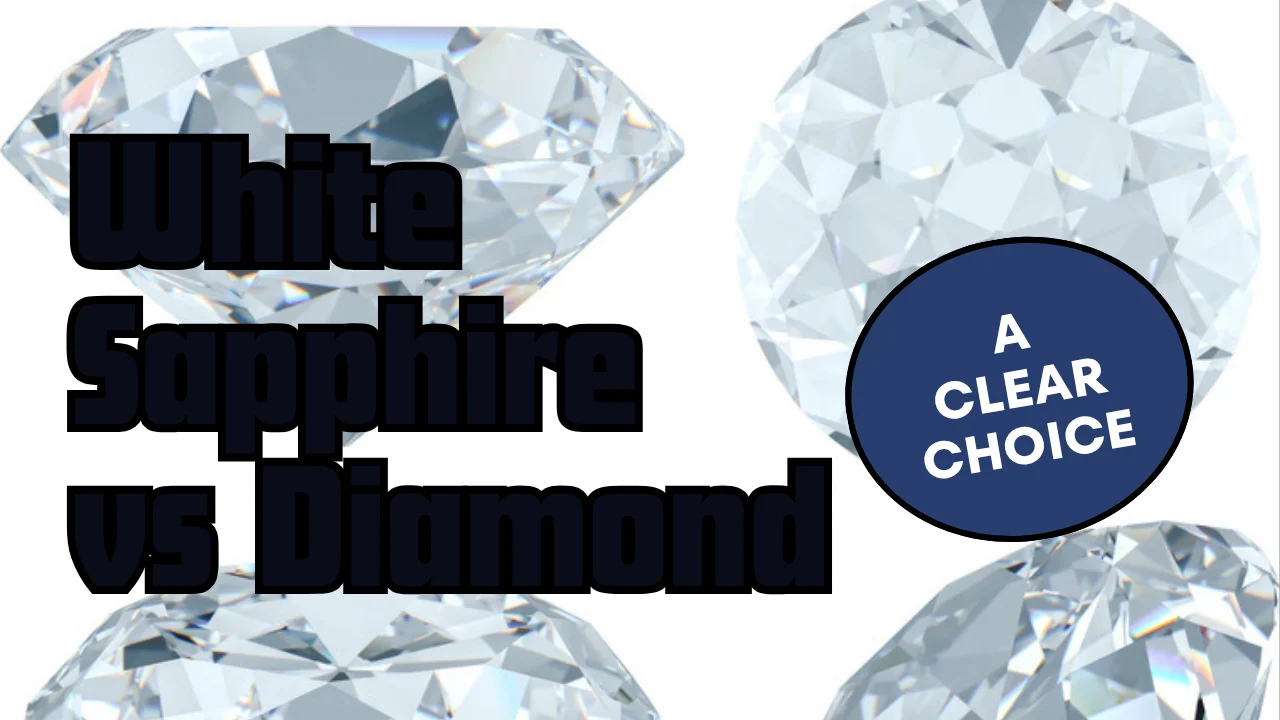
White Sapphire vs Diamond: An Honest Look at the Cheaper Clear Stone
White sapphire has a very tidy sales pitch. It is a real, natural gemstone. It is nearly as hard as anything you can buy. It is colourless. And it costs a small fraction of a diamond. Put like that, it sounds like the obvious clever-shopper choice, the thing the jewellery trade does not want you to know about.
We are going to give you the honest version instead, because the pitch leaves out the one thing that actually matters when you put the two side by side: a white sapphire does not look like a diamond, and most people can tell the difference without being told to look. That is not a fatal flaw. For some buyers it is even the point. But it changes the whole decision, and it is exactly the part the cheerful "natural diamond alternative" articles skate over.
So let us do this properly. We will lay out what white sapphire actually is, where it genuinely beats a diamond, where it clearly loses, how to tell them apart on your own hand, and, the part almost nobody updates, how the recent crash in lab-grown diamond prices has changed which stone is the smart buy in 2026. No mysticism, no loyalty to either side, just the differences that decide what ends up on your finger and what stays in your bank account.
The One-Sentence Difference
If you remember nothing else, remember this. A diamond throws light back at you in hard, bright, flashing sparks with flashes of rainbow fire. A white sapphire returns light more softly and more evenly, in a clear, glassy, slightly watery white.
That single difference, the way each stone handles light, is the whole comparison. Everything else, the price, the durability, the upkeep, the testing, follows from it. A diamond bends and splits light far more strongly than a white sapphire can, so it sparkles harder and breaks light into colour. A white sapphire is beautifully clear, but it sparkles in a quieter, more uniform way that reads, to a lot of eyes, as "clear glass" rather than "diamond."
Neither is wrong. They are just doing different things with the light. Once that clicks, the rest of this makes sense.
What White Sapphire Actually Is
White sapphire is colourless corundum. Corundum is the same mineral that gives us blue sapphire and red ruby; the only thing that makes a sapphire blue, or a ruby red, is a trace of another element in the crystal. Take those colouring elements away and you get clear, colourless corundum, which the trade sells as white sapphire.
That gives it one genuinely outstanding quality: hardness. White sapphire sits at 9 on the Mohs scale, the same as any other sapphire, beaten only by moissanite and diamond among stones you will actually meet. It is an excellent everyday stone in that respect. It will not scratch from ordinary life, it holds up in a ring you wear daily, and it is a perfectly sensible choice for someone hard on their hands.
It is also a real, natural gemstone with real history, not a "simulant" invented to imitate something else, which matters to a certain kind of buyer. And it is cheap. A nice white sapphire costs a small fraction of a diamond of the same size, often less than a tenth, sometimes far less.
A few honest caveats the listings tend to skip. Many white sapphires are heat-treated to clean up their colour, which is a normal and stable treatment. Plenty have a very faint grey, yellow or "steely" undertone rather than being truly icy white, and the cheaper the stone, the more likely you are to see it. And lab-grown white sapphire is extremely cheap and extremely clean, so a lot of what is sold, especially in fashion jewellery, was grown rather than mined. None of that makes it a bad stone. It just means "natural white sapphire" is doing less heavy lifting than the word "natural" implies.
What a Diamond Actually Is
A diamond is crystalline carbon, and the reason it has dominated for a century is not marketing alone, it is optics. Diamond has a very high refractive index, meaning it bends light hard, and relatively high dispersion, meaning it splits white light into spectral colours. Together those give a diamond its two signature tricks: intense brilliance (bright white sparkle) and fire (those little flashes of rainbow). It also sits at 10 on the Mohs scale, the hardest natural material there is.
We have written at length about diamonds elsewhere, including the myths the diamond trade built its prestige on and the way lab-grown and natural diamonds now compare, so we will not relitigate the whole thing here. For this comparison, the only diamond facts that matter are the optical ones: a diamond sparkles harder, and throws more colour, than a white sapphire physically can. That is not opinion, it is the difference in how the two minerals bend light, and it is the reason the two stones never quite look alike.
Diamond is the April birthstone, the default engagement stone, and, for most of the last century, by far the most expensive of the four classic colourless-to-coloured precious gems to put a given size on someone's hand. Which brings us to the comparison that actually decides things.
Side by Side: The Differences That Actually Matter
Theory is fine, but here is how the two stones differ in the ways that change a buying decision.
Mineral. Diamond is carbon. White sapphire is corundum (aluminium oxide). Completely different materials, which is why every gemological test below works.
Sparkle and fire. This is the headline. A diamond's higher refractive index and dispersion give it brighter, harder, more contrasty sparkle plus visible rainbow fire. A white sapphire returns light more softly and more evenly, with much less fire, reading as clear and glassy rather than dazzling. In a small stone, in good light, the gap is subtle. As the stone gets bigger, the gap gets more obvious, because there is more surface for a diamond to show off with and more clear "glassiness" for a white sapphire to reveal.
Hardness and durability. Diamond is a 10, white sapphire a 9. Both are genuinely excellent for daily wear, and this is the category where white sapphire competes hardest. Honestly, durability is not where white sapphire loses. A 9 is a lifetime stone. If toughness were the only axis, white sapphire would be a no-brainer.
Colour. A fine diamond is colourless or near it. A white sapphire is often colourless-ish, with a faint grey or steely cast in cheaper stones. Some white sapphires are beautifully white; many are merely "white enough."
Upkeep. Here is the under-reported one. Because a diamond bends light so strongly, it keeps looking bright even when it has a film of hand cream and skin oil on it. A white sapphire's lower refractive index means a dirty white sapphire goes dull and slightly milky much faster, and looks noticeably better after a clean. A white sapphire wants regular cleaning to stay at its best; a diamond is far more forgiving of neglect. Anyone who tells you white sapphire is zero-maintenance has not lived with a dirty one.
Price. White sapphire is dramatically cheaper, frequently a tenth of a diamond's price or less for the same size, and even cheaper if it is lab-grown. This is the entire reason anyone considers it, and it is a real, large advantage.
How to Tell Them Apart on Your Hand
You will not have a lab, so here are the tells that actually work for a normal person looking at a set stone, ordered from most to least practical. None of them require touching the stone with anything sharp.
1. Watch how it sparkles, in motion. This is the single best everyday tell. Tilt the stone gently under a bright light. A diamond gives a lively mix of bright white flashes and little bursts of rainbow colour, with strong contrast between the bright and dark facets, almost a twinkling effect. A white sapphire sparkles more uniformly and more softly, mostly white, with little to no rainbow, and a generally "glassier," calmer look. Once you have seen the two side by side, you usually cannot unsee it.
2. Look for fire, or its absence. Fire is the rainbow flash. Diamonds show it readily, especially in spotlighting or sunlight. White sapphire shows very little. A clear, white, brilliant stone with almost no coloured flashes is leaning white sapphire (or a lower-fire stone generally); a stone scattering little rainbows is leaning diamond.
3. Check the brightness when it is dirty. If the stone looks a bit lifeless or milky after a week of wear and then springs back to life after a wash, that "goes dull then revives" behaviour points to white sapphire. A diamond stays comparatively bright through the grime.
4. The diamond-tester caveat. Many jewellers use a thermal diamond tester. A white sapphire will read as not diamond on a thermal tester, which is genuinely useful. The thing to know is that moissanite can fool a basic thermal tester into reading "diamond," so a proper jeweller uses a combination tester. For separating white sapphire from diamond specifically, though, a tester is reliable, white sapphire simply is not a diamond and will not pretend to be one electronically.
5. Magnification, if you have a loupe. Diamonds and sapphires show different internal worlds, and a sapphire is doubly refractive while a diamond is singly refractive, which a gemologist can confirm in seconds. This is the most expert-leaning test and the least necessary, because the sparkle-in-motion test above will have told you almost everything already.
If two or three of these line up, you will have your answer. And for anything being sold as a natural diamond at a natural diamond's price, insist on a lab report rather than relying on a sparkle check, because at that money the certificate is the cheap part.
The Thing That Changed Everything: Lab-Grown Diamonds
Here is the part almost every "white sapphire vs diamond" article was written before, and never updated for.
For decades, white sapphire's pitch made total sense. If you wanted a clear, durable, real stone but could not, or would not, pay diamond prices, white sapphire was one of your few honest options. The alternatives were moissanite (which sparkles with so much rainbow fire that some people find it obviously not-a-diamond) or cubic zirconia (cheap, softer, and prone to clouding). Against that field, a natural white sapphire looked like a sensible grown-up choice.
Then lab-grown diamond prices collapsed. A lab-grown diamond is a real diamond, chemically and optically identical to a mined one, with the same brilliance, the same fire, the same hardness, and it now sells for a fraction of what a mined diamond costs. We unpack the full picture in our lab-grown vs natural diamond guide, and we put moissanite through the same honest wringer in moissanite vs diamond.
What that means for this comparison is blunt: white sapphire's old job, "an affordable stone that looks like a diamond," is now done better by a lab-grown diamond, because a lab-grown diamond does not look like a diamond, it is one. If your goal is diamond looks on a budget, a lab diamond now gets you actual diamond sparkle and fire for money that used to buy only a substitute. White sapphire can no longer win on "close enough to a diamond for less," because the price gap to a real (lab) diamond has shrunk so far.
That does not kill white sapphire. It just moves it. White sapphire is no longer the budget diamond impersonator. It is now its own thing: a soft, clear, glassy, vintage-leaning stone for people who actually want that look, or who specifically want a natural, non-diamond stone. Which is a perfectly good reason to buy one, as long as you are buying it for what it is rather than for what it is pretending to be.
Which Should You Actually Buy?
Here is how we steer people when they ask, and it depends entirely on what they want the stone to do.
Buy a white sapphire if you genuinely like its soft, clear, glassy look (a lot of people do, and it has a lovely understated, almost antique quality), or you specifically want a natural, non-diamond stone, or you want maximum size and durability for minimum money and you are honestly fine with less sparkle and no fire. It is a September birthstone in its blue form, it is tough enough for daily wear, and at small sizes the difference from a diamond is subtle. Just go in with open eyes: accept the softer sparkle, commit to cleaning it regularly so it never goes milky, and try to see the actual stone in person first, because the grey-cast cheap ones are the ones that disappoint. Our sapphire engagement rings buyer's guide covers settings and colour grades if you go this way.
Buy a diamond (and seriously consider a lab-grown one) if what you actually want is that hard, bright, fiery sparkle, the thing white sapphire cannot reproduce. Thanks to the price crash, a lab-grown diamond now delivers real diamond optics for a fraction of mined-diamond money, which has narrowed the budget argument for white sapphire enormously. If "I want it to look like a diamond" is anywhere in your reasoning, buy a diamond, because a white sapphire will quietly not, and you will see it every time the light moves.
Consider moissanite if you want even more sparkle than a diamond and the lowest price of the lot, and you do not mind, or actively like, the extra rainbow fire. It is a different look again, brighter and more colourful than both, and we compared it head to head with diamond in our moissanite vs diamond guide.
There is no universally "better" stone here, which is exactly why the comparison is worth doing. A diamond sparkles harder and throws fire, and now, in lab-grown form, does it for far less than it used to. A white sapphire is the natural, durable, genuinely cheaper stone with a soft, glassy, calmer beauty all its own, as long as you want that beauty and not a diamond's. The mistake is buying white sapphire expecting diamond looks. Buy it expecting white sapphire looks, and it is a lovely, sensible stone.
Our Verdict
White sapphire and diamond are both clear, both hard, both real, and they do not look the same, no matter how the listings phrase it. The diamond bends light harder, so it sparkles brighter and flashes colour; the white sapphire returns light softly and evenly, clear and glassy and quiet. Both are durable enough for a lifetime, so durability is not the deciding line. The deciding lines are sparkle, upkeep and price, and they pull in different directions: the diamond wins on sparkle and forgiving upkeep, the white sapphire wins, hugely, on price.
The twist that most older comparisons miss is that lab-grown diamonds have moved the goalposts. White sapphire used to be the smart way to get a clear stone that read as a diamond for less. Now a lab-grown diamond does that better, because it simply is a diamond, sold cheap. So white sapphire's real modern case is not impersonation, it is its own honest, glassy, affordable, natural look for people who want exactly that.
Tell them apart by watching the sparkle move (diamond flashes hard and colourful, white sapphire glows soft and white), by noticing fire or its absence, and by how dull each gets between cleans. Then choose with your eyes open. If you want diamond sparkle, buy a diamond, increasingly a lab-grown one. If you love white sapphire for what it actually is, buy it proudly, clean it often, and enjoy a real, tough, beautiful stone that owes the diamond trade nothing.
If you are weighing clear stones, these go deeper on the same honest, no-loyalty approach: lab-grown vs natural diamond for the grown-versus-mined question, moissanite vs diamond for the third clear contender, the sapphire engagement rings buyer's guide for sapphire settings and grades, and our April diamond myths piece for why the diamond costs what it does in the first place. Whichever clear stone you choose, choose it knowing exactly what it is, which is the entire point of a comparison like this one.
Putting numbers on it? Our diamond price calculator gives you a realistic figure by carat and quality, and the diamond clarity chart shows what each grade actually looks like.