Alexandrite: Meaning, the Colour-Change Magic, and Why It Is June's Rarest Birthstone
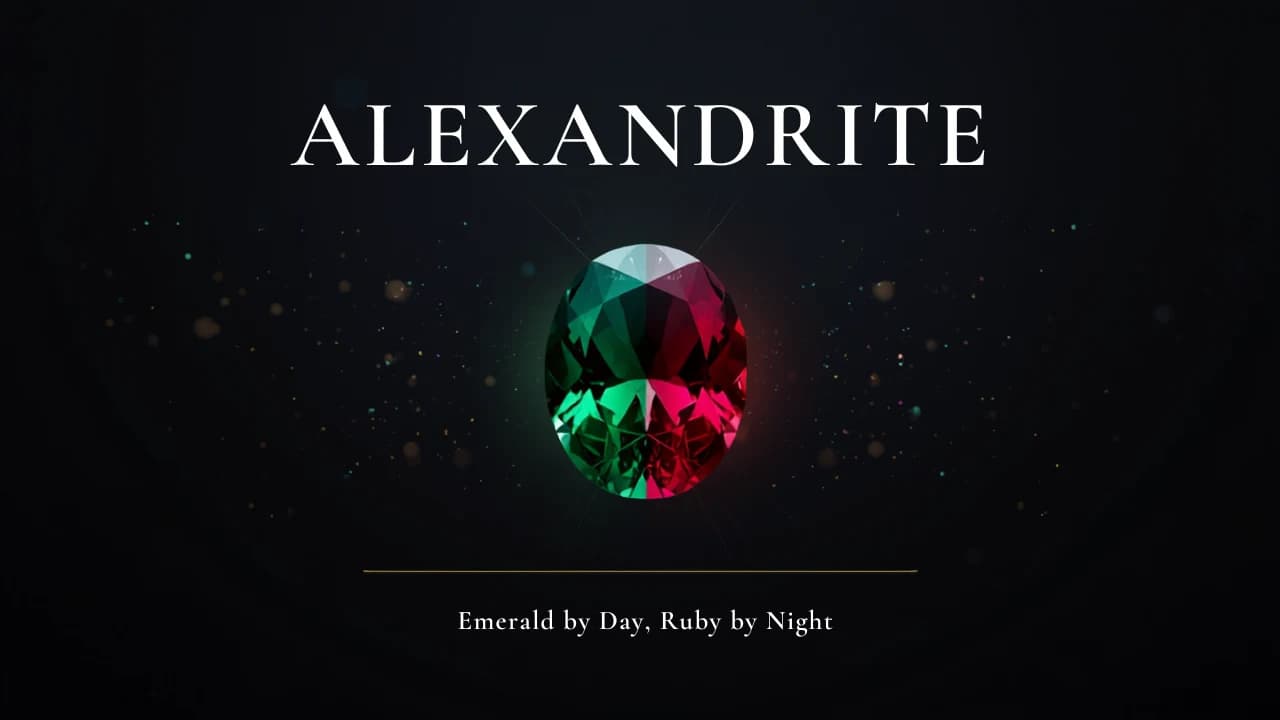
Take a fine alexandrite outside on a bright morning and it glows a cool, leafy green, like a soft emerald. Carry the same stone indoors that evening and hold it under a lamp or a candle, and it turns red, a warm raspberry or purplish red that looks like a different gem entirely. Nothing has been done to it. It is the same crystal, in the same setting, on the same finger. Only the light has changed, and the stone has answered by changing colour in front of your eyes.
That trick, and it really does look like a trick the first time you see it, is why alexandrite has been called "emerald by day, ruby by night" for almost two hundred years. It is the headline act of the gem world, a stone that performs. It is also one of the rarest gems ever pulled out of the ground, rarer than diamond by a wide margin, and one of the most heavily imitated. Most of the "alexandrite" sold cheaply online and in vintage rings is not alexandrite at all, and telling the real thing from the fakes is the single most important thing a buyer can learn.
This is the honest, complete guide. What alexandrite actually is, how the colour change works, the genuinely good Russian story behind its name, what it has meant to people, why it joined the June birthstone list, what fine stones really cost, and most importantly how to make sure the alexandrite you buy is the gem you think it is. We think alexandrite is the most quietly magical stone on the entire birthstone calendar, so we will also be blunt about where the traps are, because with this gem the traps are everywhere.
Alexandrite Meaning in One Sentence
If you only want the quick answer: alexandrite is the stone of transformation and balance, the gem of a person who contains more than one nature, prized as a bringer of good fortune, intuition, and emotional equilibrium. Its symbolism flows directly from its physics. A gem that is two colours in one body became, almost inevitably, the stone of duality, change, and the union of opposites.
That is the meaning in a line, and it is one of the rare cases where a gem's lore actually fits what the stone does. But alexandrite's real story is in the science and the history, because no other gem changes colour quite like this and no other gem got its name from a future emperor. To understand both, it helps to know what alexandrite physically is.
What Is Alexandrite?
Alexandrite is a variety of a mineral called chrysoberyl, which is a beryllium aluminium oxide. That is worth saying clearly, because it surprises people: alexandrite is not a type of emerald, not a sapphire, and not a beryl despite the name. It is chrysoberyl, the same mineral family as the honey-coloured cat's eye stones, and it is the rare, colour-changing member of that family.
What makes it change colour is a trace of chromium, the same element that turns emerald green and ruby red. In alexandrite, chromium sits in the crystal in a way that lets the stone absorb light in a very narrow band, right in the middle of the spectrum between blue-green and red. That balance point is the whole secret, and we will come to exactly how it produces the colour flip in the next section.
On the practical side, alexandrite is an excellent gem to actually own and wear. It sits at 8.5 on the Mohs hardness scale, which puts it third among the gems people commonly wear, behind only diamond at 10 and the corundum twins ruby and sapphire at 9. It is harder than spinel, harder than every quartz, harder than emerald, and it has good toughness with no troublesome cleavage to split along. In plain terms, alexandrite can handle daily life in a ring, which matters because so many "special" coloured gems (emerald, opal, moonstone, tanzanite) genuinely cannot. With alexandrite, the fragility everyone worries about is not durability. It is your wallet and the risk of fakes.
"Emerald by Day, Ruby by Night": How the Colour Change Works
This is the part that makes people fall in love, so it is worth understanding properly, because once you know how it works you also know how to test a stone in five seconds.
Ordinary daylight and fluorescent light are rich in the blue and green part of the spectrum. Incandescent bulbs, candle flames, and old-fashioned warm lamps are rich in the red and yellow part. Most gems do not care, because they reflect roughly the same colour whatever you light them with. Alexandrite cares enormously, because that narrow chromium absorption band sits right on the knife edge between the two halves of the spectrum.
Under cool, blue-rich daylight, the stone transmits its green, and you see emerald. Under warm, red-rich lamplight, the balance tips the other way and the stone transmits its red, and you see something close to ruby. The gem is not "choosing" a colour. It is faithfully showing you whichever colour dominates the light you have given it, and because it is balanced so precisely on the dividing line, a change in the light produces a dramatic change in the stone. Gemmologists call this the alexandrite effect, and alexandrite is the gem it is named after.
The strength of that change is the single most important quality factor in the entire gem, more important than size, more important than clarity. A top alexandrite shows a clean, complete flip from a vivid bluish green to a vivid purplish or raspberry red, what the trade calls a strong "hundred percent" change. A weak stone shifts only slightly, from a murky green-grey to a dull brownish red, and looks muddy in both lights. When you judge an alexandrite, you are really judging the quality of the change. Hold it under daylight, then under a warm bulb, and watch how cleanly and completely it transforms. That, far more than carat weight, is what you are paying for.
The Russian Story: How Alexandrite Got Its Name
Alexandrite has one of the best origin stories in gemology, and unlike a lot of gem legends, the core of it is true.
In the 1830s, miners working the emerald deposits in the Ural Mountains of Russia found a strange green stone that turned red by candlelight. The new gem was named alexandrite after the young Alexander Nikolaevich, heir to the Russian throne, who would later rule as Tsar Alexander II. The timing was perfect for a patriotic legend, because the stone was reportedly identified around the time of his coming of age, and here is the detail that made it irresistible to Imperial Russia: the stone's two colours, green and red, were the colours of old Imperial Russian military uniforms. A gem that was green by day and red by night, discovered in Russia, named for the future Tsar, and wearing the army's own colours, was about as patriotic an object as a jewel could be. It became wildly fashionable among the Russian nobility almost overnight.
Those original Ural Mountain stones are legendary for a reason. The Russian material showed a particularly clean, vivid green-to-red change, and because the Ural deposits were largely worked out long ago, antique Russian alexandrite is now among the most coveted and expensive coloured gemstone material on earth. Today the alexandrite you can actually buy comes mostly from Brazil, Sri Lanka, and East Africa (Tanzania and Madagascar), each with its own typical character. The romance of the Russian original, though, is a big part of why the gem carries the prestige it does, and why dealers still mention "Russian colour" as the gold standard.
We find this history genuinely lovely, and it is a useful reminder that a gem's value is never just chemistry. Alexandrite would be a remarkable stone on optics alone, but the Tsar, the imperial colours, and the romance of those vanished Ural mines are baked into why it sits where it does on the price ladder.
Alexandrite Meaning and Symbolism
Because alexandrite is physically two stones in one, almost all of its symbolism circles the same idea: duality, balance, and transformation. It is widely called the "stone of transformation," a gem for times of change, new chapters, and personal growth, and that meaning is unusually well earned, because the stone literally transforms in front of you.
From there the associations branch out in the way gem lore tends to:
- Balance and equilibrium, especially between the emotional and the rational, the day-self and the night-self. A stone that holds two natures in harmony became a symbol of holding your own opposites in harmony.
- Good fortune and luck, a long-standing association, particularly in its Russian and later Sri Lankan lore, where alexandrite was treated as a bringer of luck and prosperity.
- Intuition and creativity, tied to that idea of seeing more than one thing at once, of perceiving the hidden second colour in any situation.
- Self-esteem and joy, with the stone often described as encouraging confidence and a more optimistic outlook.
It is also commonly given as the gem for the 55th wedding anniversary, which fits beautifully: a stone of two natures living in harmony, for a marriage that has done exactly that for more than half a century.
Here is our honest position, the one we hold for every gem on this site. These are cultural and symbolic meanings, not physical powers. An alexandrite will not literally rebalance your emotions or change your luck. What a stone like this genuinely offers is a piece of symbolism you can carry, a small daily reminder of an intention, transformation, balance, a fresh start, and that is a real and ancient reason people have always worn gems. With alexandrite the symbolism happens to match the science unusually well, which is part of its charm. If the deeper history of how stones came to carry these meanings interests you, our piece on talismans and amulets in gemstone lore traces where it all began.
Is Alexandrite a Birthstone?
Yes. Alexandrite is one of the official birthstones for June. June is unusual in having three modern birthstones to choose from, and alexandrite is the rare and expensive one of the trio:
- Pearl, the classic, soft and organic, the stone most people picture for June.
- Moonstone, the glowing, affordable, underrated option, which we love and wrote about in our moonstone meaning and colours guide.
- Alexandrite, the colour-changing rarity, the showpiece of the three.
So if you were born in June, you have an unusually good spread: a timeless organic gem, a budget-friendly glowing stone, and one of the rarest gems in the world. That range is part of what makes June such an interesting birthstone month, and our full June birthstone guide covers all three, while our pearl vs alexandrite comparison helps if you are weighing the soft classic against the colour-changing rarity.
One honest note for June babies tempted by alexandrite: it is by far the most expensive birthstone of any month in fine natural quality. We ranked it number one on our most expensive birthstones list, ahead of ruby, emerald, and diamond, and that is not a typo. So while alexandrite is a genuine, official June option, most June babies who want it end up choosing a high-quality lab-grown alexandrite, which is a perfectly good and honest path. We will explain exactly why, and how to do it without being fooled, below.
What Makes Alexandrite So Rare and Expensive
It is worth understanding why this stone costs what it does, because the rarity is real and not marketing.
Three things have to come together for an alexandrite to exist at all. You need chromium to be present (the colouring agent), you need beryllium to be present (to form chrysoberyl in the first place), and in nature those two elements almost never occur in the same place, because they form under different geological conditions. Alexandrite only happens in the rare spots where that geological accident lines up. That is why it is genuinely rarer than diamond, emerald, or ruby in fine quality, not by a little, but by a lot.
On top of that scarcity, the demands of a good alexandrite are brutal. The stone has to be transparent, it has to show a strong and attractive colour change, and ideally it should be a decent size, and clean alexandrite over one carat with a vivid change is extraordinarily rare. Most natural alexandrite is small, included, and shows only a weak change. The handful of stones that tick every box are some of the most valuable gems on earth per carat.
The practical result: fine natural alexandrite routinely runs into the thousands, and for top stones the tens of thousands, of dollars per carat. Antique Russian material with a strong change sits at the very top. Even commercial-quality natural alexandrite is far from cheap. So when you see "natural alexandrite" offered for a modest price, your alarm bells should ring immediately, because the maths simply does not work. That brings us to the most important section in this guide.
The Big Trap: Natural vs Lab-Grown vs Simulant
Alexandrite is, in our experience, the single most misrepresented gem in the birthstone calendar, and most of the misrepresentation is not even deliberate fraud. It is decades of vintage jewellery and casual online listings calling things "alexandrite" that simply are not. Here is how to keep your footing, because there are three very different things being sold under the one name.
1. Natural alexandrite. Dug from the ground, genuinely rare, and priced accordingly (thousands per carat and up for anything good). If a stone is real natural alexandrite with a strong change, the price will tell you, and so should a report from a respected gem laboratory. For any natural alexandrite of real value, a lab report is not optional, it is the whole transaction.
2. Lab-grown (synthetic) alexandrite. This is real alexandrite, chemically and optically identical to the mined stone, grown in a laboratory. It shows a genuine green-to-red change because it is the actual material. It is dramatically cheaper than natural, and for most buyers who simply love the colour-change effect, a quality lab-grown alexandrite is a completely honest and sensible choice. There is no shame in it whatsoever. The only rule is that it must be sold to you, in writing, as lab-grown or synthetic, not as natural. If the natural-versus-grown question interests you across all the birthstones, we cover it in lab-grown vs natural stones.
3. Simulants, and this is the real trap. A simulant is a completely different material pretending to be alexandrite. By far the most common is synthetic colour-change sapphire (corundum), which has been mass-produced for over a hundred years and fills a vast number of "alexandrite" rings, especially older and vintage pieces from the early and mid twentieth century. Here is the tell, and it is a good one: synthetic colour-change sapphire changes from a greyish or steely blue in daylight to a purplish or amethyst-violet under lamplight. It does not do the true green-to-red flip. So if a vintage "alexandrite" ring goes blue-to-purple rather than green-to-red, you are almost certainly looking at synthetic corundum, not alexandrite at all. Colour-change garnet is another genuine natural stone sometimes confused with alexandrite, though that one is at least a real and respectable colour-change gem in its own right.
Our buyer's rule for alexandrite is therefore simpler and stricter than for almost any other gem:
- Watch the actual colours change. True alexandrite goes green (or bluish green) to red (or purplish red). Blue-to-purple is a red flag for synthetic sapphire.
- Respect the price. Cheap and "natural" cannot both be true. If the price is modest, you are buying lab-grown (fine, if disclosed) or a simulant (not fine, if sold as the real thing).
- Get it in writing, and get a report. Insist the seller states "natural alexandrite" or "lab-grown alexandrite" explicitly, and for any significant natural stone, insist on a report from a recognised gem lab. A good lab separates all three of these in minutes.
Settle which of the three you are actually buying before you pay, and you have defused almost every problem this gem can throw at you.
How to Buy Alexandrite: What Quality Actually Means
Once you know which category you are in, judging quality comes down to a clear order of priorities, and it is not the order most people expect.
Colour change comes first, always. As we covered above, the strength and beauty of the flip is the heart of the gem. You want a clean, complete change between two attractive colours, ideally a vivid bluish green and a vivid purplish or raspberry red. A weak, partial change between muddy colours is the mark of a lesser stone no matter how big it is.
Colour quality comes second. Both of the stone's faces should be appealing in their own right. The finest show a saturated green and a rich red, not a washed-out grey-green or a brownish red.
Clarity comes third. Some inclusions are normal and expected in natural alexandrite, and a slightly included stone with a stunning colour change beats a flawless stone with a weak one. Eye-clean is a bonus, not a requirement.
Carat weight comes last, and it carries a sting: because clean material with a strong change is so rare, price per carat rises steeply with size. A one-carat fine alexandrite is exponentially more than a half-carat one. For most buyers, a smaller stone with a brilliant change is far better value and far prettier than a larger stone with a weak one.
There is also a rare and spectacular variant worth knowing about: cat's eye alexandrite, which combines the colour change with chatoyancy, a bright moving band of light across the stone like a cat's pupil. A stone that both changes colour and shows a sharp eye is doubly phenomenal and correspondingly valuable. If you ever see one in person, it is unforgettable.
How to Wear and Care for Alexandrite
The good news after all those warnings: once you own a genuine alexandrite, natural or lab-grown, it is one of the easier coloured gems to live with.
At 8.5 on the Mohs scale with good toughness and no problematic cleavage, alexandrite is genuinely durable, well suited to rings and daily wear in a way that emerald, opal, moonstone, and tanzanite simply are not. This is a real advantage. You can wear an alexandrite ring as an everyday piece without the constant anxiety that softer, more fragile gems demand. It is also a gem that is typically not treated, meaning the colour and the change are the stone's own and not the product of heating or filling, which we always count as a point in a gem's favour.
For cleaning, warm water, mild soap, and a soft brush handle everything. Because natural and lab-grown alexandrite are untreated and tough, they are generally safe in an ultrasonic cleaner, though if a particular natural stone is heavily included the gentle soapy-water method is always the safe default. Store it apart from diamonds and sapphires, which can scratch it, and it will keep performing its day-to-night trick for generations.
In short, alexandrite asks very little of you in care and gives back the most dramatic optical show in the gem world. The hard part with this stone is buying it honestly. Owning it is easy.
The Bottom Line
Alexandrite is the gem that performs. It is emerald by day and ruby by night, a stone that turns from green to red as you walk from sunlight into lamplight, and that single piece of optical magic has carried it from the emerald mines of the Ural Mountains to the finger of a future Tsar to the very top of the price ladder, ahead of diamond, ruby, and emerald in fine natural quality. It is June's rarest birthstone, a stone of transformation and balance whose symbolism, for once, matches exactly what the gem actually does.
Our summary: judge an alexandrite first and foremost by the strength and beauty of its colour change, not its size, and remember that true alexandrite goes green-to-red, never the blue-to-purple of the synthetic sapphire that fills so many vintage "alexandrite" rings. Decide honestly which of the three stones you are buying, costly natural, sensible lab-grown, or a simulant to avoid, and get that answer in writing before you pay, with a lab report for anything natural and valuable. Do that, and you can wear it without worry, because at 8.5 on the Mohs scale this is one of the tougher coloured gems you can own. For June babies, it is the showpiece of the month, and for anyone who has watched a fine one change colour in their hand, it is hard to forget.
If alexandrite's magic pulled you in, the natural next stops are its two fellow June birthstones in our moonstone meaning and colours guide and our pearl vs alexandrite comparison, or the full price picture in our most expensive birthstones ranked, where alexandrite sits, deservedly, at number one.
Wondering how it stacks up against every other gem? Compare values in our gemstone price guide and toughness on the sortable Mohs hardness table.