There are two ways to personalize a gift by someone's birthday. You can engrave a date and hope they like serif type, or you can lean on the two symbols people actually remember: their birth flower and their birthstone.
The flower has been a quiet language for centuries. The stone has been a louder one. Together they make a gift that reads as thoughtful from across a room and clever up close.
This is the pairing guide I wish more jewellers and florists kept on hand. Every month gets the flower (or flowers), the stone (or stones), and a short note on why the combination tends to work, including a few I think the industry has been getting wrong.
Birth Flowers and Birthstones at a Glance
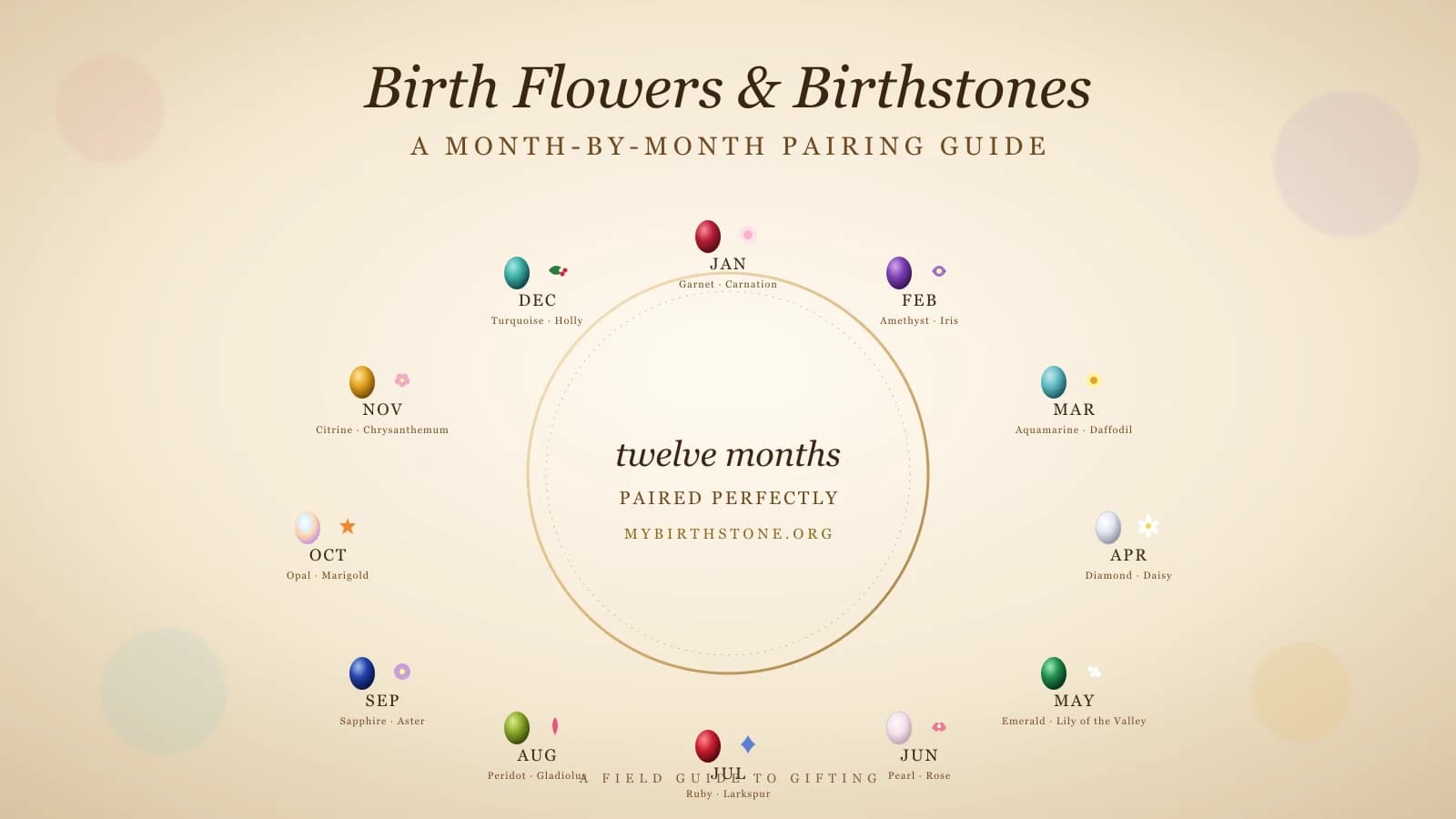
Before we go month by month, here is the quick reference. Save it, screenshot it, send it to your sister-in-law in November.
| Month | Birth Flower(s) | Birthstone(s) | Shared Mood |
|---|---|---|---|
| January | Carnation, Snowdrop | Garnet | Quiet warmth |
| February | Iris, Violet | Amethyst | Reflective purple |
| March | Daffodil, Jonquil | Aquamarine, Bloodstone | Fresh start |
| April | Daisy, Sweet Pea | Diamond | Clean optimism |
| May | Lily of the Valley, Hawthorn | Emerald | Lush, almost theatrical |
| June | Rose, Honeysuckle | Pearl, Alexandrite, Moonstone | Romantic, layered |
| July | Larkspur, Water Lily | Ruby | Bold and warm |
| August | Gladiolus, Poppy | Peridot, Spinel, Sardonyx | Confident green |
| September | Aster, Morning Glory | Sapphire | Cool, considered |
| October | Marigold, Cosmos | Opal, Tourmaline | Playful, multi-tone |
| November | Chrysanthemum, Peony | Topaz, Citrine | Honey gold |
| December | Holly, Narcissus | Turquoise, Tanzanite, Zircon | Cold blue |
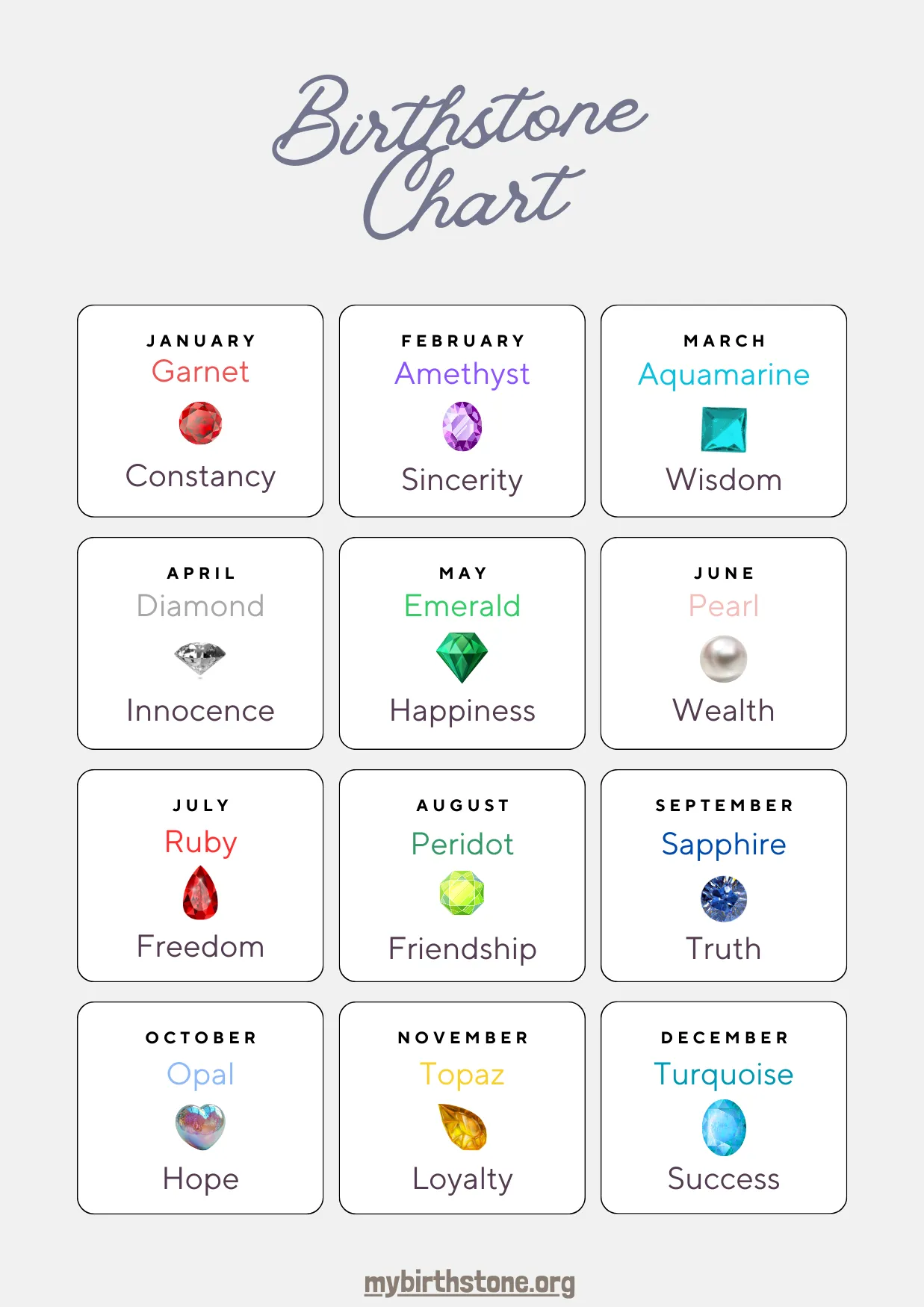
Want the chart on its own? The full breakdown lives on the birthstone chart and the matching colors lead the birthstone colors by month guide.
Why Pair the Flower and the Stone in the First Place?
Most gift guides treat birth flowers and birthstones as two separate categories. That is a missed trick.
A pairing tells a richer story. The flower is mortal, the stone is permanent, and a gift that nods to both is saying something quietly grown-up: I noticed when you were born, and I want you to feel that twice.
In my opinion, the pairing also solves the single biggest problem with birthstone jewelry, which is that it can feel a bit on-the-nose. A small bouquet of June roses next to a freshwater pearl pendant reads differently from a pearl pendant alone. The flower softens the symbolism. The stone makes it last.
Three formats work especially well:
- A piece of jewelry built around the stone, gifted alongside the flower (or its pressed version, or a watercolor of it).
- A custom illustration that places both side by side, framed, signed, dated.
- A perfume or candle that leans into the flower, with a small piece of birthstone tucked into the box.
The single rule I keep coming back to: pick one to be the loud one and one to be the quiet one. If the stone is the centrepiece, the flower shows up as a watercolor card or a fresh bouquet. If the flower is the gift, the stone is a small bead on a thin chain. Trying to make both loud at the same time is how you end up with a five-stone "family" pendant on top of a dozen long-stem roses on top of a personalised card. Restraint reads as taste.
Month-by-Month Birth Flower and Birthstone Pairings
A note on lists: there are American, British, and traditional versions of both the flower and stone lists. I am sticking with the most widely accepted American jewellery industry versions, with the second-flower and alternative-stone options called out where they genuinely matter.
January: Carnation and Snowdrop, with Garnet
The carnation is the workhorse flower of January. Cheap, available, weirdly long-lasting in a vase. The snowdrop is the romantic alternative, especially in the UK.
January's birthstone is garnet, the deep red almandine most people picture when they hear the word.
Pairing it: a red or pink carnation next to a garnet does a lot of work because the colors are in the same family without being identical. The carnation is muted, the garnet is jewel-toned. The flower softens what can otherwise read as a slightly heavy stone.
My honest take: skip the maroon roses. They look like a Valentine's leftover. White carnations next to a small garnet stud earring is the underrated January gift.
February: Iris and Violet, with Amethyst
The iris was promoted to February's birth flower because the violet, the older choice, was hard to source out of season. Both still appear on the official lists.
February's birthstone is amethyst, the purple variety of quartz.
Pairing it: this is the easiest pairing in the calendar. Purple flower, purple stone, done. A single iris or a small posy of violets next to an amethyst pendant gives you a monochrome gift that looks deliberately art-directed without being precious. I would suggest spending more on the stone than on the bouquet, because the violet is the one the recipient will remember, and the amethyst is the one they will still wear in 2036. More on this month in the February amethyst birthstone hub.
March: Daffodil and Jonquil, with Aquamarine and Bloodstone
The daffodil and the jonquil are technically the same genus (Narcissus). For the purposes of this guide, treat them as variations on the same idea: yellow, trumpet-shaped, smells like spring.
March's birthstone is aquamarine, with bloodstone as the traditional alternative.
Pairing it: yellow flower against blue stone is one of the cleanest color pairings in the year. Aquamarine on a fair-skinned recipient with a daffodil tied in twine is the photograph that ends up on Instagram. If your recipient prefers deeper colors, bloodstone with a single jonquil leans more masculine and more grown-up.
We have written about the aquamarine question in more detail in aquamarine engagement rings if you are pricing a bigger gift.
April: Daisy and Sweet Pea, with Diamond
The daisy is April's main flower. The sweet pea is the secondary, more often used in the UK and increasingly in artisan florist bouquets.
April's birthstone is diamond, which is the most expensive birth gift in the calendar unless you go lab grown.
Pairing it: this is the most "wedding shoot" pairing on the list, and you should lean into that. A single white daisy and a small lab-grown diamond stud is a 21st birthday gift that looks like a Vogue editorial. Sweet pea introduces pastel into the palette and is great for spring babies. For more on whether to spend the money on natural or lab, see our lab-grown vs natural birthstones breakdown.
May: Lily of the Valley and Hawthorn, with Emerald
Lily of the valley is May's headline flower and probably the most quietly elegant in the calendar. Hawthorn (specifically the May tree, Crataegus monogyna) is the traditional British alternative.
May's birthstone is emerald, the chromium-rich green variety of beryl.
Pairing it: this is the most luxurious-looking pairing in the year. Lily of the valley reads as bridal, hawthorn reads as old-money British countryside, emerald reads as wealth. You can spend a lot here or very little (lab emeralds in May start cheap), but the visual register stays the same.
Personal opinion: a single sprig of lily of the valley in a small bud vase next to a thin emerald necklace is the gift I would recommend to any partner of a May-born woman. The bouquet version is good, the single-sprig version is better.
June: Rose and Honeysuckle, with Pearl, Alexandrite, or Moonstone
June is the most generous month in the whole calendar. Three official stones, two flowers, and a search volume on "June birth flower" that hits 60,500 a month in the US for one reason: roses.
June's birthstones are pearl, alexandrite, and moonstone. The pearl is the everyday wear choice, the alexandrite is the rare collector's choice, the moonstone is the affordable bohemian choice.
Pairing it: a single rose next to a freshwater pearl pendant is the most cliché pairing in the calendar, and also the most reliable. If you want to dodge cliché, swap the rose for honeysuckle and the pearl for a moonstone. The pairing becomes wilder, softer, less wedding-magazine.
My take, written having bought too many of these: alexandrite is exotic and color-changing, but most recipients will not see the color change unless you walk them through it. A really good pearl will get worn every week. Buy the wearable one.
July: Larkspur and Water Lily, with Ruby
The larkspur is one of the most underrated birth flowers in the whole list. It is tall, theatrical, comes in deep blue, pink, and white, and looks expensive when it is not.
July's birthstone is ruby, the red corundum.
Pairing it: deep blue larkspur against red ruby is one of the boldest color pairings in the calendar. It is the rare birth-month gift that looks more like a still life than a bouquet. If you find the colour clash too loud, the water lily version is softer and more pastel.
Opinion: most jewellers default to pink ruby or "ruby red" garnet for July to soften the look. Don't. A real (or really good lab) deep red ruby against a tall larkspur is one of the most photographable birthday gifts you can buy. The boldness is the point. Spend on the saturation of the stone before you spend on the size.
August: Gladiolus and Poppy, with Peridot, Spinel, or Sardonyx
August picked up two extra birthstones in the last decade. Spinel was added in 2016 by the Jewelers of America. Sardonyx is the traditional version. Peridot is the one most jewellers will offer by default.
August's birthstones are peridot, spinel, and sardonyx.
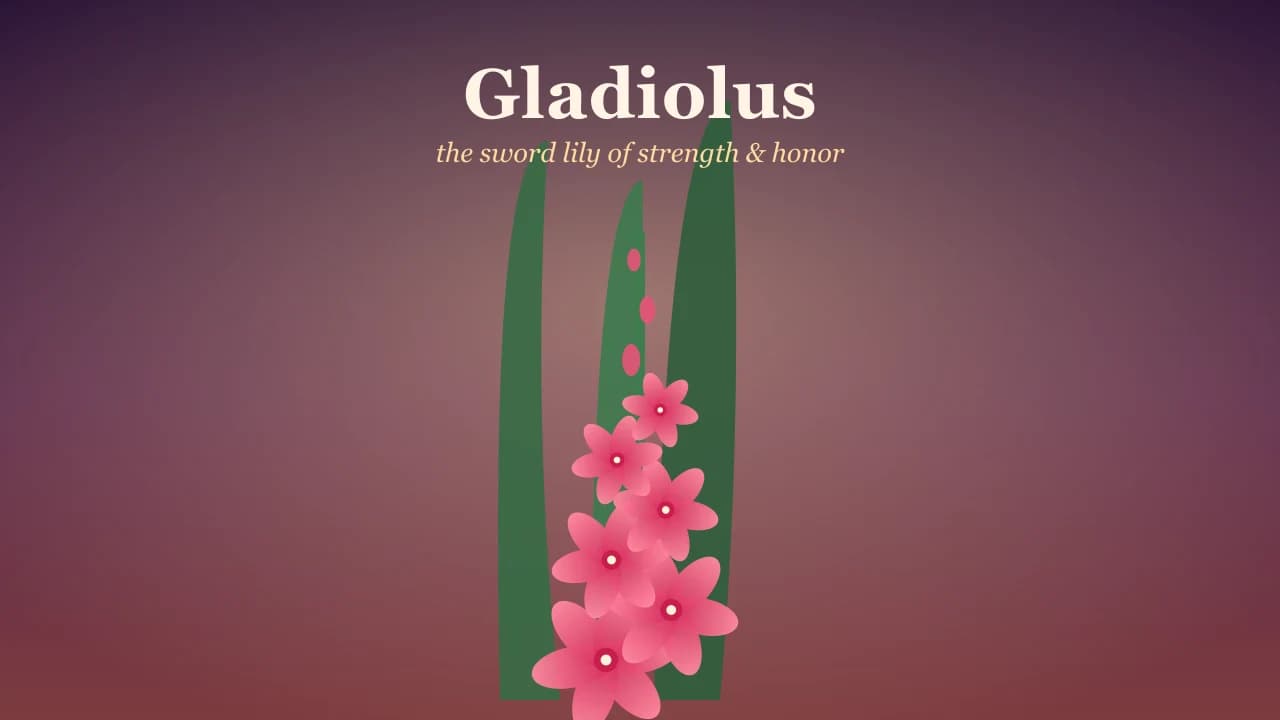
Pairing it: gladiolus is the tall, dramatic, end-of-summer flower. Pair the green-yellow peridot with the pink, red, or coral gladiolus and you get a high-summer palette that reads as warm without being hot. The poppy is the secondary flower and goes especially well with red spinel for a more saturated, dramatic version of the same idea.
Note: peridot has a strong yellow-green tone that not everyone loves. Before you commit to a bigger August gift, test the color against the recipient's wardrobe.
September: Aster and Morning Glory, with Sapphire
September's birthstone is sapphire, and although blue is the famous colour, sapphires come in pink, yellow, green, and the orange-pink "padparadscha" variety that has quietly become one of the most coveted stones of the last five years.
The aster is September's main flower, typically pale purple or pink. Morning glory is the secondary.
Pairing it: pale purple aster next to a blue sapphire is the easiest pairing here. If you want to be more interesting, go pink sapphire against a deep purple aster, or padparadscha sapphire against the more orange-pink varieties of morning glory.
My take: a blue sapphire is the safest engagement-ring upgrade in the whole calendar, and September births are the one month where I would always recommend going for a real stone over a lab stone, because the wear-and-tear difference is negligible at 9 on the Mohs scale. For sapphire-as-engagement, see birthstone engagement rings month-by-month.
October: Marigold and Cosmos, with Opal and Tourmaline
October has two birth flowers and two birthstones, which gives you the most flexibility of any month for designing a multi-element gift.
October's birthstones are opal and tourmaline.
Pairing it: marigold is orange-gold, cosmos is pale pink to deep magenta. Opal can sit alongside either. Tourmaline, which is the most colour-flexible of all birthstones (it comes in literally every shade), can be matched precisely to whichever flower you pick. Pink tourmaline next to pink cosmos is one of the most charming colour stories in the whole calendar.
Honest opinion: opal as a daily-wear ring stone is risky because of its softness and water sensitivity. If you are buying for someone who will actually wear it every day, gift the opal as a pendant or earrings and pair with a marigold bouquet. The flower carries the colour story, the stone stays safe.
November: Chrysanthemum and Peony, with Topaz and Citrine
November is the most autumnal pairing in the calendar. Yellow topaz, golden citrine, deep red and gold chrysanthemums, pink-and-cream peonies. The whole month reads as honey.
November's birthstones are topaz and citrine. Both are widely available, both are cheap, both look more expensive than they are.
Pairing it: chrysanthemum with citrine is the safest November gift you can give. The colours are so close that the eye reads them as one piece. Peony with a peach or champagne topaz is the softer version of the same idea. If the recipient is not into yellow, blue topaz exists, but the November story works best when the warm colours are doubled down on.
My take: citrine is one of the best-value coloured stones on the market. A big, well-cut citrine in a 14k gold setting costs less than a pair of trainers, and looks worth four figures. November babies should be the easiest to buy for in the whole calendar, and they are.
December: Holly and Narcissus (Paperwhite), with Turquoise, Tanzanite, or Zircon
December has three birthstones, which is more than fair given how often it has to share a gift slot with Christmas.
December's birthstones are turquoise, tanzanite, and zircon. Turquoise is the traditional, tanzanite is the modern luxury choice, zircon is the underdog.
Pairing it: holly with its red berries against turquoise is the most "holiday card" pairing you will see all year. Use it on purpose. Paperwhite narcissus next to tanzanite is the more grown-up, less Christmassy alternative.
Honest take: tanzanite is found in one place in Tanzania, and the mine is running out. If you are buying a December gift now, in 2026, and you want it to feel like an investment piece, tanzanite has a story most stones do not. Pair it with the paperwhite rather than the holly to step away from the Christmas connotation.
How to Actually Buy the Pairing
Three formats work, and one trap to avoid.
The bouquet-plus-jewelry version is the classic, and it works when you want a single delivery day to feel like an event. Match the colour or deliberately contrast it. Either is fine; muddy is not.
The framed-illustration version is what I would now recommend for first birthdays and milestone gifts. A small watercolour of the flower and the stone, framed, signed, dated, lasts for decades. For a baby's first birthday, the illustration is the gift, and the actual stone gets added later when they have ears (or earlobes mature enough for earrings, which is roughly 12 in most pediatric guidance).
The stone-only with a flower nod version is the daily-wear gift. Bezel-set stone, thin chain, then a card or note that references the flower. This is the version that gets worn most. See our push present birthstone jewelry guide and custom birthstone necklace for mom for more on that format.
The trap to avoid: piling. A "birth month box" with the stone, the flower, a personalised candle, a perfume, a printed quote, and an engraved bracelet is the gifting equivalent of a screaming five-piece band. Pick one or two elements and let them carry the meaning.
Pairing the Lists That Don't Quite Match
A quick admission: the American and British birth flower lists are not identical. The American list leans on the modern flowers compiled by the Society of American Florists. The British list incorporates a stronger traditional and Victorian flower-language influence. If you are buying for someone in the UK, hawthorn for May, snowdrop for January, and chrysanthemum for November are the more historically grounded choices. The Americans tend to default to lily of the valley, carnation, and chrysanthemum (the same), respectively.
The birthstone lists have a similar split. The 1912 standardisation in the United States gave us the modern list most jewellers still use. The British and the European Gemological Industry occasionally lists variants. For a deeper dive into how those lists came together, our birthstone origins history goes into the breastplate-to-modern-list arc.
If you are unsure, the find your birthstone tool will tell you the modern, traditional, and zodiac stones for any date, and you can choose whichever feels right.
A Note on Symbolism (and How Seriously to Take It)
The symbolic meaning of each birth flower and each birthstone is real in the sense that people have been writing it down for centuries. It is not real in the sense of being predictive or causal. If you spend an afternoon reading Kunz's Curious Lore of Precious Stones (the 1913 reference book most modern birthstone guides quietly cite), you will find that even by 1913 the meaning of any given stone was a multi-thousand-year layered argument.
So treat symbolism as a starting point, not a rulebook.
Carnation means "love and fascination." Sapphire means "wisdom and royalty." Both are true and both are vague enough to be true of almost any gift. The actual job of the pairing is to make the recipient feel seen on their birthday, not to deliver a horoscope.
If the recipient is into the symbolic side, include a small handwritten card with the meanings of both. If they are not, just buy something that looks beautiful and let the personalisation do the talking.
Frequently Asked Questions
Can I give the secondary birth flower instead of the primary?
Yes, and in some cases you probably should. The "official" list is a jewelry- and florist-industry shorthand, not a strict rule. If your recipient happens to love poppies and they are an August baby, give a poppy.
What if my birth month has two birthstones (or three)?
Pick the one that suits the recipient's daily wear style. Pearl is for the classic dresser, moonstone is for the bohemian, alexandrite is for the collector. June births are the clearest illustration of this; the same logic applies to October (opal vs tourmaline) and December (turquoise vs tanzanite vs zircon).
Should I use the American or British flower list?
Use whichever the recipient grew up with. If you don't know, default to the American list for under-40s and the British list for over-50s. Both are correct.
Can I give a man birth flowers and birthstones?
Yes, and increasingly people do. The format matters more than the symbolism: a small framed botanical print of his birth flower paired with a tie pin or cufflinks featuring his birthstone reads as considered rather than feminine.
What about babies?
For first birthdays, the framed-illustration version is better than the jewelry version. The stone can wait. The illustration can hang on the wall now.
The Bottom Line
The flower softens, the stone lasts. Pick one to be loud and one to be quiet. Match the colour or deliberately contrast it. Skip the "everything in one box" temptation.
Do that and you have given a birthday gift that says, in two languages at once, that you noticed when this person was born. Which is the only metric a birthday gift needs to hit.
Related reading
- Birthstone chart by month with dates and meanings
- Birthstone colors by month: the visual quick reference
- Birthstone engagement rings, month by month
- Push present birthstone jewelry: a 2026 field guide
- Lab-grown vs natural birthstones: a month-by-month breakdown
- Birthstone origins and history: from breastplate to modern list
- Find your birthstone in seconds
- Browse birthstone jewelry
Sources & further reading
- Society of American Florists, official birth month flowers reference list
- Kunz, G. F. (1913). The Curious Lore of Precious Stones. Archive scan
- Jewelers of America, modern birthstone list (1912 standardisation, with 2002 tanzanite and 2016 spinel additions)