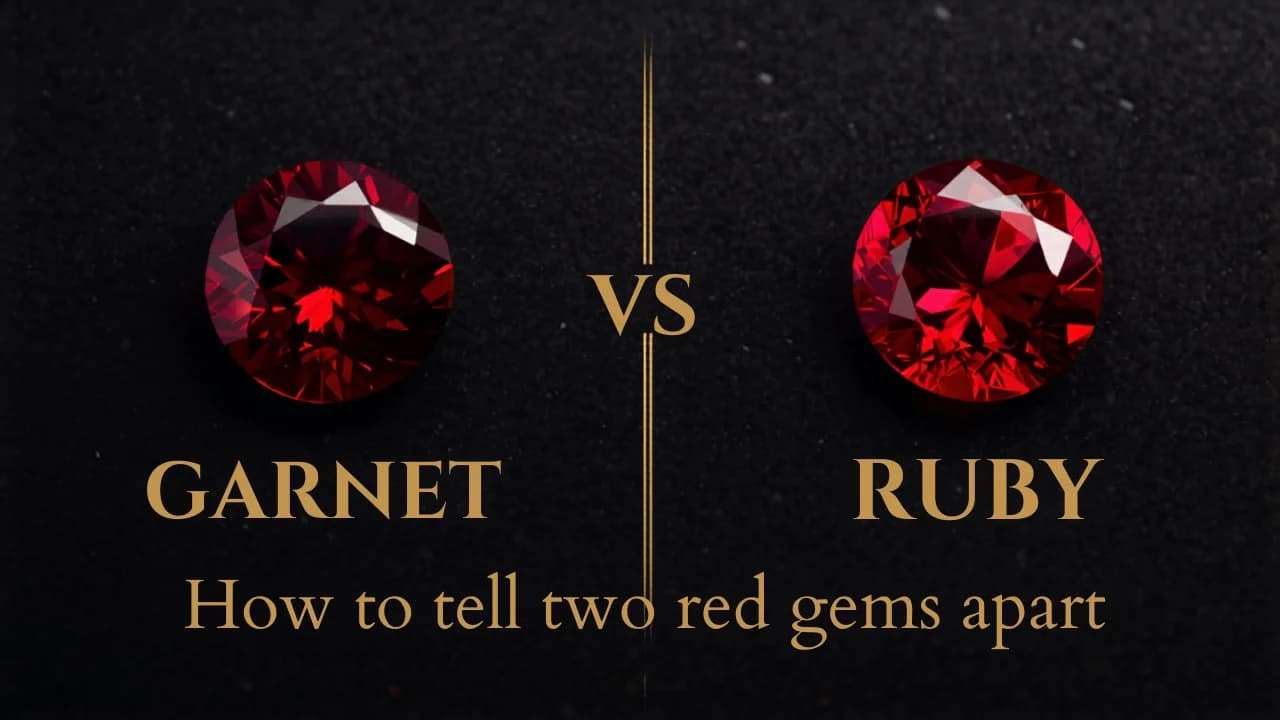
Put a good red garnet and a good ruby side by side on a shop counter, in soft indoor light, a metre from your face, and most people cannot tell which is which. Both are deep, warm, glowing red. Both have been set into rings and pendants for thousands of years. Both have spent stretches of history being called the same thing.
And yet one of them can sell for tens of thousands of pounds a carat, while the other is one of the best-value coloured stones you can buy. That gap is the whole reason this comparison matters. Confuse the two and you can either overpay wildly for a garnet wearing a ruby's price tag, or walk past a perfectly lovely garnet because you assumed anything that red must cost a fortune.
So let us do this properly. We are going to lay out what garnet and ruby actually are, where they genuinely differ, the handful of tests you can do without a lab, the sneaky trade names invented specifically to blur the line, and our honest take on which stone you should buy and when. No mysticism, no sales pressure, just the differences that change what is in your jewellery box and what leaves your bank account.
The One-Sentence Difference
If you remember nothing else, remember this. Ruby and garnet are not variations of the same stone. They are completely different minerals that happen to share a colour.
Ruby is corundum, the same mineral as sapphire, just coloured red by chromium. Garnet is a whole family of silicate minerals, coloured by iron, manganese, chromium and other elements depending on the type. They are no more "the same stone in two grades" than a sapphire and an amethyst are. The shared red is a coincidence of chemistry, not a family resemblance.
Once that clicks, everything else, the price, the hardness, the tests, the trade-name trickery, follows naturally. So let us build it out.
What Ruby Actually Is
Ruby is the red variety of corundum. Corundum is the same crystal that gives us sapphire, and the only thing separating a ruby from a "red sapphire" is a naming convention: red corundum is ruby, every other colour of corundum is sapphire. The red comes from traces of chromium swapped into the crystal, and that same chromium is what makes a fine ruby seem to glow from the inside, because chromium fluoresces red under light.
Ruby sits at 9 on the Mohs hardness scale, second only to diamond and moissanite among common gem materials. That hardness, plus excellent toughness, is a big part of why ruby has been a serious jeweller's stone for millennia. It shrugs off daily wear.
Ruby is also one of the big four precious stones, alongside diamond, sapphire and emerald, and fine ruby is genuinely one of the most expensive gem materials on the planet by weight. Top untreated Burmese "pigeon blood" rubies have sold for more per carat than comparable diamonds. It is the July birthstone, the historic "king of gems," and it carries centuries of lore about passion, protection and royal power. We dug into all of that in our piece on ruby, the king of gems, and we mapped out the colour range in our ruby colour chart if you want to see where pigeon blood sits versus the more affordable purplish and pinkish reds.
One honest caveat, the same one we make about most rubies: the overwhelming majority on the market are heat-treated to improve colour and clarity, and that is a normal, accepted, stable treatment. The thing to avoid is the heavily glass-filled "composite ruby," which is a different and much cheaper animal dressed up to look like solid ruby. More on that below, because it muddies the garnet comparison too.
What Garnet Actually Is
Here is where most "garnet vs ruby" articles go wrong: they treat garnet as one red stone. It is not. Garnet is a family, and that single fact explains almost everything that makes it interesting.
The garnets you are most likely to mistake for ruby are the red ones, mainly almandine (the common, slightly brownish-to-purplish red), pyrope (a purer, often brighter red), and rhodolite (a gorgeous raspberry-to-purple blend of the two). But the family keeps going well past red: spessartite is a fiery mandarin orange, tsavorite and demantoid are vivid greens, and there are colour-change garnets that shift under different light. We walked through the whole spectrum in our garnet ring buyer's guide, which is worth a read if you want to go deeper on the species.
Garnet sits at roughly 6.5 to 7.5 on the Mohs scale, softer than ruby. That is still hard enough for rings, pendants and earrings with a little care, but it is a real step down from corundum and it matters for a piece you will batter daily.
Garnet is the January birthstone, it is affordable across most of its common red varieties, and, in our view, its single best and most under-told selling point is this: garnet is almost never treated. No heat, no oil, no glass filling. What you see is what the earth made. After years of explaining to people that their ruby, sapphire and emerald were almost certainly treated in some way, it is genuinely refreshing to be able to say of a red garnet, "that colour is just real." For honesty per pound, garnet is hard to beat.
The catch, the one we always flag, is that common almandine cut too thick or too dark can look nearly black and lifeless, more like a bruise than a jewel. Bright, lively garnet exists in abundance, but you have to buy with your eyes, favour rhodolite and pyrope, and judge the stone face-up in normal light. Get that right and a garnet glows. Get it wrong and you will understand why some people unfairly dismiss the whole family.
Side by Side: The Differences That Actually Matter
Theory is fine, but here is how the two stones differ in the ways that change a buying decision.
Mineral and chemistry. Ruby is corundum, an aluminium oxide. Garnet is a silicate, and a whole group of them. Different crystals, different behaviour under every gemological test.
Hardness and durability. Ruby is a 9 and effectively a lifetime stone for any setting. Garnet is 6.5 to 7.5, fine for most jewellery but happier in a ring you treat with a bit of respect. If you are rough on your hands, that gap is worth weighing.
Colour and tone. Fine ruby tends toward a pure, slightly purplish or "stoplight" red with a lit-from-within glow. Almandine garnet often reads darker, with a brownish or garnety undertone; rhodolite leans raspberry-purple; pyrope can be a bright, clean red that genuinely rivals ruby to the eye. The single most useful instinct: ruby usually looks like it is glowing, while darker garnet can look like it is absorbing light rather than throwing it back.
Price. This is the headline. Fine ruby is among the priciest gems on earth and climbs steeply with size and quality. Common red garnet is one of the best values in the gem world, often a tiny fraction of ruby for a similar look at small sizes. The exceptions are the rare green garnets, tsavorite and demantoid, which can out-price ruby, but nobody is mistaking a green stone for a ruby, so for this specific comparison the rule holds: if a "ruby" is cheap, suspect garnet.
Treatment. Most rubies are heat-treated, some are glass-filled composites. Most garnets are completely untreated. So the more "natural and untouched" matters to you, the more garnet quietly wins, even though it is the cheaper stone.
Birthday. Ruby is July, garnet is January. If you are buying a birthstone gift, the calendar may make the decision for you, no gemology required.
How to Tell Them Apart at Home
You will not have a lab, so here are the tells that actually work for a normal person with a normal stone, ordered from most to least practical. None of them require scratching anything, and please do not try to scratch-test a set stone, it is a great way to ruin jewellery and prove very little.
1. Look for the glow, and use sunlight. Chromium-rich ruby fluoresces red, so a fine ruby often seems to light up, especially in sunlight or under UV, almost as if it has an internal red lamp. Most red garnet, particularly iron-rich almandine, does not do this; the iron actually quenches fluorescence, so garnet tends to sit there looking handsome but inert. Take both into sunlight and watch which one comes alive. It is not a perfect test, but it is the easiest one and it catches a lot.
2. Rotate it and look for two tones (the dichroism test). This is the cleanest amateur-accessible gemology tell, and it works because of crystal structure. Ruby is doubly refractive and pleochroic, meaning as you rotate it you can often see it shift subtly between two reds, a purplish red and a more orangey red. Garnet is singly refractive, optically isotropic, so it shows one colour no matter how you turn it. A cheap dichroscope makes this obvious, but even by eye, under good light, a stone that visibly shifts between two tones is leaning ruby, and a stone that stubbornly stays one tone from every angle is leaning garnet. Of all the home tests, this is the one we trust most.
3. Check the price and the story. Gemology aside, economics is a brilliant detector. Natural ruby is expensive, full stop. If someone is selling a sizeable, vivid "ruby" ring for the price of a nice dinner, the stone is almost certainly garnet, glass, a composite, or lab-grown ruby sold without disclosure. A price that seems too good for a ruby is the single most reliable warning sign there is, and it costs nothing to notice.
4. Mind the trade names. If the label says "Cape ruby," "Arizona ruby," "American ruby," "Bohemian ruby," "Rocky Mountain ruby" or anything similar, you are looking at garnet. We will come back to this, because it is the single most common way buyers get confused, and it is not always an honest mistake.
5. Inclusions, if you have a loupe. Under magnification, fine ruby often shows silk (fine rutile needles) and sometimes intersecting growth lines, while garnets show their own characteristic inclusions and, in some types, tiny "horsetail" patterns (that horsetail specifically flags demantoid garnet, a green one). This is the most expert-leaning test and the least necessary for telling red garnet from ruby, but if you already own a loupe, it adds confidence.
If two or three of these line up, you will usually have your answer. If real money is on the table, a proper gem lab will settle it for a small fee, and for any stone being sold as a natural ruby of significant value, we would insist on a report rather than rely on a sunlight check.
The Trade-Name Trick You Should Know About
This deserves its own section because it is where buyers lose money, and it has been going on for centuries.
For a very long time, before modern gemology could cleanly separate minerals, all sorts of red stones got lumped under the word "ruby." Plenty of famous historical "rubies" turned out to be red spinel (the Black Prince's Ruby in the British Crown Jewels is the celebrated example). And red garnet, being common and very ruby-like, picked up a whole collection of "ruby" nicknames tied to where it was mined.
So today you will still see garnet sold as Cape ruby (a pyrope from South Africa), Arizona ruby or American ruby (pyrope from the American Southwest), and Bohemian ruby (the dark red pyrope that the historic Czech jewellery trade built itself on). None of these are rubies. They are all garnet. Some sellers use these terms out of old habit and tradition, but some use them precisely because "Cape ruby" sounds, and prices, better than "garnet."
Our flat rule: any "ruby" with a place name stuck in front of it deserves a hard second look. Real ruby is just called ruby, optionally with an honest origin like "Burmese ruby" or "Mozambique ruby" stated separately. A compound name that bakes a location into the word "ruby" is a classic tell for garnet (or spinel). It is one of the oldest soft tricks in the gem trade, and simply knowing it exists puts you ahead of most buyers.
What About Lab-Grown and Composite Stones?
Two more red stones can gatecrash this comparison, and skipping them would leave the picture incomplete.
Lab-grown ruby is real ruby, chemically and optically identical to mined ruby, just grown in a lab. It has existed for over a century and is genuinely inexpensive. A lab ruby will pass the glow test and the dichroism test exactly like natural ruby does, because it is ruby. There is nothing wrong with a lab ruby sold honestly as a lab ruby, but it should never carry a natural ruby's price. If you want the broader picture on grown versus mined across all the birthstones, our lab-grown vs natural birthstones guide lays out the trade-offs.
Composite or "lead-glass-filled" ruby is the one to genuinely watch. It starts as low-grade real corundum so riddled with fractures it would otherwise be unsellable, then is flooded with lead glass to fake clarity and colour. It looks like a bargain ruby and behaves like neither a ruby nor a garnet: the glass is soft, scratches, and can be damaged by something as ordinary as a jeweller's torch or lemon juice. A garnet, ironically, is a more honest and more durable stone than a glass-filled "ruby" at the same price. If a ruby is suspiciously cheap and suspiciously clean, composite is the likeliest explanation, and we would take a solid garnet over it any day.
So the full cheap-red-stone hierarchy, in our honest order of preference, runs: a natural garnet or an honestly-sold lab ruby are both fine, fairly-priced things to own; a glass-filled composite "ruby" is the one to avoid, whatever the counter calls it.
Which Should You Actually Buy?
Here is how we steer people when they ask, and it depends entirely on what they are trying to do.
Buy ruby if you want the prestige stone, the hardness for a lifetime of daily wear, the lit-from-within glow, and the centuries of "king of gems" history, and your budget can carry it. It is the July birthstone, it is one of the great precious stones, and nothing else delivers exactly that combination of durability, glow and status. Just buy from a seller who discloses treatment, insist on a report at serious money, and read our ruby colour chart first so you know what you are paying for, because the jump from a decent red to a true pigeon blood is enormous in both look and price.
Buy garnet if you want a real, natural, untreated red stone with genuine beauty at a fraction of ruby money, you are happy to treat the ring with a little care, or you are shopping for a January birthday. Favour rhodolite or a bright pyrope, judge it face-up in normal light, and you will get a glowing red gem that owes nothing to anyone. For the price of one modest ruby you could have a larger, livelier garnet and money left over, and we have never once thought less of someone for making that trade. Our garnet ring buyer's guide walks through the species and settings in detail.
Do not buy a place-name "ruby" without checking what it really is, and do not buy a suspiciously cheap, suspiciously clean "ruby" without asking about glass filling. In both cases you are usually better served by an honest garnet.
There is no universally "better" stone here, which is exactly why the comparison is worth doing. Ruby is the more precious, more durable, more storied gem, and it charges accordingly. Garnet is the honest, untreated, brilliant-value one with a colour range ruby cannot touch. They only look like rivals because they share a colour. Knowing which is which, and why the price gap is so vast, is what stops you from overpaying for one or overlooking the other.
Our Verdict
Garnet and ruby are not two grades of one stone, they are two different minerals doing an excellent impression of each other. Ruby is hard, glowing, precious and expensive, almost always treated, and worth it if you want the king of gems on your hand. Garnet is softer, almost always natural, far cheaper across its common reds, and quietly one of the most honest stones in the case, as long as you buy bright and avoid the dark, lifeless cuts.
Tell them apart with sunlight (ruby glows, garnet usually does not), a rotation test (ruby shifts between two reds, garnet holds one), the price (cheap and vivid leans garnet), and a healthy suspicion of any "ruby" wearing a place name. Do that and you will never again mistake a January stone for a July one, or pay July money for January's gem.
If you are deciding between red stones, also worth reading: our ruby colour chart for where the value sits in ruby, the garnet ring buyer's guide for the wider garnet family, and, if "natural versus grown" is the question on your mind, our moissanite vs diamond and lab-grown vs natural birthstones guides apply the same honest, no-loyalty approach to the colourless side of the case. Whichever red you choose, choose it knowing exactly what it is, which is the entire point of a comparison like this one.
Wondering how it stacks up against every other gem? Compare values in our gemstone price guide and toughness on the sortable Mohs hardness table.