October's Birthstone: The Complete Opal and Tourmaline Guide to Colour, Meaning and Buying
If you were born in October, you do not get one birthstone. You get two: opal and tourmaline. That sounds like a bonus, and in a way it is, but it also means October babies have a genuine decision to make, because these two stones are about as different as two gems can be.
We will say our opinion up front, because it runs through this whole article. Opal is the more magical and more famous October stone, but it is also the most fragile and the most misunderstood gem on the entire birthstone calendar. Tourmaline is the quiet, sensible, wildly colourful alternative that almost nobody talks about, and for everyday jewellery it is often the smarter buy. Here is everything you need to choose well.
So What Is October's Birthstone, Exactly?
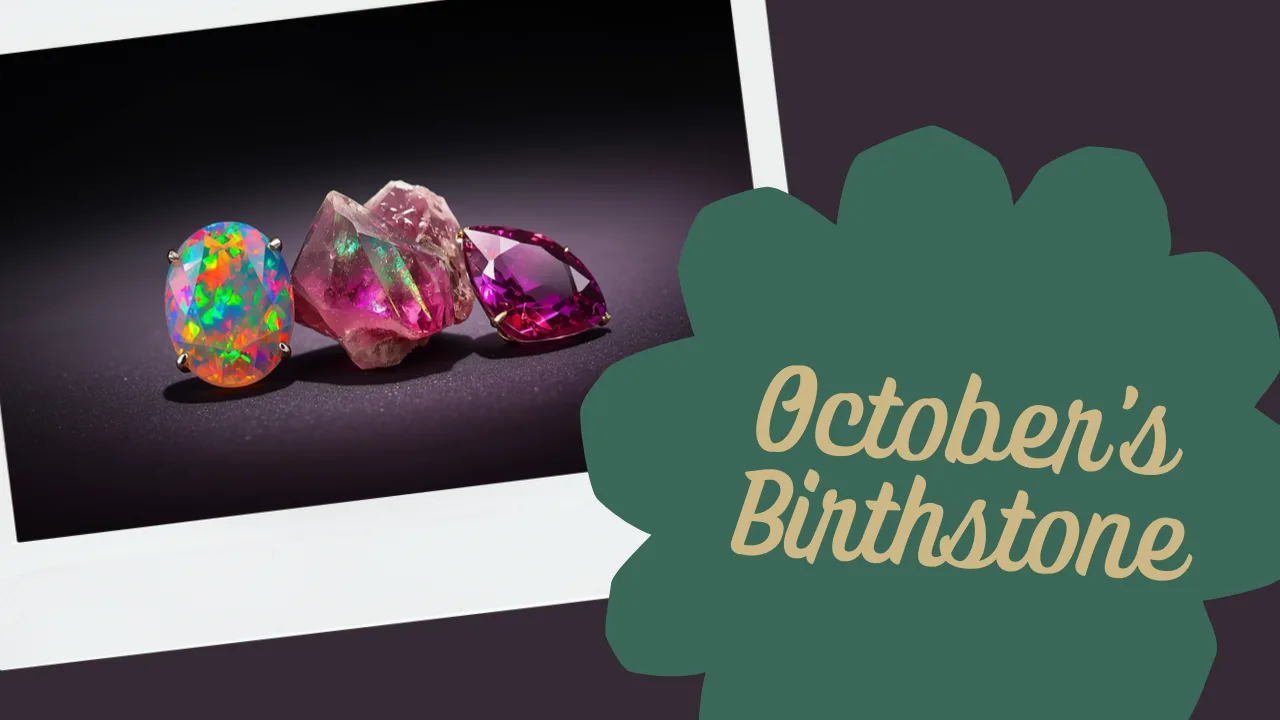
October has two official birthstones: opal and tourmaline.
Opal is the traditional one. It is the stone that appears on the original 1912 list set by the American jewellery trade, and it has been linked to October for centuries before that. Tourmaline is the newer addition, brought onto the modern list in 1952 when the industry expanded several months to give shoppers more colour and price options. So when you see October described as having "two birthstones", that is the simple history behind it. One old, one comparatively new, both completely legitimate.
Our take: do not feel you have to pick the traditional one out of loyalty. Opal and tourmaline serve different people. If you want fire, mystery and a true conversation piece, opal is unmatched. If you want a hard-wearing, brilliantly coloured stone you can wear on your hand every single day, tourmaline wins. Neither is the "wrong" October birthstone.
Opal: The Stone That Holds a Rainbow
Opal is unlike any other gem, and the reason is physical, not poetic. Most gemstones are crystals. Opal is not. It is hydrated silica, essentially microscopic spheres of silica packed together with water trapped between them. A good opal can be anywhere from three to twenty percent water by weight. You are, quite literally, wearing a stone with rain inside it.
That structure is also where the famous flashes of colour come from. When those tiny silica spheres are stacked in a neat, even grid, they bend and split light the way a prism does, throwing off shifting patches of red, green, blue and gold as you tilt the stone. Gemmologists call this play-of-colour, and it is the single thing that separates a precious opal worth real money from common opal worth very little.
Here is the field guide to the opal types worth knowing:
- Black opal. The aristocrat. A dark body tone (grey to black) that makes the play-of-colour leap off the surface. The best come from Lightning Ridge in Australia, and fine black opal is one of the most valuable gems on earth per carat. Red flashes on a black body are the holy grail.
- White or light opal. A pale, milky body with softer play-of-colour. Far more common, far more affordable, and what most people picture when they think "opal".
- Boulder opal. Australian opal still attached to its host ironstone, which gives it a dark backing and dramatic natural patterns. Brilliant value, and every piece is one of a kind.
- Fire opal. A warm orange-to-red transparent opal, mostly from Mexico. Confusingly, "fire opal" usually refers to the body colour, not to play-of-colour, and many fire opals have little or no play at all. Gorgeous in its own right.
- Crystal opal. Transparent to semi-transparent body with play-of-colour floating inside it. Often stunning.
- Doublets and triplets. Thin slices of real opal glued onto a dark backing (doublet) and capped with clear quartz (triplet). These are an honest, budget-friendly way to get the look, but they are assembled stones and should always cost much less than solid opal. Make sure you are told which you are buying.
If you want to go deeper on the colour side, we wrote a whole piece on opal colours and what drives them, and a separate one on how valuable an opal actually is, which is the question we get asked most.
The Opal "Bad Luck" Myth (And Where It Really Came From)
No gem has a more unfair reputation than opal, and the story of how it got that reputation is our favourite piece of October lore.
For most of recorded history, opal was considered intensely lucky. The Romans prized it above almost everything. The natural historian Pliny gushed about a single opal that a senator refused to sell even when threatened with exile. People believed it combined the virtues of every gem whose colour it contained, which made it a stone of hope and good fortune. So far, so positive.
Then came one novel. In 1829, Sir Walter Scott published Anne of Geierstein, in which an enchanted noblewoman, the Lady Hermione, wears an opal that flashes fire with her moods. A drop of holy water lands on it, the stone loses its colour, and she dies shortly after. The book was a bestseller, and within a generation the superstition had stuck so hard that opal sales reportedly collapsed across Europe.
George Frederick Kunz, the gemmologist whose 1913 classic The Curious Lore of Precious Stones is our regular primary source, recorded this episode with some exasperation. He was quite clear that the "bad luck" idea was essentially a publishing accident, a piece of Gothic fiction mistaken for folk wisdom.
The rehabilitation came from royalty. Queen Victoria adored opals, owned a serious collection, and handed them out as wedding gifts to her daughters. When the most fashionable woman in the world wears opals on purpose, the curse loses its grip. Australia opening up as the world's great opal source in the late nineteenth century did the rest.
Our honest opinion: the opal curse is complete nonsense, and the only grain of truth hiding inside it is practical, not supernatural. Opals genuinely are fragile, so a Victorian opal ring really might have cracked or lost its polish faster than a ruby, and a soft stone that "dies" on your finger is easy to read as a bad omen if you are already inclined to. The bad luck was never magic. It was mineralogy plus a good novelist.
Tourmaline: The Rainbow Gem Nobody Talks About
Now for October's underrated half. If opal is the diva, tourmaline is the overachiever who never asks for credit.
Tourmaline is a boron silicate, and its defining feature is colour, all of it. It naturally occurs in a wider range of colours than almost any other gemstone, which is why old traders sometimes could not tell a green tourmaline from an emerald or a red one from a ruby. The name itself comes from the Sinhalese turmali, a catch-all term Sri Lankan dealers used for the mixed parcels of colourful unknown stones they shipped to Europe. Tourmaline was, for a long time, the gem that fooled everyone.
The colours and varieties worth knowing:
- Pink and red (rubellite). The classic October look. Rich raspberry to ruby red. Rubellite is one of the most popular and valuable tourmalines.
- Green (verdelite and chrome tourmaline). From olive to a vivid emerald-like green. Chrome tourmaline in particular is a stunner.
- Blue (indicolite). Genuinely blue tourmaline is rarer than you would expect and commands a premium.
- Watermelon tourmaline. A single crystal that is pink in the centre and green around the rim, often sliced across so you can see both. It is one of the most charming gems in existence, and a personal favourite of ours.
- Paraiba. The superstar. A neon, electric blue-green coloured by copper, first found in Paraiba, Brazil, in the late 1980s. Fine paraiba can sell for tens of thousands of dollars per carat and is, in our view, one of the most beautiful colours nature has ever produced in a stone.
Tourmaline has one more party trick worth mentioning, because it is genuinely strange. The crystals are pyroelectric and piezoelectric, meaning they build up an electric charge when heated or put under pressure. Dutch traders in the 1700s noticed their tourmalines pulling ash out of their pipes and nicknamed the stone aschentrekker, the "ash puller". Few gems can claim to be both beautiful and slightly electric.
Opal vs Tourmaline: How to Actually Choose
This is the decision most October shoppers come here to make, so here is how we would think about it.
Choose opal if you want the more spectacular, one-of-a-kind, "nobody else has this exact stone" look, and the piece will be worn gently. Opal is perfect for pendants, earrings and occasional rings, the kind of jewellery that does not take daily knocks.
Choose tourmaline if you want a specific bold colour, you want a ring you can wear every day, or you are buying for someone hard on their jewellery. Tourmaline sits at 7 to 7.5 on the Mohs hardness scale, which is hard enough for daily wear with reasonable care.
The hardness gap is the whole story. Opal is soft, around 5.5 to 6.5 on Mohs, and worse, it is brittle and water-bearing, so it can chip, scratch and even crack. Tourmaline is roughly a hundred times more practical for an everyday ring. If you want the durability conversation across all twelve months, our birthstone wearability and engagement ring guide lays it out month by month.
Our flat recommendation: for a daily-wear ring, buy tourmaline. For a special-occasion pendant or pair of earrings where the goal is pure magic, buy opal. Buy the stone to suit the setting and the wearer, not just the birthday.
What October's Birthstones Mean
The two stones carry quite different symbolism, which actually gives October gift-givers a nice bit of range.
Opal has long been the stone of hope, creativity and inspiration. Because it seems to hold every colour at once, cultures across history treated it as a stone that amplified imagination and artistic vision. The Romans tied it to hope and purity, and that thread has survived intact. If you are gifting an opal, you are gifting creativity and possibility.
Tourmaline is associated with protection, healing and emotional balance, with each colour carrying its own shade of meaning (pink for love and compassion, green for vitality, black tourmaline for grounding and protection). Whether or not you put any stock in crystal lore, and we are gentle sceptics on the healing claims, the symbolism makes tourmaline a thoughtful, personal gift because you can match the colour to the message.
For the full historical picture of how each month got its stone in the first place, our birthstone origins and the 1912 list piece is the place to start, and the wider folklore lives in our summary of Kunz's Curious Lore.
The Buying Reality: Treatments, Price and What to Ask
Here is the part that saves you money and protects you from a bad purchase.
For opal, the big things to check are type and treatment. Solid natural opal is the real deal. Doublets and triplets are assembled and should cost a fraction of solid stones, so make sure you know which you are getting. Be wary of "treated" or "smoked" opals and dyed opals, which darken the body to fake the look of expensive black opal. And remember that with opal, the value is almost entirely in the play-of-colour: the brightness, the pattern, and how much of the surface comes alive when you move it. A small opal with vivid, broad flashes beats a big dull one every time.
For tourmaline, most stones on the market have been heat-treated or irradiated to improve colour, and this is a long-accepted, stable practice. It is not a scam. What you are paying a premium for is fine natural colour, especially in paraiba, rubellite and good blue indicolite. Tourmaline can also be included, so eye-clean stones in the better colours carry a premium.
The questions we would ask before paying real money:
- For opal: is it solid, a doublet, or a triplet? This single answer should swing the price enormously.
- For opal: is the body colour natural? Dyeing and smoking are used to fake black opal.
- For tourmaline: what is the variety and is the colour natural or enhanced? "Paraiba" in particular is a name worth verifying, because copper-bearing paraiba is wildly more valuable than ordinary blue-green tourmaline.
- For either stone over a carat or two, is there an independent report? For serious money, a GIA or comparable report is worth the cost.
On rough numbers, fine black opal runs into the thousands per carat and the very best far beyond that, while pretty white opal and good commercial tourmaline can be had for very reasonable sums. October is, happily, a month with great options at every budget. If you are deciding between a natural stone and a synthetic, our lab-grown versus natural birthstones guide covers the trade-offs, and synthetic opal in particular is now very good and very affordable.
When you are ready to shop actual pieces, our birthstone jewelry collection is the place to browse October settings for both stones.
Caring for Opal (Read This Before You Buy One)
We will be blunt, because this is where people get hurt. Opal needs more care than almost any other gem, and a lot of "opal is bad luck" stories are really just "I treated my opal like a diamond and it cracked" stories.
- Keep it away from heat and dry air. Because opal holds water, sudden drops in humidity or sharp heat can make it craze, which is a network of fine cracks. Do not leave opal in a hot car, on a sunny windowsill, or in a bank vault for years with a desiccant.
- Never use an ultrasonic or steam cleaner. Warm soapy water and a soft cloth, gently, is all it needs.
- Take opal rings off for washing up, gardening, the gym and anything physical. Store opal separately so harder stones do not scratch it.
- Doublets and triplets hate water even more, because prolonged soaking can lift the glue. Wipe, do not soak.
Tourmaline, by contrast, is genuinely low-maintenance. Warm soapy water and a soft brush, avoid sudden temperature shocks (because of that pyroelectric quirk), and it will serve you for a lifetime. This difference in care is, honestly, half the reason we steer everyday-ring shoppers toward tourmaline.
October's Other Symbols
If you are building an October birthday gift, the birthstones pair beautifully with the month's birth flowers, the marigold and the cosmos, both warm-toned blooms that echo the fire-opal and rubellite end of October's palette. We cover the full set in our birth flowers and birthstones by month guide, which is a lovely way to layer extra meaning into a present.
The Bottom Line for October Birthdays
A few closing opinions, the kind we would give a friend shopping for an October birthday:
- You have two real birthstones, so choose by lifestyle, not loyalty. Opal for magic and special-occasion pieces, tourmaline for everyday colour and durability.
- The opal curse is a novel, not a fact. Buy opal with confidence, just respect that it is delicate.
- For a daily ring, tourmaline is the smarter October stone. Hardness 7 to 7.5 versus opal's fragile 5.5 to 6.5 is not a close call.
- With opal, pay for play-of-colour and check whether it is solid or assembled. With tourmaline, pay for natural colour and verify any "paraiba" claim.
- Care matters more for October than almost any month. An opal you look after will outlast the superstition by a century.
For the canonical month overview, see our October birthstone hub, and the whole Kunz lore series lives on the blog as we work through the old book one gem at a time.
Sources and Further Reading
- George Frederick Kunz, The Curious Lore of Precious Stones, 1913. The opal superstition and the Anne of Geierstein episode are discussed in his chapters on the folklore of individual stones. We also wrote a plain-English summary of the whole book.
- For how the modern month-by-month list was assembled, see our birthstone origins history.
- For the opal-specific deep dives, see opal colours and how valuable is an opal.
- For the natural versus synthetic question, see lab-grown versus natural birthstones.
- For settings and styles, the birthstone engagement rings guide and the birthstone jewelry collection.
The simplest way to think about October's birthstones is this. You were handed the most magical stone on the calendar and the most versatile one, side by side. Opal gives you fire and a story. Tourmaline gives you colour and toughness. Pick the one that fits the life it will live on, and you cannot go wrong.
Wondering how it stacks up against every other gem? Compare values in our gemstone price guide and toughness on the sortable Mohs hardness table.