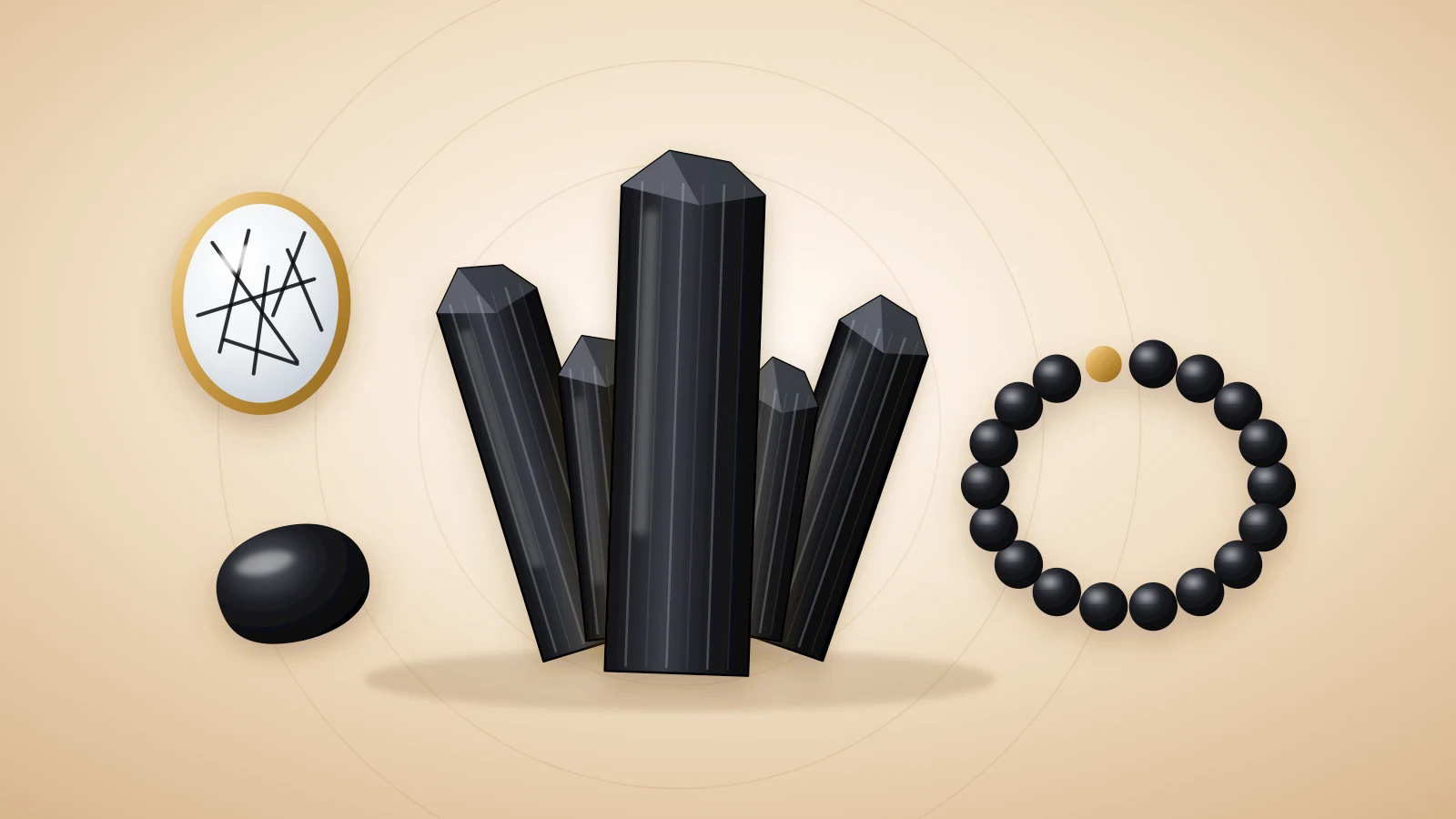
Walk into any crystal shop and there is a bowl of rough black sticks by the till. They look a bit like burnt wood, they cost about the same as a coffee, and they outsell almost everything else on the shelf. That is black tourmaline.
It is also one of the oddest success stories in the gem world. The trade spent two centuries treating black tourmaline as the boring one, the colour you dug through to reach the pinks and greens. Then the crystal boom arrived and the boring one became the most searched tourmaline online, well ahead of stones that cost a thousand times more.
We do not sell it, so we can say what we think. This guide covers what black tourmaline really is, the true story behind the "electric stone" claim, what it means to the people who buy it, what you should pay, how to spot the fakes, and whether it deserves a place in proper jewellery. We think it does.
For the rest of the family, from pink to Paraíba, start with our tourmaline meaning and colours guide.
What Black Tourmaline Actually Is
Tourmaline is a group of related minerals that share a crystal structure and swap ingredients. The gem colours you see in jewellery mostly come from a lithium-rich member called elbaite. Black tourmaline is a different member called schorl, which is loaded with iron. The iron is what makes it black and opaque.
Schorl is also the tourmaline that nature makes most of. Mineral references commonly estimate that it accounts for the large majority of all tourmaline in the Earth's crust, with some putting the figure at 95 percent or more. It turns up in granites, in the coarse veins called pegmatites, and in metamorphic rocks on every continent.
The name is old. "Schorl" was in use in German mining districts centuries before anyone used the word tourmaline, and it is usually traced to a village in Saxony, now called Zschorlau, where black tourmaline came out of the local tin mines. So the cheap black crystal has a longer written history than its expensive relatives.
The numbers
| Property | Black tourmaline (schorl) |
|---|---|
| Mineral group | Tourmaline (iron-rich sodium member) |
| Colour | Black, sometimes brownish or bluish black on thin edges |
| Hardness | 7 to 7.5 on the Mohs scale |
| Density | About 3.1 to 3.2 (heavy for its size) |
| Lustre | Glassy on crystal faces, duller on broken surfaces |
| Crystal shape | Long prisms with ridges along the length |
| Cleavage | None to speak of, but brittle |
| Transparency | Opaque |
Two of those lines matter if you plan to wear it. A hardness of 7 to 7.5 means it shrugs off household dust, which is mostly quartz at 7. Our gemstone hardness chart shows where that sits against the other birthstones. The word "brittle" is the catch. Black tourmaline crystals are often full of internal cracks, and a raw stick can snap across its width if you drop it on tile.
How to recognise a crystal
Raw schorl is easy to pick out once you have handled a piece:
- Ridges. Fine parallel grooves run down the length of the crystal, like the grain on a celery stalk.
- A rounded triangle. Look at the end of an unbroken crystal and the cross-section is a triangle with bulging sides. Very few minerals do this.
- An uneven break. Snapped ends look rough and a little splintery, never smooth and glassy.
- Weight. It feels heavier than a piece of glass the same size.
The Electric Stone: What Is True and What Is Not
This is the part where black tourmaline gets interesting, and where a lot of product pages go off the rails.
The true part
Tourmaline is pyroelectric and piezoelectric. Warm a crystal or cool it and one end picks up a small positive charge while the other goes negative. Squeeze it and the same thing happens. This is not folklore. It is a consequence of the crystal's lopsided internal structure, and it has been measured for centuries.
Dutch traders bringing tourmaline back from Sri Lanka in the early 1700s noticed that a warmed crystal attracted ash and then pushed it away again. They called the stone aschentrekker, the ash drawer, and the story goes that they used it to pull ash out of their pipes. Later, scientists put the effect to work. Tourmaline crystals were used in gauges that measured sudden pressure changes, including blast pressure from explosions during the Second World War, and thin slices were used in early polarising instruments.
So when a seller says black tourmaline "becomes electric", they are right.
The part that does not follow
The jump from "generates a tiny charge when heated" to "shields you from phone radiation" is where the science stops. The charge on a tourmaline crystal is a small static surface charge. It appears when the temperature or pressure changes and it leaks away quickly. It does not absorb radio waves, it does not block Wi-Fi, and nobody has published a test showing that a crystal on a desk reduces the electromagnetic field reaching the person sitting at it.
Our view: if you are worried about EMF exposure, a crystal is not the tool. If you like having a black stone next to your laptop because it reminds you to close the thing at six o'clock, that is a perfectly good reason to own one. Just do not pay extra for a piece that is labelled "EMF grade". There is no such grade.
The same goes for the "negative ion" claims attached to tourmaline bracelets, hair tools and mattress pads. We have not seen good evidence for health benefits from any of them, and we would not buy on that basis.
Black Tourmaline Meaning
Ask ten crystal sellers what black tourmaline means and you will get the same two words: protection and grounding. It is sold as a stone that keeps bad moods, bad luck and bad company at a distance, and that pulls a scattered mind back down to earth.
A few things are worth knowing about where that comes from.
Black stones have been used as protective charms for a very long time. Jet, onyx and obsidian all carried that job in different cultures, and our piece on talismans and amulets covers the older history. Black tourmaline's specific reputation, though, is mostly a product of the modern crystal movement of the last fifty years or so. You will not find it in the medieval lapidaries the way you find sapphire or emerald. Some sellers quote ancient magicians using it against demons. We have looked for a solid source for that and have not found one.
It also has a quieter history in jewellery. Black tourmaline is often said to have been used in Victorian mourning pieces alongside jet and onyx, which makes sense for a hard, glossy black stone that was cheap and plentiful.
Here is our honest take on the meaning. There is no evidence that any stone repels negative energy. But symbols work on people regardless of physics. A wedding ring does not make anyone faithful, and people still find that wearing one changes how they carry themselves. If a black stone by the front door makes you take a breath before you walk into the house, it is doing something useful. Where we draw the line is using a crystal in place of a doctor, a therapist or a locksmith.
The questions people actually ask
Search results for black tourmaline are full of very specific practical questions. Here are straight answers.
Which hand should you hold or wear it on? Crystal tradition says the left hand "receives" and the right hand "gives", so protective stones go on the left. There is nothing behind that beyond custom. Our advice is more boring: wear a bracelet on the hand you do not write with, because it will take fewer knocks.
Where is the best place to put it? The usual answer is by the front door, with a second piece near your desk or bed. Put it wherever you will see it. One practical note: do not leave a raw piece where it can roll off a shelf, because it will break.
Which crystals should you not wear with black tourmaline? Sellers have long lists based on clashing energies. We would ignore those and think about hardness instead. Black tourmaline is 7 to 7.5 on the Mohs scale, so a tourmaline bracelet stacked against softer stones will scratch them. Keep it away from opal, turquoise, pearl, moonstone and anything else under 7. That is the only clash we can prove.
Can it go in water? A quick rinse is fine. We would not soak a raw crystal for hours or leave it in salt water, since water gets into the cracks and the piece can start shedding fragments.
Does it need cleansing or charging? Not in any physical sense. It does need dusting. Raw schorl is a magnet for lint.
What Black Tourmaline Costs
This is the cheapest stone we have ever written a guide about, and we mean that as praise. You can own a genuinely good piece for less than a takeaway.
| What you are buying | Typical price | What moves the price |
|---|---|---|
| Tumbled stone | $2 to $6 each | Size and polish |
| Raw chunk or small crystal | $5 to $30 | Size, intact crystal faces |
| Beaded bracelet | $10 to $60 | Bead quality, clasp and metal, brand |
| Raw crystal ring or pendant | $10 to $100 | The setting, almost entirely |
| Display specimen on matrix | $50 to several hundred | Sharp terminations, lustre, no damage |
| Faceted stone | A few dollars a carat | Cutting quality |
What the market is asking this week
We pulled the product listings Google showed for "black tourmaline" on 12 November 2026. These are asking prices from the sellers named, not recommendations.
| Listing | Seller | Price |
|---|---|---|
| Raw black tourmaline ring | Earths Elements | $19.99 |
| Black tourmaline healing ring with charm | Prana Harmony | $9.50 |
| Raw black tourmaline | Earths Elements | $14.99 |
| Black tourmaline chips | Amazing Gemstones (via Walmart) | $17.98 |
| Large black tourmaline | Elevated Wisdom | $20.00 |
| Black tourmaline energy bracelet | Sivana | $38.00 |
| Black tourmaline gemstone bracelet | Chibuntu | $52.00 |
| Crystal slice in a prong setting | Starborn Creations | $89.00 |
Two things stand out. First, nothing on the page costs more than $89, and that one is mostly metalwork. Second, the bracelets cost two to three times what the raw stone does, which tells you that you are paying for stringing, branding and marketing copy. The beads in a $52 bracelet and a $15 bracelet can easily come from the same supplier.
Our buying advice
- For a crystal to keep at home, buy a single raw piece with at least one clean, ridged face and a natural end, in the $10 to $25 range. It will look better than a bag of chips and it costs about the same.
- For a bracelet, we would not go above $30 unless the clasp and findings are solid silver or gold. Ask what the cord is. Elastic dies within a year or two of daily wear.
- For a specimen, spend on condition. A small, sharp, glossy crystal beats a big chipped one every time. Material from the Erongo region of Namibia is known for a mirror-bright finish and is worth looking for.
- Skip anything sold by "grade" with letters like AAA. There is no agreed grading system for schorl. It is a seller's label.
Fakes and Lookalikes
Raw black tourmaline is so cheap and so plentiful that faking it rarely pays. The trouble starts once the stone has been polished into beads, spheres or cabochons. A shiny black bead looks like any other shiny black bead, and that is where substitutions happen.
| Sold as black tourmaline | What it really is | How to tell |
|---|---|---|
| Black obsidian | Volcanic glass | Lighter in the hand, smooth curved break, thin edges can look smoky or see-through |
| Black glass | Man-made glass | Round bubbles under a loupe, mould seams, perfectly uniform beads |
| Dyed agate or "black onyx" | Dyed chalcedony | Lighter, waxy polish, dye can gather in drill holes |
| Shungite or jet | Carbon-rich rock, fossil wood | Very soft and light, marks paper or scratches with a coin |
| Resin or plastic | Plastic | Warm to the touch, very light, a hot pin leaves a mark |
A few simple checks cover most cases:
- Weigh it in your hand. Schorl has a density of about 3.1 to 3.2. Glass, obsidian and agate all sit around 2.4 to 2.6. A real tourmaline bracelet feels noticeably heavier than a glass one of the same size.
- Look for texture. Even well polished schorl usually shows a few fine lines, tiny pits or healed cracks. Flawless, liquid-black beads that all match exactly are more likely to be glass or obsidian.
- Try a scratch on a glass bottle. Tourmaline is harder than glass and will leave a mark. Obsidian and glass will struggle. Do this with a rough piece, not a finished bead you care about.
- Check the price against the claim. If someone is charging a premium for "rare" black tourmaline, the rarity is in the description.
One reassurance. People sometimes panic because their raw crystal is crumbling at the edges and assume it must be fake. It is the opposite. Crumbly ends and loose black splinters are typical of real schorl.
If you want to test stones more methodically, our gemstone identification tool walks through colour, hardness and lustre step by step.
Black Tourmaline vs Other Black Stones
If what you want is a black stone to wear, tourmaline is one of several options. Here is how they stack up.
| Stone | Hardness | Look | Rough price | Our verdict |
|---|---|---|---|---|
| Black tourmaline | 7 to 7.5 | Glassy black, often textured | Very low | Best value for a tough black stone |
| Black onyx | 6.5 to 7 | Even, waxy black, usually dyed | Very low | Classic for signets and inlay |
| Obsidian | 5 to 5.5 | Mirror-smooth volcanic glass | Very low | Pretty but scratches and chips |
| Black spinel | 8 | Bright, sharp sparkle when faceted | Low to moderate | The one to pick for a faceted ring |
| Jet | 2.5 to 4 | Soft, warm, very light | Moderate for antiques | For collectors of Victorian pieces |
| Black diamond | 10 | Metallic, almost opaque | High | Hardest, but treated stones dominate |
Our short version: if you want sparkle, buy black spinel. If you want a smooth black signet, onyx has done that job for two thousand years. If you want a raw, textured, obviously natural black stone, tourmaline is the right call, and it is tougher than obsidian by a wide margin.
Black Tourmaline in Jewellery
The fine jewellery trade mostly ignores black tourmaline, and we think that is a missed opportunity. It is hard, it takes a good polish, and the price leaves the whole budget for the setting.
Raw crystal pieces. A slim natural crystal in a simple bezel or claw setting makes a strong pendant. The ridges catch the light in a way a polished cabochon cannot. Rings are riskier because a long crystal sticks up and takes knocks. Choose a short, stubby crystal set low, or keep raw pieces on a chain.
Beaded bracelets. These are the volume seller. They are fine for daily wear as long as you accept that the cord is the weak point. Have a good one restrung on silk or wire if you want it to last.
Faceted and cabochon stones. A well cut black tourmaline in a men's ring or a signet looks sharp and holds up better than onyx. You will usually have to find a small independent jeweller or cutter, because the big retailers do not stock it.
Tourmalinated quartz. This is clear quartz shot through with black tourmaline needles, and it is the most interesting way to wear the stone. Every piece is different, it is durable, and it is still inexpensive. If black tourmaline feels a bit plain to you, look at this first.
Metal. Black works with everything. Silver and white gold give a clean, graphic look. Yellow gold makes the black look richer and more formal.
How to Care for Black Tourmaline
It is an easy stone to live with.
- Wash it in warm water with a drop of dish soap and a soft brush, then dry it.
- Keep raw crystals out of ultrasonic cleaners. The vibration can open up existing cracks.
- Avoid sudden temperature changes, like a hot car dashboard followed by cold water.
- Store polished pieces away from softer gems so they do not scratch them, and away from sapphire and diamond so they do not get scratched.
- Dust raw pieces with a soft paintbrush. Cloths snag on the ridges.
Our guide to cleaning birthstone jewellery has stone-by-stone instructions if you are caring for a mixed collection.
Is Black Tourmaline a Birthstone?
Tourmaline is one of the two modern birthstones for October, sharing the month with opal. The official lists name the mineral and do not restrict the colour, so a black tourmaline counts. Pink is the shade most jewellers reach for when they make October pieces, and our October birthstone page explains how the month ended up with two stones.
We rather like black tourmaline as an October gift for someone who would never wear pink. It is the same birthstone in a colour that goes with a watch and a leather jacket.
Crystal guides also pair it with zodiac signs, most often Capricorn, Libra and Scorpio. Those lists are modern and they disagree with each other, so treat them as suggestions. If you want the traditional pairings, they are on our zodiac birthstones page.
Where Black Tourmaline Comes From
Almost everywhere there is granite. The main commercial sources are:
- Brazil, especially Minas Gerais, which supplies a huge share of the tumbled and raw material in shops.
- Namibia, where the Erongo Mountains produce some of the sharpest, glossiest crystals collectors can buy.
- Pakistan and Afghanistan, known for crystals perched on white feldspar or with pale aquamarine.
- Madagascar and East Africa, steady producers of rough.
- The United States, with classic localities in Maine and in San Diego County, California.
Origin makes almost no difference to the price of ordinary pieces. It only starts to matter for display specimens, where a named locality and a sharp crystal add real value.
The Short Version
- Black tourmaline is schorl, the iron-rich and most common member of the tourmaline group. It is hard at 7 to 7.5 but brittle.
- The electric charge story is true. The EMF shielding claim built on top of it is not supported by any evidence we have seen.
- Its meaning is protection and grounding. That is a modern, symbolic meaning, and it is fine to enjoy it as one.
- It is cheap. Most pieces should cost under $30, and anything pricier is charging for metal, labour or branding.
- Fakes are mostly a bead problem. Check weight, texture and whether the beads look too perfect.
- In jewellery, we would pick a raw crystal pendant or tourmalinated quartz first, and black spinel if you want a faceted black ring.
If the black stone has made you curious about its relatives, the tourmaline colours guide covers the whole range, and the Paraíba tourmaline guide covers the member of the family that sits at the opposite end of the price list.