Tanzanite rings are bought for one reason, which is the colour. Nothing else gives you that mix of blue and violet in one stone, and nothing else at the price looks as rich on a hand.
The problem is that the ring is the hardest place to put it. Tanzanite is soft enough for ordinary household dust to scratch over time, it can split from a sharp knock, and most of the affordable rings on sale use stones too small to show the colour in the adverts. Search for "tanzanite ring" today and you will also find rings for $12 that have no tanzanite in them.
So this is a guide to buying one properly. We cover how big the stone needs to be, which settings and metals work, what tanzanite rings cost this week, and when we would and would not use one as an engagement ring. We do not sell jewellery, so the opinions here are just ours.
If you want the background on the stone itself, including the one-mine story and why nearly all of it is heated, start with our tanzanite meaning and colours guide. If you are choosing between all the December stones, our December birthstone jewellery guide compares them.
Tanzanite in a Ring: The Short Version
| Question | Answer |
|---|---|
| Mohs hardness | 6 to 7 |
| Toughness | Fair to poor, with one direction of cleavage |
| Heat | Can crack from sudden temperature change |
| Treatment | Almost always heated, which is standard and stable |
| Smallest size we would buy | About 1 carat, roughly a 7 x 5 mm oval |
| Best settings | Bezel, protective halo, six prongs |
| Realistic price for a good ring | $900 to $2,500 in solid gold |
| Birthstone month | December, on the official list since 2002 |
| Anniversary | 24th |
The numbers in that table explain most of what follows. A hardness of 6 to 7 means everyday dust, which contains quartz at 7, can slowly dull the facet edges. Cleavage means there is one direction in the crystal where a hard blow can split it cleanly. Our gemstone hardness chart shows where tanzanite sits against sapphire, topaz and the other blue stones if you want to compare.
None of that makes tanzanite a bad ring stone. It makes it a stone that rewards a careful choice of setting, and that is the part most product pages skip.
How Big the Stone Needs to Be
This is the first thing we would check on any tanzanite ring, before the metal and before the price.
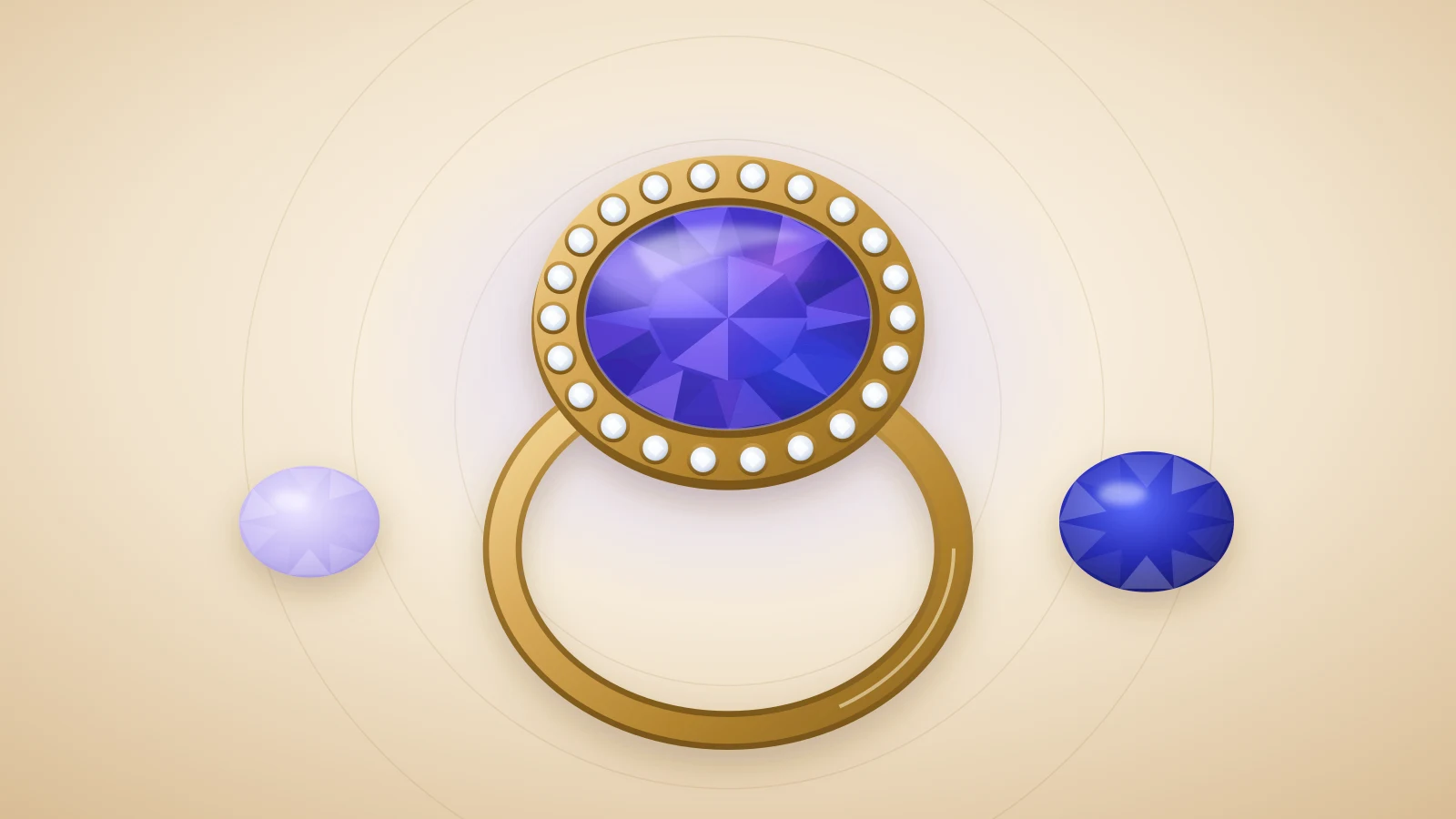
Tanzanite's colour builds with depth. Light has to travel through enough material to pick up the blue and violet, so a small stone looks pale even when it is cut from good rough. Under about half a carat, most tanzanite reads as lilac or light lavender. Somewhere around one carat it starts to look like the stone in the photographs. From two carats up, good material looks properly saturated.
Here is a rough size guide. Weights are approximate because depth varies from stone to stone.
| Shape and size | Approximate weight | What to expect |
|---|---|---|
| 4 mm round | 0.25 carat | Pale lilac. Fine as an accent stone |
| 5 mm round | 0.5 carat | Light violet. Pretty, but not the famous colour |
| 6 mm round | 0.9 carat | Colour starts to show properly |
| 7 x 5 mm oval | 0.9 to 1 carat | Our minimum for a solitaire |
| 8 x 6 mm oval | 1.4 to 1.6 carats | The sweet spot for colour against cost |
| 9 x 7 mm oval | 2 to 2.3 carats | Strong colour in good material |
| 10 x 8 mm oval | 3 to 3.5 carats | Statement size, and priced like it |
Two things in listings hide the real size, so look for both.
Total weight. Chain jewellers quote "ct. t.w.", which is the weight of every stone in the ring added together. A ring described as 5/8 carat total weight with a tanzanite centre and diamond accents may have a centre stone well under half a carat. Ask for the weight or the millimetre size of the centre stone on its own.
Millimetres without carats. A listing that gives only "4.0 mm tanzanite" is telling you the stone is about a quarter of a carat. That is real tanzanite, but it will not show much colour.
Our opinion is simple. If the budget only stretches to a quarter carat tanzanite, we would not buy a tanzanite ring. We would buy a London blue topaz ring for the same money, or put the tanzanite in a pendant where a slightly larger stone costs less to set and is far safer.
Colour, Cut and Clarity
Colour comes first
Tanzanite runs from violet through violet blue to a nearly pure blue. The trade pays most for stones where blue dominates, because they are scarcer. We think the mixed violet blue is the more interesting colour and the one that looks most like tanzanite and least like a sapphire, so we would not pay extra for pure blue unless you specifically want it.
Depth of colour matters more than the exact hue. A medium to medium dark stone looks rich in every light. A very dark one can look inky indoors, and a light one looks washed out in sunshine.
Remember that tanzanite changes with the light. It looks bluer in daylight and under cool office lighting, and more violet under warm lamps. That is normal, and it is one of the pleasures of the stone. It also means shop spotlights are a poor guide. If you can, look at the ring near a window.
Grades like AAA are marketing
You will see tanzanite sold as AA, AAA or even AAAA. There is no single body that sets those grades. One seller's AAA is another seller's AA. Treat the letters as a rough hint and judge the stone from photos and video in ordinary light. If a seller has only studio shots on a white background, ask for a video on a hand.
Cut: check for a window
Hold the stone face up and look straight down through the centre. If you can see through the middle to the finger or the setting behind it, like looking through a pane of glass, the stone has a window. It has been cut shallow to look bigger for its weight, and the middle will always look pale. A well cut tanzanite shows colour and flashes of light right across the face.
Ovals and cushions are the most common shapes, because they keep the most weight from the rough and hold colour well. Pears, trillions and emerald cuts all suit tanzanite too, but their points and corners are the places most likely to chip, so they need more protection from the setting.
Clarity should be clean
Good tanzanite is usually clean to the eye. You should not be able to see inclusions without a loupe. That makes clarity an easy test. If you can see marks, feathers or cloudy patches in a stone by eye, either pass on it or expect a real discount. A visible fracture that reaches the surface is a reason to walk away, since it is a weak point in a stone that already has one.
Settings: The Decision That Saves the Stone
We said the same thing about opal, and it applies here just as much. The setting decides how long the stone lasts.
| Setting | Protection | Our view |
|---|---|---|
| Full bezel | Excellent | The best choice for daily wear. Metal covers the whole edge |
| Half bezel | Very good | Protects two sides and lets more light in |
| Halo, slightly raised | Good | The diamonds take the knocks before the tanzanite does |
| Six prongs | Fair | Acceptable if the stone sits low |
| Four prongs, low | Fair to poor | Leaves a lot of edge exposed |
| Tall cathedral with four prongs | Poor | Looks lovely in the box. We would not wear it daily |
| Tension setting | Poor | Puts constant pressure on a stone with cleavage. Avoid |
A few details are worth asking about.
- Height. The lower the stone sits, the less it hits. A ring that stands tall off the finger catches on door frames, pockets and car doors.
- Corners. Any pear, marquise, trillion or princess shape needs V-shaped prongs or a bezel over each point.
- The girdle. That is the thin edge around the widest part of the stone, and it is where most chips start. A bezel or halo covers it. Prongs leave most of it open.
- An open back. The back of the setting should be open enough to clean behind the stone, because a film of soap and lotion behind a tanzanite kills its colour.
If you like the look of a classic solitaire, a thin bezel in white metal gives almost the same clean outline and far more protection. That is what we would pick.
Choosing the Metal
The metal changes how the stone looks, so it is worth a minute.
White gold and platinum make tanzanite look cooler and bluer. This is the most common pairing and it suits stones on the blue side. Platinum is the stronger choice for prongs, since it bends instead of wearing away, but it costs more.
Yellow gold sits opposite violet on the colour wheel, so it makes the purple in a tanzanite stand out. We think this is the most striking combination and it is underused. It also flatters a slightly lighter stone.
Rose gold warms the stone up and pushes it towards purple. It looks good with violet tanzanite and less good with strongly blue stones.
Sterling silver is fine for an occasional ring and keeps the price down. For a ring worn often we would move to gold, because silver prongs are soft and wear thin, and a worn prong is how a stone goes missing.
On karat, 14k is the practical choice in the US. It is harder than 18k and holds a stone more securely. 10k is harder still and cheaper, though the colour of the gold is paler. What we would avoid is plated metal on a ring meant to last. Our guide to gold plated, gold filled and vermeil explains why plating on a ring wears through faster than on any other piece.
What Tanzanite Rings Cost Right Now
We pulled these listed prices from the US Google results for "tanzanite ring" on 26 November 2026. They are prices shown on the day, not valuations, and with holiday sales running they will move. We have left out crossed-out "was" prices because they tell you very little.
| Where we found it | What it was | Listed price |
|---|---|---|
| Macy's | "Tanzanite cubic zirconia" halo ring, 18k gold plate | $12 |
| Macy's | "Tanzanite cubic zirconia" ring | $41.25 |
| Helzberg Diamonds | Tanzanite triangle bypass ring, sterling silver | $215.99 |
| Kay Jewelers | Tanzanite and white topaz ring, 10k yellow gold | $258.99 |
| Gemporia | 0.83 carat AA tanzanite ring, 9k gold | $291.20 |
| Jared | Natural tanzanite and diamond halo ring (1/6 ct. t.w.), 10k gold | $420 |
| Helzberg Diamonds | Tanzanite and diamond ring, 10k white gold | $479.99 |
| Kay's Fine Jewelry | 0.60 carat oval tanzanite with 0.20 carat diamonds, 14k white gold | $920 |
| Kay's Fine Jewelry | 1.25 carat oval tanzanite, 14k gold | $1,460 |
| Kay Jewelers (Neil Lane) | Tanzanite and diamond engagement ring (5/8 ct. t.w.), 14k white gold | $1,649.99 |
| Brilliant Earth | Eternity tanzanite cocktail ring | $2,690 |
| Macy's (Effy) | Tanzanite and diamond halo ring, 14k white gold | $3,374.70 |
| Kay's Fine Jewelry | 3 carat cushion tanzanite, 18k rose gold | $4,620 |
| Kay's Fine Jewelry | 6.50 carat pear tanzanite, 18k gold | $10,430 |
Kay's Fine Jewelry appeared in the results as a separate seller from the Kay Jewelers chain. The names are close enough to confuse, so check which site you are on.
A few things stood out to us.
The two cheapest rings are not tanzanite. The words "tanzanite cubic zirconia" mean cubic zirconia in a tanzanite colour. The listings say so, which is fair, but in a row of product photos they look like the real thing at a 99 per cent discount. More on this below.
Under $500 you are mostly buying metal and small stones. These are real tanzanite rings and they make good birthday gifts. Just do not expect the deep colour of a two carat stone from a ring where the tanzanite is a few millimetres across.
The price per carat climbs as stones get bigger. Look at the specialist listings. The 1.25 carat ring works out to roughly $1,170 for each carat of tanzanite including the gold. The 3 carat ring is about $1,540 a carat and the 6.5 carat ring about $1,600. Bigger stones with good colour are scarcer, so they cost more per carat as well as more overall.
Listings that state the weight of the centre stone are easier to trust. The specialists tell you the carat weight of the tanzanite itself. Most of the chain listings give a total weight or no weight. That does not make them bad rings, but it makes them hard to compare.
Putting that together, this is how we would read the market.
- Under $50: simulants in plated metal. Costume jewellery, and fine as that.
- $200 to $600: small natural tanzanite in silver or 10k gold, often with diamond or white topaz accents. A good gift tier. Colour will be on the light side.
- $900 to $2,500: a one to two carat stone in solid 14k gold. This is where a tanzanite ring starts to look the way people hope it will, and it is the tier we would aim for.
- $2,500 to $5,000: two to three carat stones, designer settings and bigger diamond halos.
- $5,000 and up: four carats and above with strong colour. At this level a lab report should come with the ring.
For loose stones, good tanzanite of one to three carats sells for roughly $300 to $1,200 a carat depending on colour. You can compare that with other stones on our gemstone prices page. If you are setting a budget for a proposal, our engagement ring budget calculator is a quick way to see what is comfortable.
Tanzanite Engagement Rings: Our Honest Verdict
Search results for "tanzanite engagement ring" are a row of shops selling them, with a Reddit thread in the middle from someone asking whether tanzanite is acceptable for a proposal. The replies split roughly in half between "I love mine" and "mine got scratched".
We think both groups are right, and the difference between them is usually the setting and the wearer's habits.
Tanzanite is not the most durable engagement stone. If you want a blue stone you can forget about for fifty years, buy a sapphire. We compare the two directly in tanzanite vs sapphire, and our sapphire engagement ring guide covers what to look for. Sapphire wins on toughness without any argument.
But tanzanite gives a colour sapphire does not, in a bigger stone, for much less money. A two carat tanzanite costs a fraction of a two carat sapphire of similar quality.
We would say yes to a tanzanite engagement ring if all of these are true:
- The setting is a bezel or a raised halo, and the stone sits low.
- The wearer will take it off for the gym, gardening, cleaning and anything involving tools or weights.
- You both accept that the stone may need repolishing, or even replacing, after ten or twenty years. A repolish removes a little weight and brings the surface back. Replacing a one to two carat tanzanite costs hundreds, not thousands.
- The stone comes with paperwork saying it is natural tanzanite.
If any of those is a no, here are two alternatives we like.
- Sapphire centre, tanzanite sides. The hard stone takes the wear in the middle and the tanzanite adds violet either side.
- A tougher engagement ring now and a tanzanite ring later. Tanzanite is the gift for a 24th anniversary, and a right-hand ring that comes out for dinners and weddings will stay perfect for decades.
One more honest point. Some people will tell you a coloured stone that cannot take daily wear is a bad omen for a marriage. We do not agree. Plenty of people look after things they love. The only mistake is buying one without knowing what it needs.
Men's Tanzanite Rings
Men's tanzanite rings get close to a thousand searches a month in the US, and the advice changes a little. Men's rings tend to be worn harder and taken off less, so protection matters even more.
The styles that work are a flush or gypsy setting, where the stone is sunk into a wide band, and a heavy bezel on a signet-style ring. Both keep the stone at or below the level of the metal. Channel-set bands with a row of small tanzanites look good but the stones will scuff in time, since nothing protects their top surface.
If the ring is going to be worn at work every day by someone who uses their hands, we would choose a sapphire or a blue spinel in the same style and keep tanzanite for a ring worn at weekends.
Fakes, "Created" Stones and Listing Language
Tanzanite is one of the stones where the wording of a listing matters most, because there is no real lab-grown version sold to the public. With sapphire or emerald, "lab-created" means the same mineral made in a factory. With tanzanite it almost never does.
| What the listing says | What it usually is | What to do |
|---|---|---|
| "Tanzanite cubic zirconia" or "tanzanite CZ" | Cubic zirconia in a purple blue colour | Fine as costume jewellery at costume prices |
| "Tanzanite colour" or "tanzanite hue" | Glass, CZ or another simulant | Same as above |
| "Simulated tanzanite" | A lookalike, by definition | Do not pay gemstone prices |
| "Lab-created tanzanite" | Often synthetic forsterite or coloured CZ | Ask the seller what the material is |
| "Tanzanite quartz" or "mystic tanzanite" | Coated quartz or topaz | The coating can wear off. Skip |
| "Natural tanzanite" with a weight and size | What you want | Ask for it in writing on the receipt |
| "Unheated tanzanite" | Rare, if true | Only pay extra with a lab report |
On heat treatment, do not worry. Almost every tanzanite on the market has been heated to bring out its blue, the result is permanent, and the trade treats it as standard. Our lab-grown vs natural birthstones guide explains the difference between a treated stone, a grown stone and an imitation, which are three separate things.
A quick test you can do yourself
Tanzanite shows different colours in different directions through the crystal. You can use that.
- Look at the stone face on, then tilt it slowly from side to side. You should see the colour shift between blue and violet, sometimes with a flash of pinkish purple at the edges.
- Look at it by a window, then under a warm lamp. It should look bluer in daylight and more violet under the lamp.
Glass and cubic zirconia stay the same flat colour from every angle and in every light. This test will not tell tanzanite from every possible imitation, and it is no replacement for a lab report on an expensive stone. But it catches the common fakes in about ten seconds.
For any ring over about $1,500, we would want either a report from an independent gem lab or an independent jewellery appraisal after purchase, inside the returns window. The appraisal also gives you the paperwork for jewellery insurance, and a tanzanite ring is exactly the sort of piece worth insuring, since a chipped stone is a more likely claim than a stolen one.
Sizing, Resizing and Repairs
This is the section we have not seen in other guides, and it matters.
Tanzanite can crack from thermal shock. A jeweller resizing a ring uses a torch on the band, and heat travels through metal quickly. If the jeweller does not know the stone is tanzanite, or treats it like a sapphire, the stone can crack on the bench.
So get the size right before you buy if you can. Our ring size chart and calculator shows how to measure at home. If the ring does need altering later:
- Tell the jeweller it is tanzanite, in words, even if it seems obvious.
- Ask how they will protect the stone. Good answers are removing it first, or using a heat shield and a laser welder.
- Expect to pay a little more than for a plain band. Our ring resizing cost guide has typical prices.
The same goes for retipping prongs, repairing a bezel or soldering a wedding band to the ring. Any work with heat near the stone carries the same risk.
Living With a Tanzanite Ring
The care is easy once it is a habit.
Take it off for rough or hot jobs. Gym, gardening, DIY, cooking over a hot hob, washing up, saunas and hot tubs. The knocks are the main danger and sudden heat is the second.
Never use an ultrasonic cleaner or a steamer. This includes the machine at the jewellery counter. If a shop offers to "give it a quick clean", say it is tanzanite and ask them to do it by hand.
Clean it with lukewarm water, a drop of washing-up liquid and a soft brush. Get behind the stone, rinse and pat dry. A clean tanzanite looks a full shade richer than a greasy one. Our birthstone jewellery cleaning guide lists the safe method for every stone if your ring has diamonds or other gems in it.
Store it on its own. Diamonds, sapphires and even topaz will scratch tanzanite if they rub together in a box. A soft pouch is enough.
Have the setting checked once a year. Loose prongs are how stones are lost, and a jeweller can check them in a couple of minutes.
Repolish when it looks tired. If the facet edges go soft and the stone loses its crispness after years of wear, a gem cutter can repolish it. It comes back a touch smaller and looking new.
What We Would Actually Buy
If we were shopping for a tanzanite ring this December, this is where our money would go.
- For a December birthday gift under $500: honestly, we would buy tanzanite earrings or a pendant at this budget and get a better stone. If it has to be a ring, choose the one with the largest single tanzanite you can find in sterling silver or 10k gold, and skip the designs with a scatter of tiny stones.
- For a ring to wear often, $900 to $2,000: an oval of 1.2 to 1.8 carats with medium dark violet blue colour, in a thin 14k bezel or a low halo. Yellow gold if you like the purple, white gold if you like the blue.
- For an engagement ring: the same stone, two carats if the budget allows, in a full bezel or a halo that stands just above it, with "natural tanzanite" and the carat weight written on the receipt.
- For a statement ring worn on occasions: this is where tanzanite is at its best. A three carat cushion in a simple setting, worn to dinners and taken off afterwards, will still look new in thirty years.
- For a mother's or family ring: be careful mixing tanzanite with harder stones in one ring, since it will be the first to show wear. Our mother's ring guide suggests swaps for the softer months.
What we would skip: any ring where the centre stone's weight is not stated, tall four-prong settings for daily wear, tension settings, "lab-created tanzanite" at natural prices, anything graded by letters alone with no video, and tiny pale stones sold on the strength of the name.
The Bottom Line
A tanzanite ring is worth buying for the colour and worth buying carefully because of the stone. Get at least a carat, put it in a bezel or a protective halo, read the listing for what the stone really is, and tell every jeweller who touches the ring that it is tanzanite.
Do those four things and you end up with a ring that looks like nothing else in the jewellery box. If you would like to know more about where the stone comes from and why there is only one source, our December birthstone page has the full story.