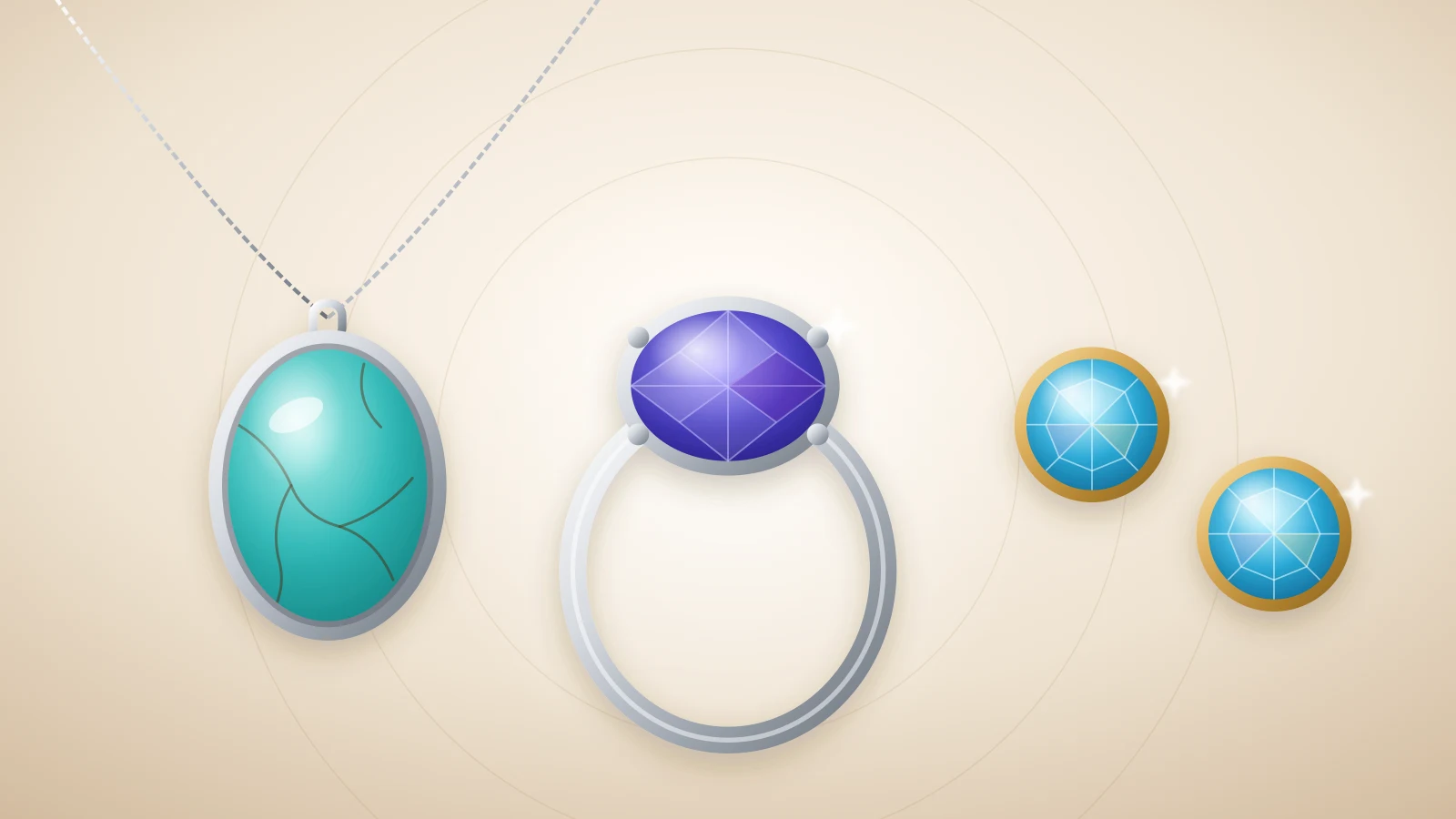
December is the hardest month to shop for, and we do not just mean the crowds. Most months have one birthstone. December has three official ones (turquoise, tanzanite and zircon) plus blue topaz, which most high-street jewellers sell as the December stone even though it is not on the official list.
Those four stones have very little in common beyond being blue. One is an opaque stone that has been worn for thousands of years. One was discovered in 1967 and comes from a single hillside in Tanzania. One is the oldest mineral on Earth and gets confused with cubic zirconia every day. And one starts life colourless and is turned blue in a reactor.
So "December birthstone jewelry" is really four different purchases. The right one depends on the piece, the budget and how hard the person is on their jewellery. This guide goes through all of that, with prices we pulled today. We do not sell jewellery, so we have no reason to push you towards any of them.
If you want the history of how December ended up with so many stones, our December birthstone page covers it, and there is a longer version in our tanzanite, turquoise and zircon history.
The Four December Stones at a Glance
| Stone | On the official list? | Mohs hardness | Look | Typical price for jewellery |
|---|---|---|---|---|
| Turquoise | Yes, since 1912 | 5 to 6 | Opaque sky blue to green, often with matrix veins | Low to mid |
| Zircon (blue) | Yes, since 1952 | 6 to 7.5 | Bright teal blue with strong sparkle and fire | Mid |
| Tanzanite | Yes, since 2002 | 6 to 7 | Violet blue, shifts colour as it moves | Mid to high |
| Blue topaz | No (topaz is November) | 8 | Clean sky, Swiss or deep London blue | Low |
You can compare all four against every other birthstone on our gemstone hardness chart.
A quick word on each, with links to the full guides:
- Turquoise is soft and porous. Most of what is sold has been stabilised with resin, which is normal and makes it tougher. Its fakes are dyed howlite and plastic. See our turquoise guide.
- Blue zircon is a natural gemstone and has nothing to do with cubic zirconia. It has more fire than any other December stone, but its facet edges wear down if it rubs against other jewellery. See our zircon guide.
- Tanzanite has the best colour of the four in our opinion, but it needs size to show it and care to keep it. Almost all of it is heated, which is accepted. See our tanzanite guide.
- Blue topaz is hard, clean and cheap. Its colour comes from irradiation and heat, which is standard and stable. See our topaz guide.
Is Blue Topaz Really a December Birthstone?
Search for December birthstone jewellery and the first results are full of blue topaz. Kay, Jared, Zales and most department stores lead with it. So it is fair to ask whether it counts.
On the Jewelers of America list, the answer is no. Topaz is a November stone, and the December stones are turquoise, zircon and tanzanite. Blue topaz crept into December because it solves a problem for retailers. Tanzanite is expensive at any decent size, zircon is hard to explain to customers who hear "zirconia", and turquoise does not suit the faceted, sparkly look most people expect from a birthstone ring. Blue topaz is cheap, comes in big clean stones and wears well.
Our view is that this is fine as long as nobody is misled. Birthstone lists have always been edited by the jewellery trade, and nobody is going to check your pendant against a 1912 document. If the person you are buying for just wants a pretty blue stone for their birth month, blue topaz does the job at a very fair price.
But if the point of the gift is "this is your birthstone", we would buy one of the official three. And we would not pay tanzanite-style money for blue topaz because a listing calls it a "December birthstone". The stone itself costs very little. In a blue topaz piece you are paying for metal, design and the shop's margin.
December Birthstone Rings
Rings take more knocks than any other piece of jewellery, so this is where the choice of stone matters most. A December birthstone ring is also the most searched piece of the lot, so we will take it first.
| Stone | Verdict for a ring | Best setting | What goes wrong |
|---|---|---|---|
| Blue topaz | Good for daily wear | Any, prongs are fine | Can chip along its cleavage from a hard knock |
| Blue zircon | Good with protection | Bezel or halo, worn alone | Facet edges abrade over time |
| Tanzanite | Occasional wear, or daily with care | Bezel or halo | Scratches, can cleave, dislikes heat shock |
| Turquoise | Occasional wear | Bezel, flush or inlay | Scratches, absorbs oils and changes colour |
Tanzanite rings
Tanzanite rings are the big one in this cluster. People search for them all year and the numbers nearly double in December.
The first thing to know is that tanzanite needs size. In stones under about one carat the colour often looks pale lilac instead of the deep violet blue in the adverts. That matters, because most affordable tanzanite rings use small stones. You will see listings quoted as "1/6 ct. t.w." or "5/8 ct. t.w.". The "t.w." means total weight, which is the weight of all the stones added together. A 1/6 carat total weight ring might have three stones of about 0.05 carats each. They are real tanzanite. They are also tiny.
The second thing is durability. Tanzanite sits at roughly 6 to 7 on the Mohs scale and can split along a cleavage plane if it is struck in the wrong place. We would not call it a bad ring stone, but it is not a stone you can forget about. Choose a bezel or a halo that sits a little higher than the stone, and take it off for the gym, the garden and the washing up.
If you are comparing it with sapphire for a ring you plan to wear daily for decades, read our tanzanite vs sapphire comparison first. Sapphire wins on toughness and tanzanite wins on price for the colour.
Blue topaz rings
Blue topaz is the practical choice. It is harder than the three official stones and cheap enough that you can have a large, clean, well-cut stone without thinking about the bill.
There are three trade colours. Sky blue is pale. Swiss blue is a bright, almost electric blue. London blue is a deep, slightly inky teal. We would pick London blue nearly every time, because it looks the least like a stone from a discount counter and it suits both white and yellow metal.
Because the stone costs so little, put your money into the setting. A London blue topaz in solid 14k gold will outlast and outshine the same stone in thin plated silver. Our guide to gold plated, gold filled and vermeil explains what those metal terms actually mean.
Blue zircon rings
Blue zircon is the stone we wish more people bought. Good zircon has more fire than anything else on this page and can out-sparkle stones costing far more. Hardly any large retailer stocks it, though. We did not see a single zircon piece in today's shopping results for December birthstone jewellery.
Its weakness is brittleness. The facet edges can wear and look frosted after years of rubbing against other rings or loose in a jewellery box. Keep it in a protective setting, wear it on its own finger and store it separately. Do that and it makes a lovely ring.
You will mostly find it at independent jewellers and coloured-stone specialists. Make sure the listing says "natural zircon" and not "zirconia" or "CZ".
Turquoise rings
Turquoise rings look wonderful and age quickly. The stone is soft enough to scratch on everyday surfaces, and it is porous, so hand cream, soap and skin oils slowly shift its colour towards green. Some people love that patina. If you do not, keep a turquoise ring for days out and take it off to wash your hands.
Bezel and inlay settings suit it best, which is why they dominate Native American silverwork. Stabilised turquoise is the sensible choice for a ring because the resin makes it harder and less absorbent.
Before you order any ring as a surprise, check the size. Our ring size calculator converts between US, UK and EU sizes and explains how to measure a ring they already own.
December Birthstone Necklaces
A pendant sits against clothing and rarely hits anything, so all four stones are safe choices here. That makes a necklace the easiest December gift to get right. It also has no size to guess.
Here is how we would match stone to style:
- Tanzanite is at its best in a pendant. You can use a bigger stone than you would risk in a ring, and tanzanite shows flashes of blue and violet as it moves, which a swinging pendant shows off. If we had $500 to $1,000 to spend on one December piece, this is what we would buy.
- Turquoise suits a pendant better than any other piece. A cabochon in a silver bezel on a simple chain is a classic for good reason. The one thing to watch is perfume and sunscreen, because the stone sits right where people spray both.
- Blue topaz gives you the most stone for the money. A London blue topaz pendant in silver is one of the best gifts under $150 for any month.
- Blue zircon in a pendant avoids nearly all of its wear problems. It is the piece we would start with if you want to try zircon.
On chains, 18 inches is the safe length for most adults and sits just below the collarbone. Look for a soldered jump ring and a lobster clasp. The tiny spring ring clasps on cheap chains are the first thing to fail.
If the gift is for a mother or grandmother and you want to include children's birth months, our guides to the three-stone birthstone necklace and the custom birthstone necklace for mom cover those family pieces.
December Birthstone Earrings
Earrings are as safe as necklaces for soft stones, with one extra cost to know about. A pair needs two stones that match in colour, and matching is harder with some December stones than others.
- Blue topaz matches easily, because treated colour is very consistent. Pairs are cheap and look identical.
- Tanzanite is harder to match, since colour depth varies from stone to stone and with the direction it was cut. A well matched pair of one carat stones costs noticeably more than two loose stones of the same size. Small tanzanite studs tend to look pale, so we prefer drops with a slightly larger stone.
- Turquoise varies the most. Two cabochons from the same piece of rough can have completely different matrix patterns. Decide whether you want a clean matched pair or two stones with character, and look at photos of the actual pair you will receive.
- Blue zircon makes superb studs. The sparkle carries across a room and the stones are protected on the ear.
For studs, we like screw backs or firm friction backs for anything worth more than about $200. For drops, a lever back is more secure than a simple hook.
What About a December Birthstone Bracelet?
Searches for December birthstone bracelets jump in the weeks before Christmas, so plenty of people are considering one. We are cautious about them. A bracelet takes as much abuse as a ring, more if the person types or works at a desk all day.
If you want one, blue topaz is the stone to use. Turquoise beads are traditional and look great, but expect them to change colour and pick up scratches. We would avoid tanzanite in a bracelet unless it is worn only for special occasions. Our birthstone bracelet buyer's guide goes through settings and styles in more detail.
What December Birthstone Jewelry Costs Right Now
We pulled these listed prices from the US Google results for "december birthstone jewelry" and "tanzanite ring" on 19 November 2026. They are prices shown on the day, not appraisals, and they will change. Where a retailer showed a higher crossed-out price, we have included it.
| Retailer | Piece | Listed price |
|---|---|---|
| Simple & Dainty | Dainty CZ birthstone ring | $41 |
| Macy's | Tanzanite (1/6 ct. t.w.) and diamond infinity ring, sterling silver | $112.50 (was $450) |
| Kay Jewelers | Swiss blue topaz birthstone pendant | $119.99 |
| Macy's (Effy) | Tanzanite trillion ring, sterling silver | $150.05 |
| Jared | Cushion-cut London blue topaz and lab-created white sapphire ring, sterling silver | $264 |
| Jared | Cushion-cut London blue topaz halo necklace, sterling silver, 18 inch | $264 |
| Wexford Jewelers | Silver blue topaz December birthstone necklace | $278 |
| Jared | Natural tanzanite and diamond three-stone ring, sterling silver | $344 (was $430) |
| IceCarats | 0.27 carat natural tanzanite solitaire ring, 14k white gold | $462 (was $590) |
| Jared | Natural tanzanite and diamond halo ring, 10k white gold | $560 (was $700) |
| Macy's | Tanzanite (5/8 ct. t.w.) and diamond ring, 10k yellow gold | $674.70 (was $2,499) |
| Zales | Oval tanzanite and diamond twist shank ring, 10k white gold | $1,299.35 (was $1,999) |
A few things stand out to us.
Blue topaz owns the "December birthstone" results. Every piece that used the phrase and named a stone was blue topaz. Not one was turquoise or zircon, and tanzanite only appeared when we searched for it by name.
The cheapest "birthstone" rings are not gemstones at all. The $41 ring is cubic zirconia in a December colour. That is fine for a teenager's first birthstone ring, but it should be bought knowingly. Under about $60, read the listing for "CZ", "crystal", "glass" or "simulated".
The crossed-out prices are decoration. A ring listed at $2,499 and sold at $674.70 was never really a $2,499 ring. We ignore the "was" price completely and compare pieces only on what you get: stone weight, stone colour, and metal.
Most affordable tanzanite is small. A 0.27 carat solitaire and a 1/6 carat total weight ring are both real tanzanite, but neither will show the saturated colour you see in a two carat stone. For tanzanite with proper colour, loose stones of good quality in the one to three carat range sell for roughly $300 to $1,200 a carat, and the setting comes on top.
Reading across the market, we see four tiers:
- Under $60: CZ, glass or dyed imitation turquoise in plated metal. Fashion jewellery.
- $60 to $300: blue topaz in sterling silver, stabilised turquoise in silver, and very small tanzanite. Most gift buyers land here, and blue topaz or turquoise is the better buy at this level.
- $300 to $1,500: tanzanite in 10k or 14k gold with diamond accents, blue zircon from independent jewellers, and better turquoise. This is where the official stones start to look like themselves.
- $1,500 and up: tanzanite of two carats or more with strong colour, large blue zircon, and high-grade natural turquoise from named mines. Ask for the details in writing at this level.
Our gemstone prices page gives per-carat ranges for each stone, and most expensive birthstones ranked shows where the December stones sit against the other months.
Listing Tricks to Watch For
December gift shopping is rushed, and rushed buyers are who vague listings are written for. These are the ones we see most.
| What the listing says | What it often means | What to ask |
|---|---|---|
| "December birthstone" with no stone named | CZ, glass or crystal | What is the stone, and is it natural? |
| "Zircon" at a very low price | Cubic zirconia | Is this natural zircon or cubic zirconia? |
| "Turquoise" under about $30 | Dyed howlite, magnesite or plastic | Is it natural turquoise, and is it stabilised? |
| "Tanzanite colour" or "tanzanite CZ" | A purple-blue simulant | Is the stone natural tanzanite? |
| "Created" or "lab-created" tanzanite | A simulant such as synthetic forsterite or coated glass | What is the material, exactly? |
| "1/4 ct. t.w." | Several tiny stones adding up to a quarter carat | What does the centre stone weigh? |
| "Gold" with no karat | Plated brass or silver | Is it solid gold, and what karat? |
Treatments are a separate matter, and we do not count them as tricks. Nearly all tanzanite is heated, blue topaz is irradiated and heated, blue zircon is heated, and most turquoise is stabilised. All of that is standard in the trade. What matters is that you do not pay a premium for "untreated" unless a lab report backs it up. Our lab-grown vs natural birthstones guide explains the difference between a treated stone, a lab-grown stone and an imitation.
On metal, 10k gold is 41.7% gold and is harder than 14k, which makes it a reasonable choice for an affordable ring. Sterling silver is good value but tarnishes. For a ring that will be worn every day, we would stretch to solid gold if the budget allows.
Caring for December Stones
None of the three official December stones belongs in an ultrasonic or steam cleaner. That is the main thing to remember, and it is worth telling the person you are giving the piece to.
- Clean with warm water, a drop of mild washing-up liquid and a soft cloth. This is safe for tanzanite, zircon and blue topaz. Rinse and dry.
- Wipe turquoise with a barely damp cloth only. No soap, no soaking. It is porous and will take in whatever you put on it.
- Put jewellery on last and take it off first. Perfume, hairspray, sunscreen and hand cream are hard on turquoise in particular.
- Avoid sudden temperature changes with tanzanite. Do not leave it on a hot windowsill or rinse it in very hot water.
- Store each piece separately. Zircon's facet edges abrade against other jewellery, and everything here will be scratched by sapphire and diamond.
- Keep heated blue zircon out of long periods of strong sunlight. A small number of stones can lose some colour with heavy light exposure.
Our full guide to cleaning birthstone jewellery covers every month's stone. For anything over about $1,000, an appraisal and insurance are worth arranging, and we explain both in jewellery appraisal cost and jewellery insurance cost.
What We Would Actually Buy
If we were shopping for a December birthday or a Christmas gift with our own money, this is what we would choose.
- Around $100: a London blue topaz pendant in sterling silver, or stabilised turquoise drops in silver from a maker who names the mine or at least the country. We would skip tanzanite at this price.
- Around $250 to $400: a London blue topaz ring in solid 10k or 14k gold, or a turquoise pendant in heavy silver with a hand-cut stone.
- Around $500 to $1,000: a tanzanite pendant with a single stone of one carat or more in 14k gold, bezel set. We would take one good stone over a cluster of small ones every time.
- Around $1,000 to $2,500: a blue zircon ring from an independent jeweller, or a tanzanite ring with a stone near two carats in a protective setting.
What we would skip: tanzanite rings with a total weight under half a carat, anything described only as "December birthstone", turquoise so cheap it cannot be turquoise, and any decision based on the size of the discount.
If you are still deciding between a birthstone and something else entirely, our birthstone jewellery guide covers how to choose a piece for any month.
The Bottom Line
December gives you more choice than any other month, and that is a good thing once you know what each stone is for. Blue topaz is the durable, affordable one and is not on the official list. Turquoise is the traditional one and belongs in pendants and earrings more than rings. Tanzanite has the best colour and needs both size and care. Blue zircon has the most sparkle and is the hardest to find in a shop.
For a ring that gets worn every day, we would choose blue topaz or a well-protected blue zircon. For a necklace, we would choose tanzanite if the budget stretches and turquoise or London blue topaz if it does not. For earrings, any of the four will last for years.
Whichever you choose, read the listing for the name of the stone, ignore the crossed-out price, and ask what the centre stone weighs. Those three checks will save you from most of the bad December gifts on sale this month.